
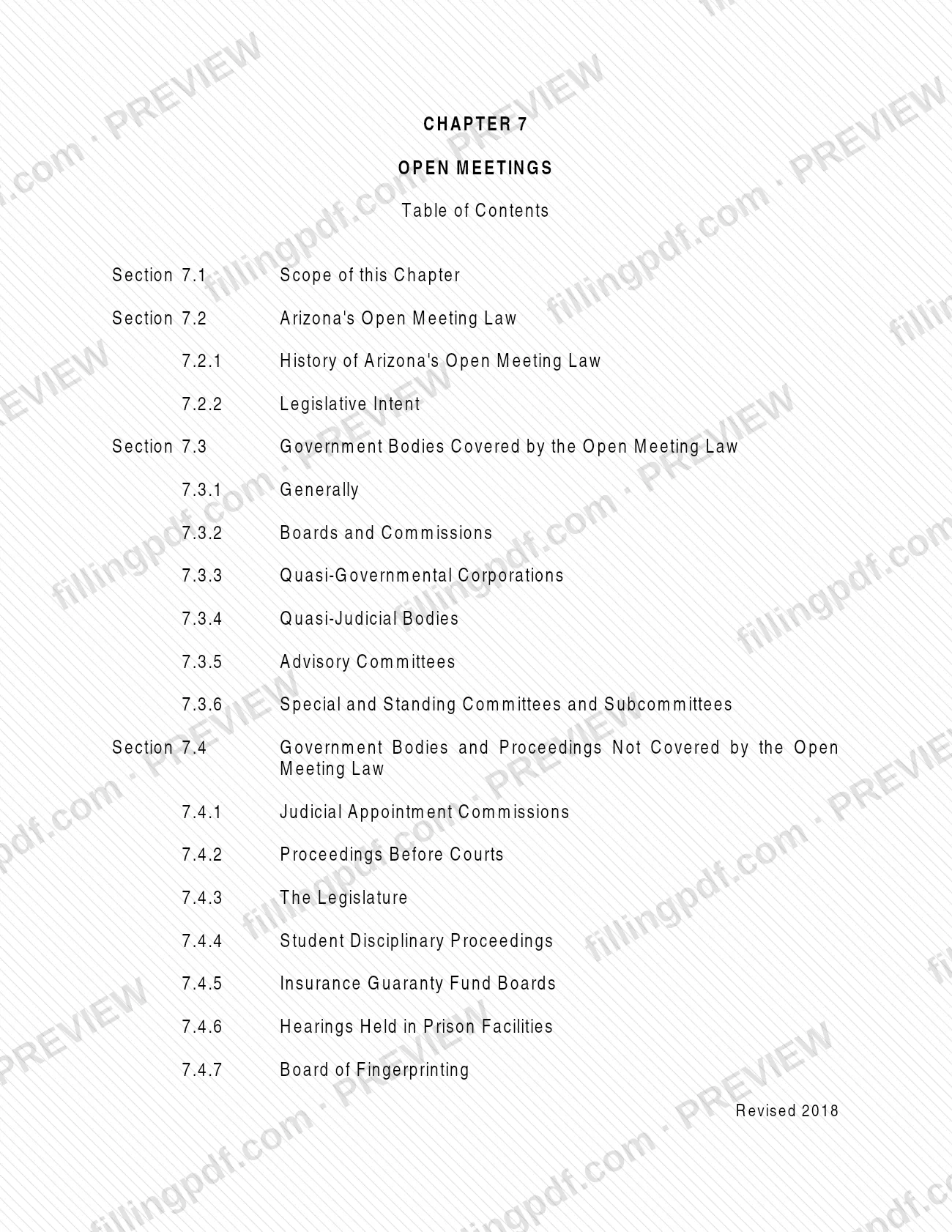
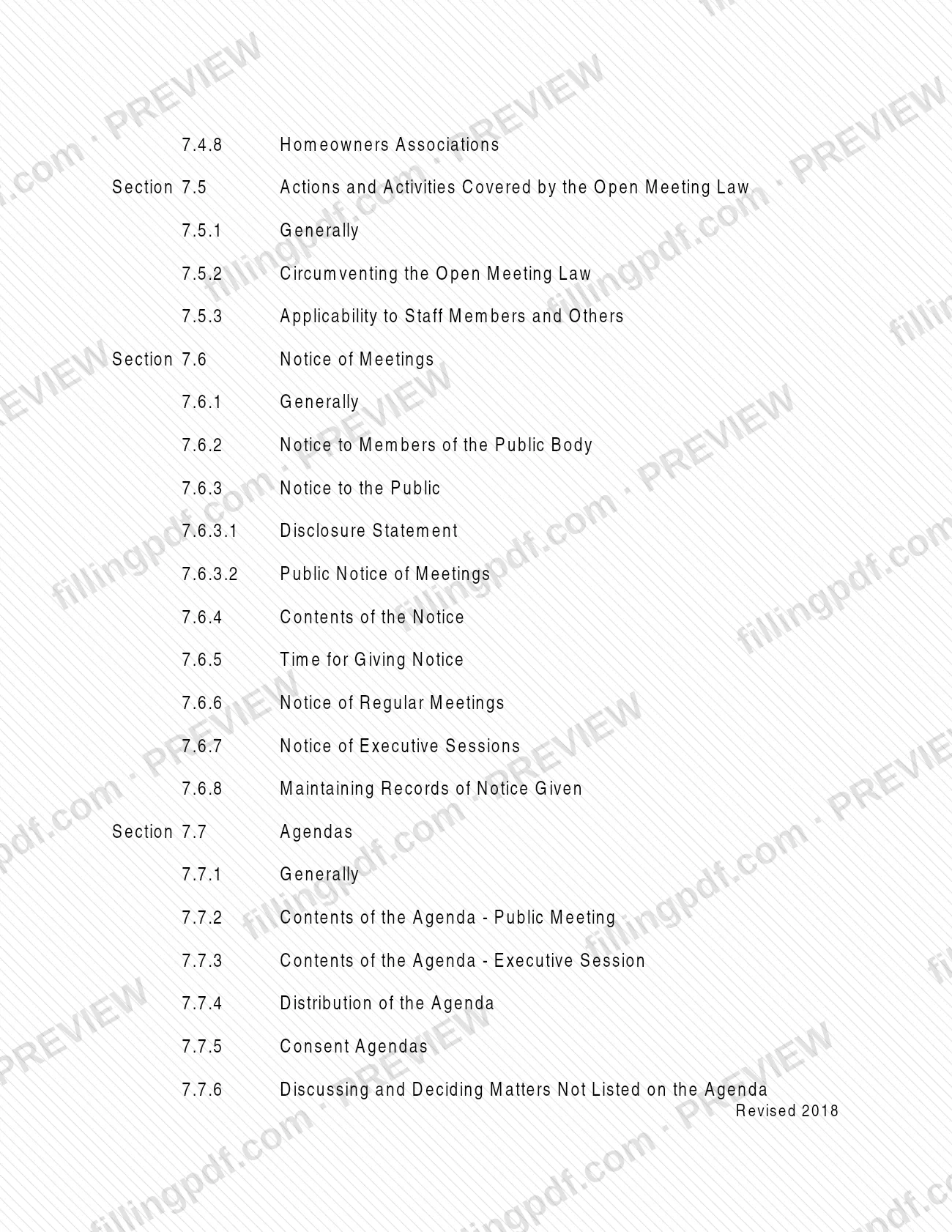
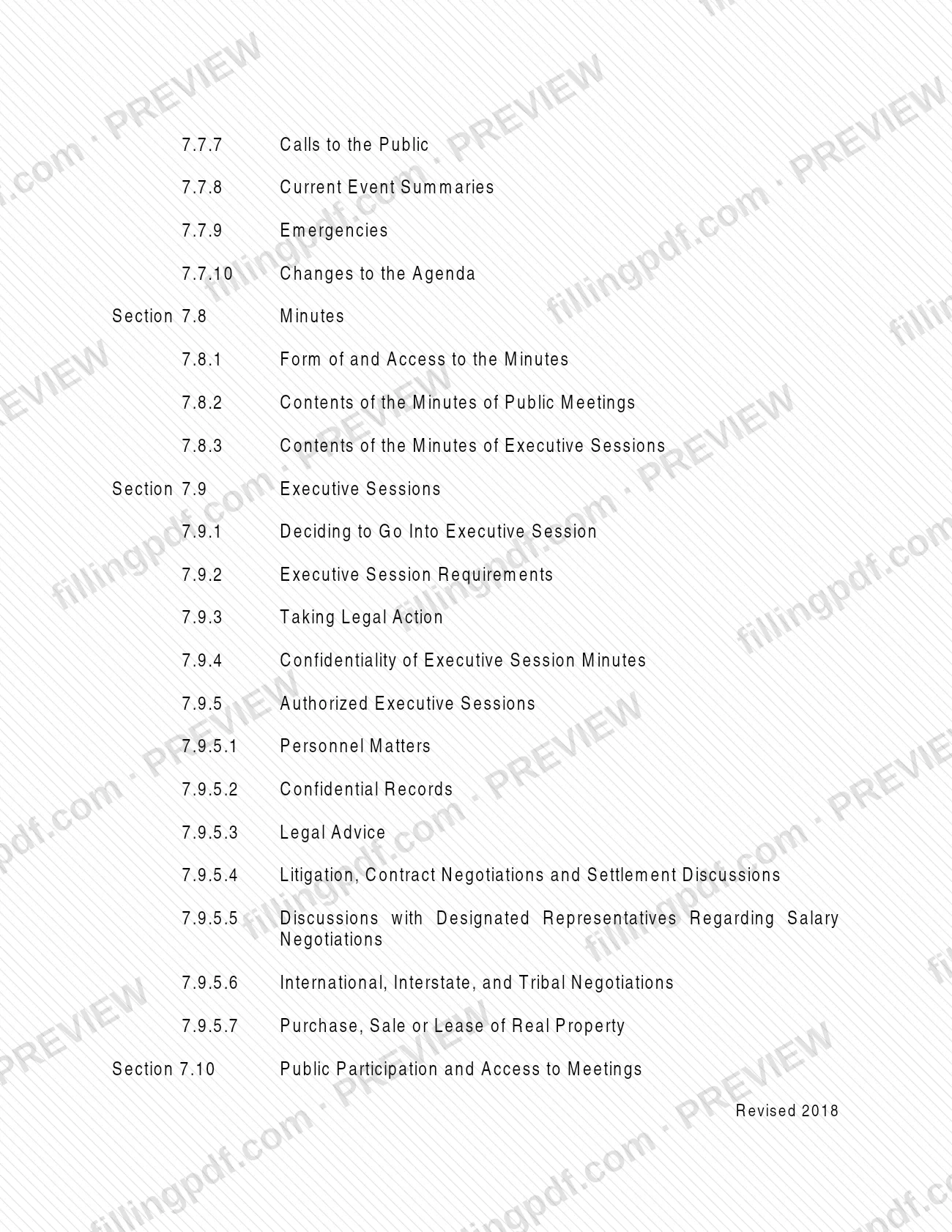
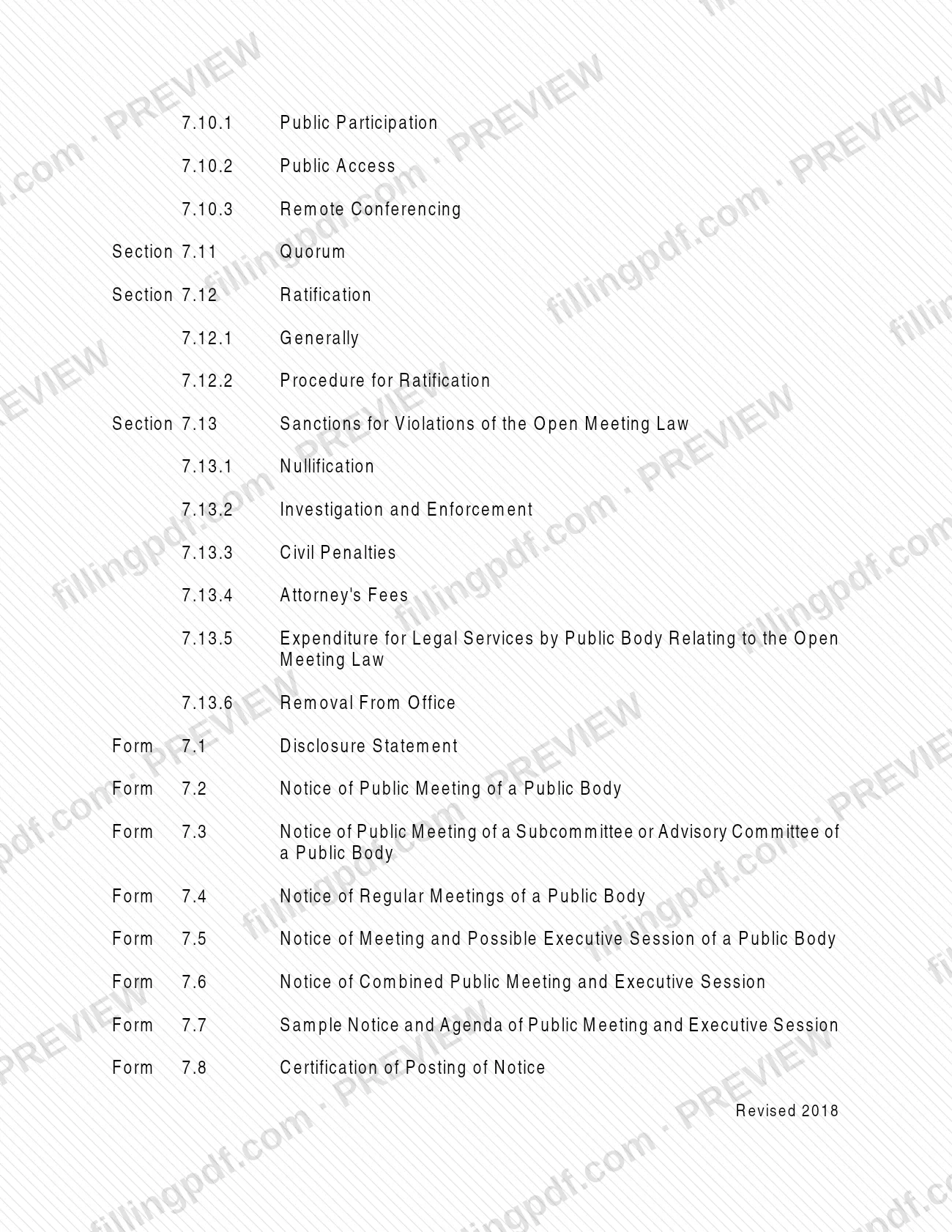

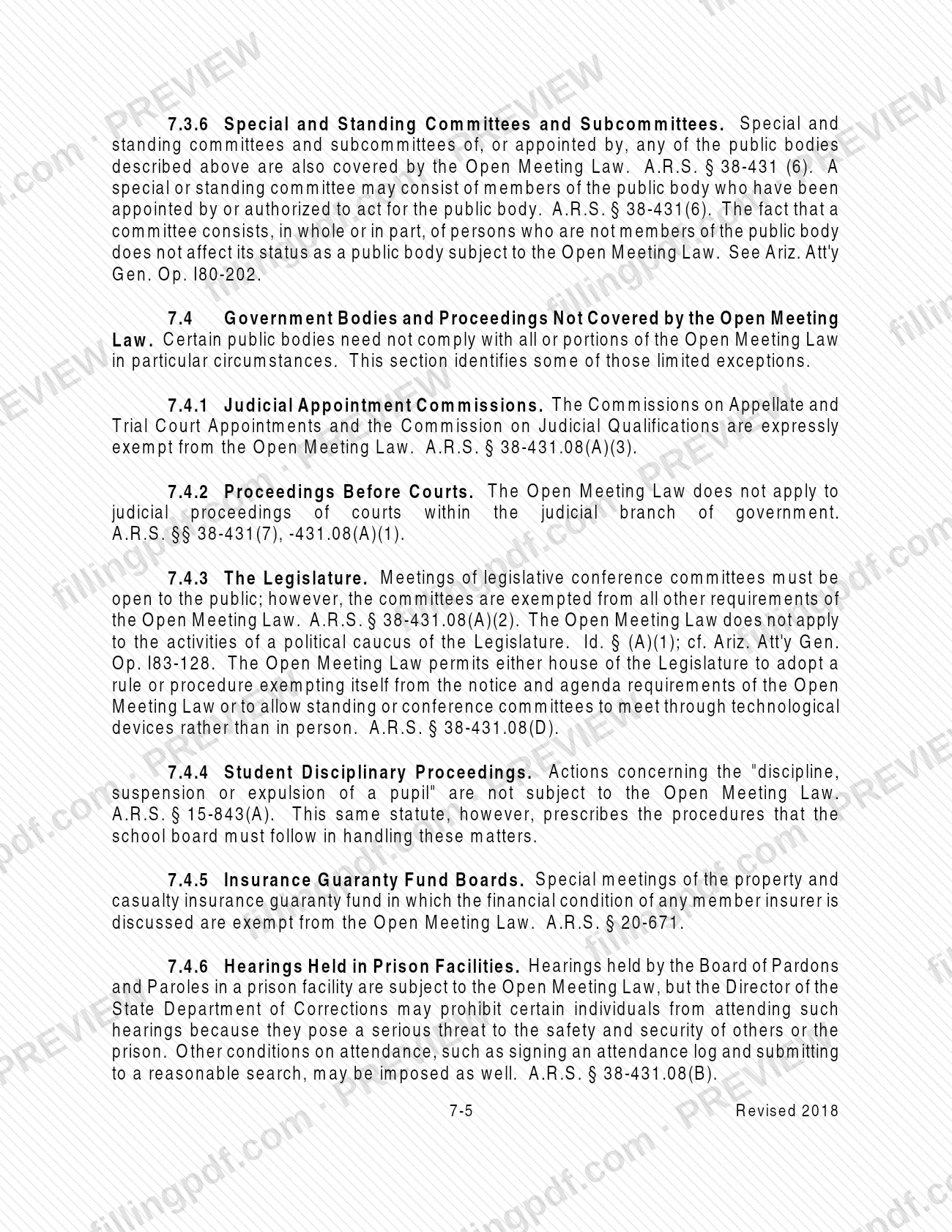
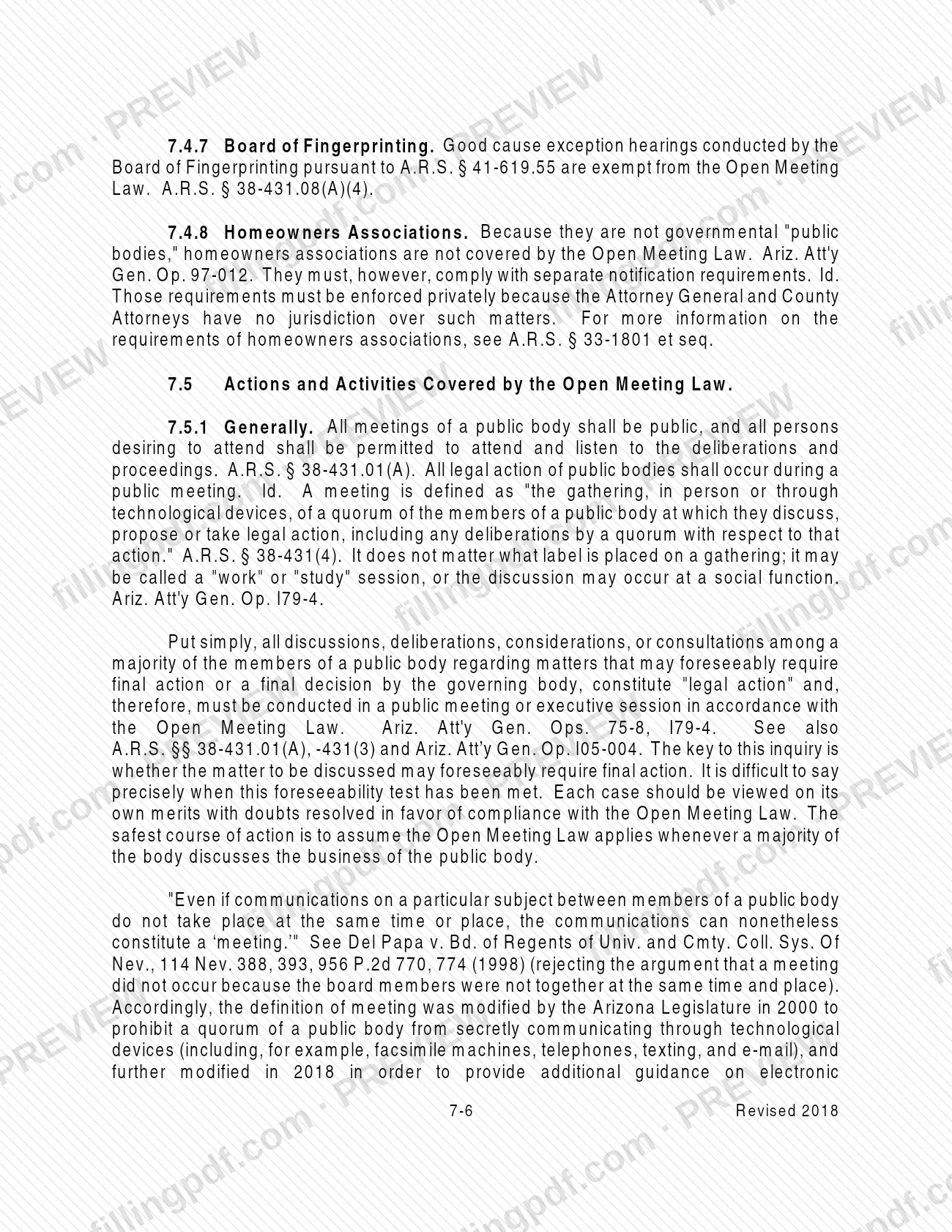
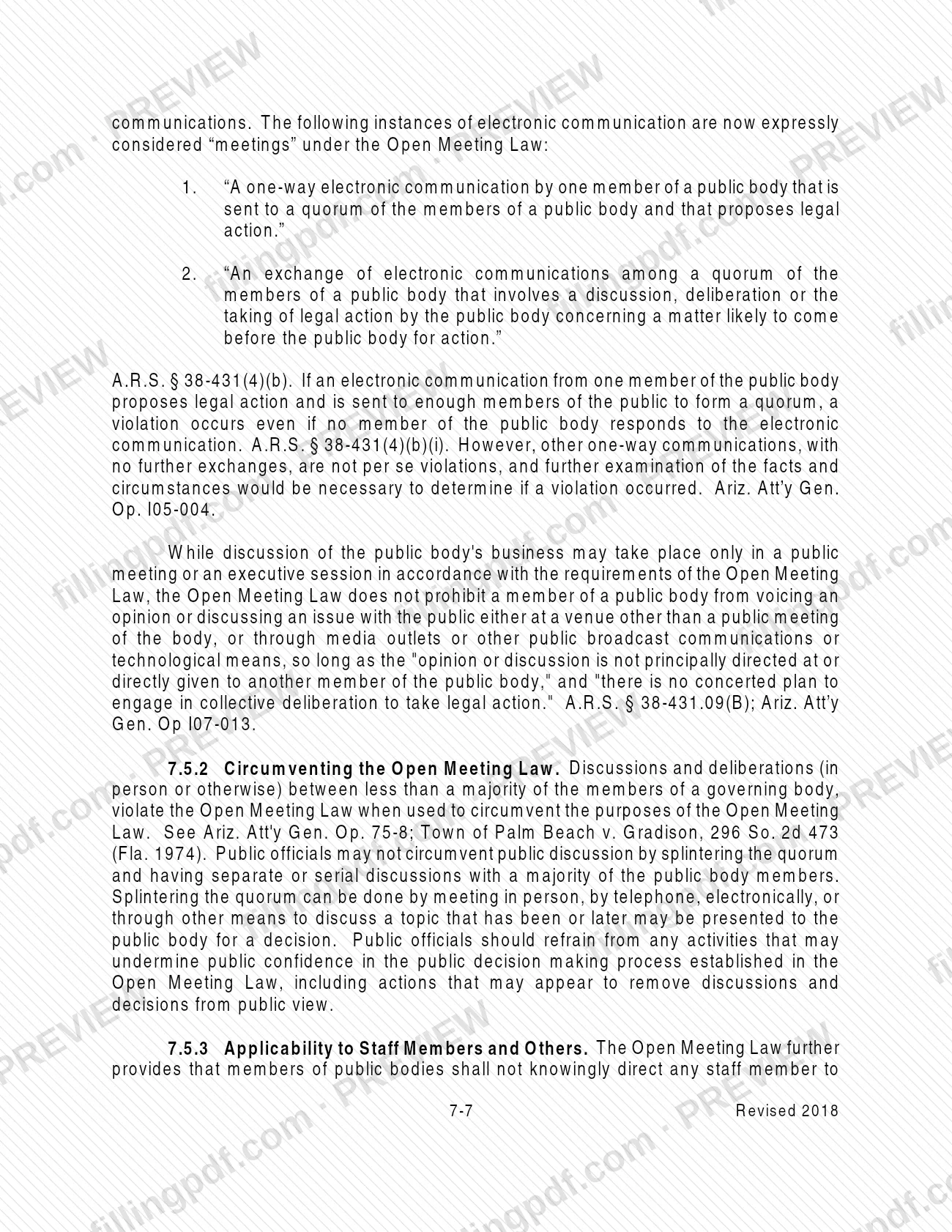
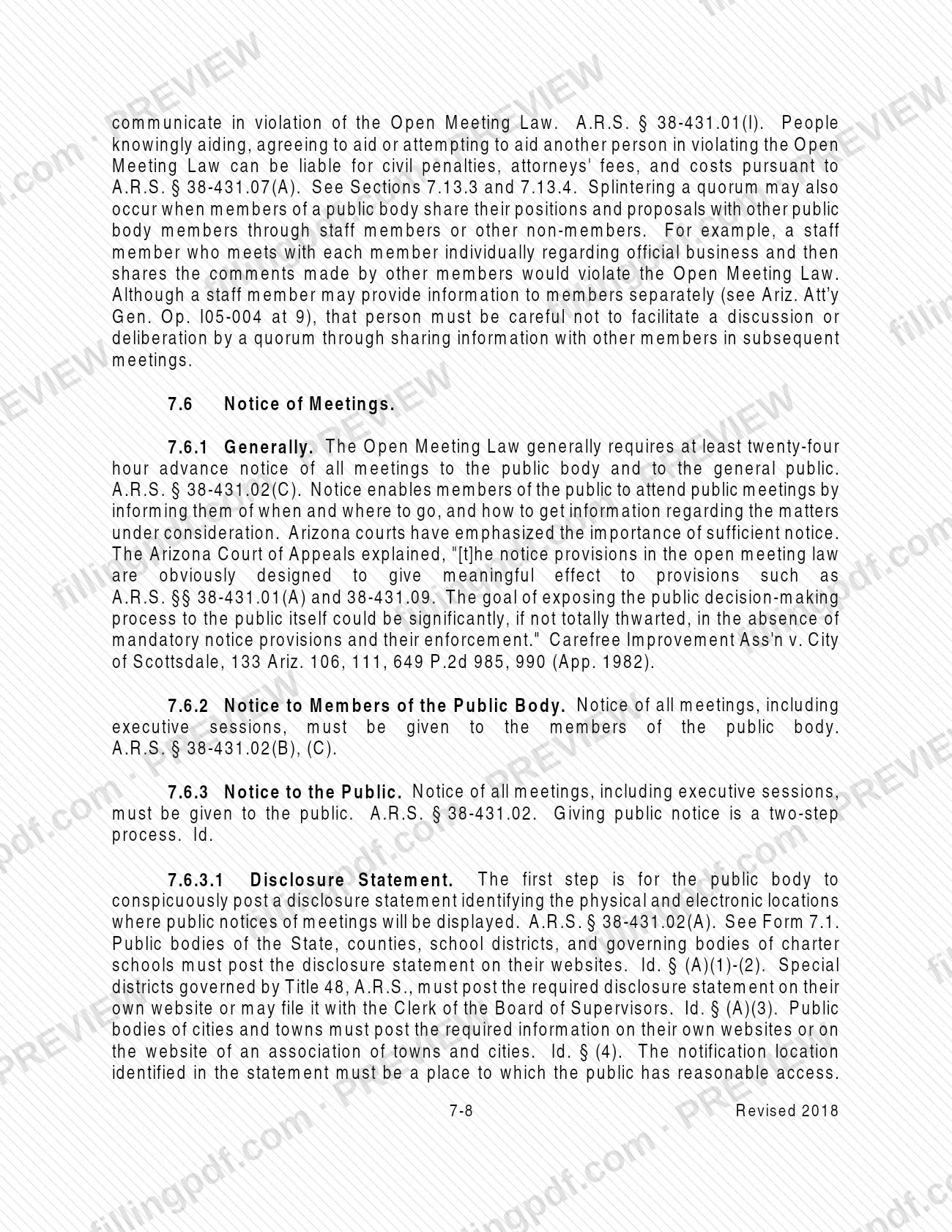
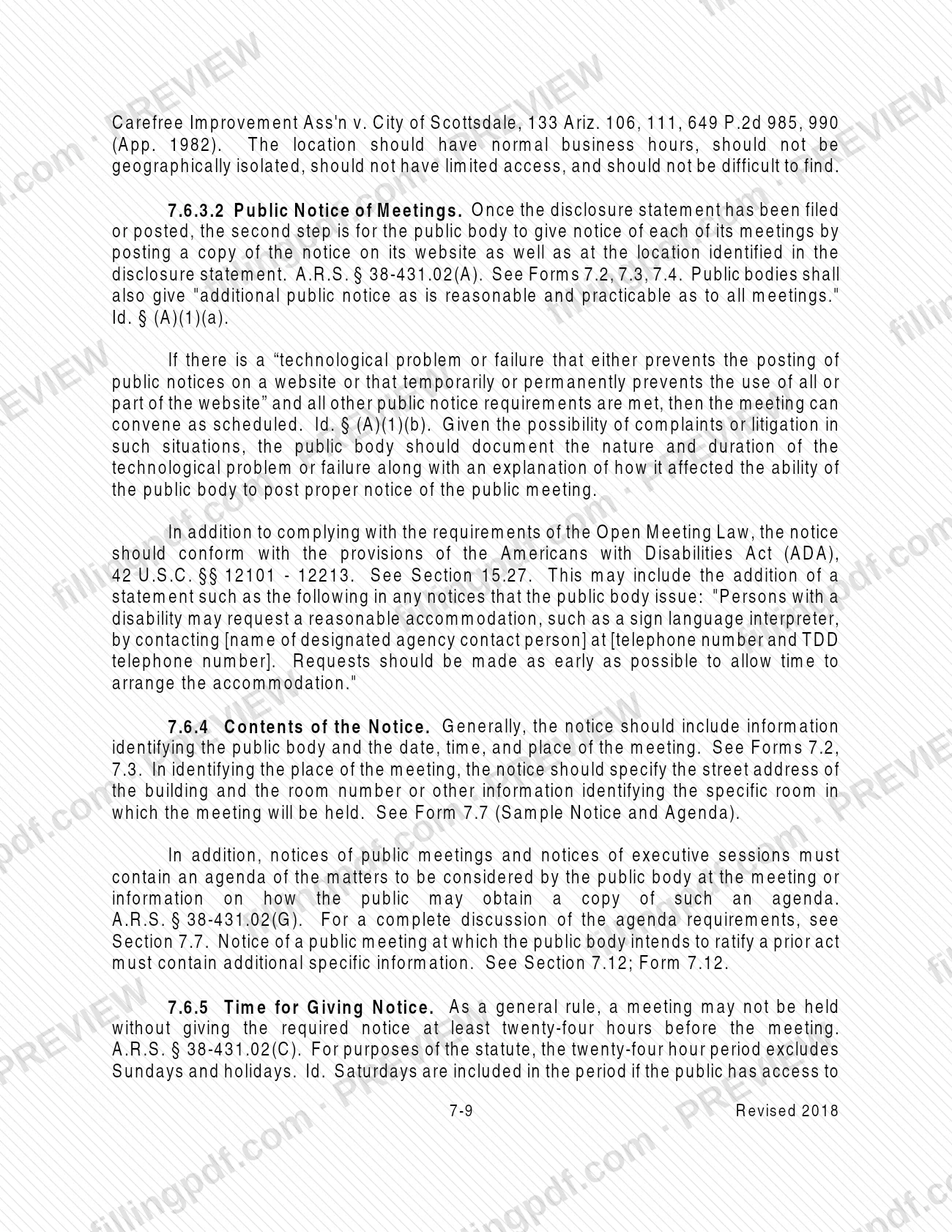
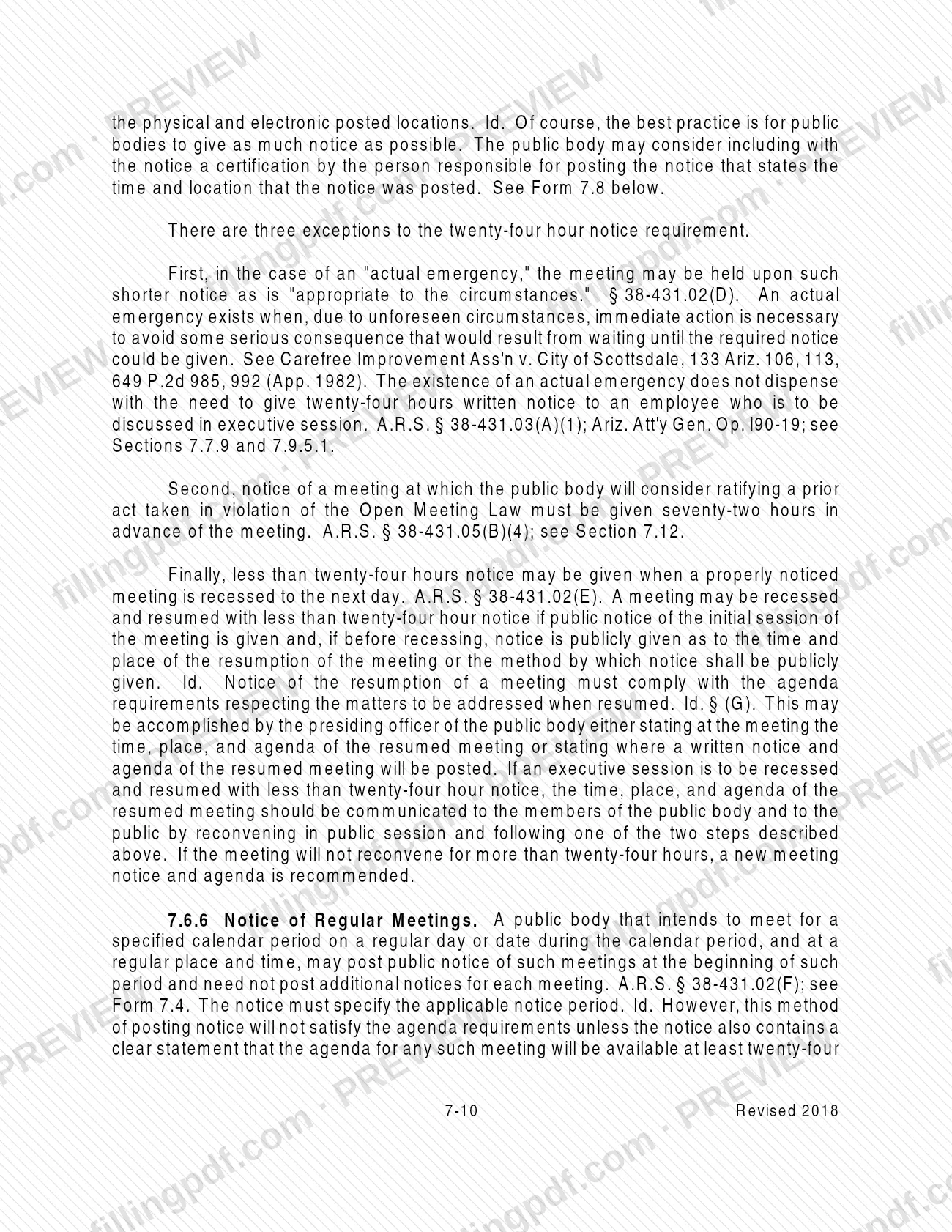
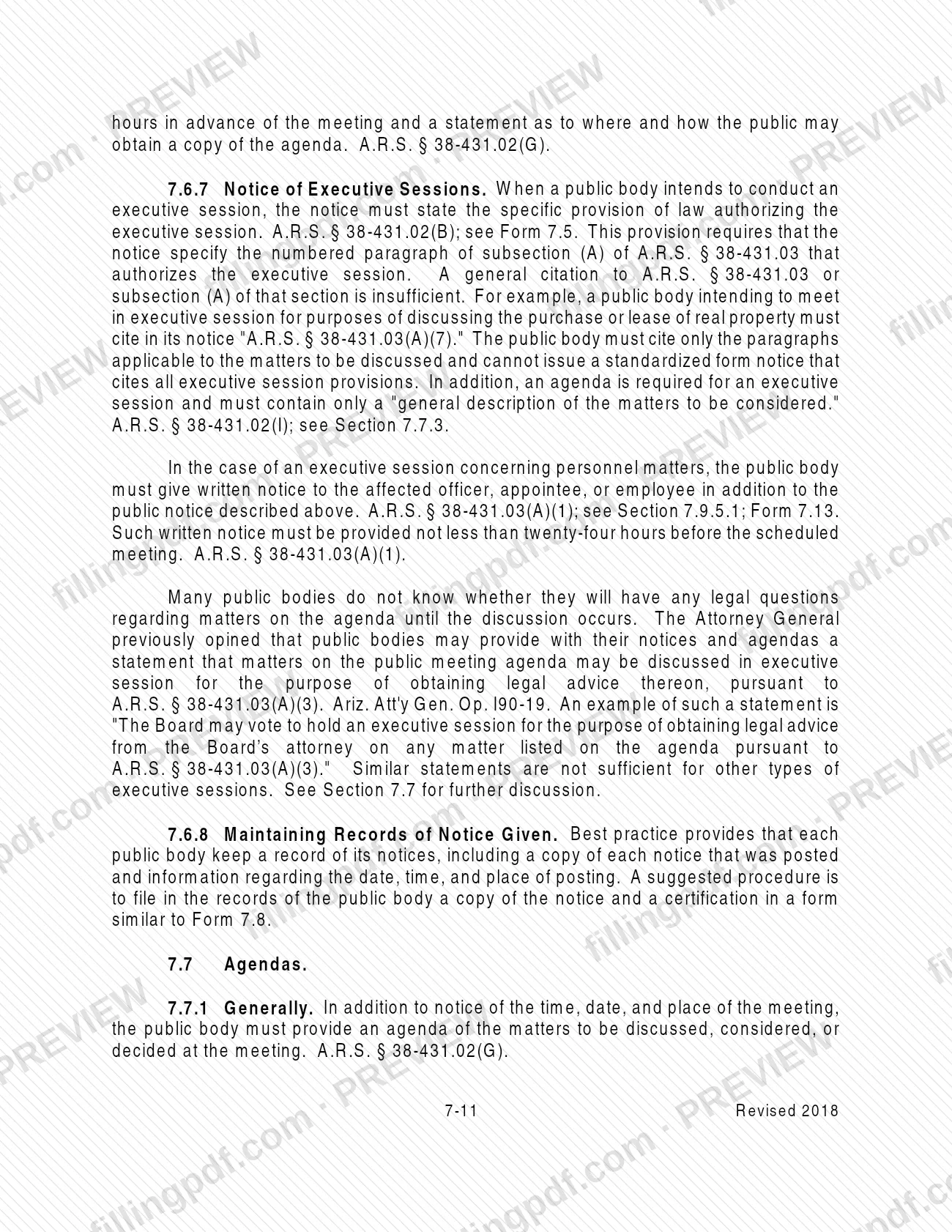
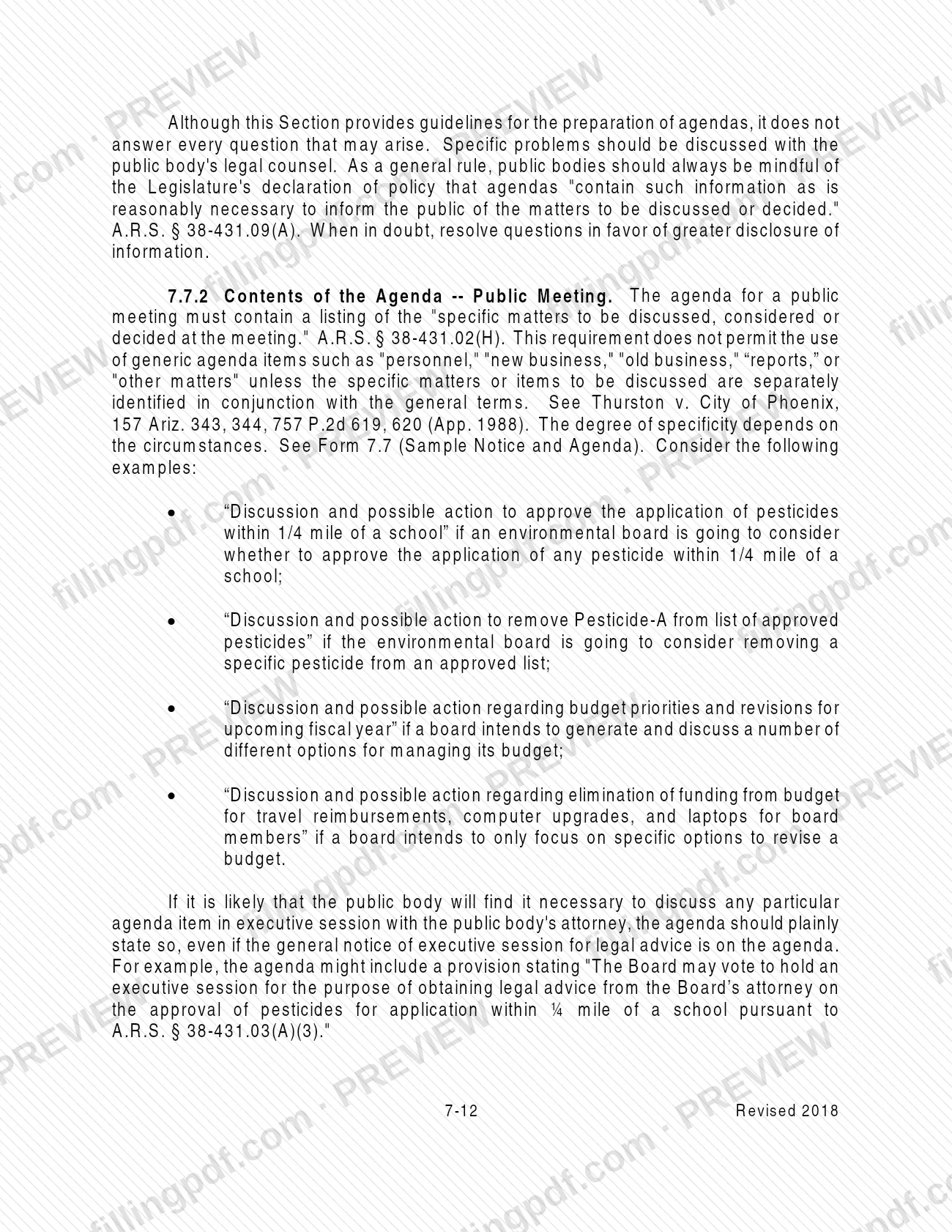
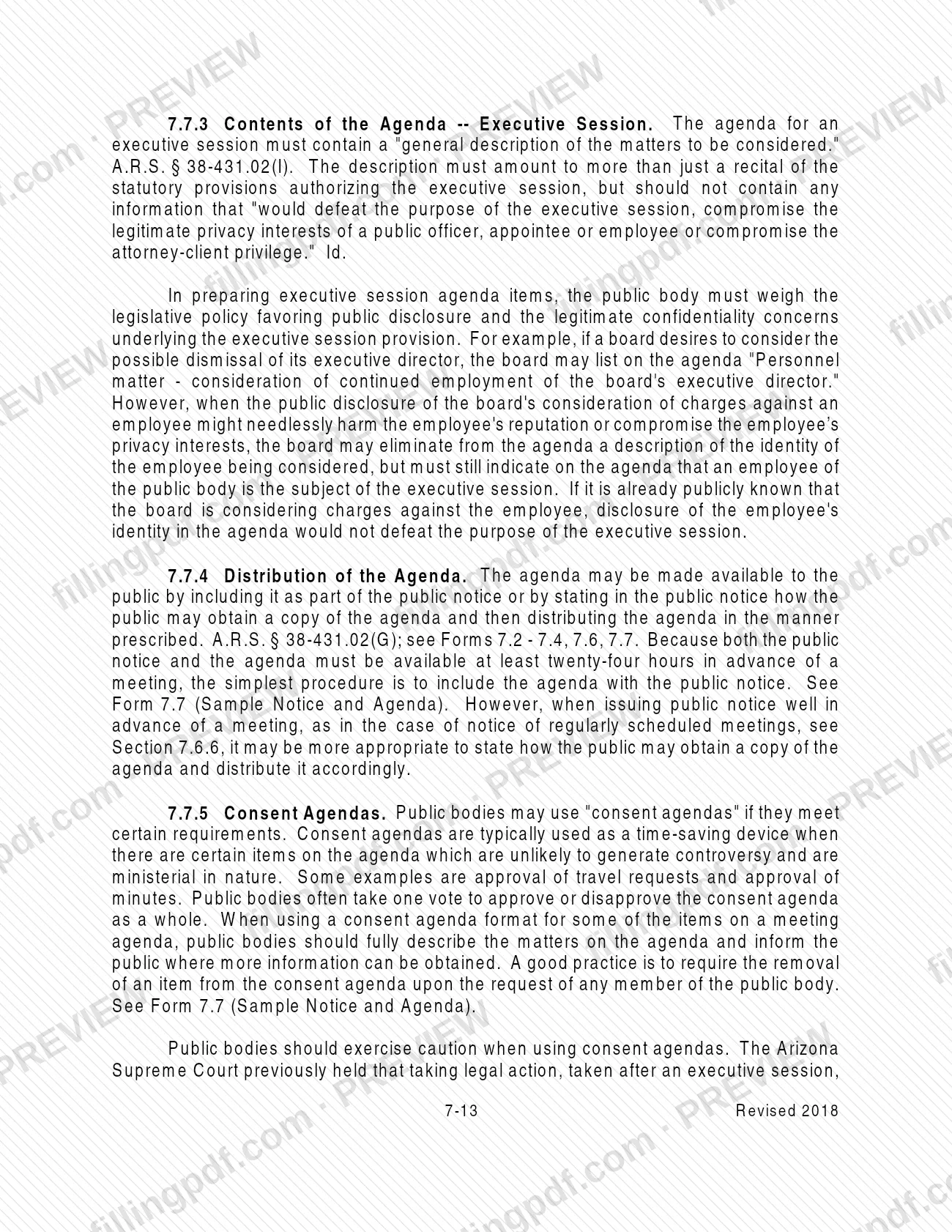
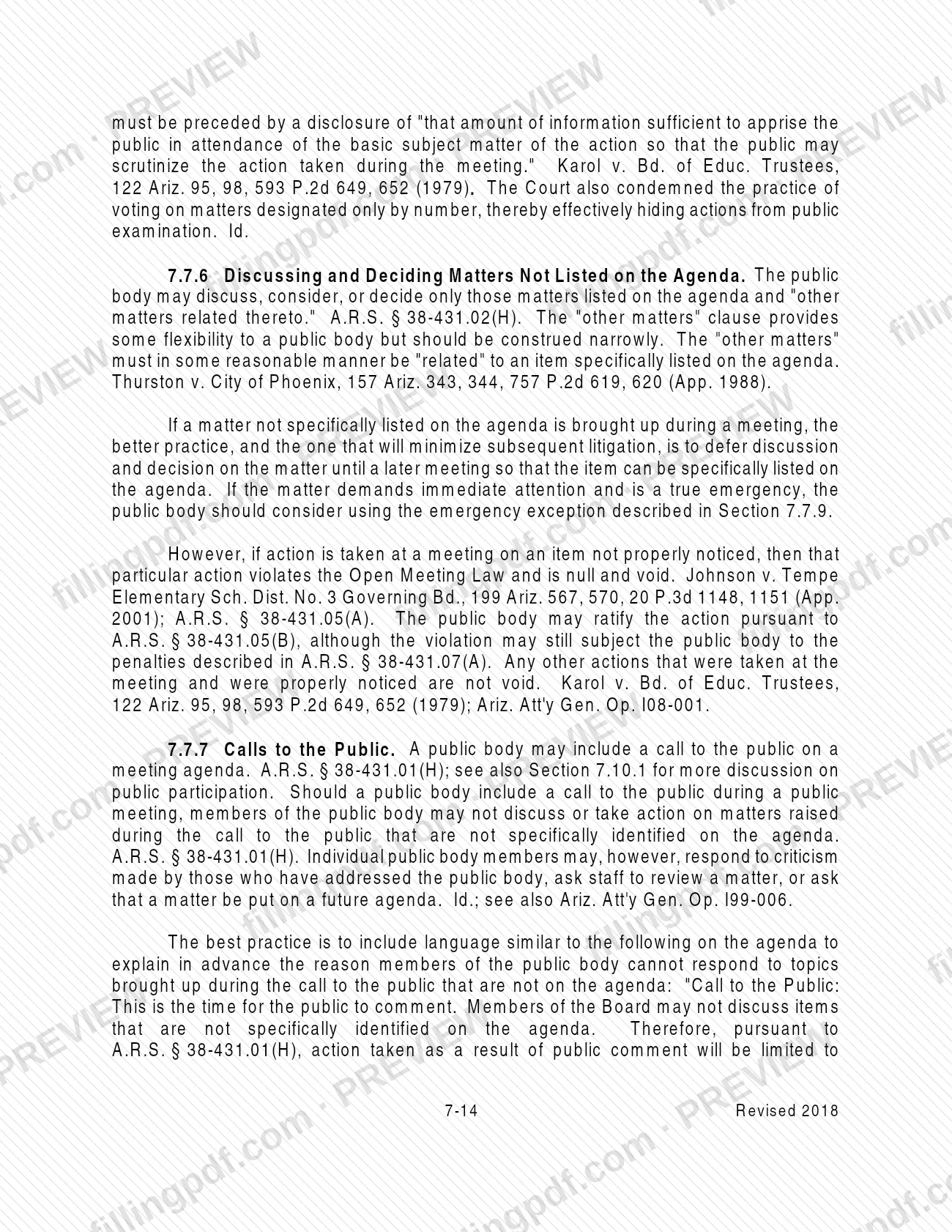
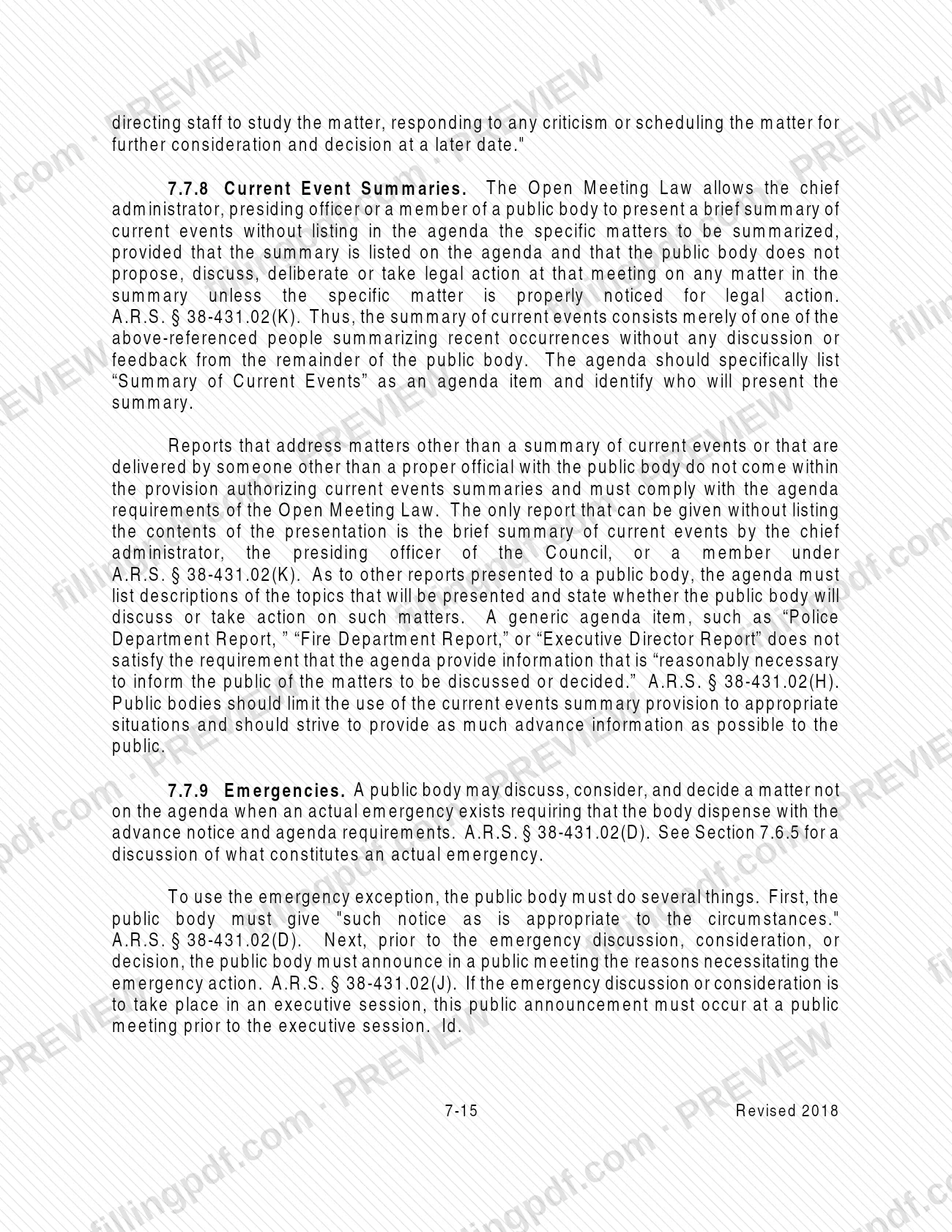
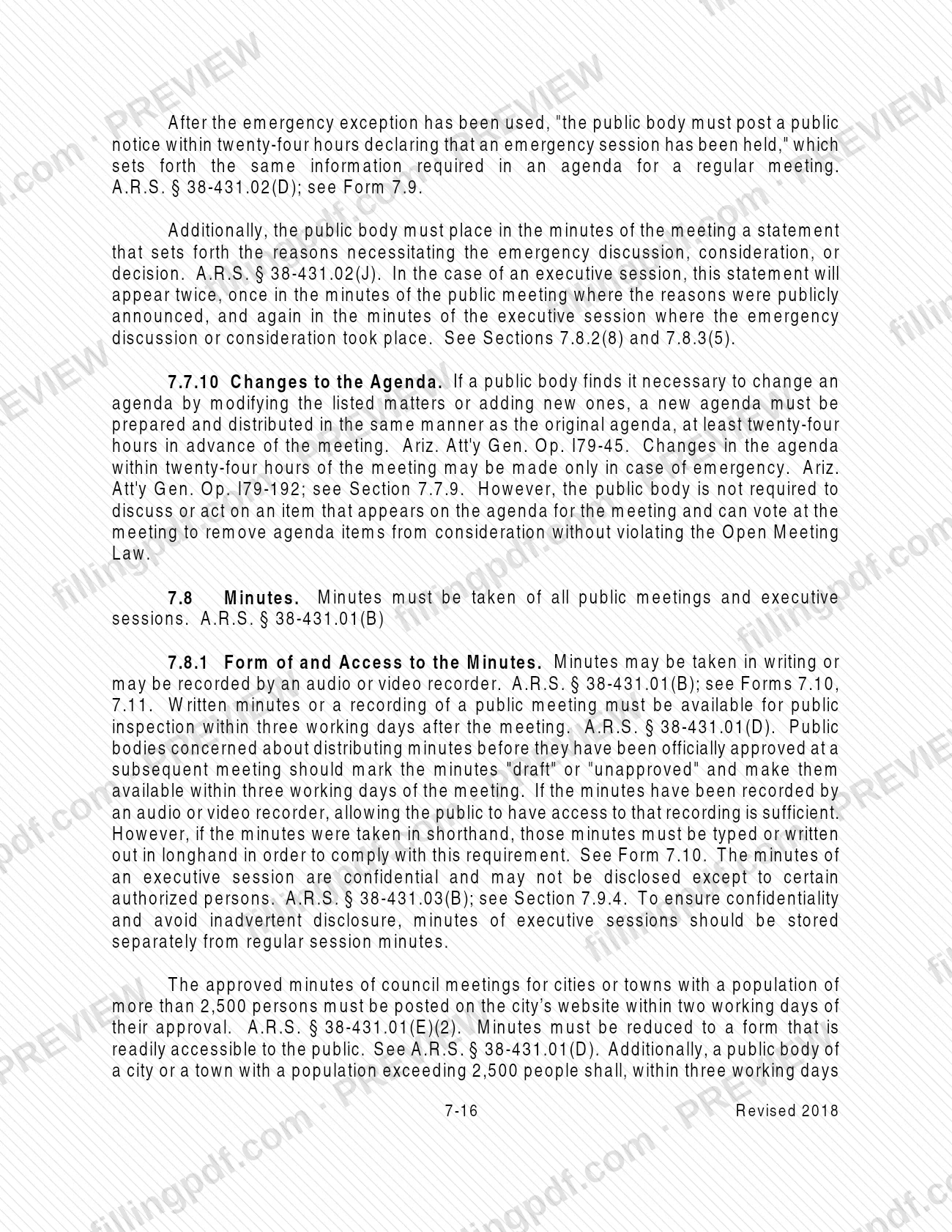
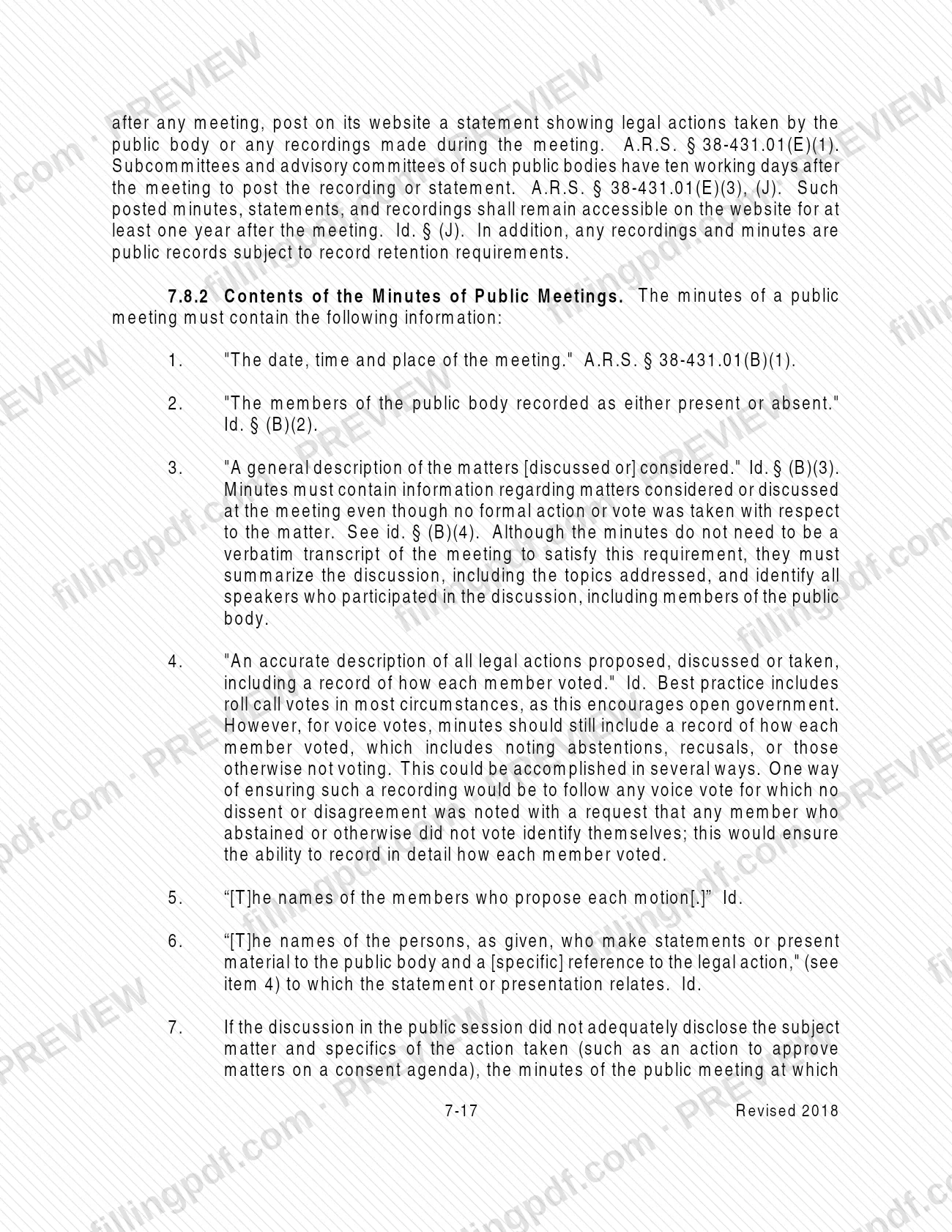
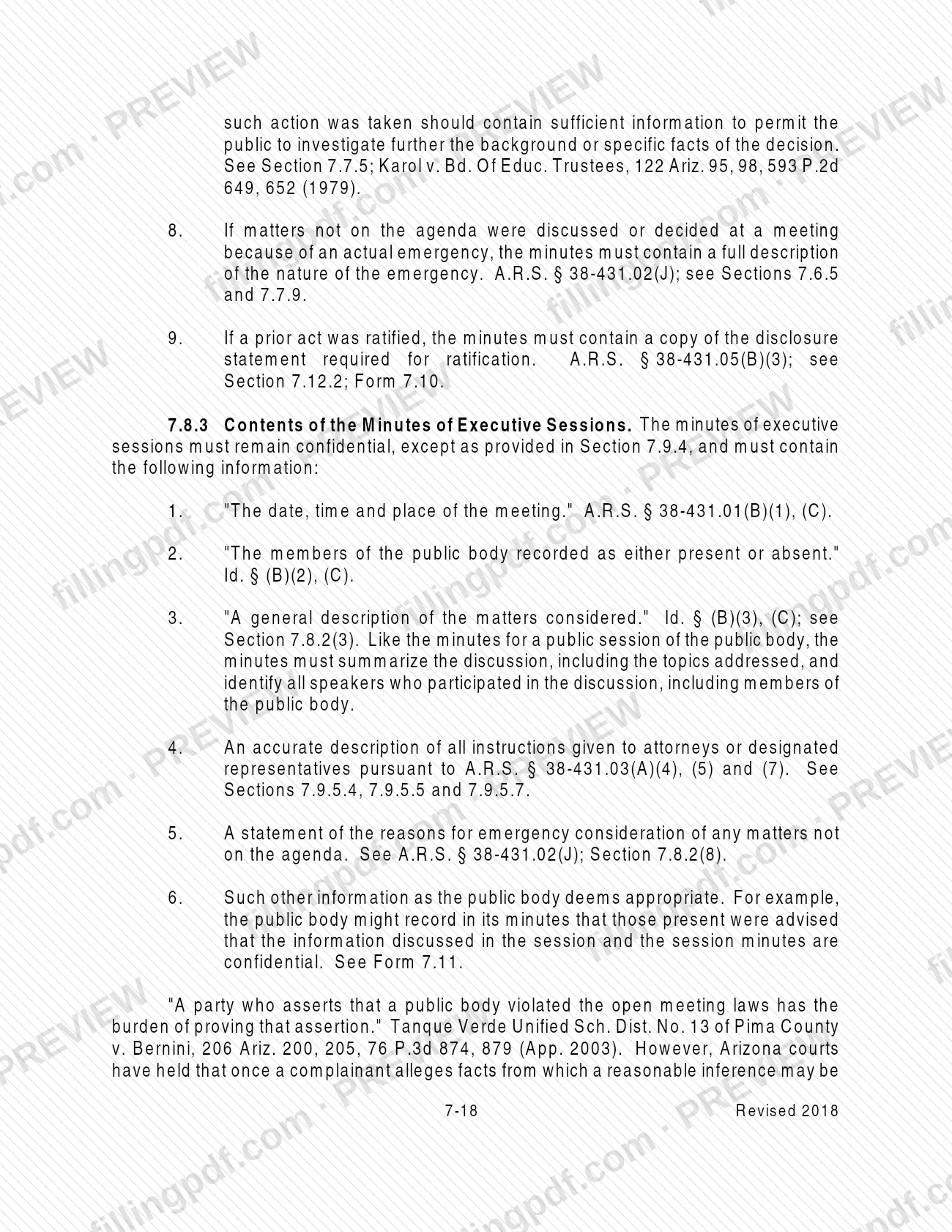
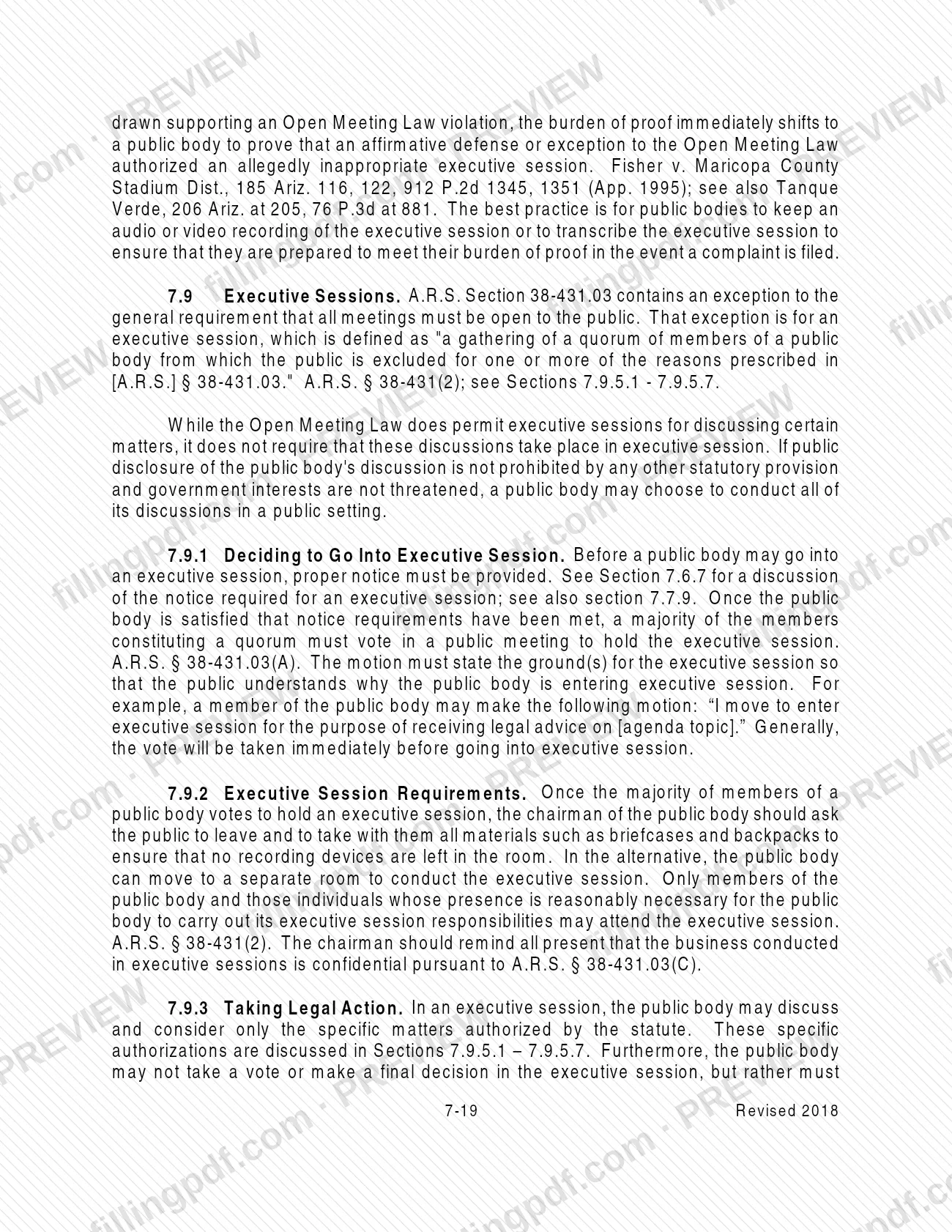
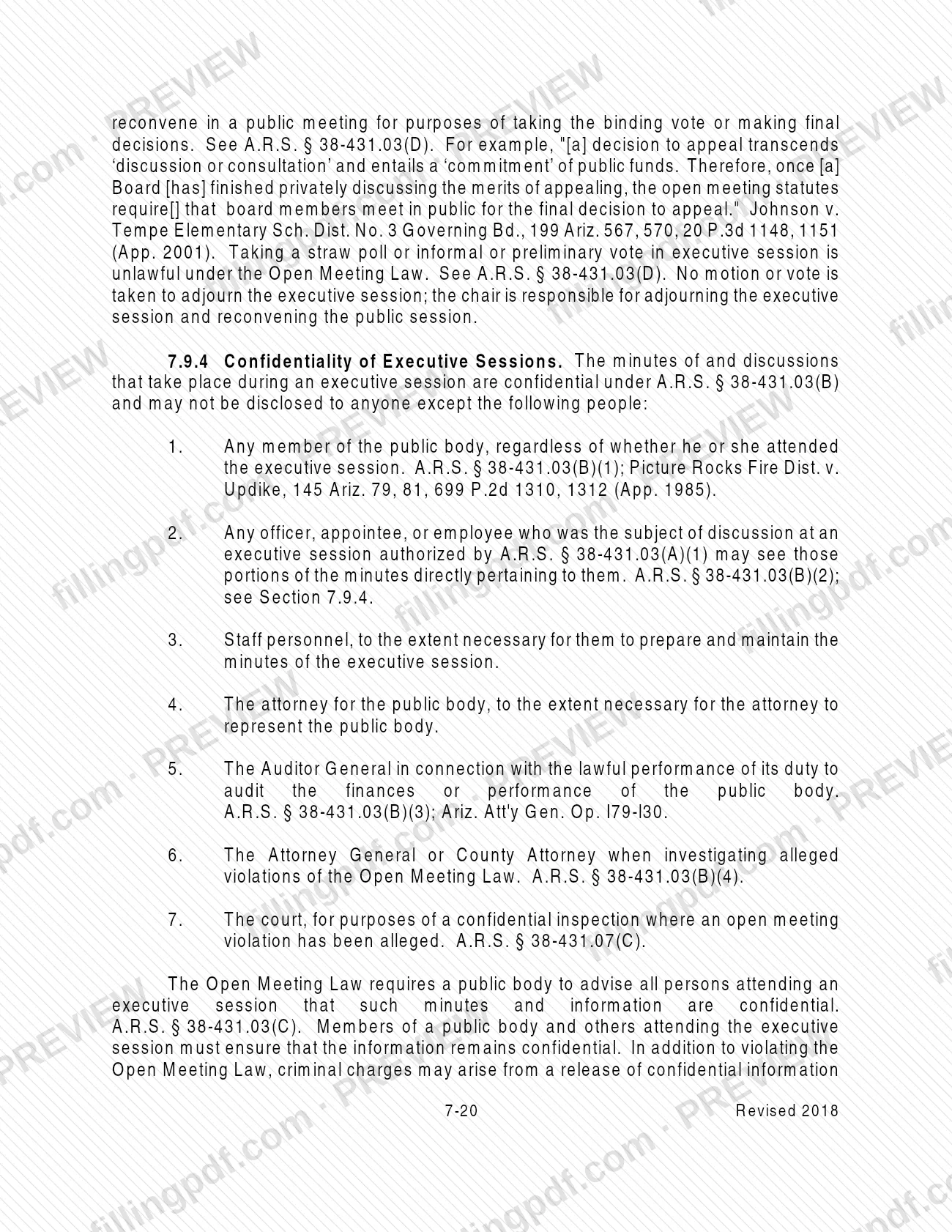

Open Meeting Law Information is Chapter 7, Open Meetings, of Arizona's agency handbook (Revised 2018). It explains the Open Meeting Law, A.R.S. §§ 38-431 to -431.09, and includes model Forms 7.1 to 7.13 for notices, agendas, minutes and ratification. The chapter says the city or town clerk must conspicuously post it for municipal public bodies, and members of a public body must review it at least one day before taking office. On FillingPDF you can fill out the form online and download or print the completed PDF; the original chapter is published at azag.gov.
Last updated
What is Open Meeting Law Information – Maricopa, AZ?
Open Meeting Law Information is Chapter 7, Open Meetings, of the Arizona agency handbook: a reference for public officials on Arizona's Open Meeting Law, A.R.S. §§ 38-431 to -431.09, with thirteen model forms for notices, agendas, minutes and ratification.
The chapter covers which bodies are subject to the law, which are not, what counts as a meeting, how and when notice must be given, what an agenda and minutes must contain, when an executive session is allowed, quorum, ratification and the sanctions for violations. It states that it does not resolve every issue and tells officials facing an unaddressed situation to consult legal counsel.
The model forms are:
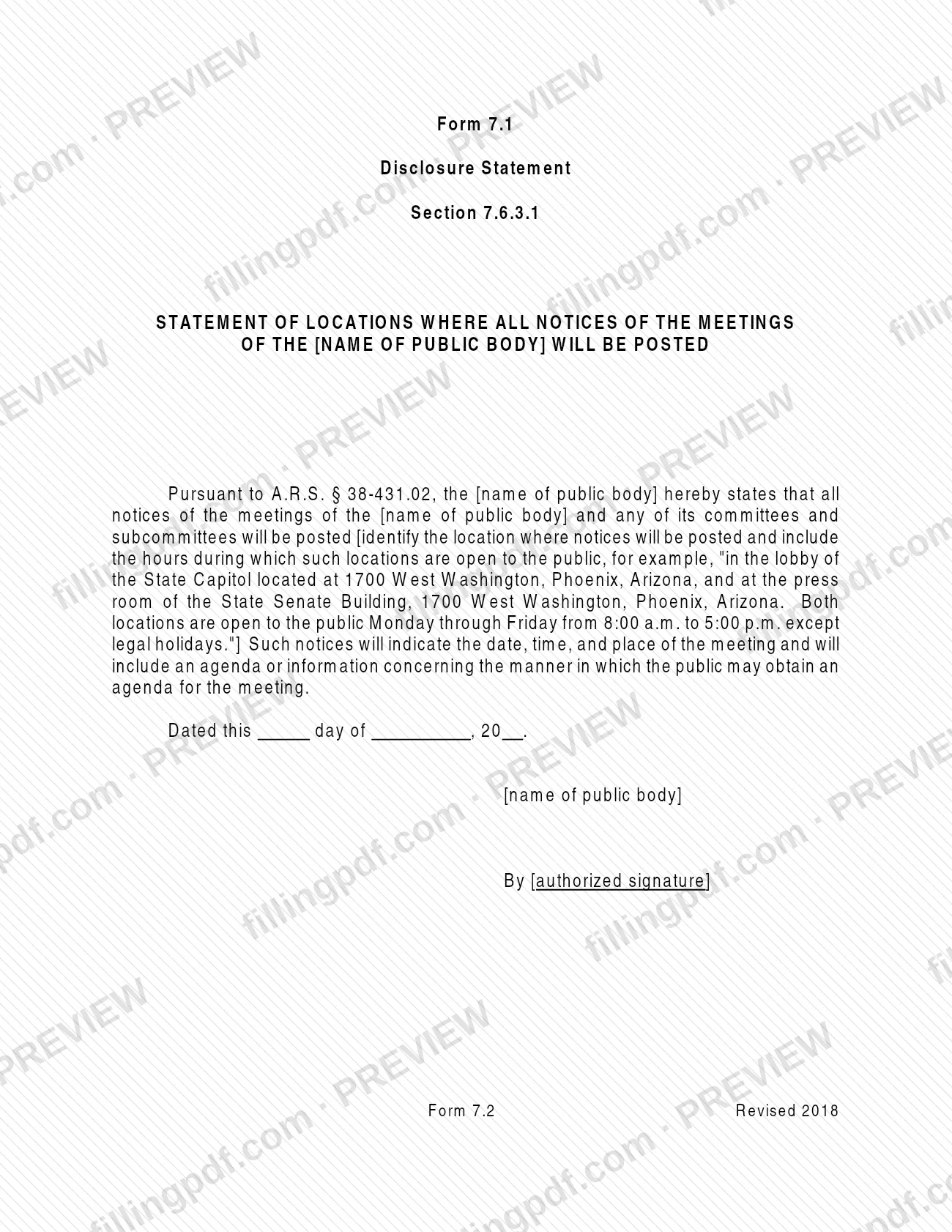
- Form 7.1 Disclosure Statement
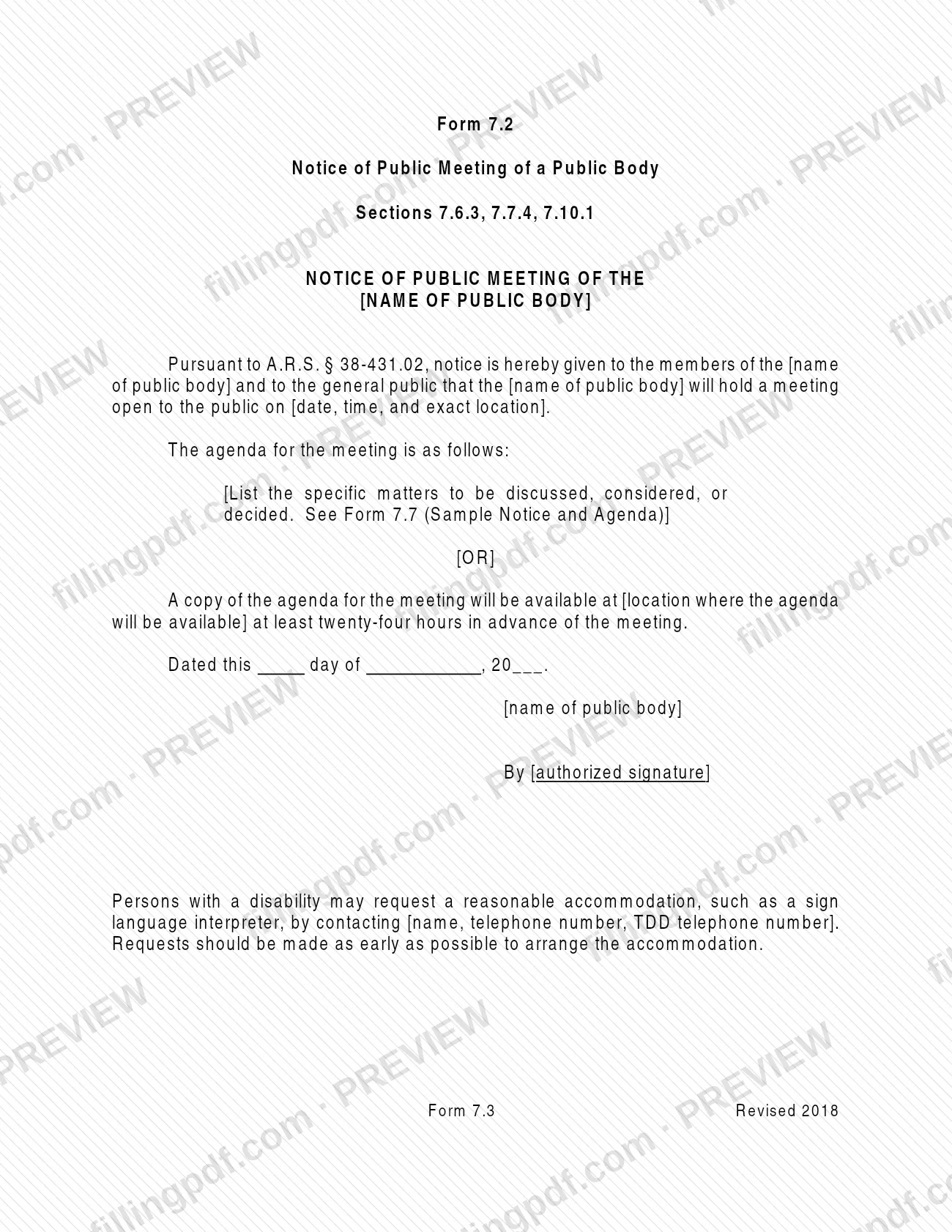
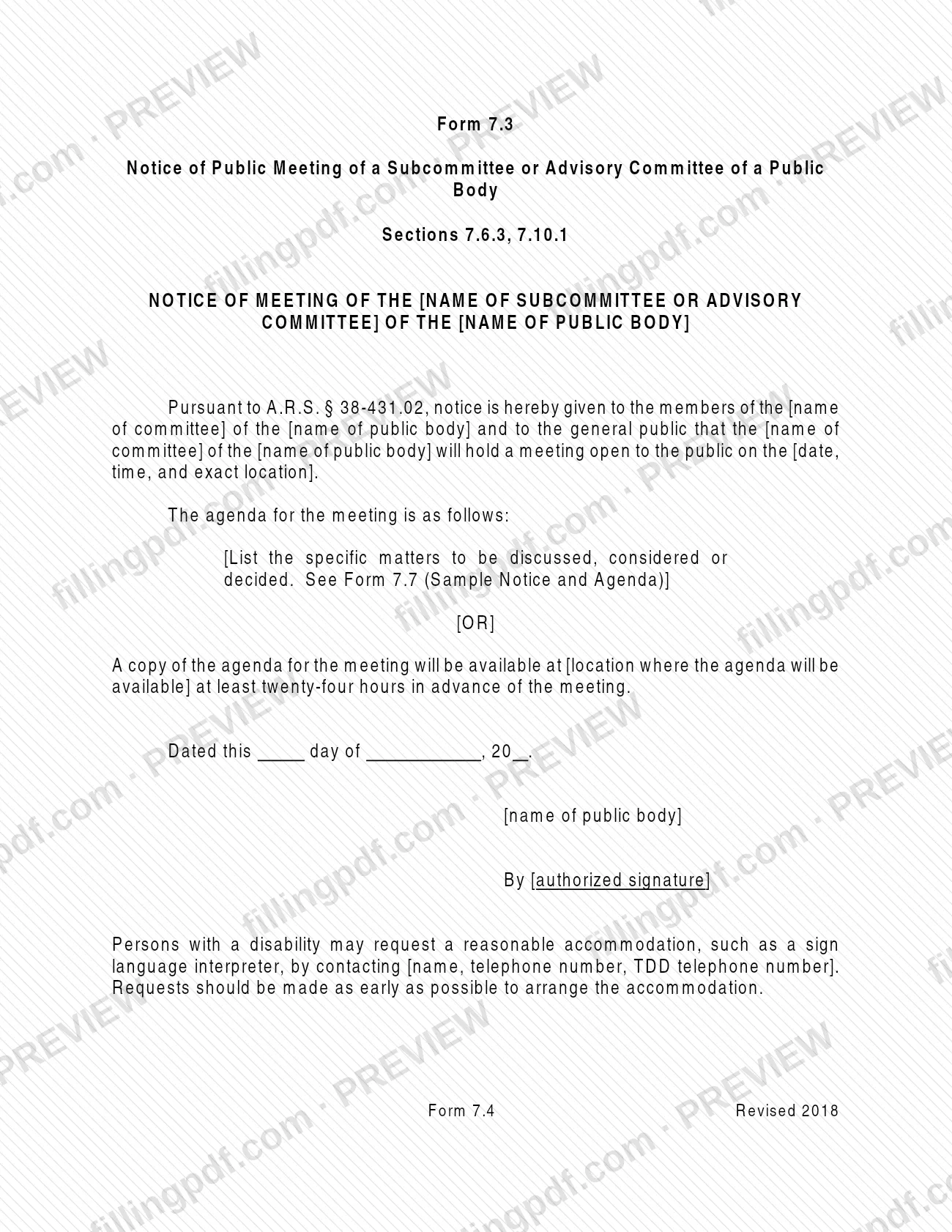
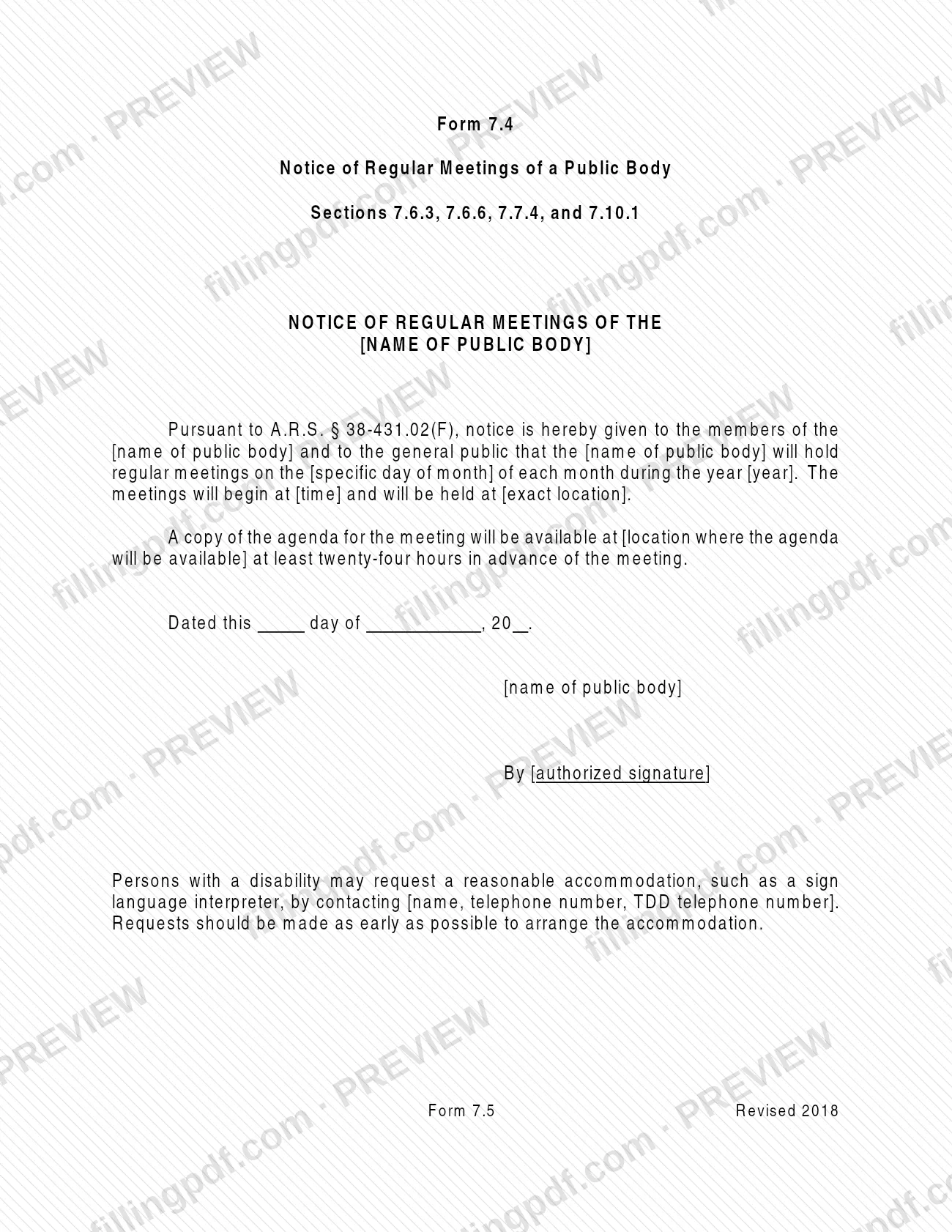
- Forms 7.2 to 7.4 notices of public meetings, committee meetings and regular meetings
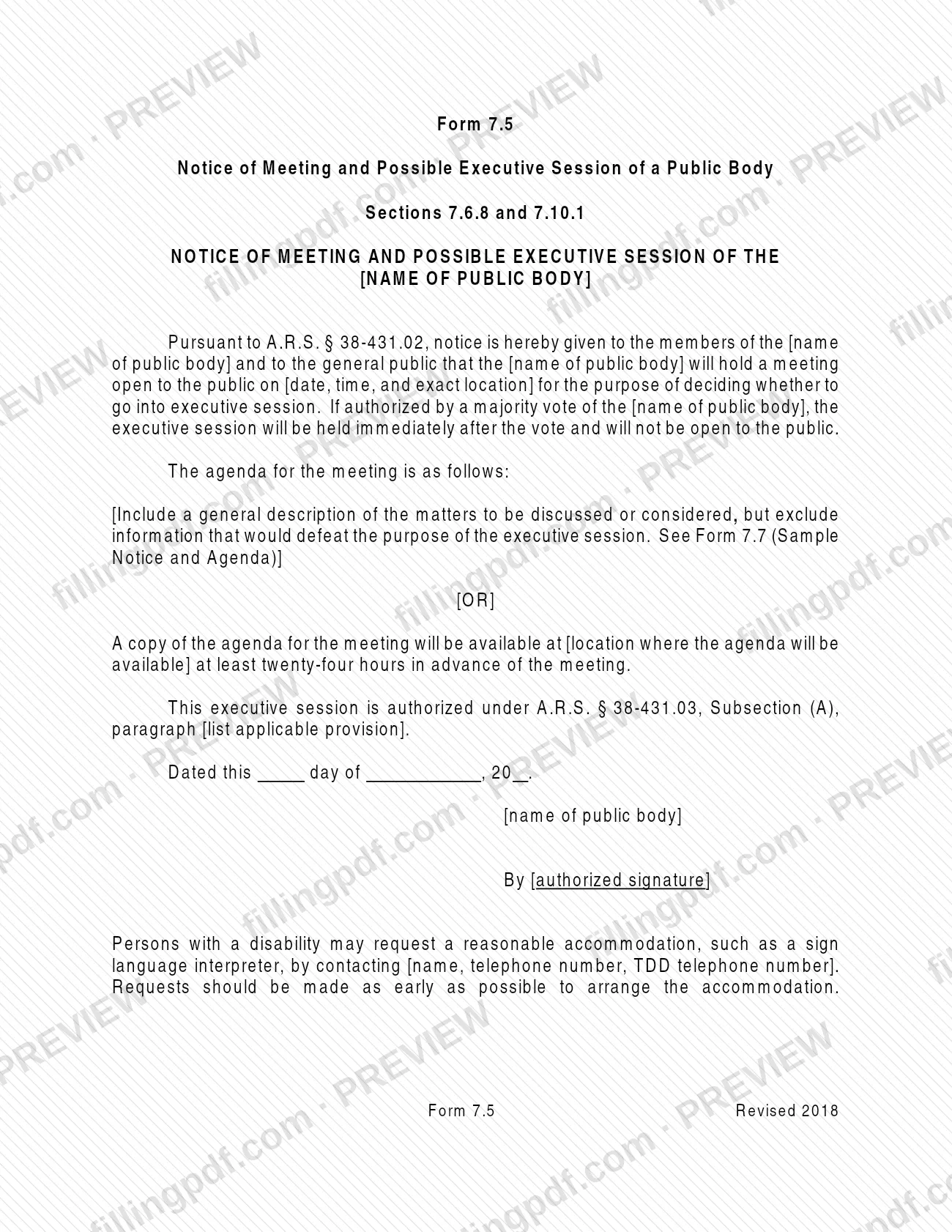
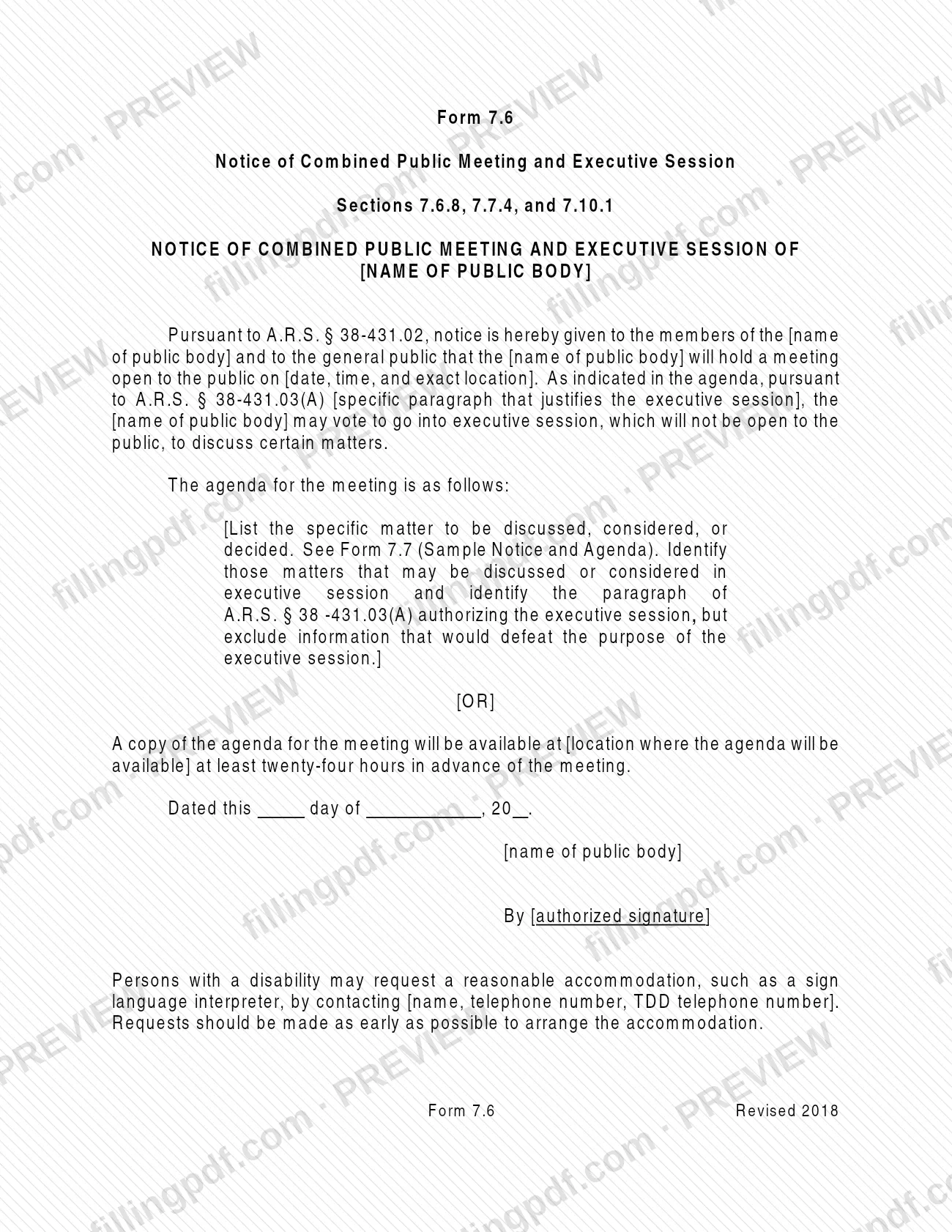
- Forms 7.5 and 7.6 notices that include a possible executive session
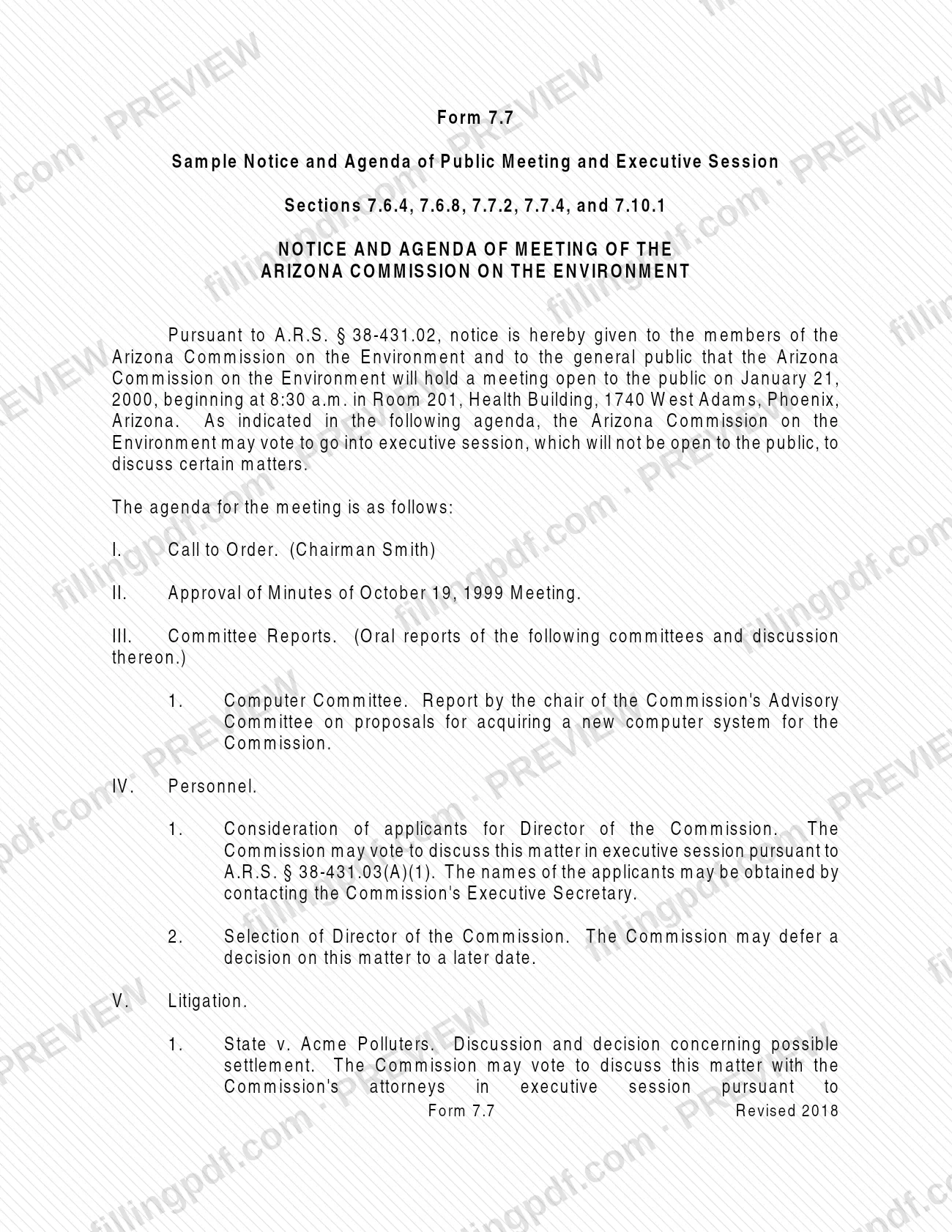
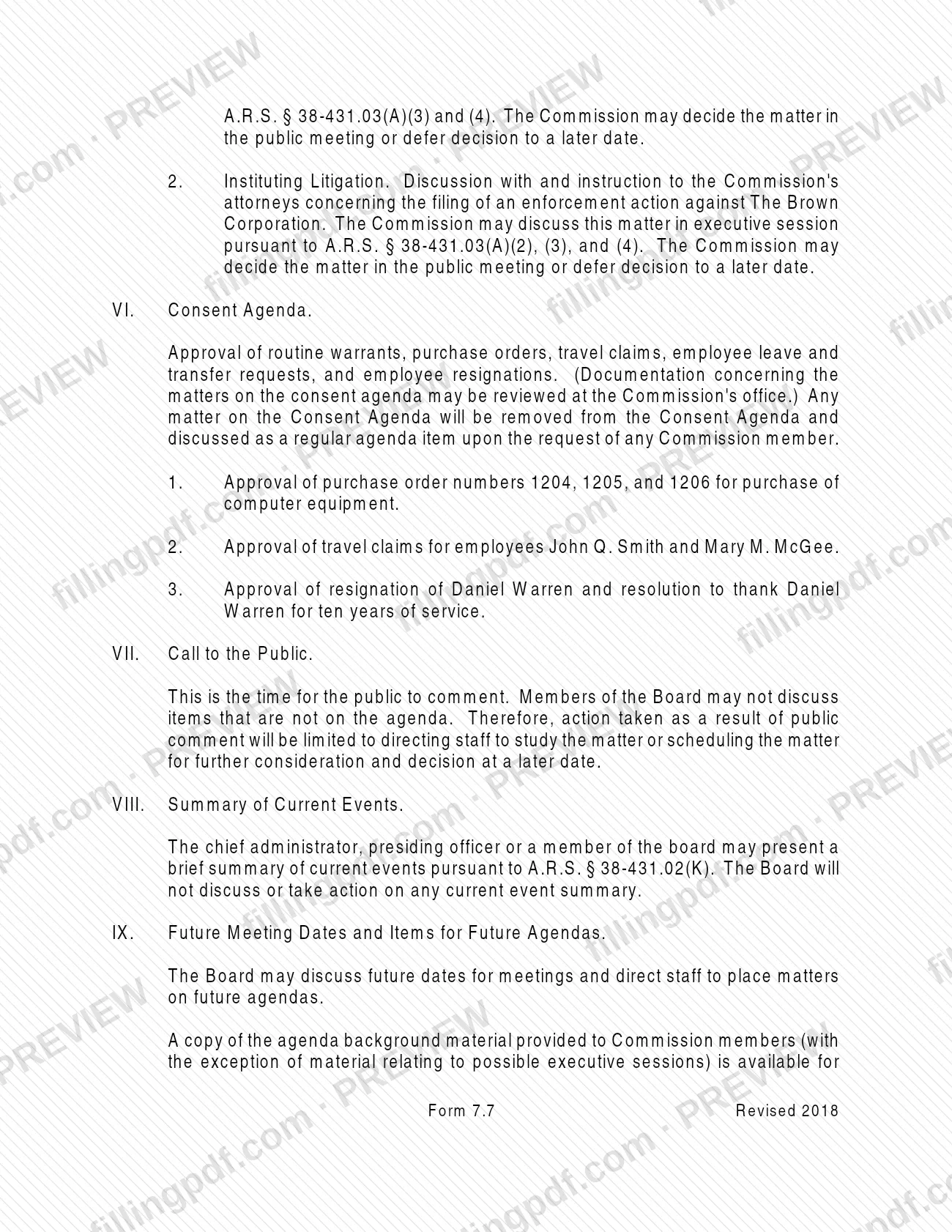
- Form 7.7 Sample Notice and Agenda
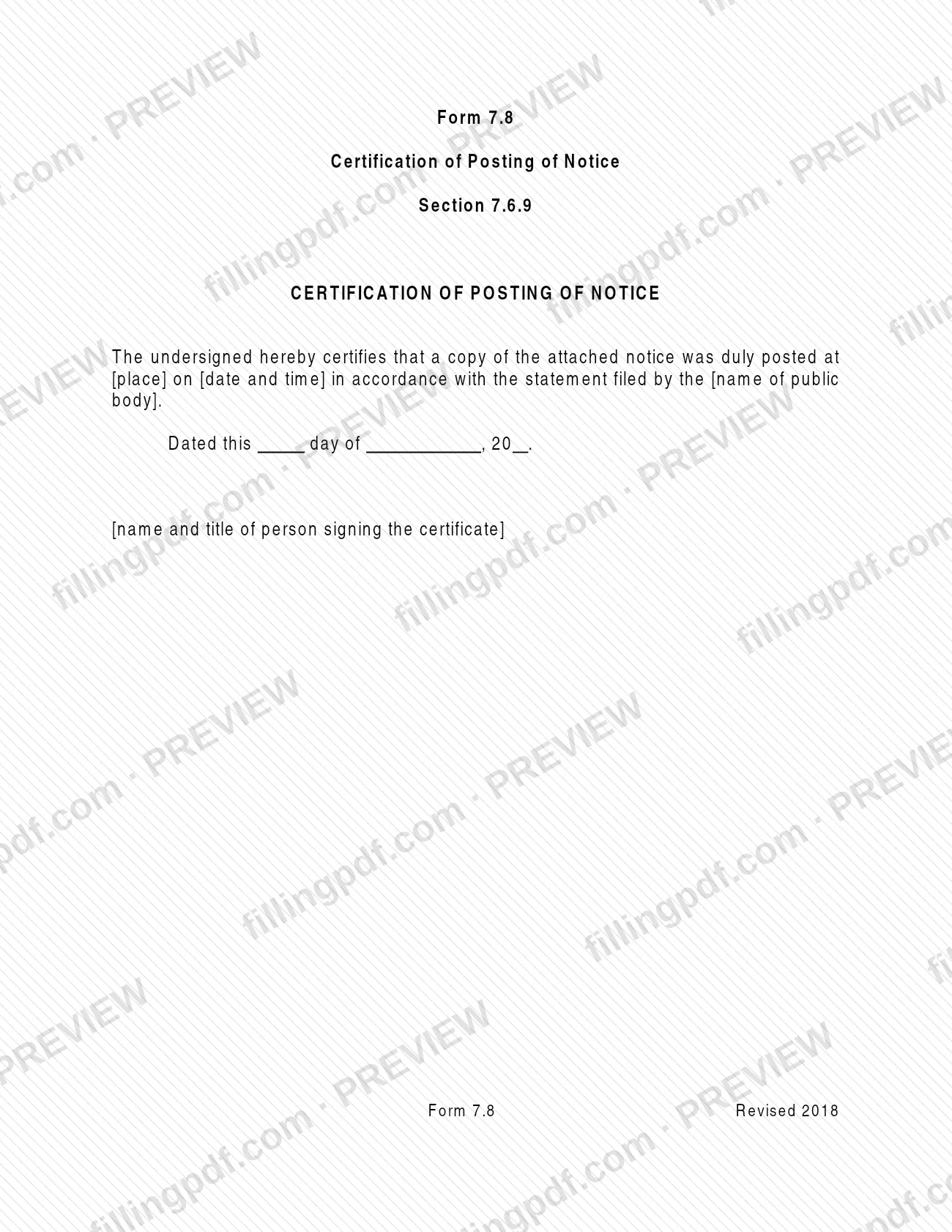
- Form 7.8 Certification of Posting of Notice
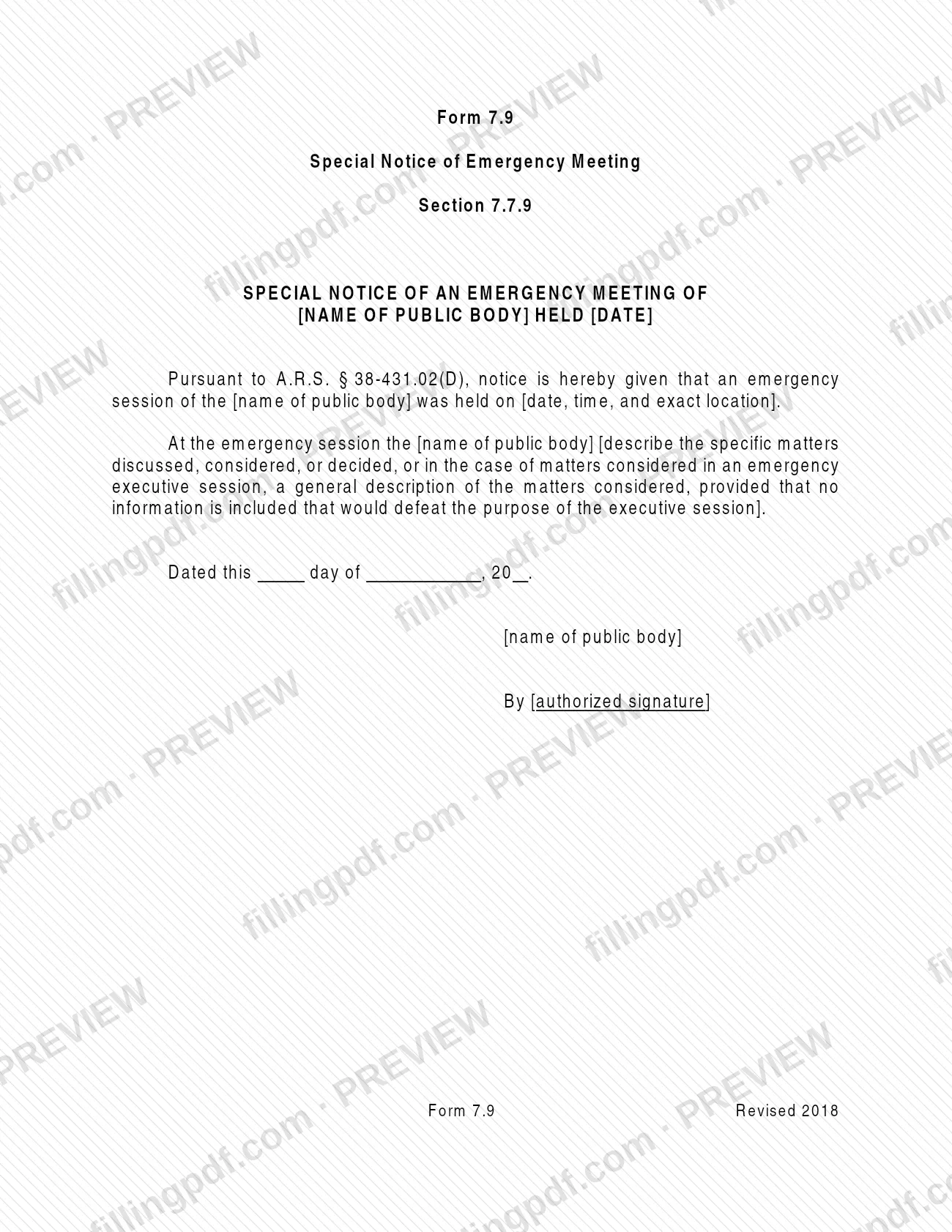
- Form 7.9 Special Notice of Emergency Meeting
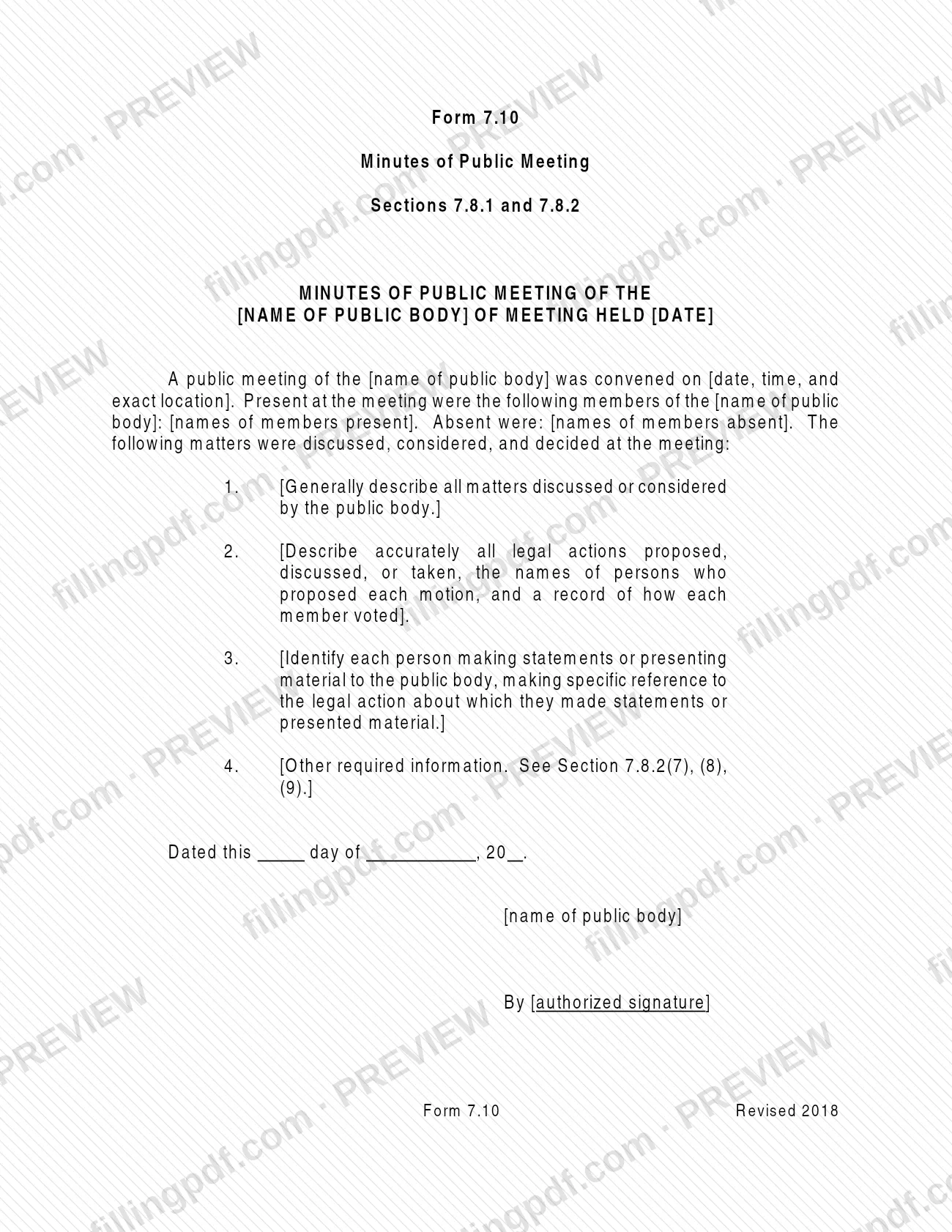
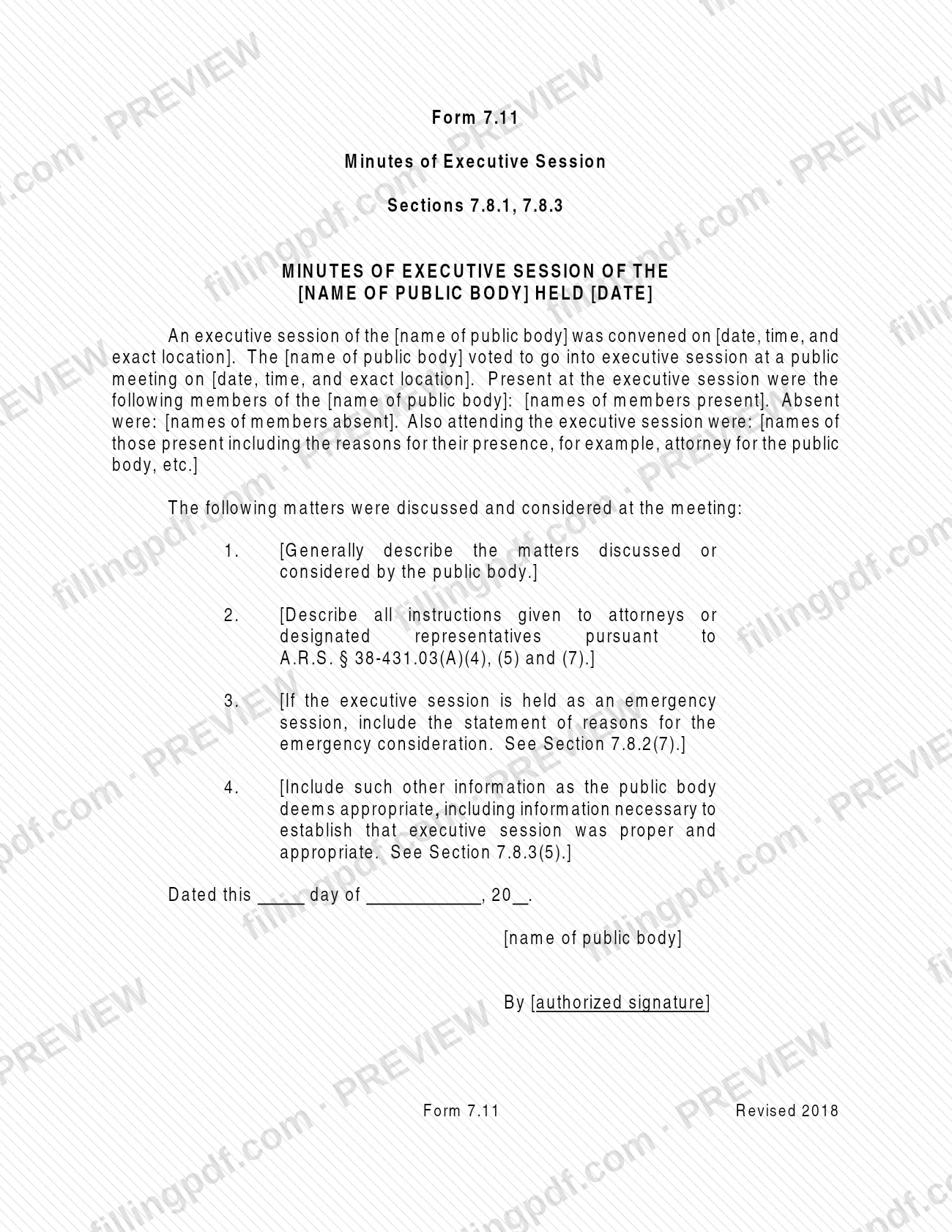
- Forms 7.10 and 7.11 Minutes of Public Meeting and of Executive Session
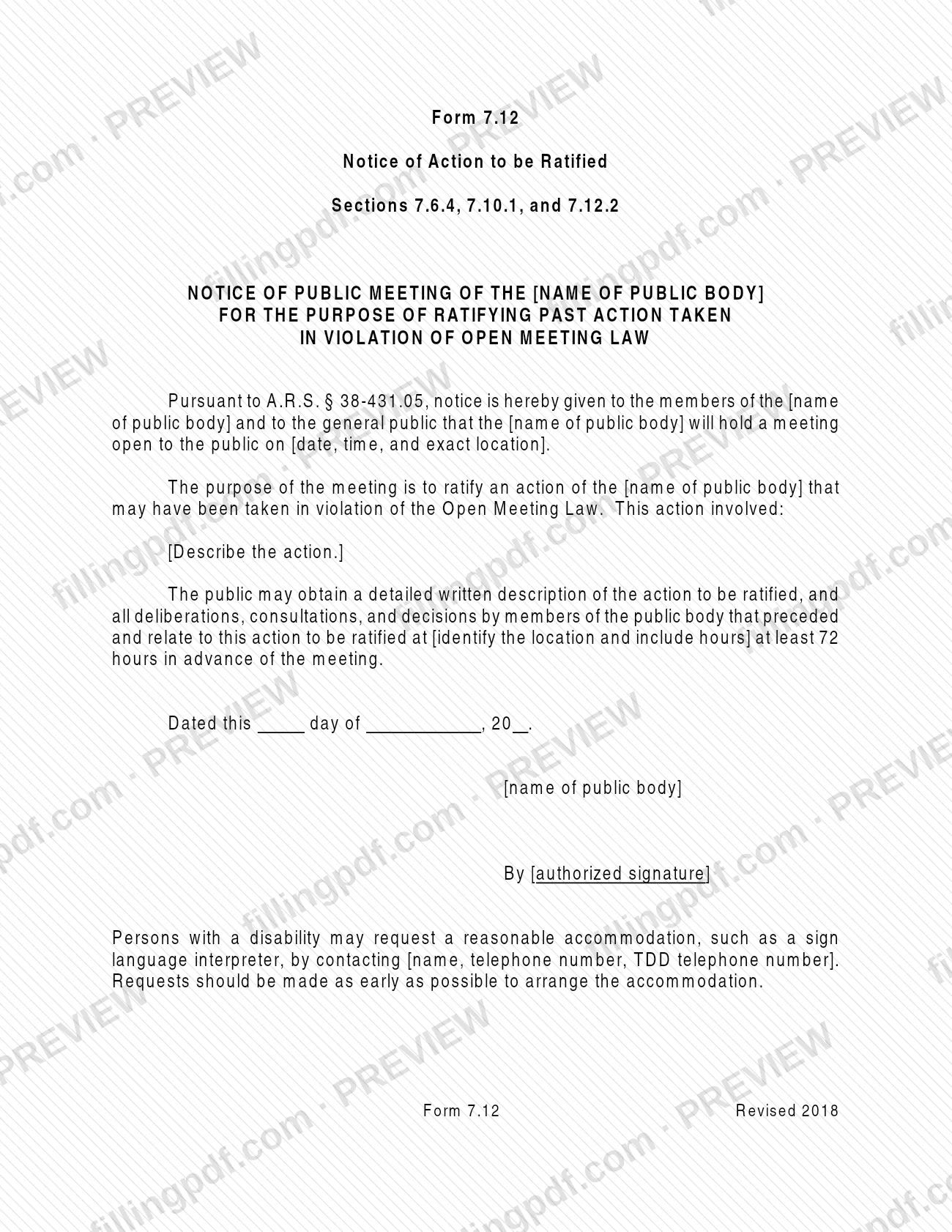
- Form 7.12 Notice of Action to be Ratified
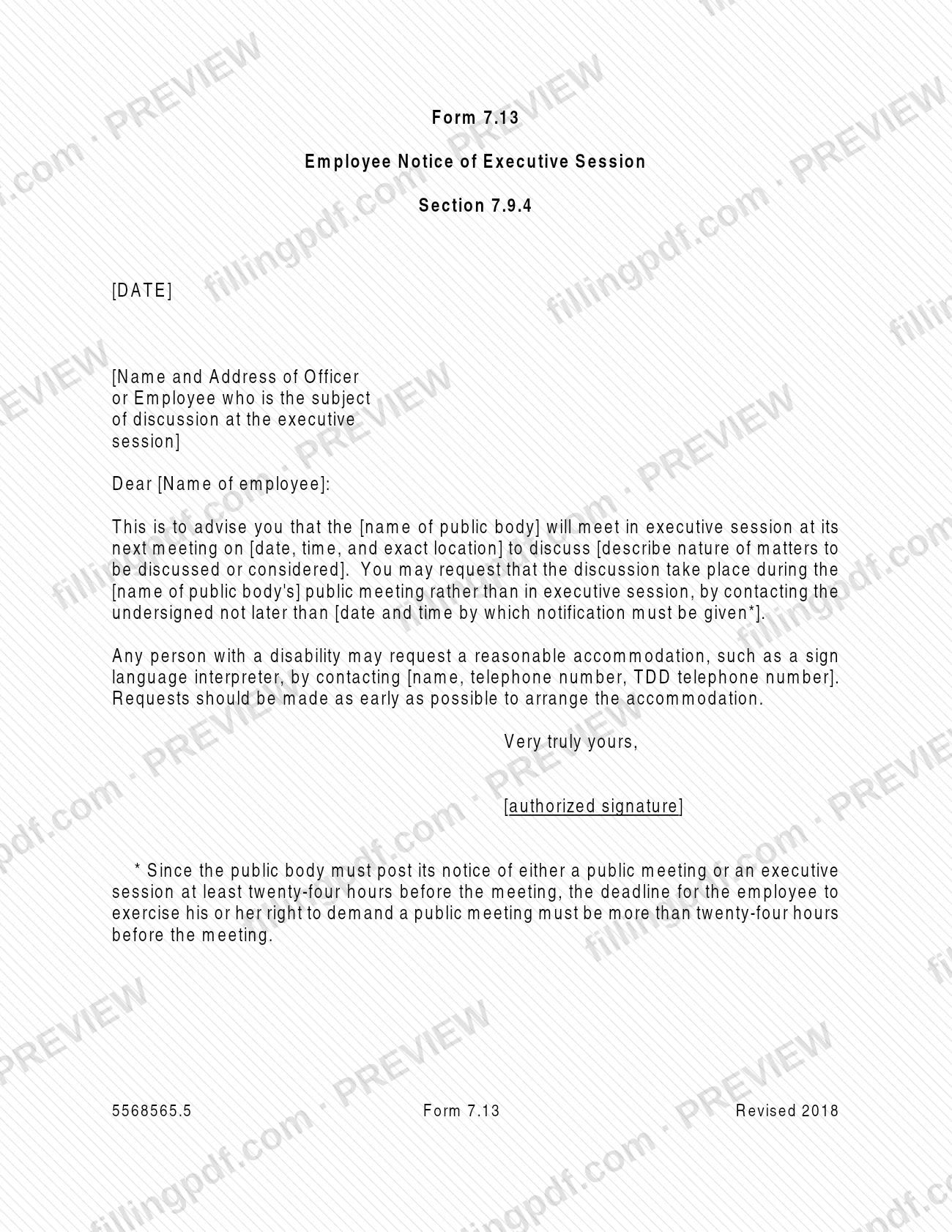
- Form 7.13 Employee Notice of Executive Session
This is guidance and a set of sample forms, not an application. Nothing in it is filed with an agency to obtain a permit, license or number.
Who needs to file Open Meeting Law Information – Maricopa, AZ?
Members of public bodies and the staff who prepare their notices, agendas and minutes use this chapter. A public body includes boards and commissions of the state or its political subdivisions (counties, cities and towns, school districts, special districts), multimember governing bodies, quasi-judicial bodies, advisory committees, and standing or special committees and subcommittees. Persons elected or appointed to a public body must review the chapter at least one day before taking office.
The chapter also serves members of the public who want to know what notice, agendas and minutes they are entitled to expect.
Exclusions the chapter states:
- The law applies only to multimember bodies, not to the single head of an agency.
- Judicial proceedings of courts, the judicial appointment commissions and the Board of Fingerprinting's good cause exception hearings are exempt.
- Student disciplinary proceedings are not subject to it.
- Homeowners associations are not governmental public bodies and are not covered, though separate notification requirements apply to them.
- Legislative conference committees must meet openly but are exempt from the other requirements.
When to file Open Meeting Law Information – Maricopa, AZ
The chapter's timing rules attach to each meeting. As a general rule, notice must be given to the members of the public body and to the public at least twenty-four hours before a meeting; Sundays and holidays are excluded from that period, and Saturdays count if the public has access to the posting locations. Exceptions: an actual emergency allows shorter notice appropriate to the circumstances, a meeting recessed to the next day may resume on less notice, and a meeting to ratify a prior act requires seventy-two hours' notice.
An employee who is the subject of an executive session must receive written notice at least twenty-four hours ahead, with no emergency exception. Ratification must take place within thirty days after discovery of the violation. Minutes or a recording of a public meeting must be available for public inspection within three working days after the meeting. Cities and towns with a population over 2,500 must post a statement of legal actions or the recordings on their website within three working days, and approved council minutes within two working days of approval.
Documents you need
- Agenda listing the specific matters to be discussed, considered or decided, or a statement in the notice of where and how the public may obtain it, for every public meeting and executive session.
- Disclosure statement (Form 7.1) identifying the physical and electronic locations where meeting notices will be posted, before notices of meetings are posted.
- Written notice to the affected officer, appointee or employee (Form 7.13), at least twenty-four hours before an executive session on a personnel matter.
- Detailed written description of the action to be ratified and of related prior deliberations, available at least seventy-two hours before a ratification meeting; it is also included in that meeting's minutes.
- Minutes of each public meeting and executive session, in writing or as an audio or video recording.
- Certification of Posting of Notice (Form 7.8), an optional best practice for keeping a record of when and where a notice was posted.
How to fill out Open Meeting Law Information – Maricopa, AZ
Enter the public body's name
Replace every [name of public body] placeholder with the exact name of the board, council, commission or committee. For a subcommittee or advisory committee, use Form 7.3 and name both the committee and its parent body.
Complete the disclosure statement
On Form 7.1, identify where notices will be posted, including the hours those locations are open to the public. Date it and add the authorized signature.
Fill in the meeting notice
On Form 7.2, 7.3 or 7.4, enter the date, time and exact location. Give the street address and the room number or other identification of the room.
Add the agenda or where to get it
List the specific matters to be discussed, considered or decided, or state where a copy of the agenda will be available at least twenty-four hours before the meeting.
Cite the executive session provision
On Form 7.5 or 7.6, name the numbered paragraph of A.R.S. § 38-431.03(A) that authorizes the session. Describe the matters generally without information that would defeat the session's purpose.
Include the accommodation statement
Where the form carries it, enter the name, telephone number and TDD telephone number of the contact for reasonable accommodation requests.
Date and sign the notice
Complete the line "Dated this ___ day of _, 20" and add the authorized signature under the public body's name.
Prepare special notices
Use Form 7.13 to notify an employee of an executive session, Form 7.9 to report an emergency session, and Form 7.12 to announce a ratification meeting with a description of the action.
Write the minutes
On Form 7.10 or 7.11, record the date, time and place, members present and absent, the matters considered, motions, how each member voted, and speakers. For executive sessions, add instructions given to attorneys or representatives.
Certify the posting
On Form 7.8, enter the place, date and time the notice was posted, the public body's name, and the name and title of the person signing.
Review, sign and download the PDF
Check every bracketed placeholder, date and signature line, then download or print the completed PDF from FillingPDF and post or deliver it as described under How to submit.
How to submit Open Meeting Law Information – Maricopa, AZ
The chapter's forms are not filed with the Attorney General or the city. They are posted or delivered by the public body itself, through these channels:
- Website: Public bodies of cities and towns post the disclosure statement (Form 7.1) on their own website or on the website of an association of towns and cities. Each meeting notice is posted on the public body's website as well.
- Posting location: Each notice is also posted at the physical location named in the disclosure statement, which must be reasonably accessible to the public.
- Written notice to an employee: For an executive session about a personnel matter, the affected officer, appointee or employee receives written notice (Form 7.13).
- Public inspection: Minutes or recordings are made available to the public within three working days after a meeting.
The agenda goes with the notice, or the notice states how the public may obtain it. A technological failure that blocks website posting does not stop a meeting if all other notice requirements are met. FillingPDF lets you fill out and download the PDF; submission follows the channels above.
Common mistakes to avoid
- Using generic agenda items such as "personnel," "new business," "old business," "reports" or "other matters" without separately identifying the specific matters.
- Citing only A.R.S. § 38-431.03 or subsection (A) in an executive session notice instead of the specific numbered paragraph that authorizes it.
- Issuing a standardized notice that cites every executive session provision rather than only those that apply to the matters to be discussed.
- Taking a vote, straw poll or final decision in executive session; binding votes must occur in a public meeting.
- Giving an employee less than twenty-four hours' written notice of an executive session on personnel matters; an emergency does not excuse it.
- Giving less than seventy-two hours' notice of a meeting to ratify a prior act, or ratifying more than thirty days after discovery of the violation.
- Recording voice votes in the minutes without noting how each member voted, including abstentions and recusals.
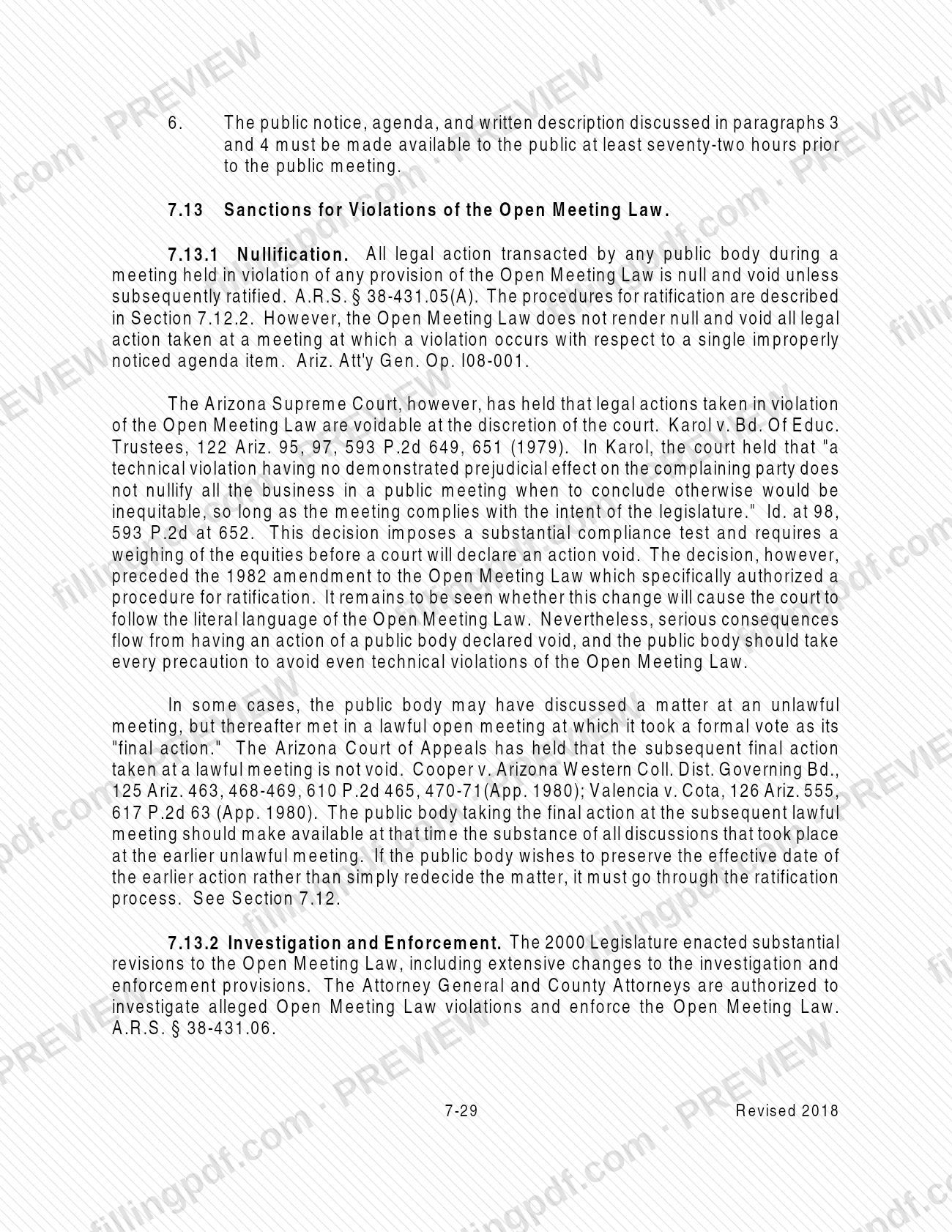
- Discussing or deciding matters not listed on the agenda, other than closely related matters or a true emergency; action on an improperly noticed item is null and void.
- Storing executive session minutes together with regular session minutes, risking disclosure of confidential information.
Frequently asked questions
What is Open Meeting Law Information?
It is Chapter 7, Open Meetings, of Arizona's agency handbook (Revised 2018). It explains the Open Meeting Law, A.R.S. §§ 38-431 to -431.09, and provides model Forms 7.1 to 7.13 for disclosure statements, notices, agendas, minutes and ratification.
How much notice is required before a public meeting in Arizona?
Generally at least twenty-four hours, given to the members of the public body and the public. Sundays and holidays are excluded from that period, and Saturdays count if the public has access to the posting locations. An actual emergency, a recess to the next day, and ratification meetings (seventy-two hours) follow different rules.
Where must a city post its meeting notices?
On the public body's website and at the physical location named in its disclosure statement. City and town bodies post the disclosure statement on their own website or on the website of an association of towns and cities. The location must be one the public can reasonably reach.
When may a public body hold an executive session?
Only for the matters the law authorizes: personnel matters, confidential records, legal advice, litigation and contract negotiation instructions, salary negotiation instructions, international, interstate and tribal negotiations, and real property purchase, sale or lease. A majority must vote in public, and no final vote may be taken in the session.
How soon must meeting minutes be available?
Written minutes or a recording of a public meeting must be available for public inspection within three working days after the meeting. Minutes not yet approved can be marked "draft" or "unapproved." Executive session minutes stay confidential except for the persons the law lists.
Does the Open Meeting Law apply to homeowners associations?
No. The chapter states that homeowners associations are not governmental public bodies, so the Open Meeting Law does not cover them. They must follow separate notification requirements, which are enforced privately because the Attorney General and County Attorneys have no jurisdiction over them.
What happens if a public body violates the Open Meeting Law?
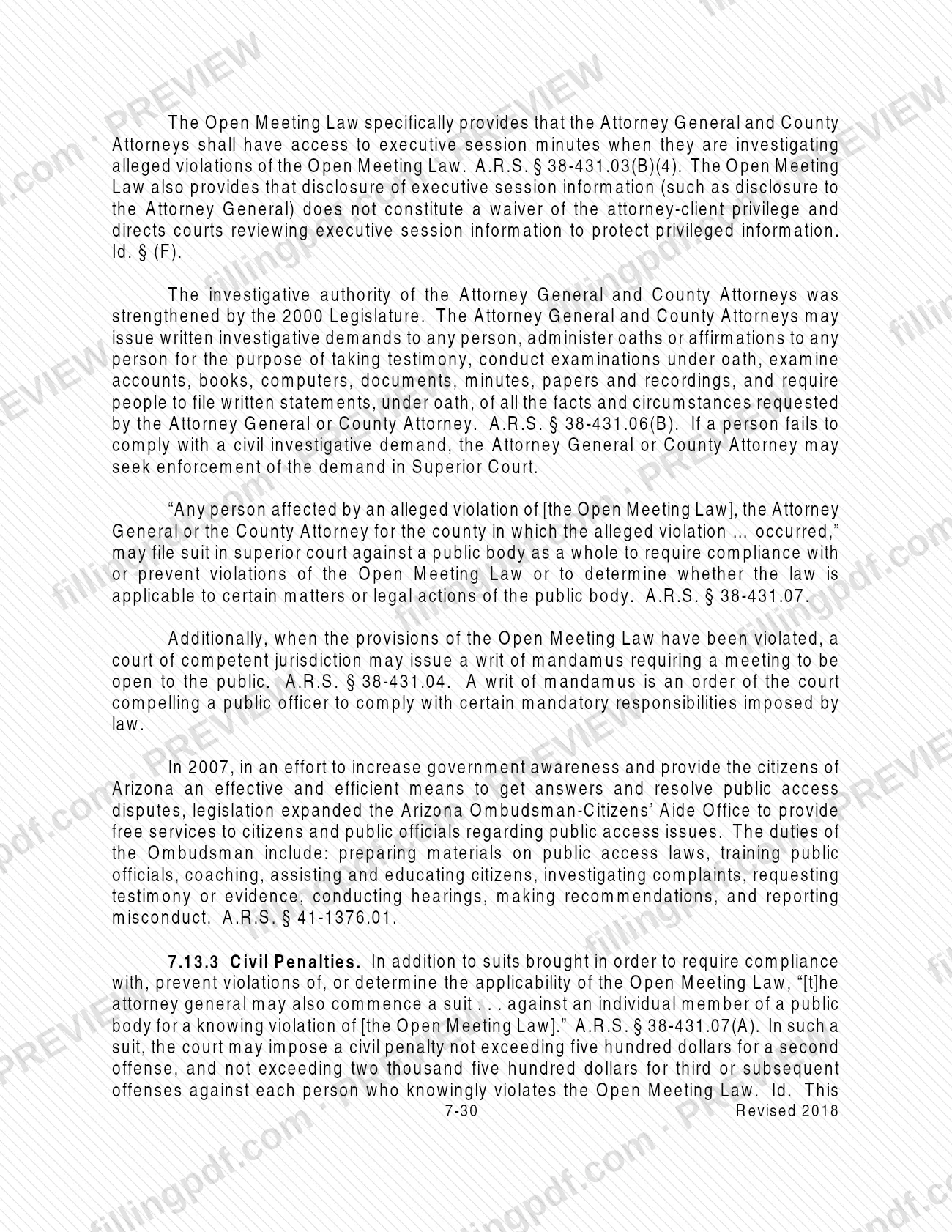
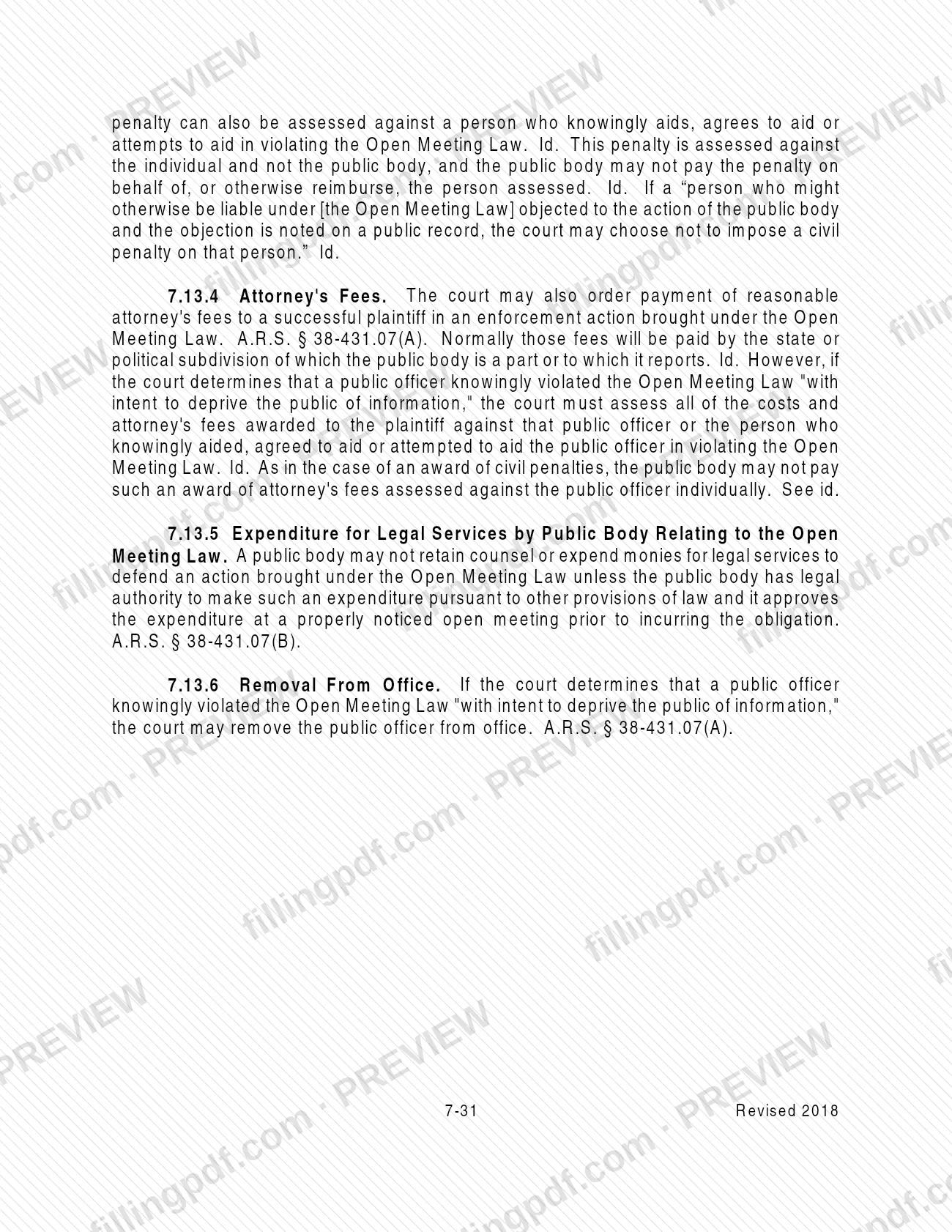
Legal action taken at a meeting held in violation is null and void unless ratified. The Attorney General and County Attorneys may investigate, and a court may award attorney's fees, impose civil penalties on individual members who knowingly violate the law, or remove an officer who acted with intent to deprive the public of information.
Can I fill out these forms online on FillingPDF?
You can fill out the form online on FillingPDF and download or print the completed PDF. FillingPDF is an independent service: it does not post notices, file anything with the city or the Attorney General, or give legal advice. The public body posts or delivers the notices itself.
Ready to fill out Open Meeting Law Information – Maricopa, AZ?
Fill out Open Meeting Law Information – Maricopa, AZ now