
FL-341(D), Additional Provisions—Physical Custody Attachment, is a Judicial Council of California form that adds further physical custody terms to a custody request, agreement or order. Parents and other parties use it to set rules on matters such as address changes, child care, canceled visits and phone contact with the children. On this page you can fill out the form online on FillingPDF and download or print the completed PDF; the official form is published by the Judicial Council at courts.ca.gov.
Last updated
What is FL-341(D)?
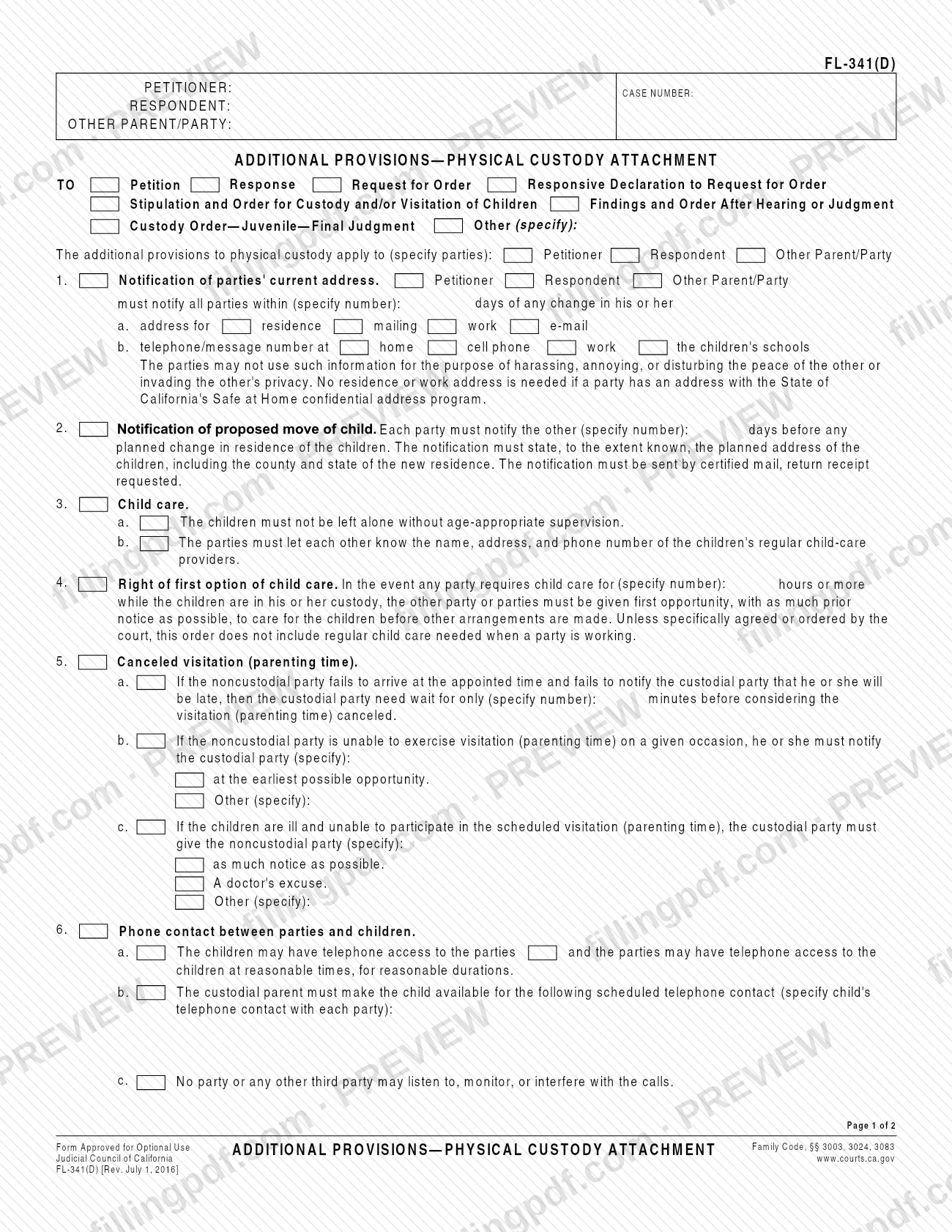
Additional Provisions—Physical Custody Attachment (FL-341(D)) is a two-page Judicial Council of California form that lists optional physical custody provisions, which parties can agree to, request from the court, or use to record a court's orders on additional custody issues.
The form is an attachment. It does not start a case or ask for custody on its own. At the top you check which document it is attached to: a Petition, Response, Request for Order, Responsive Declaration to Request for Order, Stipulation and Order for Custody and/or Visitation of Children, Findings and Order After Hearing or Judgment, Custody Order—Juvenile—Final Judgment, or Other. You also say which parties the provisions apply to: Petitioner, Respondent or Other Parent/Party.
The provisions run from item 1 to item 17. They cover:
- notice of changes in address and phone numbers, and of a planned move of the children;
- child care, including a right of first option;
- canceled visitation (parenting time) and phone contact;
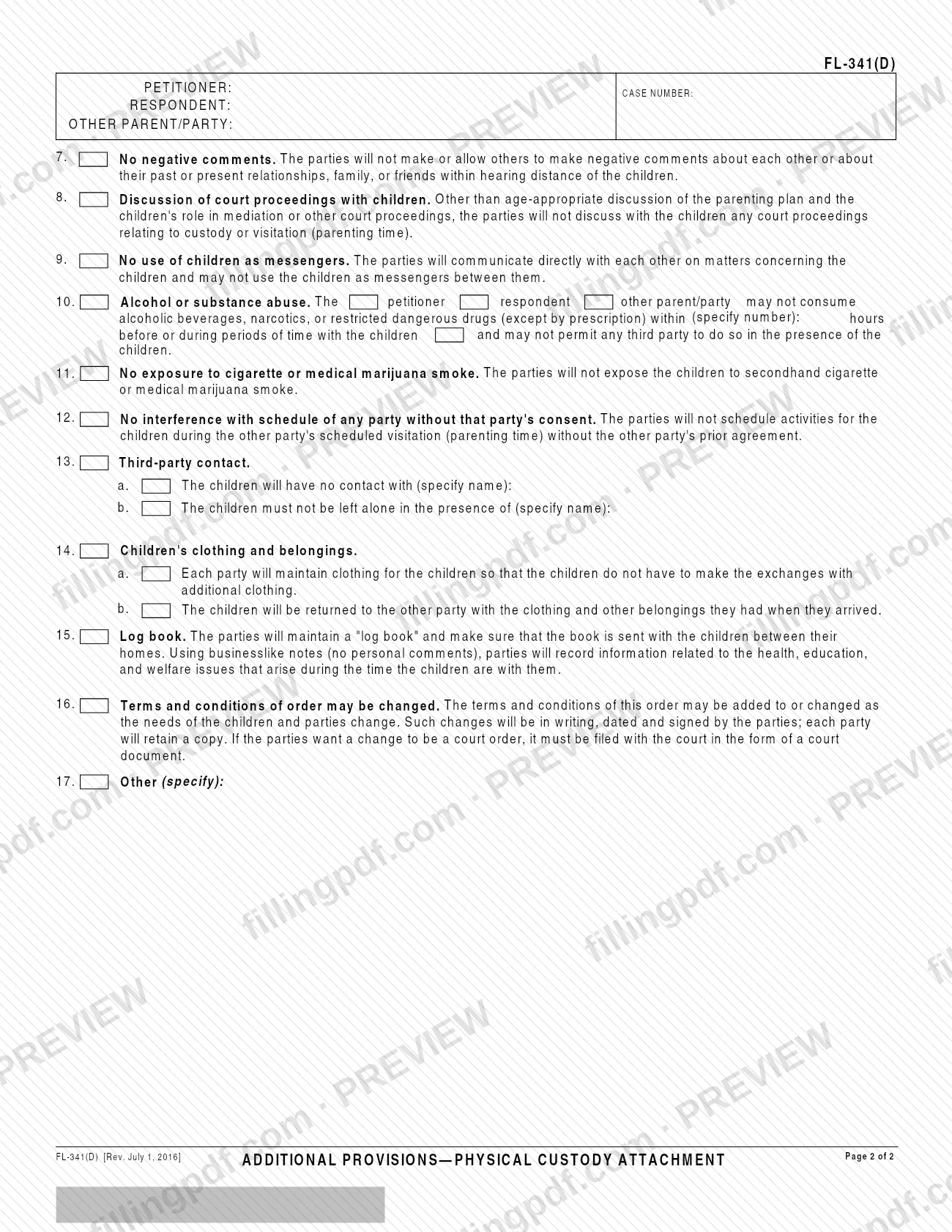
- no negative comments, no discussion of court proceedings with the children, and no use of the children as messengers;
- alcohol or substance use, secondhand smoke, third-party contact, clothing, a log book, and how the terms may be changed.
The form is marked "Form Approved for Optional Use" and cites Family Code, §§ 3003, 3024, 3083. The Judicial Council's self-help site describes it as an attachment to many forms.
Who needs to file FL-341(D)?
Parents and other parties in a California child custody or visitation matter use FL-341(D) when they want additional physical custody provisions in their agreement, request or order. The Judicial Council's self-help page says parents can use it to make agreements, or request court orders, about other custody matters that are in the child's best interest. It can also be used to state the family or juvenile court's orders on additional custody issues.
The form lets you pick who is bound. You check Petitioner, Respondent, Other Parent/Party, or a combination, at the top and again in items 1 and 10 where a specific party is named.
Some items apply only in certain cases:
- Item 1: a party with an address in the State of California's Safe at Home confidential address program does not need to give a residence or work address.
- Items 3 to 15 apply to the children generally, and you fill in numbers or names only where the item asks you to specify them.
The form is approved for optional use, so a court is not required to receive these provisions on this particular form. The form names no one who is excluded from using it.
When to file FL-341(D)
FL-341(D) has no filing date of its own. It is completed and submitted at the moment you prepare the document it attaches to, such as a Petition, Response, Request for Order or Stipulation and Order for Custody and/or Visitation of Children, so its timing follows that document. Once the provisions are in an order, item 16 says they can later be added to or changed as the needs of the children and parties change. Such changes must be in writing, dated and signed by the parties, and each party keeps a copy. If the parties want a change to be a court order, it must be filed with the court in the form of a court document.
How to fill out FL-341(D)
Enter case information
Fill in the PETITIONER, RESPONDENT and OTHER PARENT/PARTY names and the CASE NUMBER at the top of page 1. The same header appears on page 2.
Check the document it attaches to
Under ATTACHMENT TO, check Petition, Response, Request for Order, Responsive Declaration to Request for Order, Stipulation and Order for Custody and/or Visitation of Children, Findings and Order After Hearing or Judgment, Custody Order—Juvenile—Final Judgment, or Other and specify.
Choose the parties covered
Check Petitioner, Respondent, Other Parent/Party, or more than one, for the parties to whom the additional provisions apply.
Complete item 1, address notification
Check who must give notice, enter the number of days, and check each kind of information covered: residence, mailing, work or e-mail address, and home, cell, work or the children's schools phone numbers.
Complete items 2 to 4
Item 2: enter the number of days of notice before a planned change in the children's residence. Item 3 sets child care rules. Item 4: enter the number of hours of needed care that triggers the other party's first option.
Complete item 5, canceled visits
Enter the minutes the custodial party must wait in 5a. In 5b and 5c, specify how the parties must notify each other, or check A doctor's excuse where it applies.
Complete item 6, phone contact
Item 6a gives reasonable telephone access. In 6b, specify the child's scheduled phone contact with each party. Item 6c bars listening to or interfering with the calls.
Review items 7 to 9
These items on negative comments, discussing court proceedings with the children and using the children as messengers have no blanks. Keep or remove them as agreed or requested.
Complete items 10 to 13
Item 10: check the party and enter the number of hours for the alcohol and substance restriction. Item 13: specify names for no contact or no unsupervised presence of third parties.
Review items 14 to 16
Items 14 and 15 cover clothing and belongings and a shared log book. Item 16 explains that changes must be written, dated and signed by the parties.
Add other provisions in item 17
Use item 17, Other (specify), for any additional term the parties agree to or request.
Review and download the PDF
Check the header, the checked boxes and every number you entered. Download or print the completed PDF from FillingPDF and attach it to the form you selected at the top.
How to submit FL-341(D)
FL-341(D) is submitted as an attachment to the form or order you checked at the top, so it travels through whatever channel that document uses. The form prints no mailing address, portal or appointment rule of its own.
- With a court filing: attach the completed pages to the Petition, Response, Request for Order, Responsive Declaration to Request for Order or other listed document, and file them together as that document requires.
- With a stipulation or order: attach it to the Stipulation and Order for Custody and/or Visitation of Children, or to the Findings and Order After Hearing or Judgment, so the provisions become part of that order.
- Later changes: a written, dated and signed change between the parties becomes a court order only if it is filed with the court as a court document (item 16).
For your protection and privacy, the form tells you to press the Clear This Form button after you have printed it. FillingPDF lets you fill out and download the PDF; submission follows the channels above.
Common mistakes to avoid
- Leaving the case number and party names off page 2; both pages carry the PETITIONER, RESPONDENT, OTHER PARENT/PARTY and CASE NUMBER header.
- Not checking which document the form is attached to, such as a Request for Order or a Stipulation and Order for Custody and/or Visitation of Children.
- Not checking which parties the provisions apply to (Petitioner, Respondent, Other Parent/Party), so it is unclear who is bound.
- Leaving a blank where the item says (specify number), such as the days in item 1 or 2, the hours in items 4 and 10, or the minutes in item 5a.
- Requiring a residence or work address from a party who has an address with the State of California's Safe at Home confidential address program; item 1 says none is needed.
- Planning a change of the children's residence without giving the notice in item 2, which must state the planned address, county and state to the extent known and be sent by certified mail, return receipt requested.
- Treating a written change under item 16 as a court order; it becomes one only if it is filed with the court as a court document.
- Leaving the completed form on a shared computer without pressing Clear This Form after printing, as the form advises for privacy.
Frequently asked questions
What is form FL-341(D) used for?
FL-341(D) is a Judicial Council of California attachment that adds physical custody provisions to a custody request, agreement or order. It covers matters such as address notices, child care, canceled visits, phone contact and a log book.
Is FL-341(D) filed by itself?
No. It is an attachment. At the top you check the document it goes with, such as a Request for Order or a Stipulation and Order for Custody and/or Visitation of Children, and it is submitted together with that document.
Do I have to use FL-341(D)?
No. The form is marked "Form Approved for Optional Use." Parents can use it to make agreements or request orders about additional custody matters, and the court can use it to state its orders.
Do I need to give my address under FL-341(D) if I am in Safe at Home?
No residence or work address is needed if a party has an address with the State of California's Safe at Home confidential address program. Item 1 states this exception.
How much notice do I give before moving the children under FL-341(D)?
The number of days is blank on the form; you or the court enter it in item 2. The notice must state the planned address, including county and state, to the extent known, and be sent by certified mail, return receipt requested.
Can we change the terms after the order is made?
Yes. Item 16 says the terms may be added to or changed as needs change, in writing, dated and signed by the parties, with each keeping a copy. A change becomes a court order only if it is filed with the court as a court document.
Can I fill out FL-341(D) online?
You can fill out the PDF online on FillingPDF and download or print it. FillingPDF is an independent service and does not file the form with the court; you submit it with the document it attaches to.
Ready to fill out FL-341(D)?
Fill out FL-341(D) now