
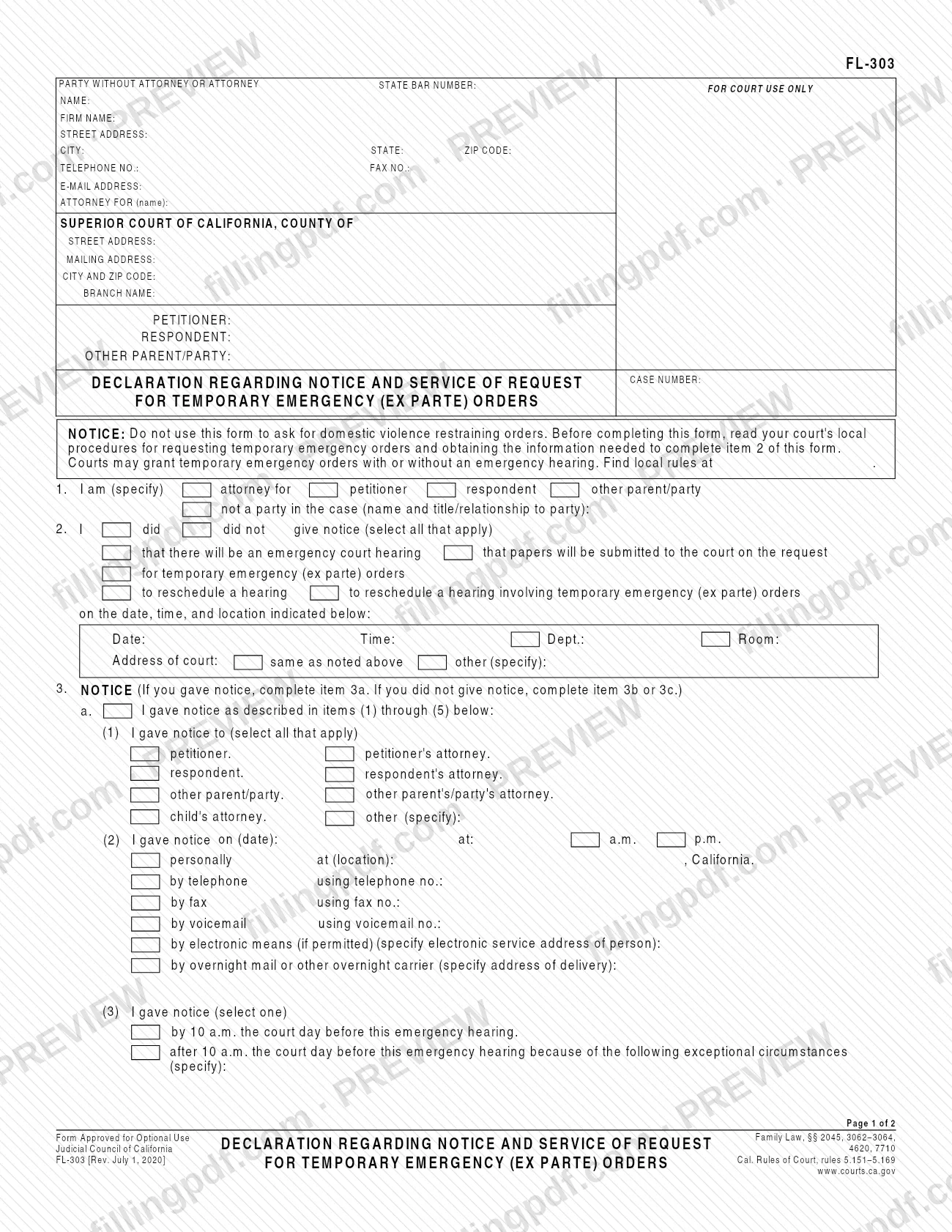
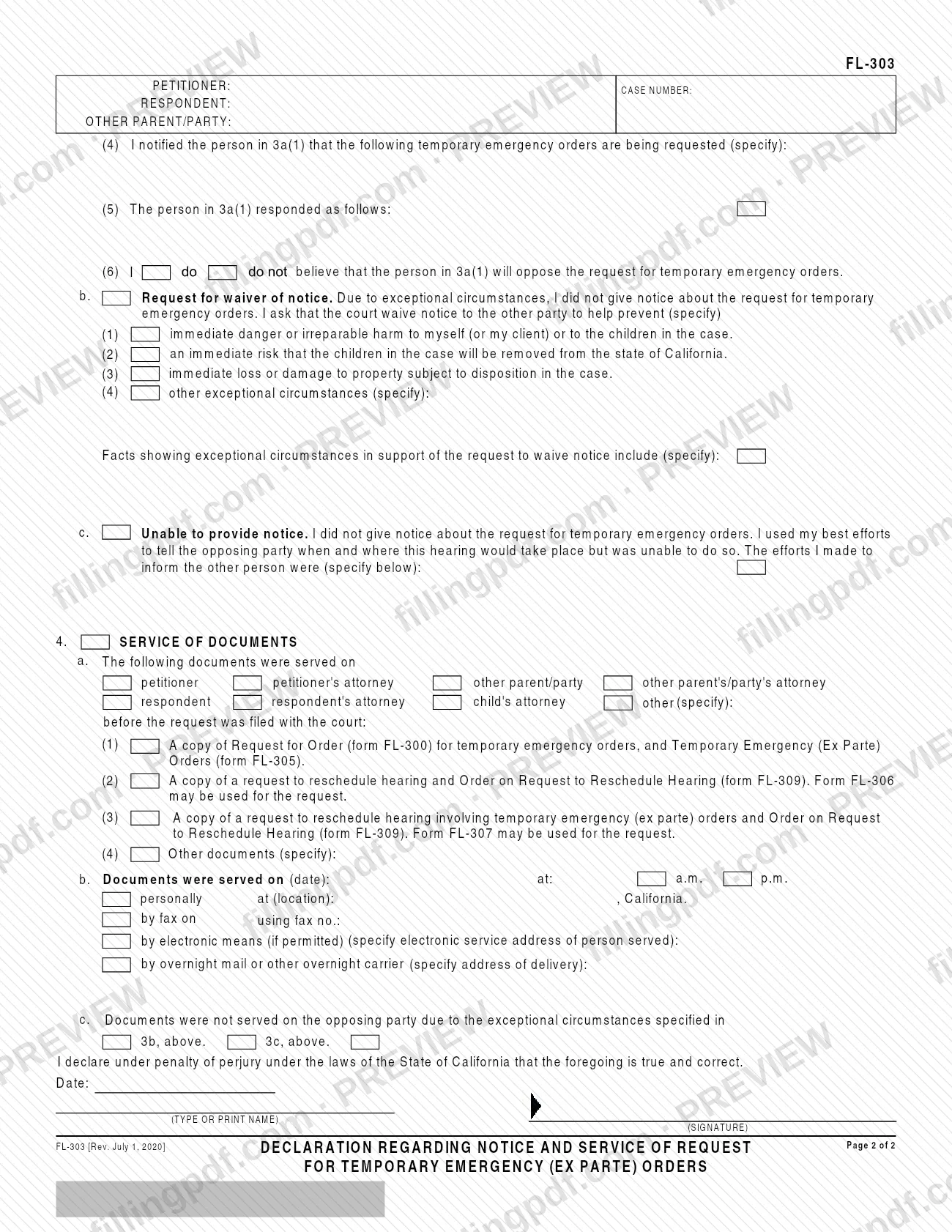
FL-303, the Declaration Regarding Notice and Service of Request for Temporary Emergency (Ex Parte) Orders, is a Judicial Council of California form that tells the court if and how you notified the other party before asking for emergency orders. An attorney or a party in a California family law case completes it, and it can also ask the court to waive notice. On this page you can fill out the form online on FillingPDF and download or print the completed PDF; the form itself is published by the Judicial Council at courts.ca.gov.
Last updated
What is FL-303?
FL-303, Declaration Regarding Notice and Service of Request for Temporary Emergency (Ex Parte) Orders, is the Judicial Council of California form on which you tell the court whether and how you notified the other party of an emergency request, and which documents you served.
The form is signed under penalty of perjury under the laws of the State of California. It is a Form Approved for Optional Use, and its footer cites Family Code sections 2045, 3062–3064, 4620 and 7710 and California Rules of Court, rules 5.151–5.169.
It works in four parts. Item 1 identifies who you are in the case. Item 2 states whether you gave notice of an emergency hearing, of the submission of papers on the request, or of a rescheduled hearing. Item 3 describes the notice you gave (3a), asks the court to waive notice because of exceptional circumstances (3b), or explains that you used best efforts but could not give notice (3c). Item 4 lists the documents served and how.
It is companion paperwork to the Request for Order (form FL-300) and the Temporary Emergency (Ex Parte) Orders (form FL-305), which item 4 refers to.
The form is not for domestic violence restraining orders: its printed notice says not to use it to ask for them.
Who needs to file FL-303?
The form is completed by the person who requested, or is requesting, temporary emergency (ex parte) orders in a family law case and must report what notice was given. Item 1 lets the person completing it say they are the attorney for the petitioner, the respondent or another parent/party, or a person who is not a party in the case, in which case you give your name and title or relationship to a party.
You complete item 3a if you gave notice, and item 3b or 3c if you did not. Item 3b is the request to waive notice; item 3c applies when you used best efforts to tell the opposing party when and where the hearing would take place but could not.
Do not use this form to ask for domestic violence restraining orders. Before completing it, read your court's local procedures for requesting temporary emergency orders, because they give the information needed for item 2. The form notes that courts may grant temporary emergency orders with or without an emergency hearing, and that local rules are at courts.ca.gov/3027.htm.
When to file FL-303
Complete FL-303 when you request temporary emergency (ex parte) orders, because it reports the notice and service connected to that request. The form itself sets no separate due date, but it does state the notice timing it expects: item 3a(3) asks whether you gave notice by 10 a.m. the court day before the emergency hearing, or after 10 a.m. that day because of exceptional circumstances, which you must specify.
Item 4 reports documents served before the request was filed with the court, so the service it describes comes first. Your court's local procedures govern the hearing date, time and department you enter in item 2.
Documents you need
- Attachment 3a(5), only if you gave notice and want to state how the person notified responded, as item 3a(5) provides.
- Attachment 3b, if you ask the court to waive notice: the facts showing exceptional circumstances in support of the request.
- Attachment 3c, if you were unable to provide notice: the efforts you made to inform the other person.
- Attachment 4c, if documents were not served on the opposing party because of the exceptional circumstances in 3b or 3c.
- A copy of Request for Order (form FL-300) and Temporary Emergency (Ex Parte) Orders (form FL-305), served before the request is filed, as listed in item 4a(1).
- A copy of a request to reschedule hearing and Order on Request to Reschedule Hearing (form FL-309), when item 4a(2) applies; form FL-306 may be used for the request.
- A copy of a request to reschedule a hearing involving temporary emergency (ex parte) orders and form FL-309, when item 4a(3) applies; form FL-307 may be used for the request.
How to fill out FL-303
Enter attorney or party information
At the top, enter the name, State Bar number if you are an attorney, firm name, address, telephone, fax and e-mail, and who you are attorney for. Then add the court's county, street and mailing address, branch name, the parties' names and the case number.
Identify your role in item 1
Under item 1, check whether you are an attorney for the petitioner, respondent or other parent/party, or not a party in the case. If you are not a party, enter your name and title or relationship to a party.
Complete the notice statement in item 2
Check whether you did or did not give notice, and select all that apply: an emergency court hearing, papers submitted on the request, or rescheduling a hearing. Enter the date, time, department and room, and the court address if it differs from the one above.
Describe who was notified in item 3a
If you gave notice, in 3a(1) select everyone you notified, including attorneys or others you specify. In 3a(2) enter the date and time and check the method used, with the location, number or address.
State timing and orders requested
In 3a(3) select whether notice was given by 10 a.m. the court day before the hearing or after that time, and specify any exceptional circumstances. In 3a(4) list the temporary emergency orders you told the person were requested.
Record the response in item 3a
In 3a(5) describe how the person responded, using Attachment 3a(5) if needed. In 3a(6) check whether you do or do not believe the person will oppose the request.
Request waiver of notice in item 3b
If you did not give notice, check one reason in 3b(1) to 3b(4) and specify any other exceptional circumstances. Put the supporting facts on Attachment 3b.
Explain inability to notify in item 3c
If you tried but could not tell the opposing party when and where the hearing would take place, complete 3c and describe your efforts on Attachment 3c.
List documents served in item 4a
Select each person served, then check the documents served before the request was filed: FL-300 and FL-305, a reschedule request with FL-309 (FL-306 or FL-307), or other documents you specify.
Enter how and when you served
In item 4b enter the date and time and check the method: personally, fax, electronic means (if permitted) or overnight mail or carrier, with the location, number or address. If nothing was served, check 3b or 3c in item 4c and use Attachment 4c.
Review, sign and download the PDF
Type or print your name, date the form and sign it under penalty of perjury. Check each item against your notice and service facts, then download or print the completed PDF from FillingPDF.
How to submit FL-303
The form names no filing channel or address of its own. Its printed notice tells you to read your court's local procedures for requesting temporary emergency orders before completing it, and to find local rules at courts.ca.gov/3027.htm. Follow the filing method your Superior Court of California describes there for the request that this declaration supports.
The top of the form identifies the Superior Court of California, county, branch, parties and case number, and has a "For court use only" area, so the declaration is tied to a specific case. Notice and service on the other party are separate from filing: items 3a(2) and 4b list the methods used, such as personal delivery, fax, electronic means (if permitted) and overnight mail or carrier.
FillingPDF lets you fill out and download the PDF; submission follows the channels your court describes.
Common mistakes to avoid
- Using FL-303 to ask for domestic violence restraining orders; the form's notice says not to use it for that.
- Completing item 2 without first reading your court's local procedures, which the form says supply the information needed for that item.
- Completing item 3a when you gave no notice, instead of item 3b or 3c; the form says to complete 3a if you gave notice and 3b or 3c if you did not.
- Giving notice after 10 a.m. the court day before the hearing without specifying the exceptional circumstances in item 3a(3).
- Requesting a waiver of notice in item 3b without selecting a reason or describing the facts in Attachment 3b.
- Claiming in item 3c that you used best efforts without describing those efforts in Attachment 3c.
- Selecting a notice or service method that the form allows only if permitted, such as electronic means, without entering the electronic service address.
- Leaving the signature and date blank on the declaration under penalty of perjury.
Frequently asked questions
What is FL-303 used for?
FL-303 is the Judicial Council of California declaration that tells the court if and how you notified the other party that you are asking for temporary emergency (ex parte) orders. It can also ask the court to waive notice when exceptional circumstances apply.
Can I use FL-303 to ask for a domestic violence restraining order?
No. The form's printed notice says not to use it to ask for domestic violence restraining orders. It only reports notice and service for a request for temporary emergency (ex parte) orders.
By what time must notice be given before an emergency hearing?
Item 3a(3) asks whether you gave notice by 10 a.m. the court day before the emergency hearing. If you gave it after 10 a.m. that day, you must specify the exceptional circumstances that explain why.
What do I complete if I did not give notice to the other party?
Complete item 3b to ask the court to waive notice due to exceptional circumstances, or item 3c if you used best efforts to tell the opposing party but could not. Each needs an attachment: 3b for the facts, 3c for your efforts.
Which documents does item 4 say must be served?
Item 4a lists a copy of Request for Order (form FL-300) and Temporary Emergency (Ex Parte) Orders (form FL-305), reschedule requests with form FL-309 (FL-306 or FL-307 may be used), and other documents you specify, served before the request is filed.
Who can complete FL-303?
An attorney for the petitioner, respondent or other parent/party, or a person who is not a party in the case. In item 1, a non-party gives their name and title or relationship to a party.
Where do I file FL-303?
The form gives no address. It tells you to read your court's local procedures for requesting temporary emergency orders and points to local rules at courts.ca.gov/3027.htm. File as your Superior Court's procedures direct.
Can I fill out FL-303 online on FillingPDF?
Yes. You can fill out the fillable PDF online on FillingPDF and download or print it. FillingPDF is an independent service and does not file the declaration with the court; you file and serve it through your court's procedures.
Ready to fill out FL-303?
Fill out FL-303 now