
FTB 3514 is the form the California Franchise Tax Board (FTB) uses to decide whether you can claim the California Earned Income Tax Credit (EITC) and to figure the amount, along with the Young Child Tax Credit (YCTC) and the Foster Youth Tax Credit (FYTC). You attach it to your California Form 540, Form 540 2EZ or Form 540NR. On this page you can fill out the form online on FillingPDF and download or print the completed PDF; the form and its instruction booklet are published by the FTB at ftb.ca.gov.
Last updated
What is FTB 3514?
Form 3514, California Earned Income Tax Credit, is the Franchise Tax Board (FTB) form used to determine whether you qualify for the California Earned Income Tax Credit (EITC), Young Child Tax Credit (YCTC) and Foster Youth Tax Credit (FYTC), and to figure each credit.
The California EITC is a refundable credit for people who earned wage income subject to California withholding and/or have net earnings from self-employment. It is similar to the federal Earned Income Credit (EIC) but has different income limits. It reduces your California tax, or produces a refund if no California tax is due. You do not need a child to qualify, but you must file a California income tax return and attach this form.
The same form also carries the YCTC (for a qualifying child younger than six at the end of the tax year) and the FYTC (for a person age 18 to 25 who was in California foster care at age 13 or older). Part-year residents use separate parts of the form to prorate each credit.
The results transfer to the return: Form 540 lines 75, 76 and 77; Form 540 2EZ lines 23a, 23b and 23c; Form 540NR lines 85, 86 and 87. The 2025 booklet that contains this form also has the instructions, the worksheets and the 2025 Earned Income Tax Credit Table. The form is not a tax return itself.
Who needs to file FTB 3514?
Taxpayers who want to claim the California EITC file Form 3514 with their California return. The credit is open to filers with or without a qualifying child, within the income and eligibility tests in Steps 1 to 4 of the instructions.
- All filers: federal AGI and California earned income must both be under the limit stated in the instructions, and you (and your spouse/RDP on a joint return) need a valid SSN or federal ITIN.
- Filers without a qualifying child: you or your spouse/RDP must be at least 18 at the end of 2025, and your main home must have been in California for more than half of the year.
- Separated spouses/RDPs: you can claim the credit while filing separately only if you meet the special rule, and then you check the box at the top of the form.
- YCTC and FYTC claimants: these credits are claimed on the same form when the Step 8 or Step 10 qualifications are met.
You cannot take the credit if you file federal Form 2555, or if you or your spouse/RDP were California nonresidents for half the year or more. Form 540NR filers must have lived in California at least 183 days (184 in a leap year). If you claim the credit knowing you are not eligible, you may be barred from it for up to 10 years.
When to file FTB 3514
Form 3514 has no due date of its own: you complete it when you file the California return for the tax year, because the form says to attach it to Form 540, Form 540 2EZ or Form 540NR. The 2025 form is for the 2025 taxable year.
Your SSN or federal ITIN must be in place by the due date of your 2025 return, including extensions. If you did not have one by then, you cannot claim the EITC, YCTC or FYTC on the original or an amended 2025 return, even if you get a number later. The same applies to a child who lacked an SSN or ITIN by that date.
If your EITC was reduced or disallowed earlier for a reason other than a math or clerical error and you now want the credit, answer "Yes" on line 1b and work through Steps 1 to 7.
Documents you need
- A copy of your complete federal return, including any federal Schedule C, Schedule F, Schedule SE and Schedule K-1 (Form 1065), if you are self-employed and report business income or loss on line 18.
- For a child born alive and died in 2025 with no SSN or ITIN: write "Died" on line 7 and attach a copy of the child's birth certificate, death certificate or hospital medical records, or include it as your software directs.
- For the FYTC, if you do not check the consent box on line 33: a letter from a county or state agency confirming your foster youth status at or after age 13, or other proof of status.
- Acceptable other proof for the FYTC includes a CDSS Foster Care Verification Form or a county-issued letter.
- If you use an ITIN, identifying documents on FTB request: those acceptable for a California driver's license or identification card, and documents used to report earned income for the year.
How to fill out FTB 3514
Enter your name and SSN or ITIN
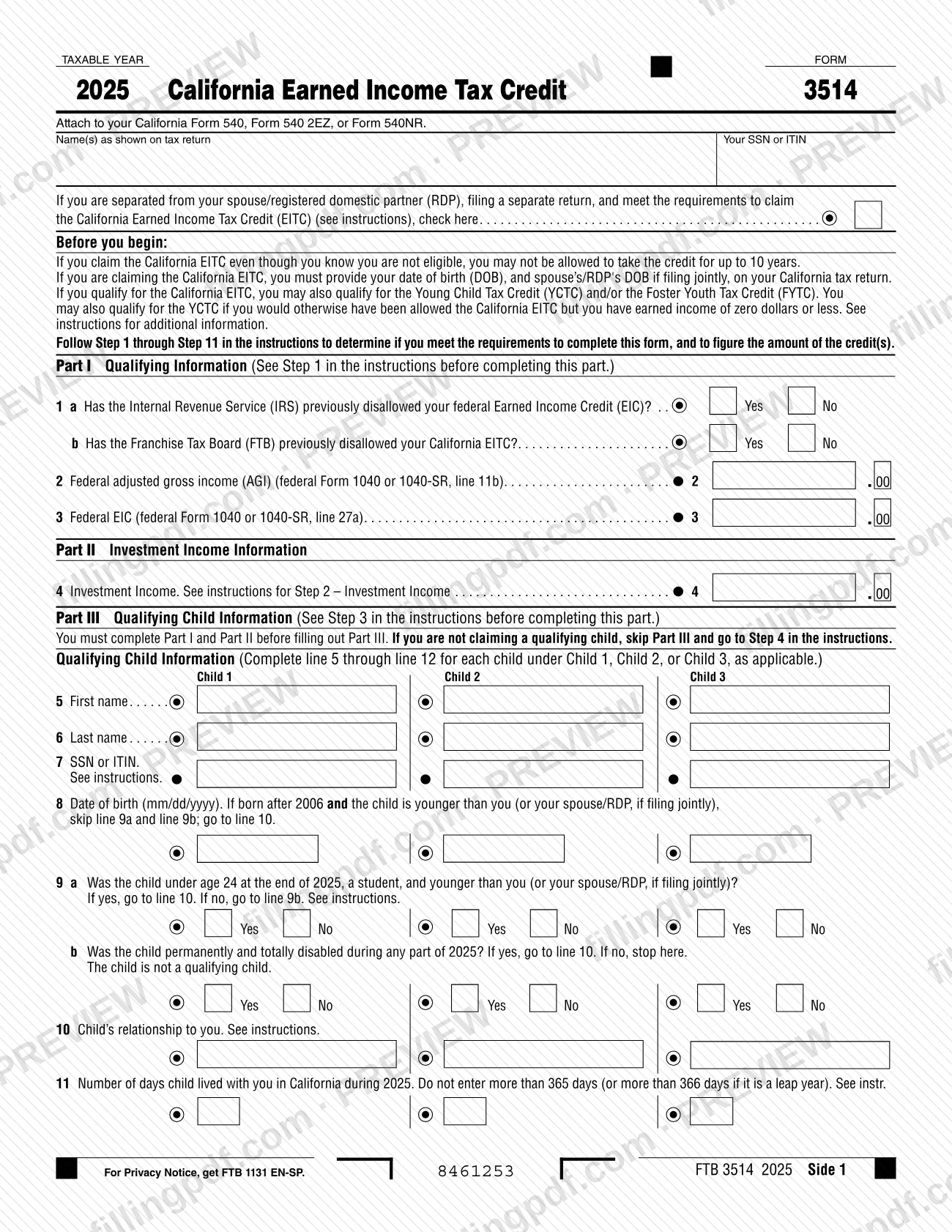
At the top, enter the name(s) as shown on your tax return and your SSN or ITIN. If you are separated from your spouse/RDP, filing separately and meet the special rule, check the box under the name.
Answer the Part I qualifying questions
Line 1a asks whether the IRS previously disallowed your federal EIC and line 1b whether the FTB disallowed your California EITC; check Yes or No. Enter federal AGI on line 2 (federal Form 1040 or 1040-SR, line 11b) and the federal EIC on line 3 (line 27a).
Figure investment income
On line 4 enter the investment income from Worksheet 1 (Form 540 and 540NR filers) or Worksheet 2 (Form 540 2EZ filers) in Step 2. If the worksheet result is above its limit, you cannot take the credit.
Describe each qualifying child
Complete Part I and Part II first, then lines 5 to 12 for up to three children: name, SSN or ITIN, date of birth (mm/dd/yyyy), the line 9a and 9b age/student/disability answers, relationship, days lived with you in California and the child's physical address. Skip Part III if you have no qualifying child.
Report wages and other earned income
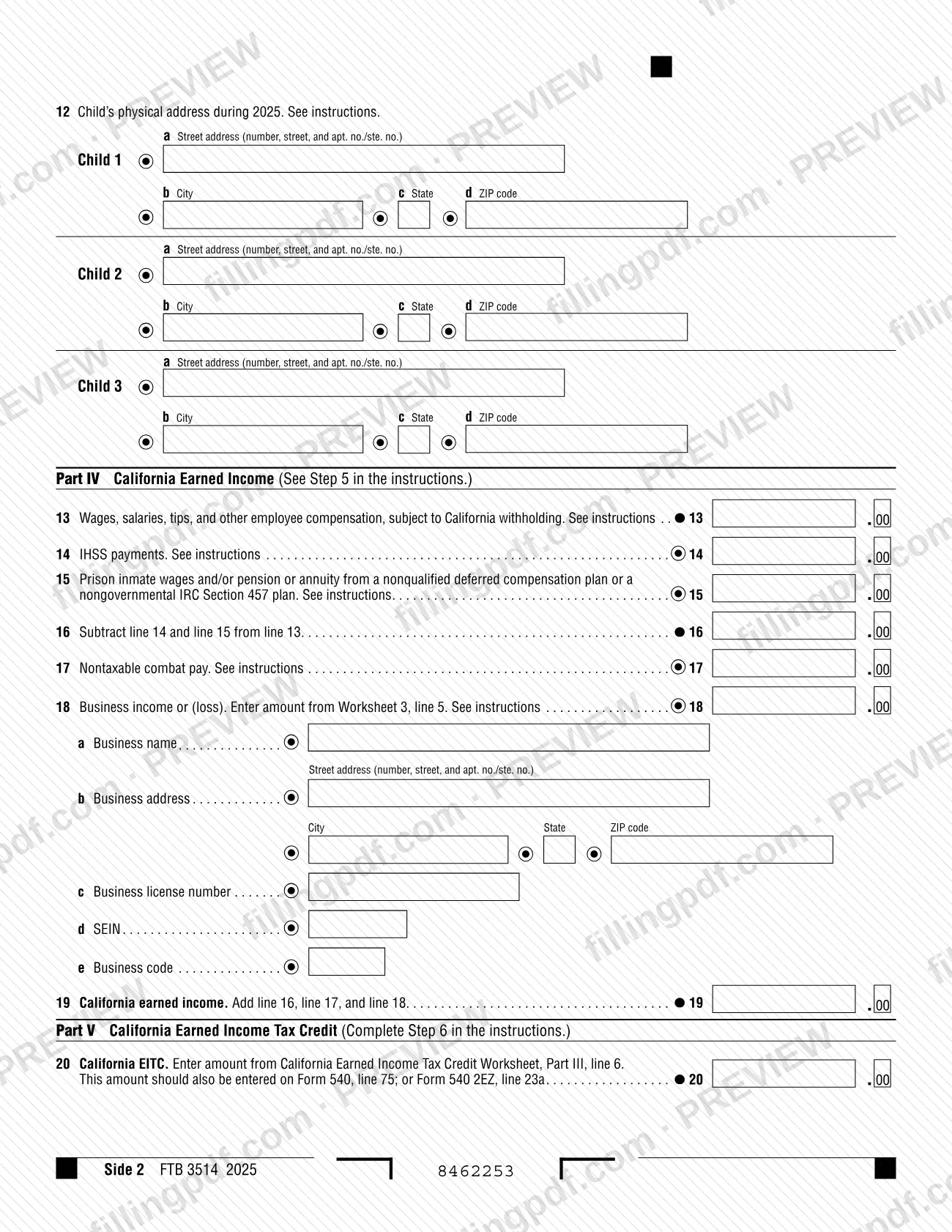
Line 13: California wages from Form W-2, box 16. Line 14: nontaxable Medicaid waiver or IHSS payments only if you elect to exclude them. Line 15: prison inmate wages or certain deferred-compensation pensions or annuities; line 16 subtracts lines 14 and 15 from line 13. Line 17: nontaxable combat pay if you elect to include it.
Enter business income if self-employed
Line 18: the amount from Worksheet 3, line 5. Then give the business name, street address, license number if any, SEIN if any, and six-digit business code (lines 18a to 18e). Finish with line 19, adding lines 16, 17 and 18.
Figure the California EITC
Complete the California Earned Income Tax Credit Worksheet in Step 6 using the EITC Table in the booklet, then enter its Part III, line 6 amount on line 20. Carry it to Form 540 line 75 or Form 540 2EZ line 23a.
Prorate the credit if part-year resident
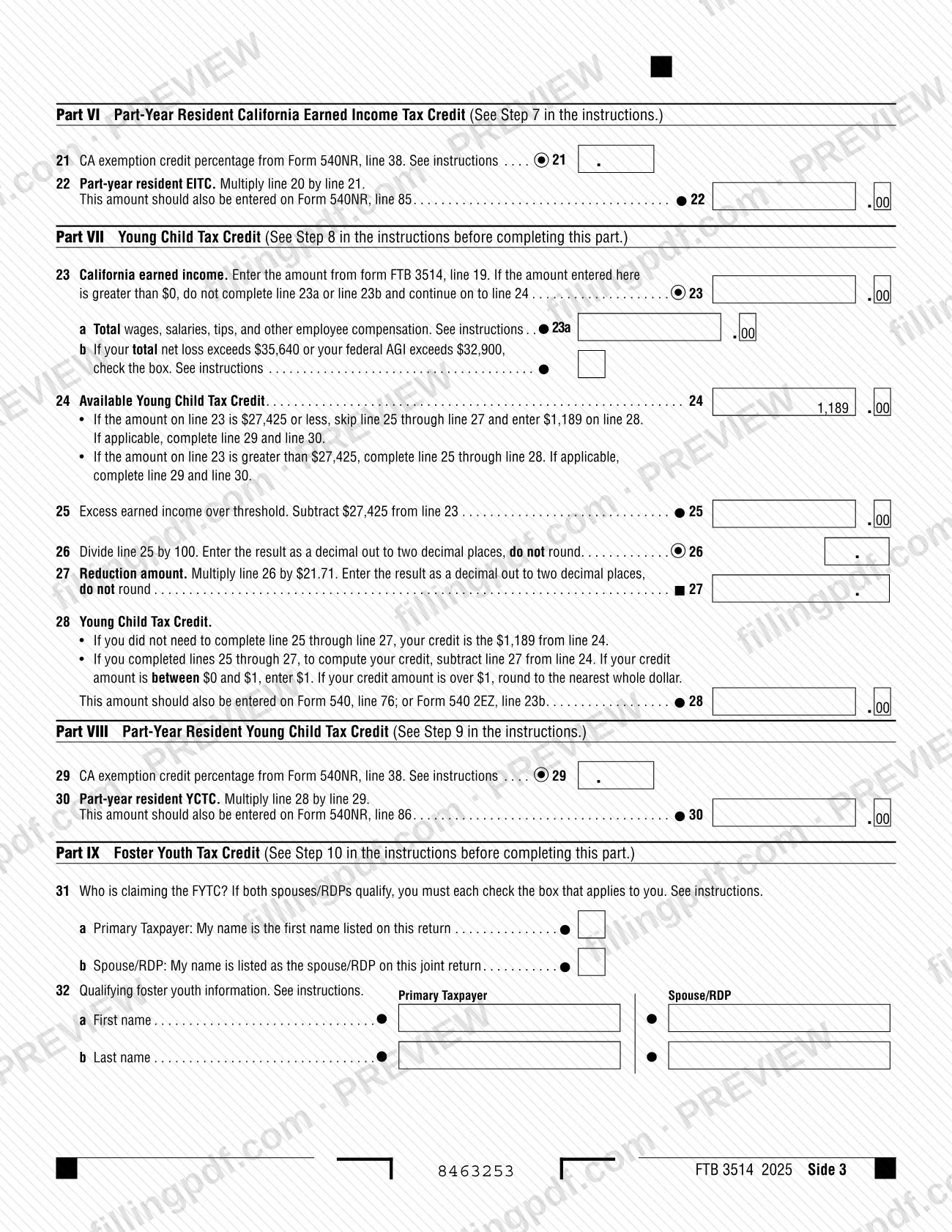
Form 540NR filers enter the California exemption credit percentage from Form 540NR, line 38 on line 21 and multiply line 20 by it for line 22, which also goes on Form 540NR line 85. Worksheet 4 applies if taxable income was below zero.
Complete the Young Child Tax Credit
If you meet the Step 8 qualifications, enter line 19 on line 23; use lines 23a and 23b only if earned income is zero or less. Follow the line 24 to 28 instructions to reach the credit, which goes on Form 540 line 76 or Form 540 2EZ line 23b.
Prorate the YCTC if part-year resident
Form 540NR filers enter the exemption credit percentage on line 29 and multiply line 28 by it on line 30, also entered on Form 540NR line 86.
Complete the Foster Youth Tax Credit
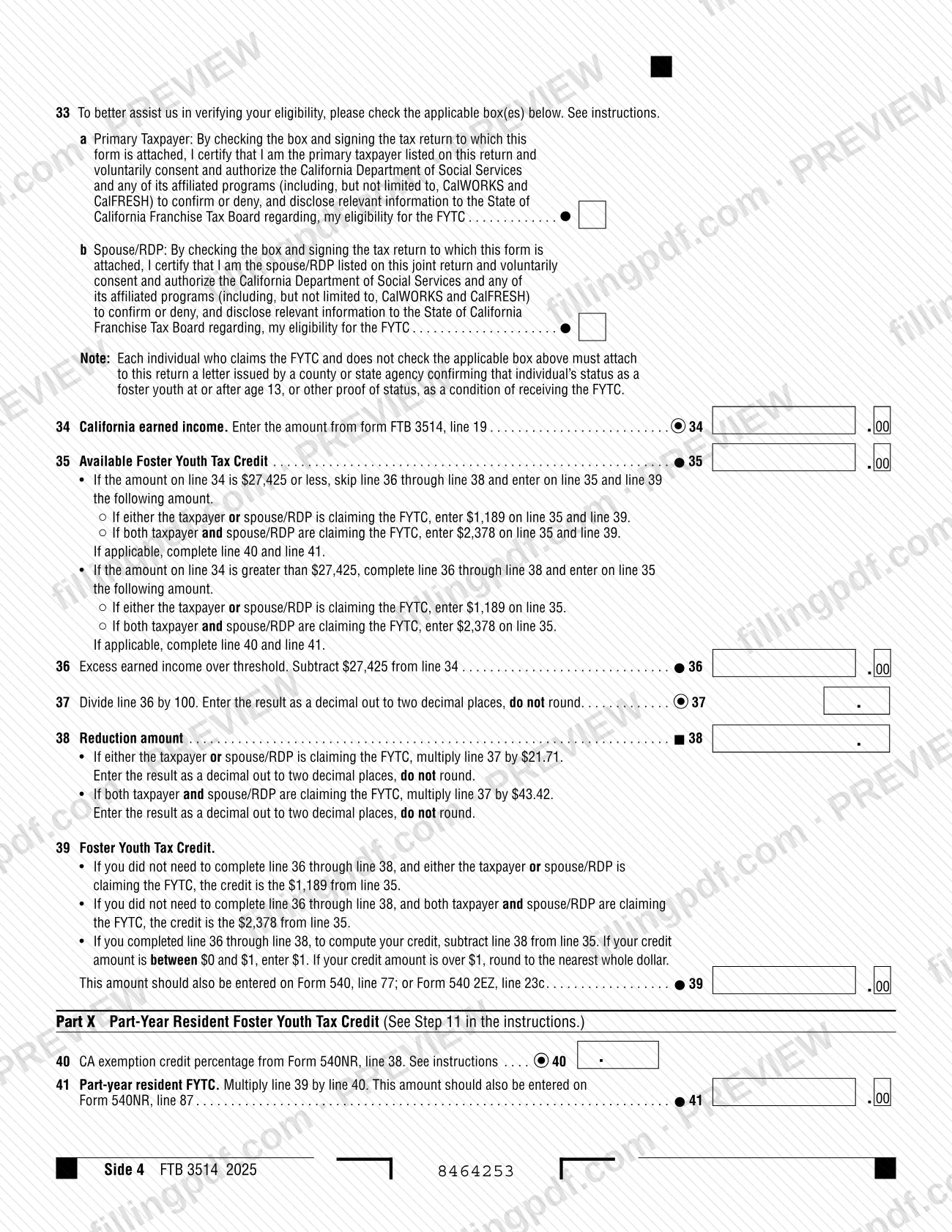
On line 31 check the box that applies to you, give your foster-care name on line 32 if it differs, and check the consent box on line 33 or attach proof. Complete lines 34 to 39; the credit goes on Form 540 line 77 or Form 540 2EZ line 23c.
Prorate the FYTC if part-year resident
Form 540NR filers enter the percentage on line 40 and multiply line 39 by it on line 41, which is also entered on Form 540NR line 87.
Review and download the completed PDF
Check each line, the totals carried to your return, and your SSN or ITIN. Download or print the completed PDF from FillingPDF and attach it to your California return as described under How to submit.
How to submit FTB 3514
Form 3514 is not filed on its own. It goes with your California income tax return, through whichever channel you use to file that return.
- Attach it to your return: attach the completed form to Form 540, Form 540 2EZ or Form 540NR. The form prints no separate mailing address or portal.
- E-file: the FTB lists CalFile among its online services for e-filing a personal income tax return at ftb.ca.gov. If you use tax software, follow its instructions for adding the form and any supporting records.
- Sign the return: you must sign your tax return, and claiming the FYTC also requires lines 31 and 33 and your signature.
- Questions: FTB telephone assistance is 800.852.5711 from within the United States and 916.845.6500 from outside, Monday through Friday, 8 a.m. to 5 p.m., except holidays. California Relay Service is 711 or 800.735.2929.
FillingPDF lets you fill out and download the PDF; submission follows the channels above.
Common mistakes to avoid
- Skipping the "Yes" answer on line 1b when the FTB previously disallowed or reduced your EITC for a reason other than a math or clerical error and you want the credit now.
- Listing a child younger than six in an attachment instead of in the Child 1, Child 2 or Child 3 columns of Part III.
- Entering more than 365 days (366 in a leap year) on line 11, or counting days the child did not live with you in California.
- Using an Adoption Taxpayer Identification Number (ATIN) for a child; it cannot be used to claim a qualifying child for the EITC or YCTC.
- Entering the net loss amount or the federal AGI on line 23b; you only check the box when either limit is exceeded.
- Giving a P.O. box on line 18b instead of the business street address.
- Checking the FYTC consent box for someone else; you can consent only for yourself, and each spouse/RDP checks their own box.
- Entering the wrong income on line 13 or 18 when your California and federal worker classifications differ; use the federal classification for EITC purposes.
- Forgetting to sign the tax return or to attach Form 3514 to it when claiming the credit.
Frequently asked questions
What is FTB 3514 used for?
FTB 3514 is the California Franchise Tax Board form for claiming the California Earned Income Tax Credit. It also determines and figures the Young Child Tax Credit and the Foster Youth Tax Credit, and it collects information about your qualifying children. It is attached to your California return.
Do I need a qualifying child to claim the California EITC?
No. You may claim the credit without a qualifying child if you meet the requirements, including being at least 18 at the end of 2025 and having your main home in California for more than half the year. The credit is larger with a qualifying child, up to three.
Where do I send Form 3514?
You do not send it separately. Attach it to your California Form 540, Form 540 2EZ or Form 540NR and file the return the way you normally do. The form prints no separate address; the FTB's phone line, 800.852.5711, can answer filing questions.
Can I fill out FTB 3514 online?
You can fill out the PDF online on FillingPDF and download or print it. FillingPDF is an independent service and does not file the form with the FTB; the completed form must be attached to your California return and filed through the FTB's channels.
Can I claim the credit with an ITIN instead of an SSN?
Yes. California allows a valid federal ITIN or any valid SSN for eligible filers, spouses and qualifying children. Enter it in the Your SSN or ITIN field. On request the FTB may ask for identifying documents, and the number must exist by your return's due date, including extensions.
What do I attach if I am self-employed?
Attach a copy of your complete federal return, including federal Schedule C or Schedule F, Schedule SE and any Schedule K-1 (Form 1065). Business income or loss on line 18 comes from Worksheet 3 in the instructions.
How do I prove foster youth status for the FYTC?
Check the consent box on line 33 so the California Department of Social Services can share limited information with the FTB. If you do not, attach a county or state agency letter, or other proof such as a CDSS Foster Care Verification Form.
What if the FTB previously disallowed my California EITC?
Answer Yes on line 1b and work through Steps 1 to 7 to check eligibility. This applies when the credit was reduced or disallowed for a reason other than a math or clerical error. Otherwise, the instructions say you cannot take the credit.
Can I claim the Young Child Tax Credit if my earned income is zero?
Possibly. You may qualify if you would otherwise have been allowed the California EITC but have earned income of zero or less, and you meet the net loss and wage limits in Step 8. You must also have a qualifying child younger than six at year end.
Ready to fill out FTB 3514?
Fill out FTB 3514 now