
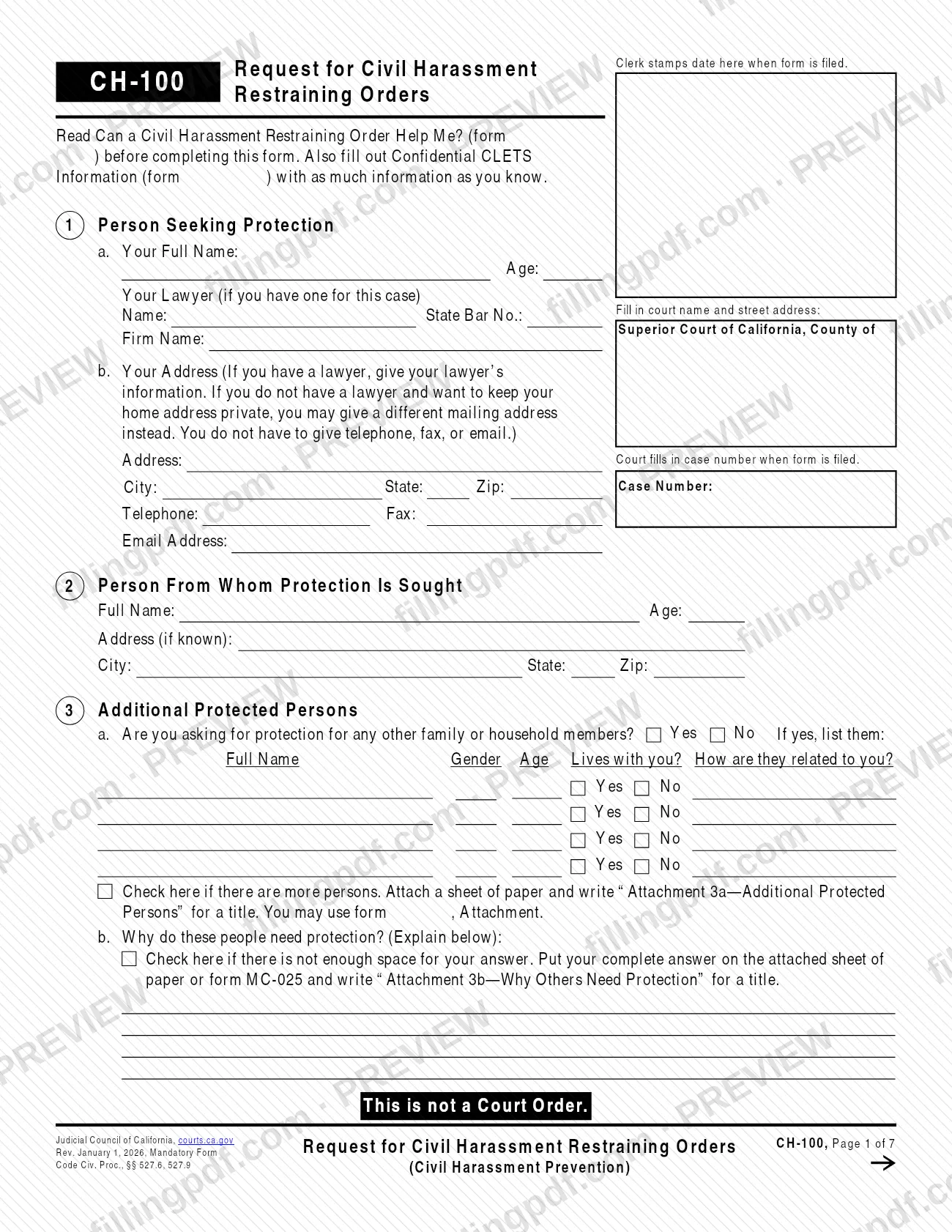
CH-100 is the Request for Civil Harassment Restraining Orders, a Mandatory Form of the Judicial Council of California that you use to ask a superior court for protective orders against a person who has harassed you. It also lets you ask for a Temporary Restraining Order (TRO) that lasts until the hearing. You fill out Form CH-100 together with Confidential CLETS Information (form CLETS-001), and the court's own instructions tell you to read form CH-100-INFO first. On this page you can fill out the form online on FillingPDF and download or print the completed PDF; the official PDF is published at courts.ca.gov.
Last updated
What is CH-100?
Form CH-100, Request For Civil Harassment Restraining Orders, is the Judicial Council of California form on which a person asks a superior court for civil harassment restraining orders against another person. It is a Mandatory Form under Code Civ. Proc., §§ 527.6 and 527.9 (Civil Harassment Prevention).
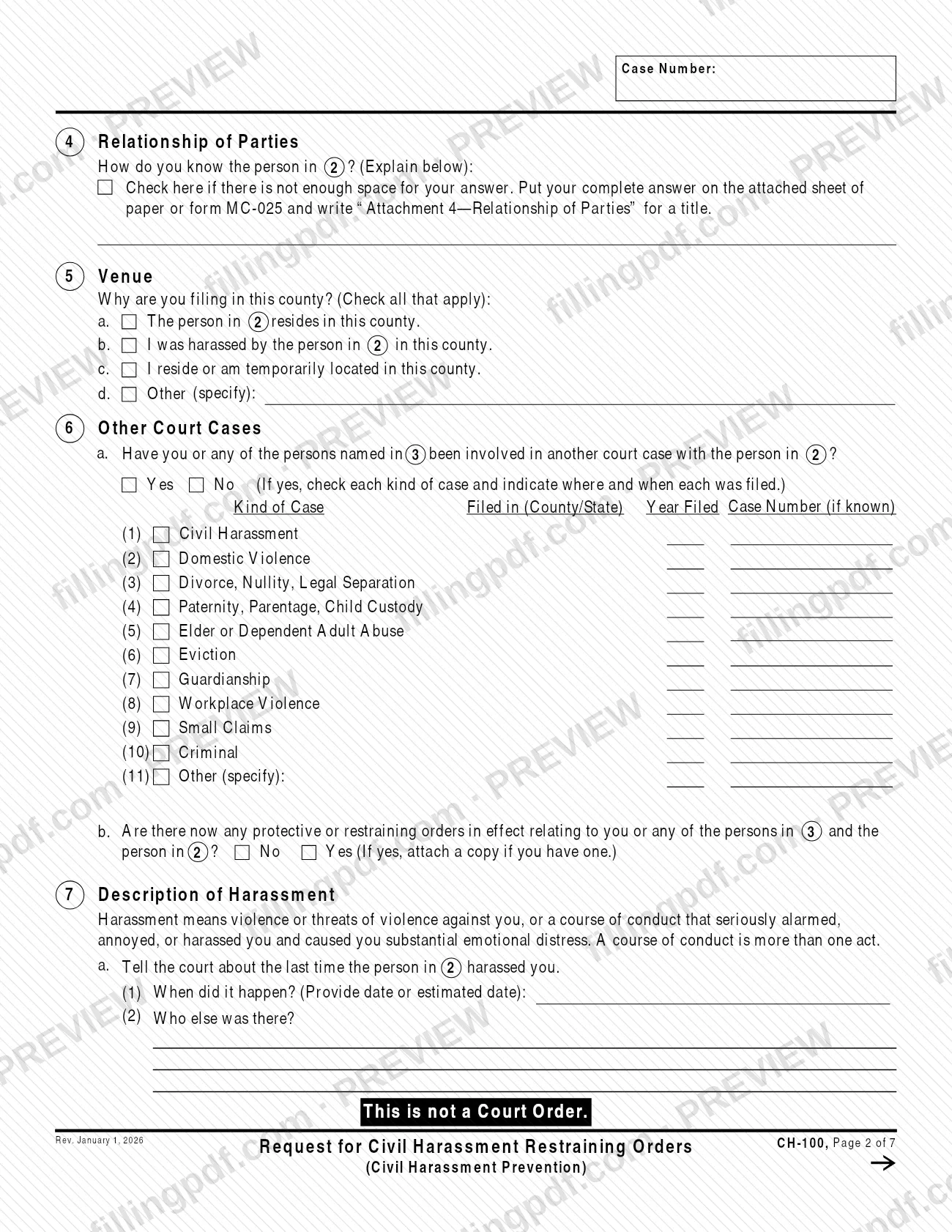
The form defines harassment as violence or threats of violence against you, or a course of conduct that seriously alarmed, annoyed, or harassed you and caused you substantial emotional distress. A course of conduct is more than one act.
Completing it produces a request, not an order: every page is marked "This is not a Court Order." You identify yourself and the other person, any additional protected persons, the venue, other court cases, and a description of the harassment. You then check the orders you want: personal conduct orders, stay-away orders, firearms restrictions, a Temporary Restraining Order, shorter notice of the hearing, fee relief, lawyer's fees and costs, protection of animals, and other orders.
CH-100 works with other Judicial Council forms. CH-110, Temporary Restraining Order, is presented to the court for signature with the request. CLETS-001 carries confidential information. CH-100-INFO explains whether a civil harassment order can help you. MC-025 is the attachment sheet for long answers. The Judicial Council also offers CH-100 in Chinese Simplified, Korean, Spanish and Vietnamese.
Who needs to file CH-100?
The person seeking protection files Form CH-100. That is someone who says another person has used or threatened violence against them, or has engaged in a course of conduct that seriously alarmed, annoyed, or harassed them and caused substantial emotional distress.
- You may ask for protection for other family or household members too. List each one in item 3, with gender, age, whether they live with you and how they are related to you, and explain why they need protection.
- If you have a lawyer for this case, the lawyer's name, State Bar number and firm go in the box at the top, and the lawyer's contact details replace your address.
- If you have no lawyer and want to keep your home address private, the form lets you give a different mailing address. You do not have to give a telephone number, fax or email.
Read Can a Civil Harassment Restraining Order Help Me? (form CH-100-INFO) before you complete the form. The form does not describe a representative signing for you: you declare under penalty of perjury, and your lawyer, if any, also signs.
When to file CH-100
File CH-100 when you want the court to issue civil harassment restraining orders against the person who harassed you. The form prints no filing deadline of its own.
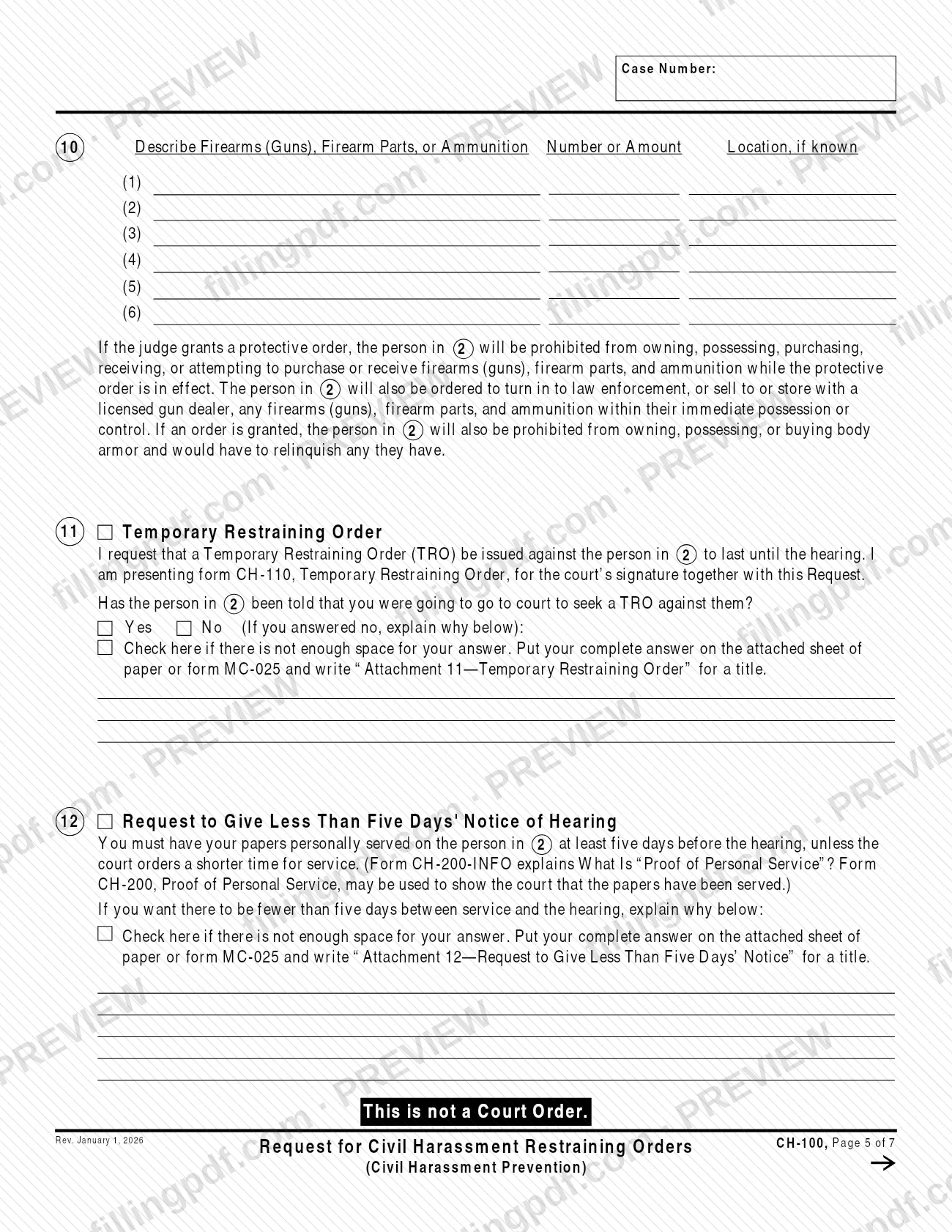
If you ask for a Temporary Restraining Order in item 11, it is requested to last until the hearing, and you present form CH-110 for the court's signature together with the request.
After filing, the papers must be personally served on the person in item 2 at least five days before the hearing, unless the court orders a shorter time. If you want fewer than five days between service and the hearing, explain why in item 12.
The court clerk stamps the filing date on the form, and the court fills in the case number when the form is filed.
Documents you need
- Confidential CLETS Information (form CLETS-001), filled out with as much information as you know; the form tells you to complete it with CH-100.
- Form CH-110, Temporary Restraining Order, presented for the court's signature with the request, if you ask for a TRO in item 11.
- A copy of any protective or restraining order now in effect between you or the persons in item 3 and the person in item 2, if you have one (item 6b).
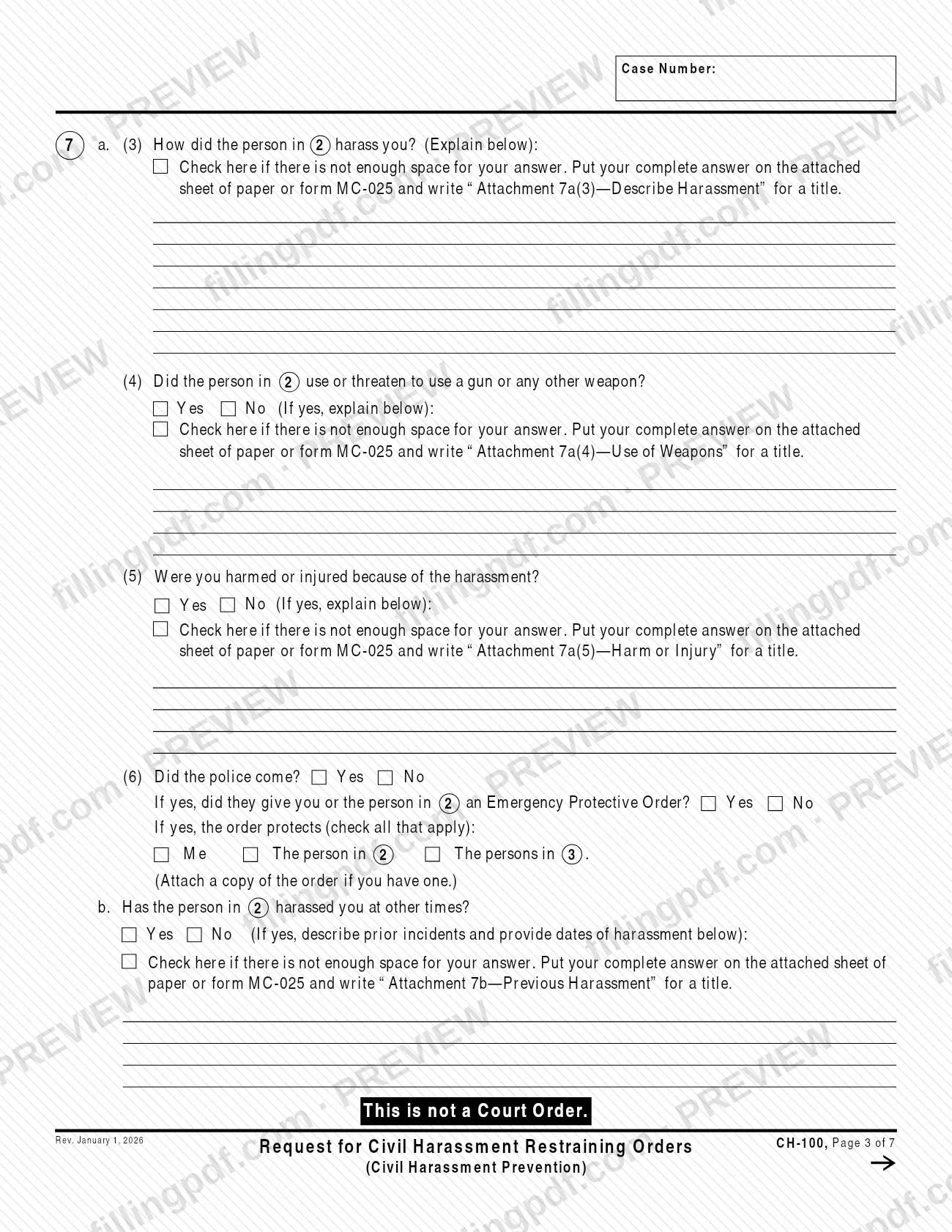
- A copy of any Emergency Protective Order the police gave you or the person in item 2, if you have one (item 7a(6)).
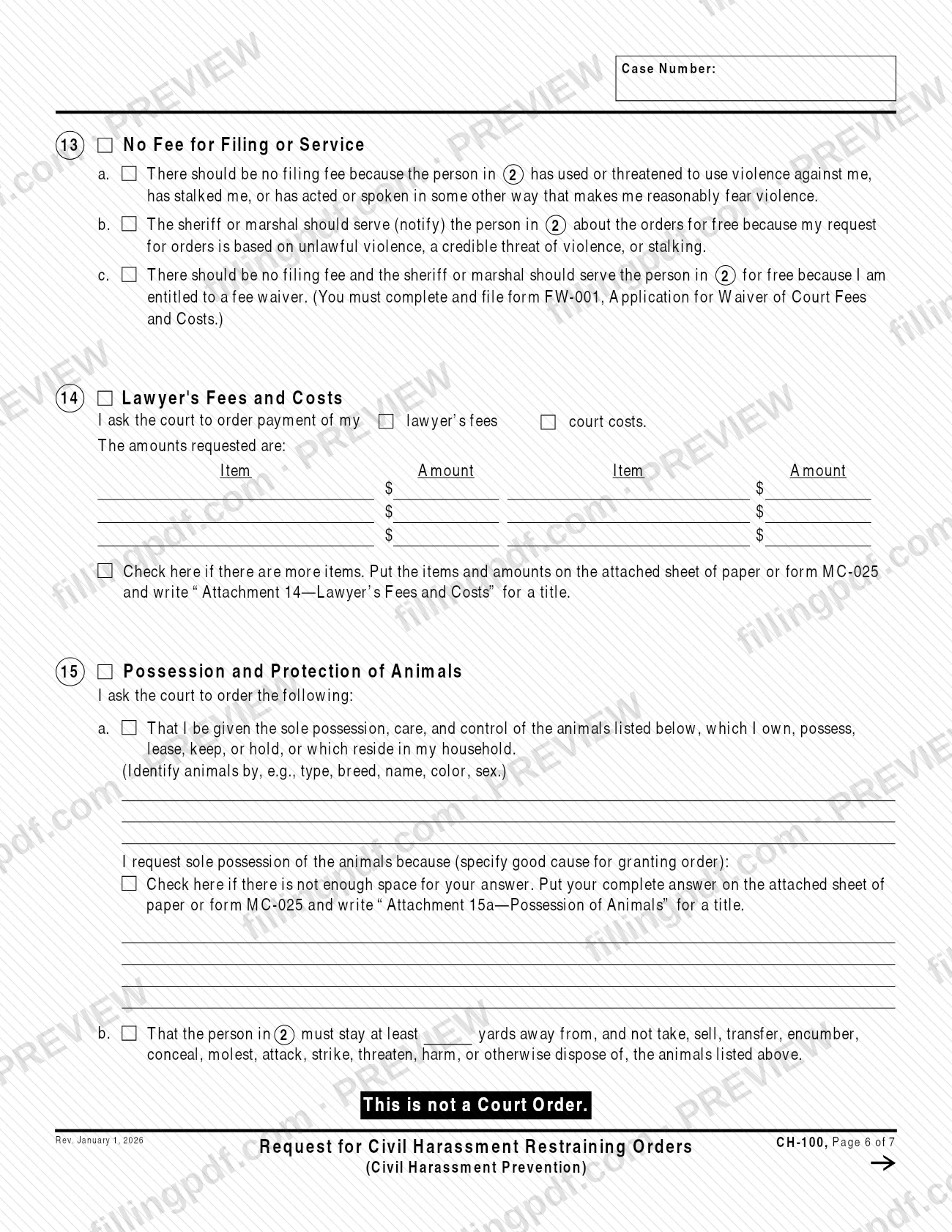
- Form FW-001, Application for Waiver of Court Fees and Costs, only if you check item 13c because you are entitled to a fee waiver.
- Attachment sheets or form MC-025, Attachment, only where an answer does not fit; title each one as the item directs, for example "Attachment 7a(3)—Describe Harassment".
How to fill out CH-100
Enter court and lawyer details
At the top of page 1, fill in the court name and street address (Superior Court of California, County of). If you have a lawyer for this case, enter the name, State Bar No. and firm name.
Complete Person Seeking Protection (item 1)
Enter your full name and age in 1a. In 1b give your address, or your lawyer's information if you have one; without a lawyer you may give a different mailing address to keep your home address private.
Identify the other person (item 2)
Enter the full name and age of the person from whom protection is sought, and their address if known.
List additional protected persons (item 3)
Answer Yes or No in 3a and list each person with gender, age, whether they live with you and their relationship to you. Explain in 3b why they need protection, using an attachment if needed.
Explain relationship and venue (items 4 and 5)
In item 4 describe how you know the person in item 2. In item 5 check each reason you are filing in this county, or specify another reason.
Report other cases and orders (item 6)
In 6a check Yes or No for other court cases with the person in item 2 and list kind, county or state, year and case number. In 6b say whether protective or restraining orders are in effect and attach a copy if you have one.
Describe the harassment (item 7)
In 7a give the date or estimated date of the last incident, who else was there, how you were harassed, any weapons, any harm or injury, and any police response or Emergency Protective Order. In 7b describe earlier incidents with dates.
Check the orders you want (items 8 to 10)
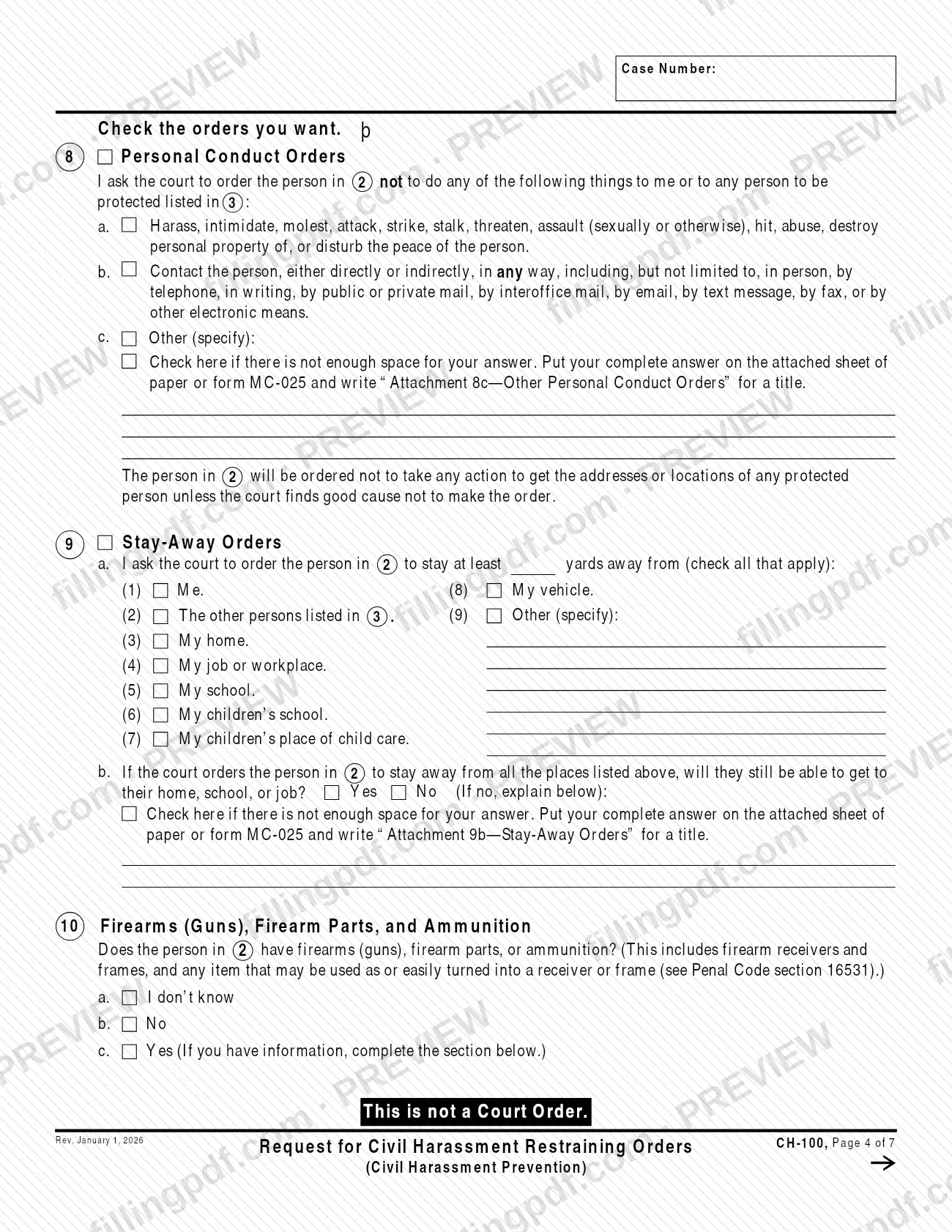
Check the personal conduct orders in item 8. In item 9 enter the stay-away distance in yards and check each place or person. In item 10 mark I don't know, No or Yes for firearms, firearm parts or ammunition, and describe them if you have information.
Request a TRO and notice (items 11 and 12)
In item 11 state whether the other person has been told you will seek a TRO and explain if not. In item 12 explain why, if you want less than five days between service and the hearing.
Address fees and animals (items 13 to 15)
Check the reasons in item 13 for no filing or service fee; item 13c needs form FW-001. In item 14 list lawyer's fees and costs if you ask for them, and in item 15 identify any animals and the orders you want.
Add other orders and attachments (items 16 and 17)
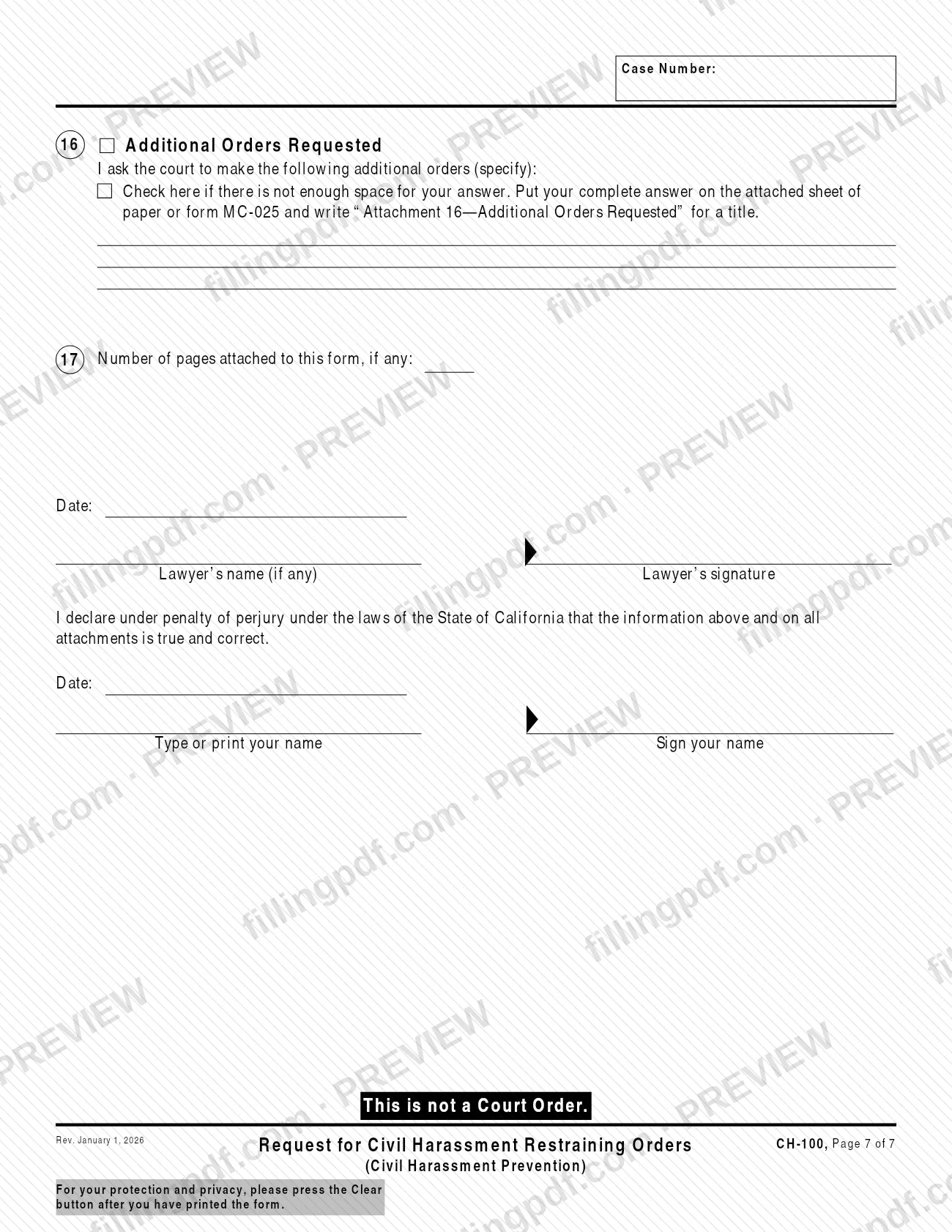
In item 16 specify any additional orders you request. In item 17 enter the number of pages attached, if any.
Review, sign and download the PDF
Enter the date, type or print your name and sign the declaration under penalty of perjury; a lawyer, if any, signs too. Check every item, then download or print the completed PDF from FillingPDF and assemble the package described under How to submit.
How to submit CH-100
The form names the court as the place of filing: you complete the top of page 1 with the name and street address of the Superior Court of California, County of the county where you file. It names no other channel.
- Choose the county. Item 5 asks why you file there. The reasons printed are that the person in item 2 resides in the county, that you were harassed there, that you reside or are temporarily located there, or another reason you specify.
- Present the package. File the signed CH-100 with Confidential CLETS Information (form CLETS-001), and present form CH-110, Temporary Restraining Order, for the court's signature if you request a TRO. Add any attachments, copies of existing orders and, if you seek a fee waiver, form FW-001.
- Filing stamp and case number. The clerk stamps the filing date, and the court fills in the case number.
- Serve the other person. Have the papers personally served on the person in item 2 at least five days before the hearing, unless the court orders a shorter time. Form CH-200, Proof of Personal Service, may be used to show the court that service happened.
For your privacy, the form asks you to press the Clear button after you print it. For the current filing fee and local filing procedures, contact the court clerk. FillingPDF lets you fill out and download the PDF; submission follows the court's channels described above.
Common mistakes to avoid
- Filing CH-100 without Confidential CLETS Information (form CLETS-001), which the form says to complete with as much information as you know.
- Requesting a Temporary Restraining Order in item 11 without presenting form CH-110 for the court's signature.
- Checking "not enough space" for an item but not attaching a sheet or form MC-025 with the title the item specifies.
- Checking item 13c for a fee waiver without completing and filing form FW-001.
- Planning to serve the papers fewer than five days before the hearing without explaining why in item 12.
- Leaving out a copy of an existing protective order or Emergency Protective Order when you have one (items 6b and 7a(6)).
- Giving your home address when you want it kept private and have no lawyer; the form allows a different mailing address.
- Not entering the number of attached pages in item 17, or leaving the declaration under penalty of perjury unsigned and undated.
- Skipping the Clear button after printing, which the form asks you to press for your protection and privacy.
Frequently asked questions
What is the CH-100 form used for?
CH-100 is the Judicial Council of California form for asking a superior court for civil harassment restraining orders. You describe the harassment and check the orders you want, such as personal conduct, stay-away and firearms orders. It is a request, not a court order.
Can I fill out the CH-100 form online?
Yes. You can fill out the CH-100 PDF online on FillingPDF and download or print it. FillingPDF is an independent service and does not file the form with the court; you file it through the court's channels.
What other forms do I need with CH-100?
The form tells you to fill out Confidential CLETS Information (form CLETS-001) and to read CH-100-INFO first. If you request a Temporary Restraining Order, you also present form CH-110 for the court's signature together with the request.
How much notice must I give the other person before the hearing?
The papers must be personally served on the person in item 2 at least five days before the hearing, unless the court orders a shorter time. To ask for less than five days, explain why in item 12. Form CH-200 can show the court that service happened.
Do I have to pay a filing fee for a civil harassment request?
Item 13 lets you state why there should be no filing or service fee: violence or threats, stalking, or reasonable fear of violence, or an entitlement to a fee waiver. A fee waiver requires form FW-001. Ask the court clerk about any fee.
Can I keep my home address private on CH-100?
Yes, if you have no lawyer. Item 1b lets you give a different mailing address instead of your home address, and you do not have to give a telephone number, fax or email. If you have a lawyer, you give the lawyer's information.
What counts as harassment on Form CH-100?
The form defines harassment as violence or threats of violence against you, or a course of conduct that seriously alarmed, annoyed, or harassed you and caused you substantial emotional distress. A course of conduct is more than one act.
Is CH-100 available in Spanish or other languages?
Yes. The Judicial Council of California's self-help page offers CH-100 in Chinese Simplified, Korean, Spanish and Vietnamese. This page covers the English-language form, revision January 1, 2026.
Where do I file CH-100 and how do I choose the county?
File it with the superior court, entering the court's name and address at the top of page 1. Item 5 asks why you file in that county: the other person lives there, the harassment happened there, you live or are temporarily there, or another reason.
Ready to fill out CH-100?
Fill out CH-100 now