
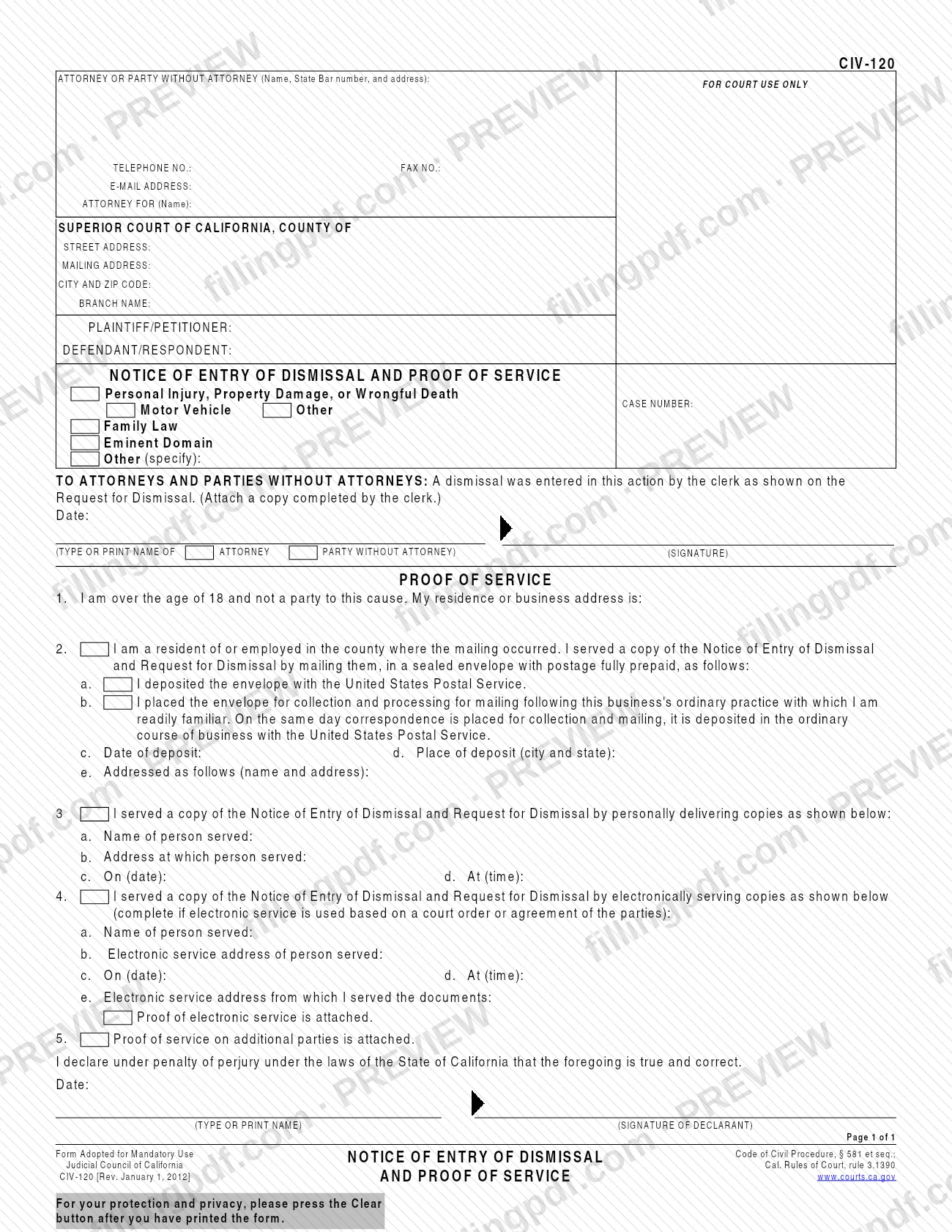
CIV-120 is the Notice of Entry of Dismissal and Proof of Service, a Judicial Council of California form that tells attorneys and parties without attorneys that the clerk entered a dismissal in the action. It combines the notice with a proof of service showing how copies of the notice and the Request for Dismissal were served: by mail, by personal delivery or electronically. On this page you can fill out the form online on FillingPDF and download or print the completed PDF; the official PDF is published by the California courts at courts.ca.gov.
Last updated
What is CIV-120?
Form CIV-120, Notice of Entry of Dismissal and Proof of Service, is a Judicial Council of California form that notifies attorneys and parties without attorneys that a dismissal was entered in an action by the clerk, as shown on the Request for Dismissal, and documents how that notice was served.
The form has two parts. The first is the notice itself, addressed "To attorneys and parties without attorneys," with a date, the printed name of the attorney or party without attorney, and a signature. A copy of the Request for Dismissal completed by the clerk must be attached. The agency's self-help page identifies that companion document as form CIV-110 and describes CIV-120 as the form that tells the parties about the court's decision to dismiss the case.
The second part is the proof of service. The person who served the papers states that they are over 18 and not a party, then completes the method used: mailing (item 2), personal delivery (item 3) or electronic service (item 4). Item 5 is checked when proof of service on additional parties is attached. The declarant signs under penalty of perjury under the laws of the State of California.
The form header has a case-type area: Personal Injury, Property Damage, or Wrongful Death (Motor Vehicle or Other), Family Law, Eminent Domain, or Other (specify). It is marked Form Adopted for Mandatory Use and cites Code of Civil Procedure, § 581 et seq. and California Rules of Court, rule 3.1390. The revision printed on it is Rev. January 1, 2012.
Who needs to file CIV-120?
The form is addressed to attorneys and parties without attorneys in an action in which the clerk has entered a dismissal. The notice is signed by the attorney or the party without attorney who gives it, and the header asks for that person's name, State Bar number, address, telephone, fax and e-mail, and the party the attorney represents.
The proof of service is completed by a different role, the declarant. The declarant states on the form that they are over the age of 18 and not a party to the cause, and gives a residence or business address.
- Serving by mail: the declarant must be a resident of or employed in the county where the mailing occurred.
- Serving electronically: complete item 4 only if electronic service is used based on a court order or an agreement of the parties.
- More than one party served: check item 5 and attach proof of service on the additional parties.
The form does not describe who may use it beyond these statements, and it does not set exclusions of its own. Questions about whether a particular dismissal calls for this notice are answered by Code of Civil Procedure, § 581 et seq. and California Rules of Court, rule 3.1390, which the form cites.
When to file CIV-120
The triggering event is the clerk's entry of a dismissal in the action: the notice states that a dismissal was entered by the clerk as shown on the Request for Dismissal, and a copy completed by the clerk must be attached, so the form cannot be completed until that copy exists. No separate due date is printed on CIV-120. The form cites Code of Civil Procedure, § 581 et seq. and California Rules of Court, rule 3.1390 as its authority, and the agency's self-help page lists it as effective January 1, 2012. The date in the proof of service must match the actual date of mailing, delivery or electronic service, and the declaration at the bottom carries its own date.
Documents you need
- A copy of the Request for Dismissal completed by the clerk, attached to the notice; the form identifies it as the document showing the entered dismissal, and the agency's page names it as form CIV-110.
- Proof of electronic service, only if you served electronically under item 4 and check the box stating it is attached.
- Proof of service on additional parties, only if you check item 5 because other parties were served.
How to fill out CIV-120
Enter attorney or party information
At the top, enter the attorney or party without attorney: name, State Bar number, address, telephone and fax numbers, e-mail address, and the party you represent on the Attorney for (Name) line. Leave the For Court Use Only area blank.
Identify the court
Enter the county on the Superior Court of California, County of line, then the street address, mailing address, city and ZIP code, and branch name.
Enter the parties and case number
Write the Plaintiff/Petitioner and Defendant/Respondent names and the Case Number exactly as they appear on the court's papers.
Mark the case type
Check Personal Injury, Property Damage, or Wrongful Death (then Motor Vehicle or Other), Family Law, Eminent Domain, or Other and describe it on the Other (specify) line.
Date and sign the notice
Enter the date, type or print the name of the attorney or party without attorney, and sign. Attach the copy of the Request for Dismissal completed by the clerk.
Complete proof of service items 1 and 2
In item 1, enter the declarant's residence or business address. For service by mail, check 2a or 2b, then enter the date of deposit (2c), the city and state of deposit (2d) and the name and address of the person served (2e).
Complete item 3 for personal delivery
If you delivered copies by hand, enter the name of the person served, the address, and the date and time of delivery (3a through 3d).
Complete item 4 for electronic service
Use item 4 only when a court order or agreement of the parties allows it. Enter the person served, their electronic service address, the date and time, and your own sending address (4a through 4e), and check the box if proof of electronic service is attached.
Check item 5 if needed
Check item 5 when proof of service on additional parties is attached, and attach it.
Review, sign and download the PDF
Enter the declaration date, type or print the declarant's name and have the declarant sign. Check every entry against the clerk's Request for Dismissal, then download or print the completed PDF from FillingPDF.
How to submit CIV-120
CIV-120 is delivered to the other attorneys and parties through the service methods printed in its proof of service:
- By mail (item 2): place the notice and the Request for Dismissal in a sealed envelope with postage fully prepaid. Either deposit it with the United States Postal Service, or place it for collection and processing following the business's ordinary practice. Record the date of deposit, the city and state of deposit, and the name and address of each person served.
- By personal delivery (item 3): give copies to the person served, and record the person's name, the address, and the date and time.
- By electronic service (item 4): use only if a court order or an agreement of the parties provides for it. Record the name and electronic service address of the person served, the date and time, and the address you served from; check the box if proof of electronic service is attached.
If other parties were served, check item 5 and attach the additional proof of service. The form prints no court address and no filing instructions of its own, so confirm where and how to file with the clerk of the court that entered the dismissal. The form also asks you to press the Clear button after printing, for your protection and privacy. FillingPDF lets you fill out and download the PDF; submission follows the channels above.
Common mistakes to avoid
- Leaving out the copy of the Request for Dismissal completed by the clerk; the notice says it must be attached.
- Completing item 4 (electronic service) when no court order or agreement of the parties provides for it.
- Having a party to the case, or someone under 18, sign the proof of service; the declarant must state they are over 18 and not a party.
- Signing the notice but not the Signature of Declarant line under the penalty-of-perjury statement, or the reverse.
- Using item 2 without entering the date of deposit, the city and state of deposit, or the name and address of each person served.
- Not checking item 5 or attaching proof of service when additional parties were served.
- Checking the box that proof of electronic service is attached without actually attaching it.
- Choosing Other under the case type without writing the description on the Other (specify) line.
Frequently asked questions
What is form CIV-120?
CIV-120 is the Judicial Council of California's Notice of Entry of Dismissal and Proof of Service. It tells attorneys and parties without attorneys that the clerk entered a dismissal, as shown on the Request for Dismissal, and records how copies were served on them.
What do I attach to the CIV-120 form?
Attach a copy of the Request for Dismissal completed by the clerk. Also attach proof of electronic service if you served under item 4 and check that box, and proof of service on additional parties if you check item 5.
Who can complete the proof of service on CIV-120?
Someone who is over 18 and not a party to the case. For service by mail, the declarant must also reside or work in the county where the mailing occurred. The declarant signs under penalty of perjury under California law.
When can I use electronic service on CIV-120?
Only when a court order or an agreement of the parties provides for it. Item 4 is marked complete if electronic service is used based on one of those, and it asks for the electronic addresses of the person served and of the sender.
What is the difference between CIV-120 and CIV-110?
CIV-110 is the Request for Dismissal, which shows the details of the dismissal. CIV-120 is the notice that the clerk entered that dismissal, plus proof of service. The clerk-completed copy of the Request for Dismissal is attached to CIV-120.
Is there a deadline printed on CIV-120?
No due date is printed on the form. It is used after the clerk enters a dismissal, since it needs the clerk-completed Request for Dismissal. The form cites Code of Civil Procedure, § 581 et seq. and California Rules of Court, rule 3.1390 for the governing rules.
Can I fill out CIV-120 online?
Yes. You can fill out the CIV-120 PDF online on FillingPDF and download or print it. FillingPDF is an independent service and does not file or serve the form; you serve and file it through the methods described on the form and by the court.
Ready to fill out CIV-120?
Fill out CIV-120 now