
DE-111 is the Judicial Council of California's Petition for Probate, the form a petitioner files with a California superior court to ask for a will to be admitted to probate and for Letters to be issued to a personal representative. The same form also covers Letters of Administration, Letters of Special Administration with general powers, and authorization to administer under the Independent Administration of Estates Act with limited authority. On this page you can fill out the DE-111 form online on FillingPDF and download or print the completed PDF; the official form and the court's how-to instructions for probate are published by the California Courts.
Last updated
What is DE-111?
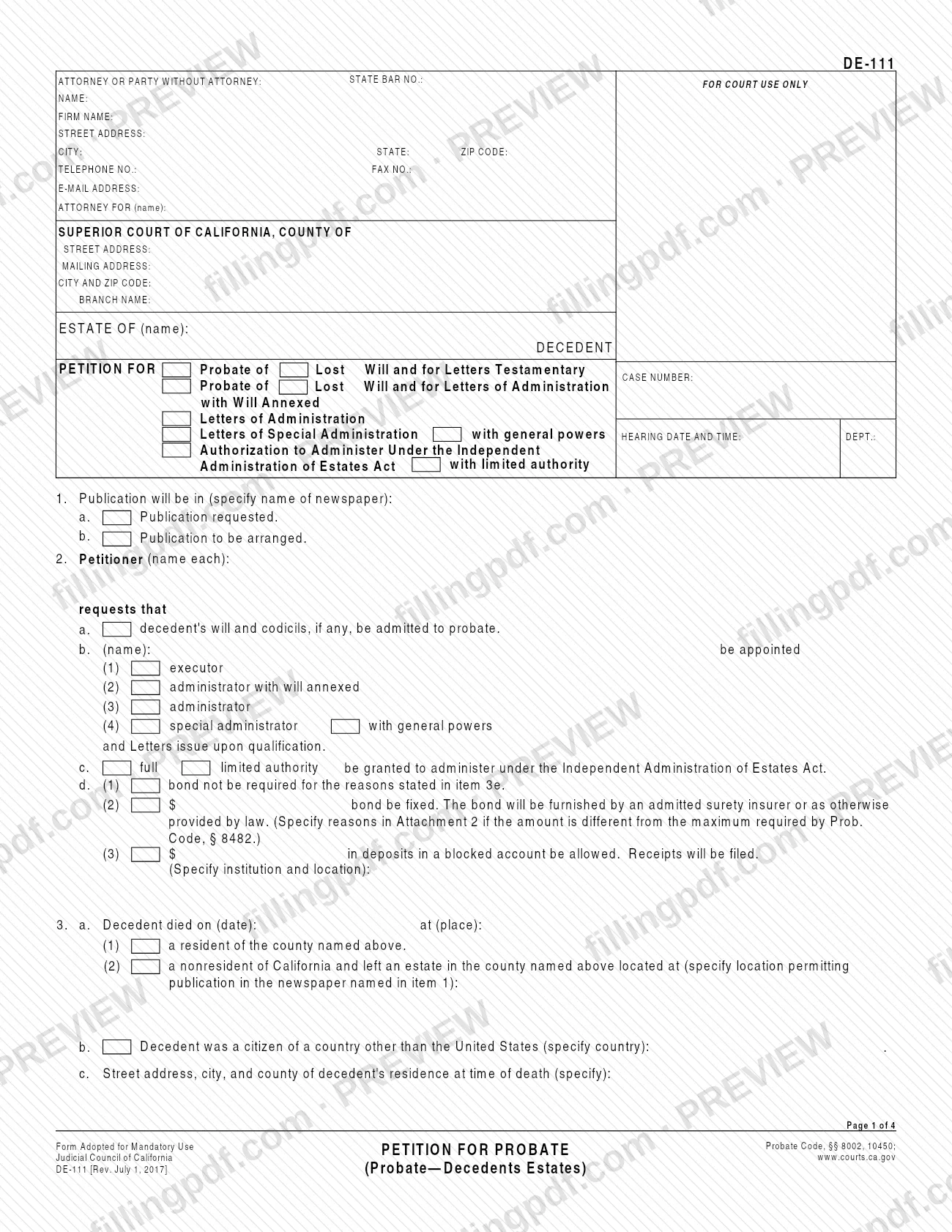
Petition for Probate (Form DE-111) is the Judicial Council of California form on which a petitioner asks a California superior court to start probate of a decedent's estate: to admit the will and any codicils, to appoint a personal representative, and to issue Letters upon qualification.
The caption lets the petitioner check what is being requested: probate of a will and Letters Testamentary; probate of a lost will and Letters Testamentary; probate of a lost will and Letters of Administration with Will Annexed; Letters of Administration; Letters of Special Administration with general powers; and authorization to administer under the Independent Administration of Estates Act with limited authority. The California Courts self-help page describes the petition as the request that starts the process of distributing a deceased person's property, paying the decedent's debts and settling the decedent's financial affairs.
The form is four pages and follows numbered items:
- Items 1 and 2: newspaper for publication, the petitioner, the requested appointment and bond.
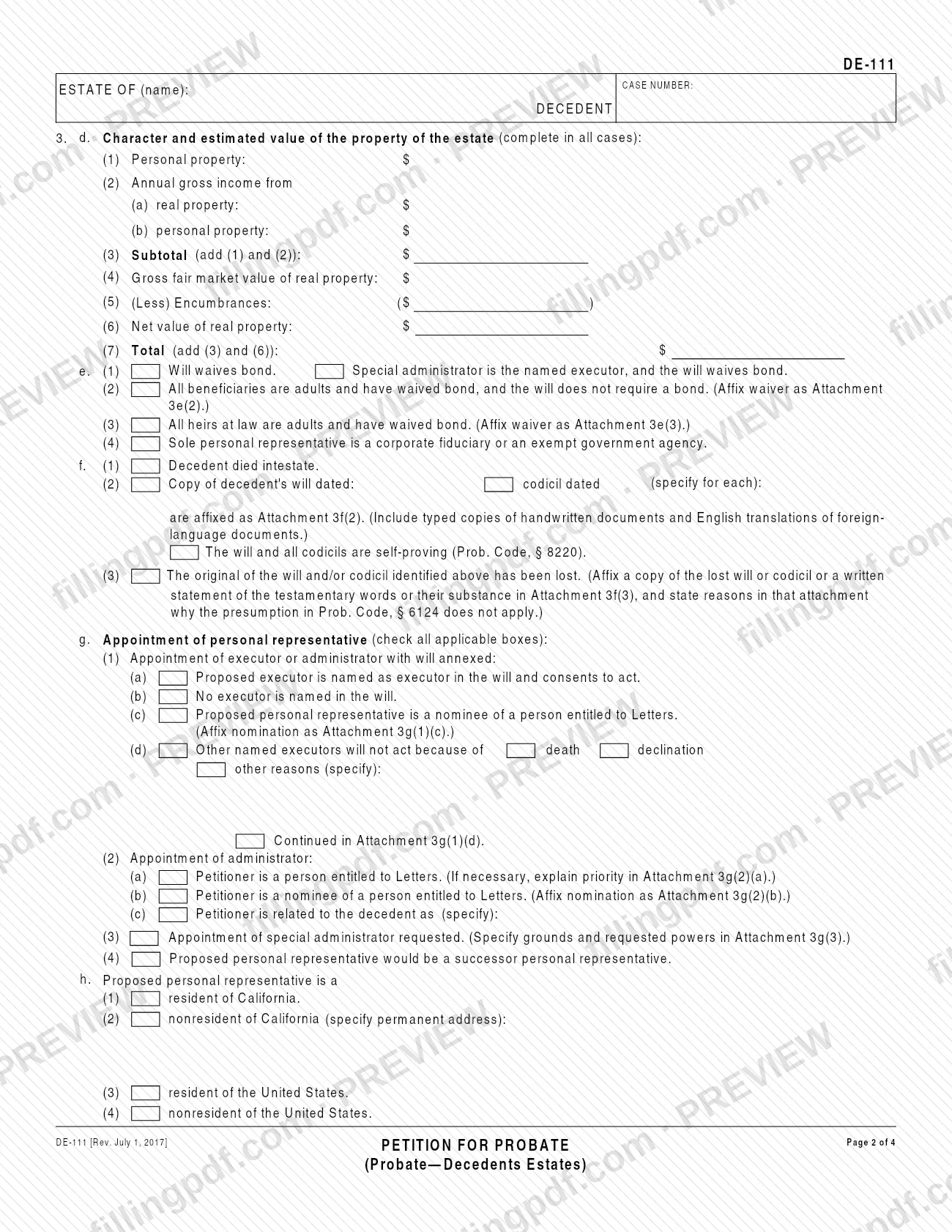
- Item 3: the decedent's death, residence, estate value, will, and the proposed personal representative.
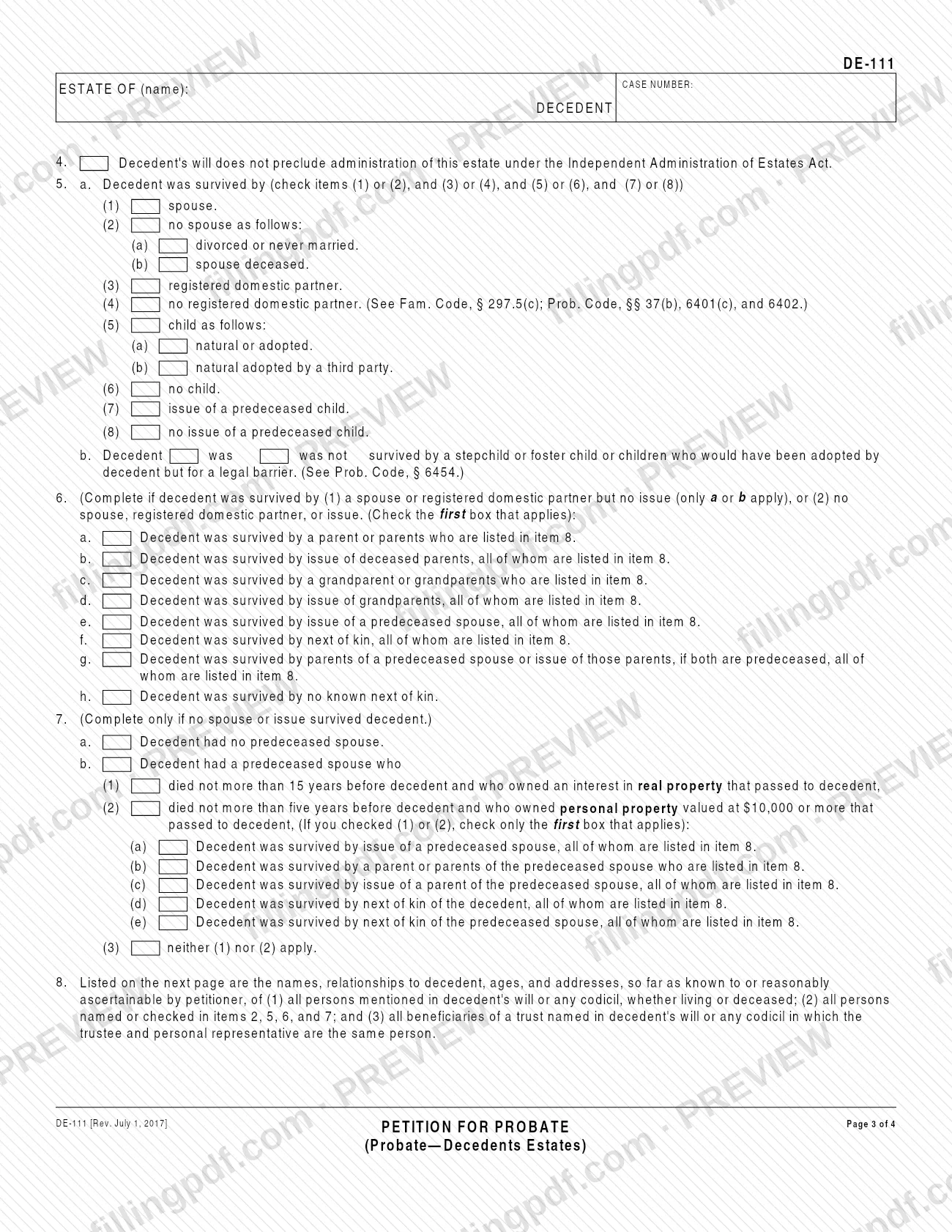
- Items 4 to 7: the Independent Administration of Estates Act and the decedent's surviving family.
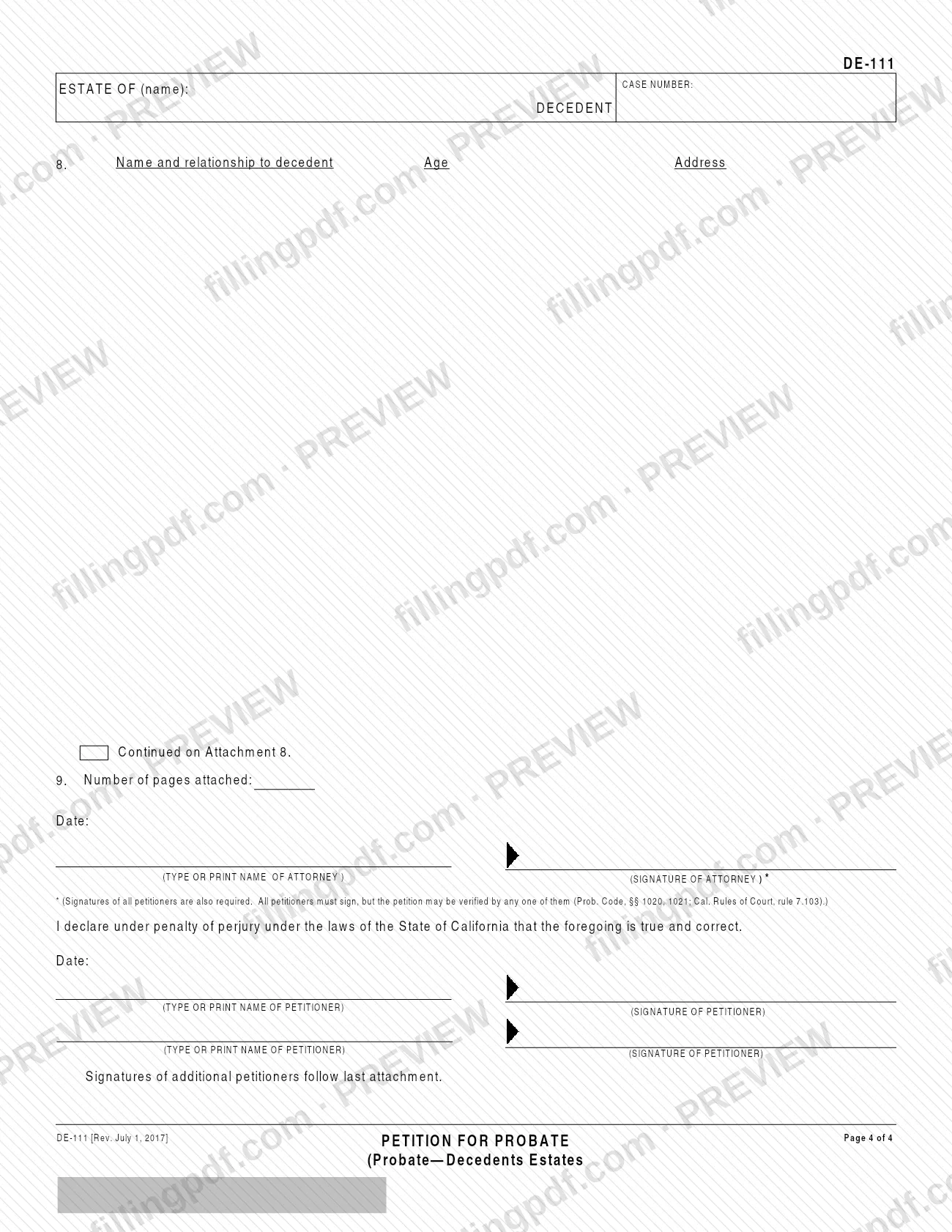
- Item 8: names, ages and addresses of the people the petition must list.
- Item 9 and the signature blocks.
The form is marked Form Adopted for Mandatory Use and cites Probate Code, §§ 8002 and 10450. Its effective date is July 1, 2017.
Who needs to file DE-111?
The main group is the petitioner or petitioners who want the court to admit a decedent's will to probate and appoint an executor, an administrator with will annexed, an administrator or a special administrator with general powers. The form is completed by an attorney or by a party without an attorney, and the caption has a block for each.
Conditions printed on the form:
- A petitioner asking to administer under the Independent Administration of Estates Act checks item 2c; item 4 states that the will does not preclude it.
- If the proposed personal representative is a nominee of a person entitled to Letters, the nomination is affixed as an attachment.
- If the decedent left no will, the petitioner checks item 3f(1), the decedent died intestate.
- If the original will has been lost, item 3f(3) applies and extra statements are required.
- Item 3a covers both a decedent who lived in the county named on the form and a nonresident of California who left an estate there.
All petitioners must sign, but any one of them may verify the petition. The form does not say that anyone other than a petitioner or the petitioner's attorney signs.
When to file DE-111
DE-111 is filed when a petitioner is ready to ask the court to open probate and appoint a personal representative; the court then sets the hearing date, time and department shown in the caption. The form prints no deadline of its own, and the California Courts self-help page for DE-111 gives none either.
Timing items that appear on the form: item 1 asks you to name the newspaper where publication will occur and to say whether publication is requested or will be arranged. Item 3a asks for the date of death. The decedent's death date and the family facts in items 5 to 7 should be settled before you start, because several attachments depend on them. For general steps around probate, use the how-to instructions the self-help page links to.
Documents you need
- Attachment 2, only if you ask for a bond in an amount different from the maximum required by Prob. Code, § 8482: the reasons for the different amount.
- Attachment 3e(2), only if you check item 3e(2): the waiver of bond signed by all beneficiaries, who must all be adults, when the will does not require a bond.
- Attachment 3e(3), only if you check item 3e(3): the bond waiver from all heirs at law, who must all be adults.
- Attachment 3f(2), if the decedent left a will: a copy of the will and any codicils, with typed copies of handwritten documents and English translations of foreign-language documents.
- Attachment 3f(3), only if the original will or codicil is lost: a copy of it or a written statement of its testamentary words or substance, plus the reasons the presumption in Prob. Code, § 6124 does not apply.
- Attachment 3g(1)(c) or 3g(2)(b), only if the proposed personal representative is a nominee of a person entitled to Letters: the nomination.
- Attachment 3g(1)(d), only if other named executors will not act and the explanation does not fit on the form: the continued reasons.
- Attachment 3g(2)(a), only if needed to explain the petitioner's priority as a person entitled to Letters.
- Attachment 3g(3), only if you request a special administrator: the grounds and the powers requested.
- Attachment 8, only if the list of names, relationships, ages and addresses does not fit on page 4 and is continued.
How to fill out DE-111
Complete the caption and court block
Enter the attorney or party information, the Superior Court of California county and branch, and the name of the decedent after ESTATE OF (name). Leave CASE NUMBER, HEARING DATE AND TIME and DEPT. for the court if you do not have them.
Check the type of petition
In the PETITION FOR box, check the request that applies, such as Probate of Lost Will and for Letters Testamentary, Letters of Administration or Letters of Special Administration with general powers. Check the Independent Administration of Estates Act box if you want that authority.
Complete item 1, publication
Write the name of the newspaper where publication will occur, then check 1a (publication requested) or 1b (publication to be arranged).
Complete item 2, the requests
Name each petitioner. Check 2a for admission of the will and codicils, name the proposed personal representative in 2b and check executor, administrator with will annexed, administrator or special administrator, and check 2c if you request full limited authority.
Choose the bond option
In item 2d check one option: no bond for the reasons in item 3e, a bond fixed in the amount you enter, or deposits in a blocked account, with the institution and location. Give reasons in Attachment 2 if the bond differs from the maximum under Prob. Code, § 8482.
Enter the decedent's death details
Item 3a: date and place of death, and whether the decedent resided in the county named or was a nonresident of California who left an estate there. Item 3b: country of citizenship if not the United States. Item 3c: residence address at death.
Estimate the estate in item 3d
Complete item 3d in all cases: personal property, annual gross income from real and personal property, the subtotal, gross fair market value of real property, encumbrances, net real property, and the total.
Explain bond waiver and the will
Item 3e: check the reason bond is not required, if any, and affix any waiver. Item 3f: check intestate, or give the dates of the will and codicils and whether they are self-proving, or check the lost-original box.
Complete the appointment in item 3g and 3h
Check all applicable boxes in 3g for executor, administrator, special administrator or successor representative, and affix any nomination. In 3h indicate whether the proposed personal representative is a resident of California or the United States, and give a permanent address if a nonresident of California.
Answer items 4 through 7
Item 4 is a statement about the Independent Administration of Estates Act. In item 5 check the surviving spouse, partner, child and issue boxes and the stepchild or foster child line. Complete item 6 or 7 only when the form's conditions apply, checking the first box that applies.
List the people in item 8
Enter name, relationship to the decedent, age and address for each person item 8 describes, so far as known or reasonably ascertainable. Check Continued on Attachment 8 if you need more room.
Review, sign and download the PDF
Enter the number of attached pages in item 9, then add the date, the attorney's name and signature if any, and each petitioner's name and signature. Check all items, then download or print the completed PDF from FillingPDF and assemble the attachments.
How to submit DE-111
The DE-111 form itself names no filing channel, address or portal. It is captioned for the Superior Court of California, County of a county you fill in, so the petition goes to the superior court of the county named there. Item 3a explains which county applies: the county where the decedent resided, or, for a nonresident of California, the county where the estate is located.
- Court filing: file the signed petition and its attachments with that superior court, following the court's own rules for filing. The form lists no mailing address, so use the court's contact details.
- Court help: the California Courts self-help page for DE-111 at https://selfhelp.courts.ca.gov/jcc-form/DE-111 links to the form and to how-to instructions for probate.
The petition must carry the attorney's signature if one is acting and the signatures of all petitioners, and it is verified by at least one petitioner under penalty of perjury. The form also reminds you to press the Clear This Form button after printing, for your protection and privacy. FillingPDF lets you fill out and download the PDF; submission follows the channels above.
Common mistakes to avoid
- Signing as only one petitioner when there are several; all petitioners must sign, although one of them may verify the petition.
- Checking more than one box in a group where the form says to check only the first box that applies, as in items 6 and 7.
- Choosing a bond waiver in item 3e without affixing the matching waiver as Attachment 3e(2) or 3e(3).
- Attaching only a photocopy of a handwritten will or a foreign-language will, without a typed copy or an English translation as item 3f(2) requires.
- Claiming a lost will without a copy or statement of its words and the reasons the Prob. Code, § 6124 presumption does not apply (Attachment 3f(3)).
- Leaving out someone item 8 requires: everyone mentioned in the will or any codicil, everyone named or checked in items 2, 5, 6 and 7, and certain trust beneficiaries.
- Requesting a bond amount different from the maximum under Prob. Code, § 8482 without stating reasons in Attachment 2.
- Skipping item 3d, which the form says to complete in all cases.
- Not entering the number of pages attached in item 9.
Frequently asked questions
What is the DE-111 form?
DE-111 is the Judicial Council of California's Petition for Probate. A petitioner uses it to ask a superior court to admit a will to probate, appoint a personal representative and issue Letters, or to request Letters of Administration or of Special Administration.
Who can sign the DE-111?
The attorney signs if one is acting, and all petitioners must sign. The petition may be verified by any one petitioner, who declares under penalty of perjury under California law that the contents are true and correct (Prob. Code, §§ 1020, 1021; Cal. Rules of Court, rule 7.103).
Can I fill out DE-111 online?
Yes. You can fill out the DE-111 PDF online on FillingPDF and download or print it. FillingPDF is independent of the California Courts and does not file the petition; you file it with the superior court yourself.
What do I attach to the DE-111?
It depends on the boxes you check. A copy of the will and codicils goes in Attachment 3f(2), bond waivers in 3e(2) or 3e(3), nominations in 3g, and extra names in Attachment 8. A lost will needs a copy or statement of its words in Attachment 3f(3).
Can I use DE-111 if the will is lost?
Yes, the caption offers probate of a lost will with Letters Testamentary or Letters of Administration with Will Annexed. Check item 3f(3) and affix a copy or a written statement of the will's words, with the reasons the Prob. Code, § 6124 presumption does not apply.
Which county court do I file DE-111 in?
The form is addressed to the Superior Court of California, County of the county you name. Item 3a ties it to the county where the decedent resided, or, for a nonresident of California, the county where the estate is located.
What is the bond section on DE-111?
Item 2d lets you ask that no bond be required, that a bond be fixed in an amount you enter, or that deposits be allowed in a blocked account. Item 3e lists the reasons a bond may not be required, such as a will that waives bond.
Is there a deadline to file the DE-111?
The form prints no deadline of its own. It is filed to start the probate process, and the court sets the hearing date and time shown in the caption. Check the California Courts how-to instructions for probate for the surrounding steps.
Ready to fill out DE-111?
Fill out DE-111 now