
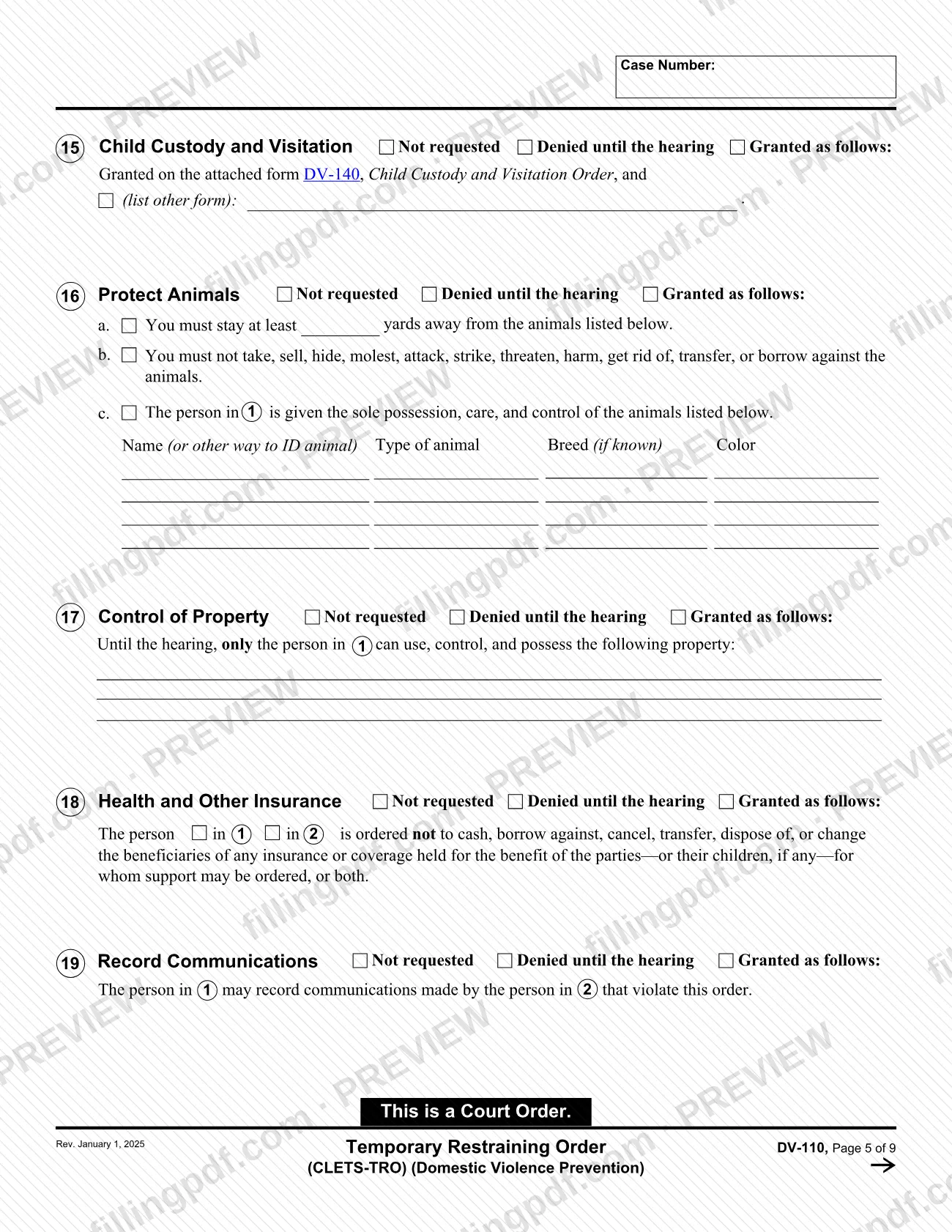
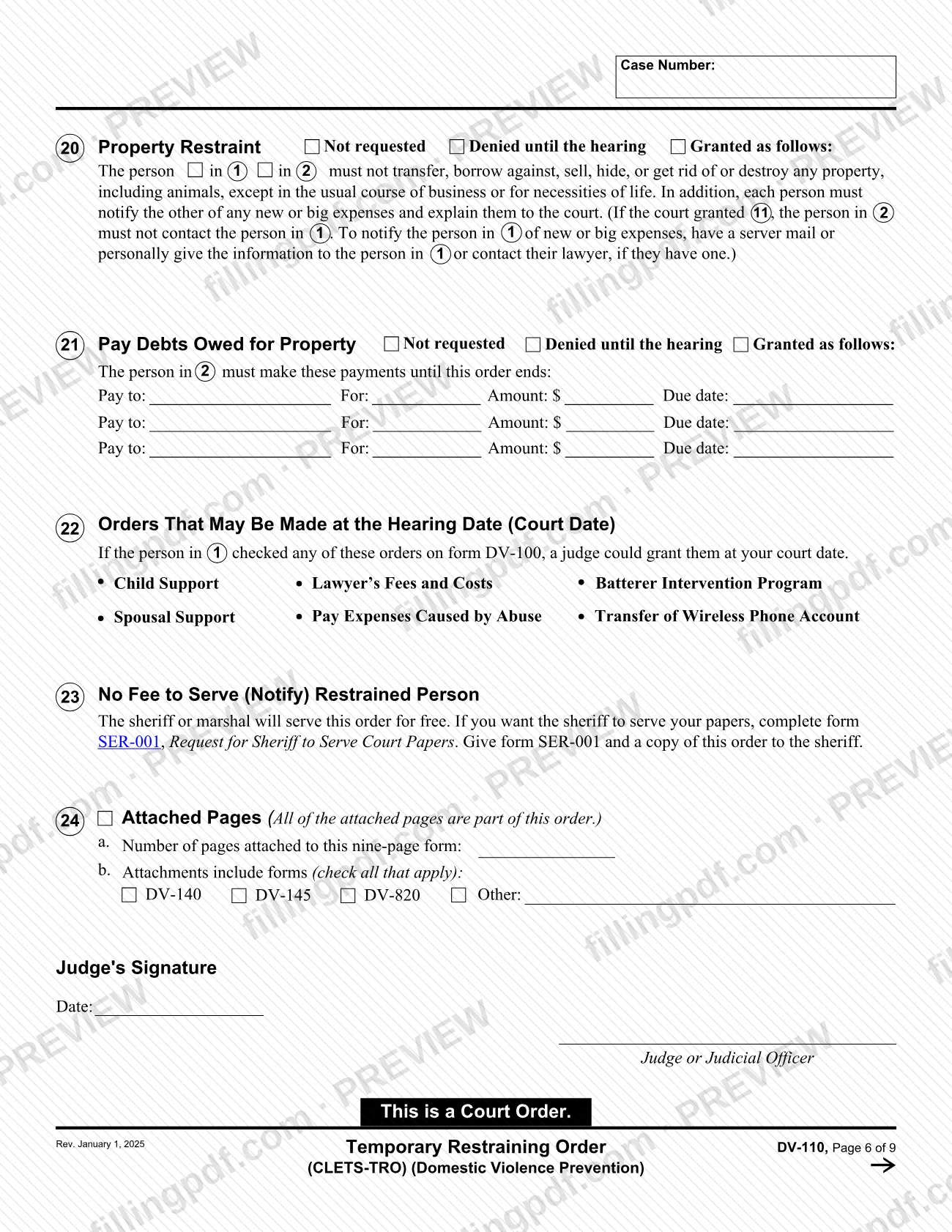
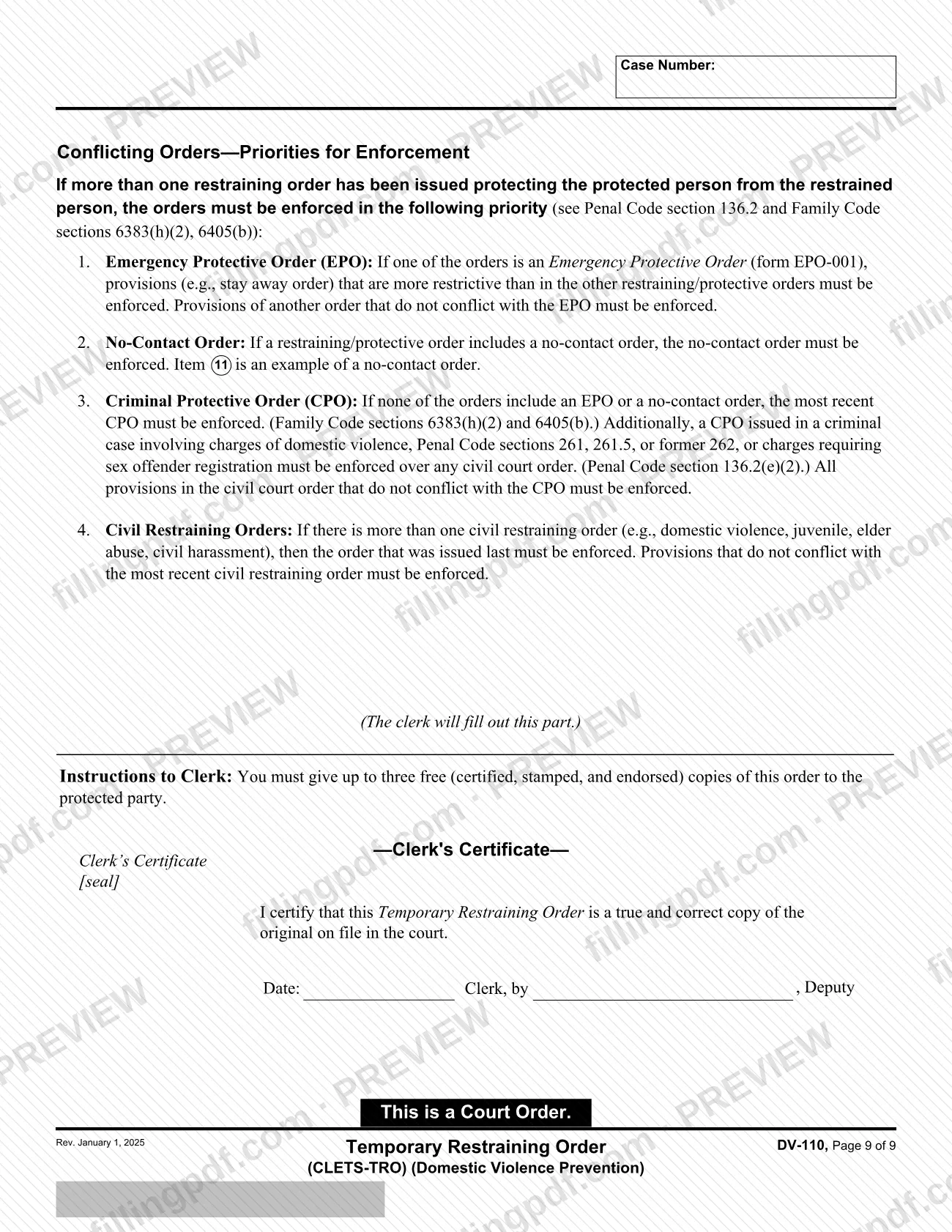
DV-110 is the Temporary Restraining Order (CLETS—TRO) that the Judicial Council of California publishes for domestic violence prevention cases under Family Code, § 6200 et seq. The person asking for the order completes only items 1, 2 and 3; the court completes everything else, including the orders the judge grants until the hearing. On FillingPDF you can fill out the form online and download or print the completed PDF. The official PDF is published by the California courts at courts.ca.gov, and the form is filed with the court.
Last updated
What is DV-110?
Form DV-110, Temporary Restraining Order (CLETS—TRO), is the mandatory Judicial Council of California form on which a court records the temporary restraining orders a judge grants in a domestic violence case, and which stays in force until the hearing date printed on it.
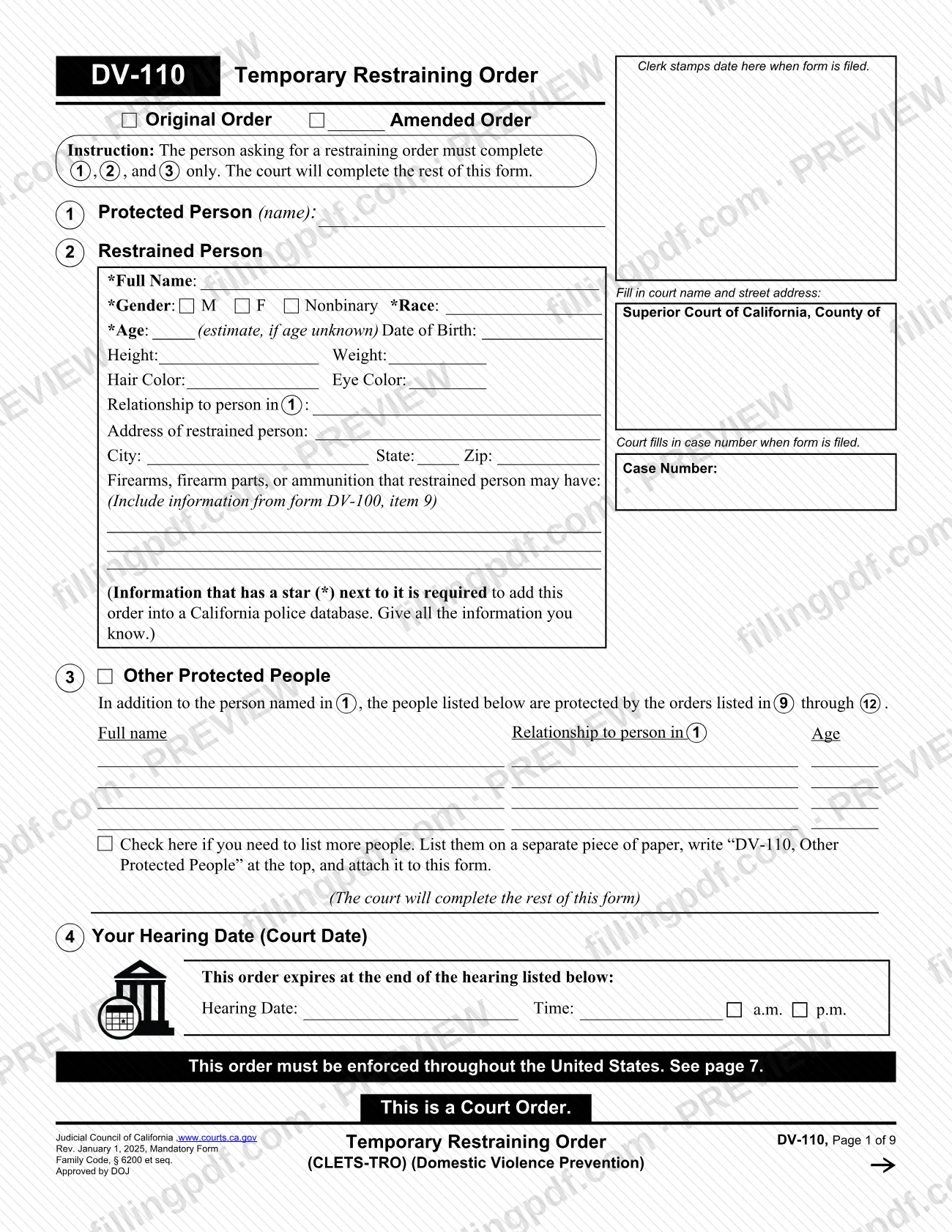
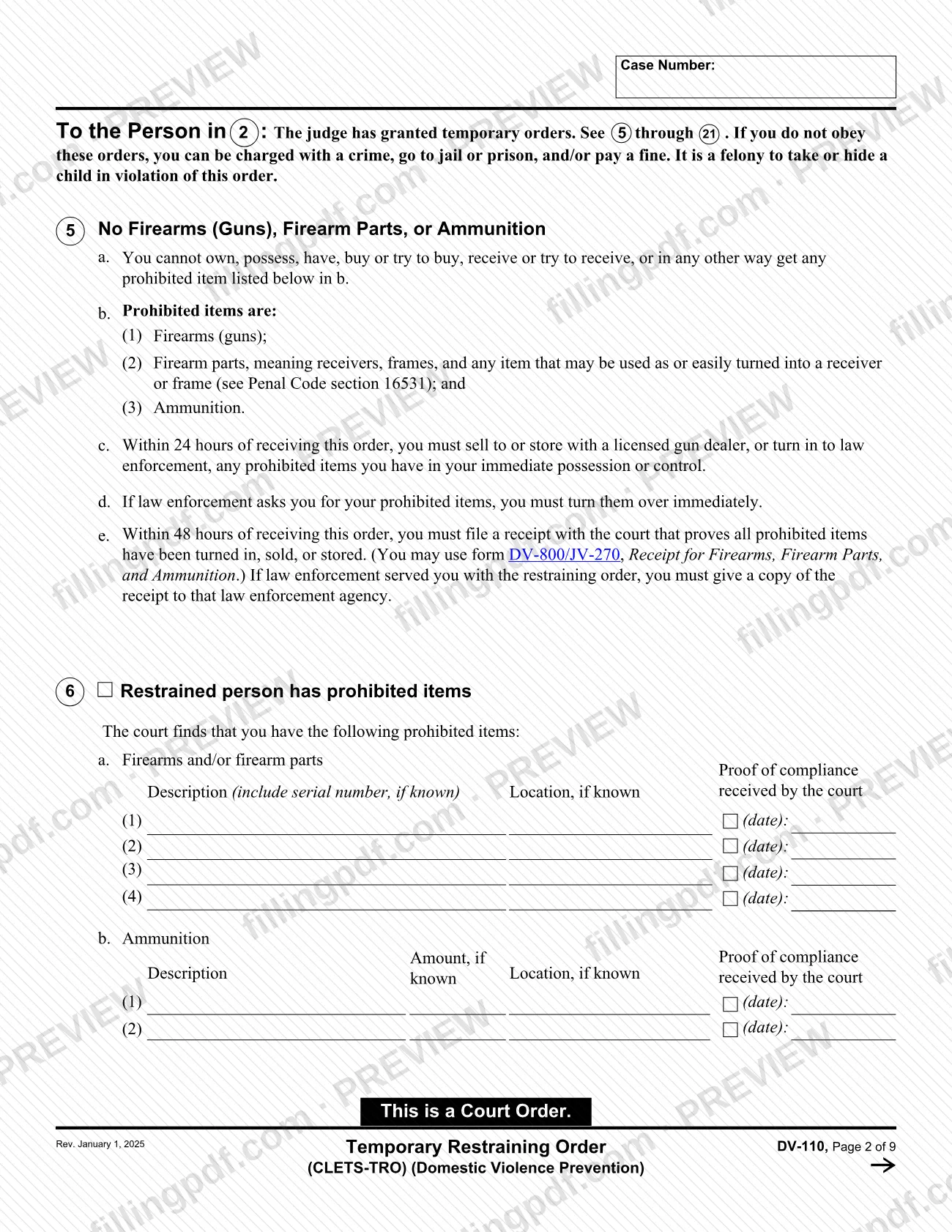
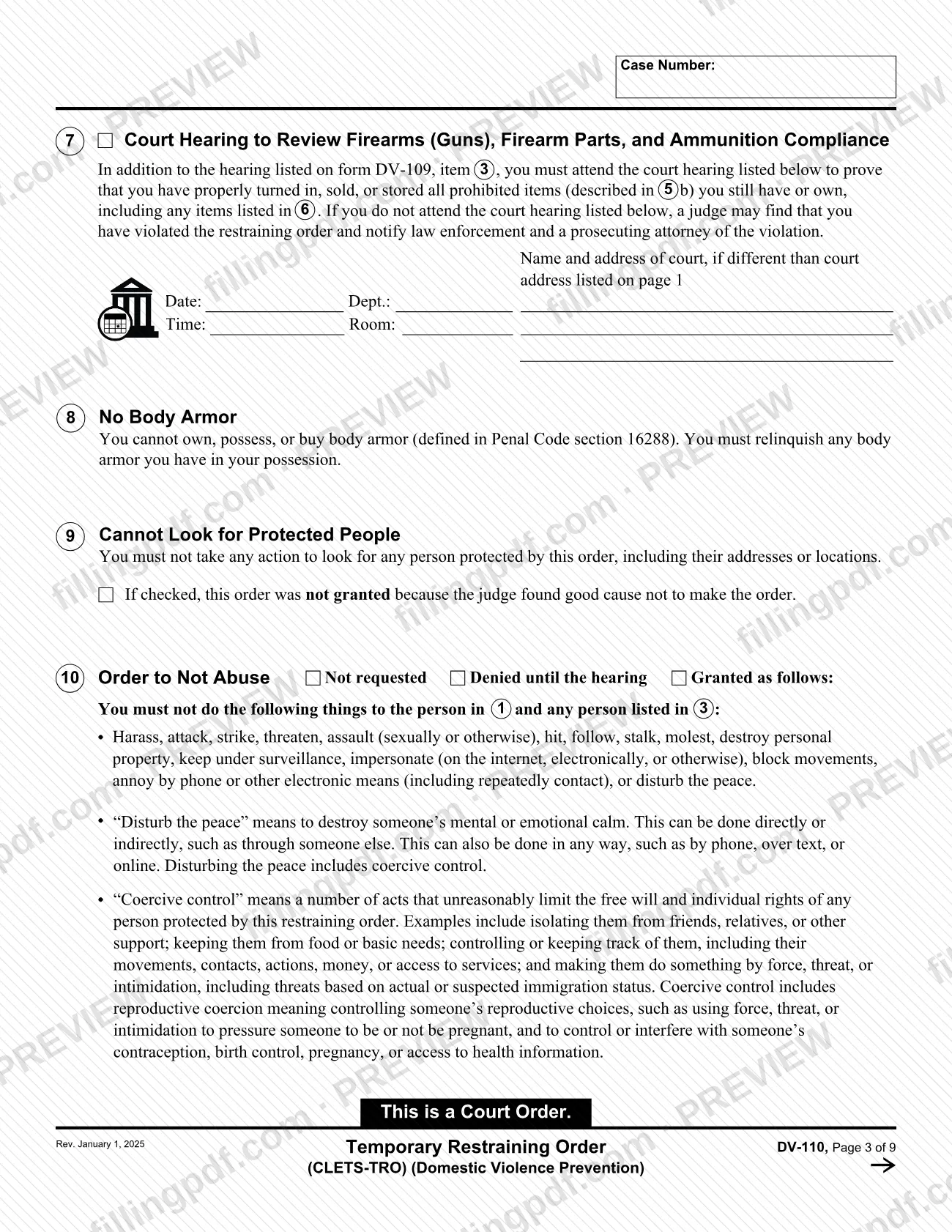
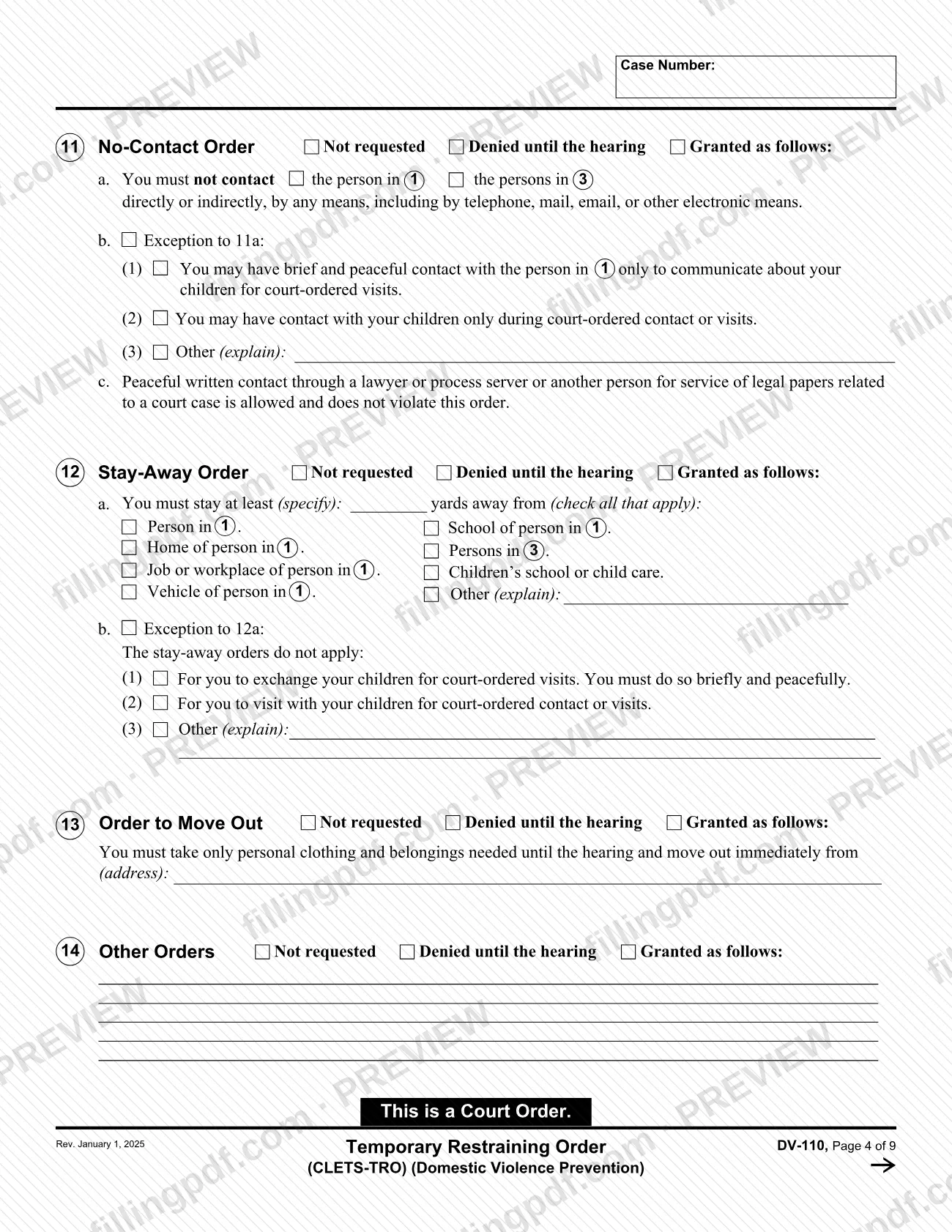
The form has two parts. The person asking for the restraining order identifies the protected person (item 1), the restrained person (item 2) and any other protected people (item 3). The court then completes the rest: the hearing date (item 4), the firearm, firearm parts and ammunition orders (items 5 to 7), the body armor order (item 8), and the orders a judge may grant or deny, such as no abuse, no contact, stay away, move out, child custody and visitation, animals, property and insurance (items 9 to 21). The judge signs on page 6.
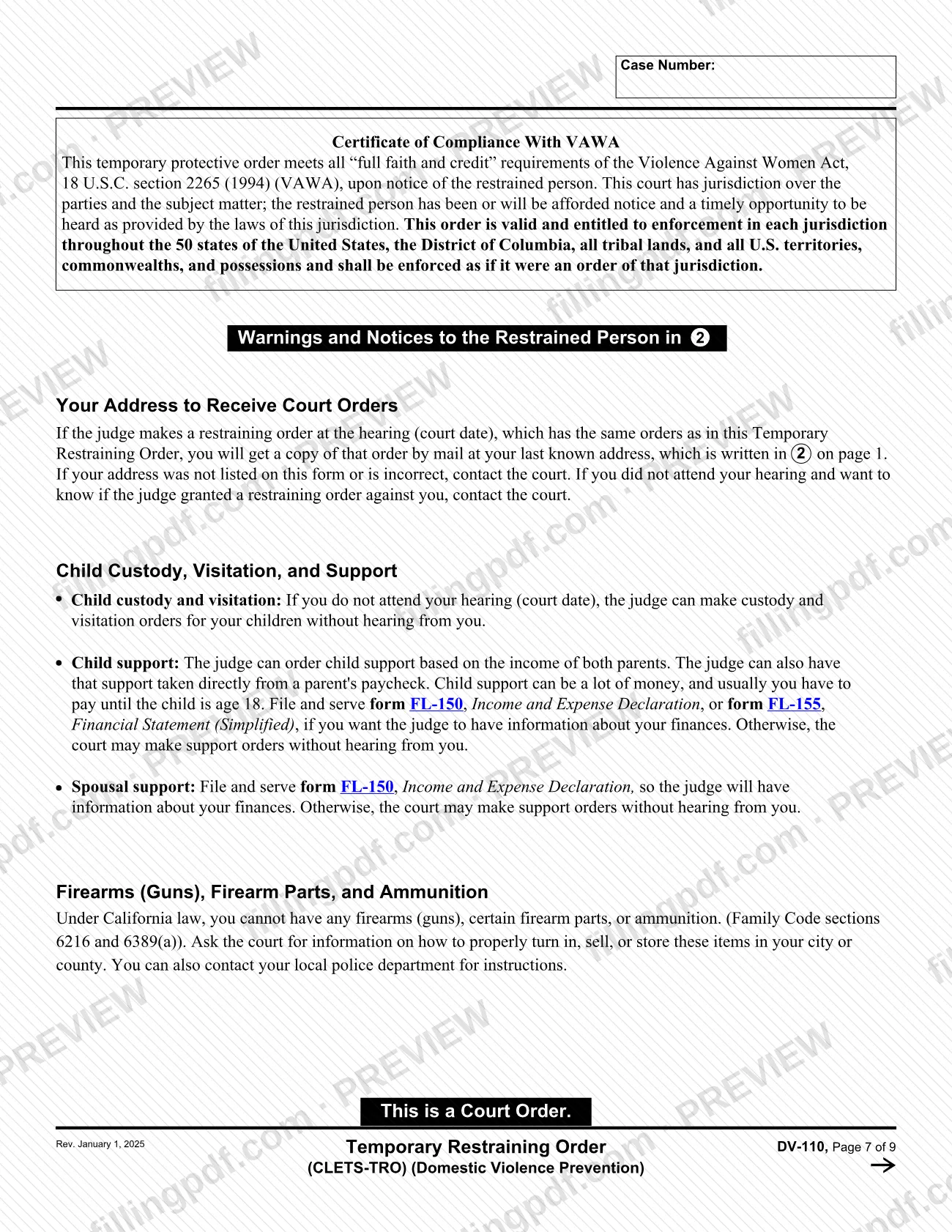
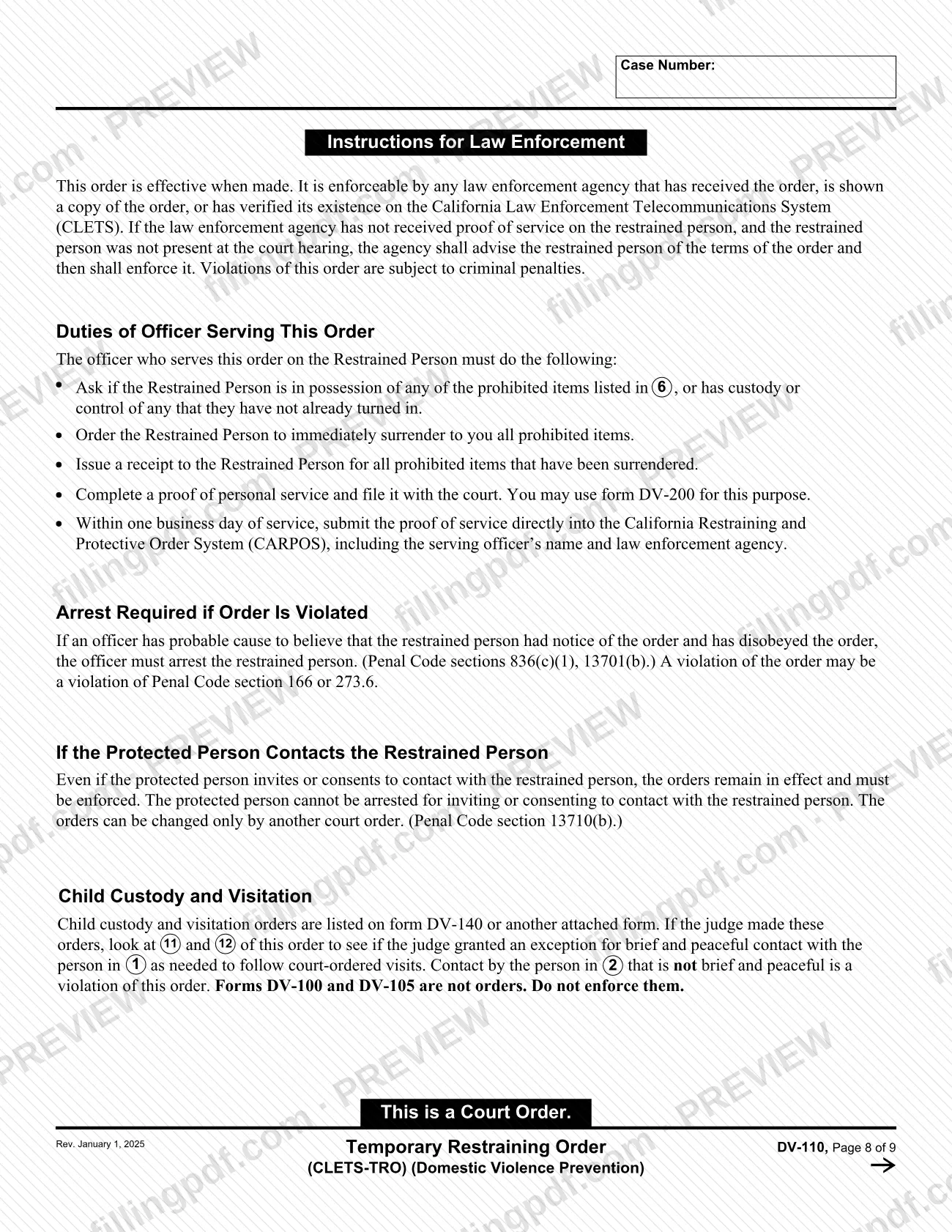
"CLETS" is the California Law Enforcement Telecommunications System. Information marked with a star on the form is required to add the order to a California police database. The form includes a Certificate of Compliance With VAWA, so that the order is enforced throughout the United States, and instructions for law enforcement. It is a court order itself: the form states that forms DV-100 and DV-105 are not orders.
The California courts also offer form DV-110 in Chinese Simplified, Korean, Spanish, Tagalog and Vietnamese.
Who needs to file DV-110?
The main user is the person asking the court for a domestic violence restraining order. That person completes items 1, 2 and 3 only, and the form says the court completes the rest.
Other people who work with the completed form:
- Protected person (item 1) and other protected people (item 3): the people the order protects. The people in item 3 are protected by the orders in items 9 through 12.
- Restrained person (item 2): the person the judge ordered to follow the temporary orders. The form warns that disobeying them can lead to a criminal charge, jail or prison, and/or a fine, and that taking or hiding a child in violation of the order is a felony.
- Judge and clerk: the judge completes the orders and signs; the clerk stamps the filing date and certifies the copies.
- Law enforcement: the form contains instructions for officers who enforce and serve the order.
You do not complete items 4 through 24 or the clerk's certificate: those are for the court. Anyone who is only the restrained person receiving the order does not fill out this form.
When to file DV-110
You complete items 1, 2 and 3 when you ask the court for a restraining order, and the clerk stamps the date at the top of page 1 when the form is filed. The form prints no separate due date for this step.
Once the judge grants temporary orders, the order is effective when made and expires at the end of the hearing listed in item 4, unless the court sets otherwise on the form. If the judge makes a restraining order at the hearing with the same orders, the restrained person receives a copy by mail at the last known address shown in item 2.
The form also sets time limits for the restrained person on firearms, firearm parts and ammunition: within 24 hours of receiving the order they must sell, store with a licensed gun dealer or turn in prohibited items, and within 48 hours they must file a receipt with the court.
Documents you need
- A separate sheet titled "DV-110, Other Protected People" at the top, only if you need to list more people than item 3 has room for; check the box in item 3 and attach the sheet.
- Form SER-001, Request for Sheriff to Serve Court Papers, together with a copy of the order, only if you want the sheriff or marshal to serve the restrained person (item 23).
- Information from form DV-100, item 9, about firearms, firearm parts or ammunition the restrained person may have, to enter in item 2.
- Attached forms the court may add and count in item 24, such as DV-140, Child Custody and Visitation Order, DV-145 or DV-820; the court, not the requester, attaches them.
How to fill out DV-110
Confirm which items you complete
Read the instruction at the top of page 1: the person asking for the restraining order completes items 1, 2 and 3 only. Leave the clerk's stamp, case number and all other items to the court.
Fill in the court name and address
In the box "Fill in court name and street address" on page 1, enter the county after "Superior Court of California, County of" and the court's street address.
Enter the protected person in item 1
Write the name of the person the order is meant to protect.
Describe the restrained person in item 2
Enter the full name, gender (M, F or Nonbinary), race, age (estimate if unknown), date of birth, height, weight, hair color and eye color. Starred entries are required for the police database, so give all you know.
Add relationship and address
Enter the restrained person's relationship to the person in item 1, then their address, city, state and ZIP code.
List firearms the person may have
In the firearms line of item 2, include the information from form DV-100, item 9, about firearms, firearm parts or ammunition the restrained person may have.
List other protected people in item 3
For each additional person, enter full name, relationship to the person in item 1 and age. If you need more room, check the box, list them on a separate sheet headed "DV-110, Other Protected People" and attach it.
Leave the court's sections blank
Do not complete the case number, Original Order or Amended Order boxes, the hearing date in item 4, items 5 through 24, the judge's signature or the clerk's certificate.
Review and download the completed PDF
Check that the names and the restrained person's details are accurate, then download or print the completed PDF from FillingPDF and file it with the court as described under How to submit.
How to submit DV-110
Form DV-110 is filed with the court named at the top of page 1, where the box "Fill in court name and street address" reads "Superior Court of California, County of". The clerk stamps the filing date and the court fills in the case number. The form names no other filing channel, so ask that court's clerk how it accepts filings.
After the judge acts, these steps on the form apply:
- Copies: the clerk must give the protected party up to three free certified, stamped and endorsed copies of the order.
- Service on the restrained person: item 23 says the sheriff or marshal serves the order for free. To use this, complete form SER-001, Request for Sheriff to Serve Court Papers, and give it and a copy of the order to the sheriff.
- Proof of service: the officer who serves the order completes a proof of personal service and files it with the court; form DV-200 may be used.
FillingPDF lets you fill out and download the PDF; submission follows the channels above.
Common mistakes to avoid
- Completing items 4 through 24 yourself. The form says the person asking for the order completes items 1, 2 and 3 only and the court completes the rest.
- Leaving out starred details in item 2 (full name, gender, race, age) that you know; they are needed to add the order to the California police database.
- Listing extra protected people on loose paper without writing "DV-110, Other Protected People" at the top, or without checking the box in item 3.
- Assuming people named in item 3 are covered by every order; the form protects them under the orders in items 9 through 12.
- Treating forms DV-100 or DV-105 as orders. The form states they are not orders and must not be enforced.
- Believing the protected person's invitation or consent to contact cancels the order. It stays in effect and can be changed only by another court order.
- Skipping the SER-001 request when you want the sheriff or marshal to serve the order for free.
- As the restrained person, missing the 24-hour deadline to give up prohibited items or the 48-hour deadline to file a receipt with the court.
Frequently asked questions
What is Form DV-110?
Form DV-110 is the Temporary Restraining Order (CLETS—TRO), the Judicial Council of California form on which the court lists the temporary orders a judge grants in a domestic violence case. The person asking for protection completes items 1 to 3; the court completes the rest.
Which parts of the DV-110 form do I fill out?
Only items 1, 2 and 3: the protected person, the restrained person and any other protected people. The form states that the court will complete the rest, including the hearing date, the orders and the judge's signature.
Can I fill out the DV-110 form online?
Yes. You can complete the PDF online on FillingPDF and download or print it. FillingPDF does not file it: the form is filed with the court named on page 1, and the court then decides which orders to grant.
How long does a DV-110 temporary restraining order last?
It expires at the end of the hearing listed in item 4. The order is effective when made. If the judge makes a restraining order at the hearing, the restrained person receives a copy by mail at their last known address.
Who serves the DV-110 on the restrained person?
Item 23 says the sheriff or marshal serves the order for free. Complete form SER-001, Request for Sheriff to Serve Court Papers, and give it and a copy of the order to the sheriff.
What happens if the restrained person breaks the order?
The form says disobeying it can lead to a criminal charge, jail or prison, and/or a fine. If an officer has probable cause that the person had notice of the order and disobeyed it, the officer must arrest them.
What must the restrained person do about guns under DV-110?
Within 24 hours of receiving the order, they must sell to or store with a licensed gun dealer, or turn in to law enforcement, any firearms, firearm parts or ammunition. Within 48 hours they must file a receipt with the court; form DV-800/JV-270 may be used.
Is DV-110 valid outside California?
The form includes a Certificate of Compliance With VAWA stating the order is valid and enforceable in all 50 states, the District of Columbia, tribal lands and U.S. territories, as if it were an order of that jurisdiction.
Is there a Spanish version of Form DV-110?
Yes. The California courts' self-help page lists form DV-110 in Spanish, as well as Chinese Simplified, Korean, Tagalog and Vietnamese.
Ready to fill out DV-110?
Fill out DV-110 now