
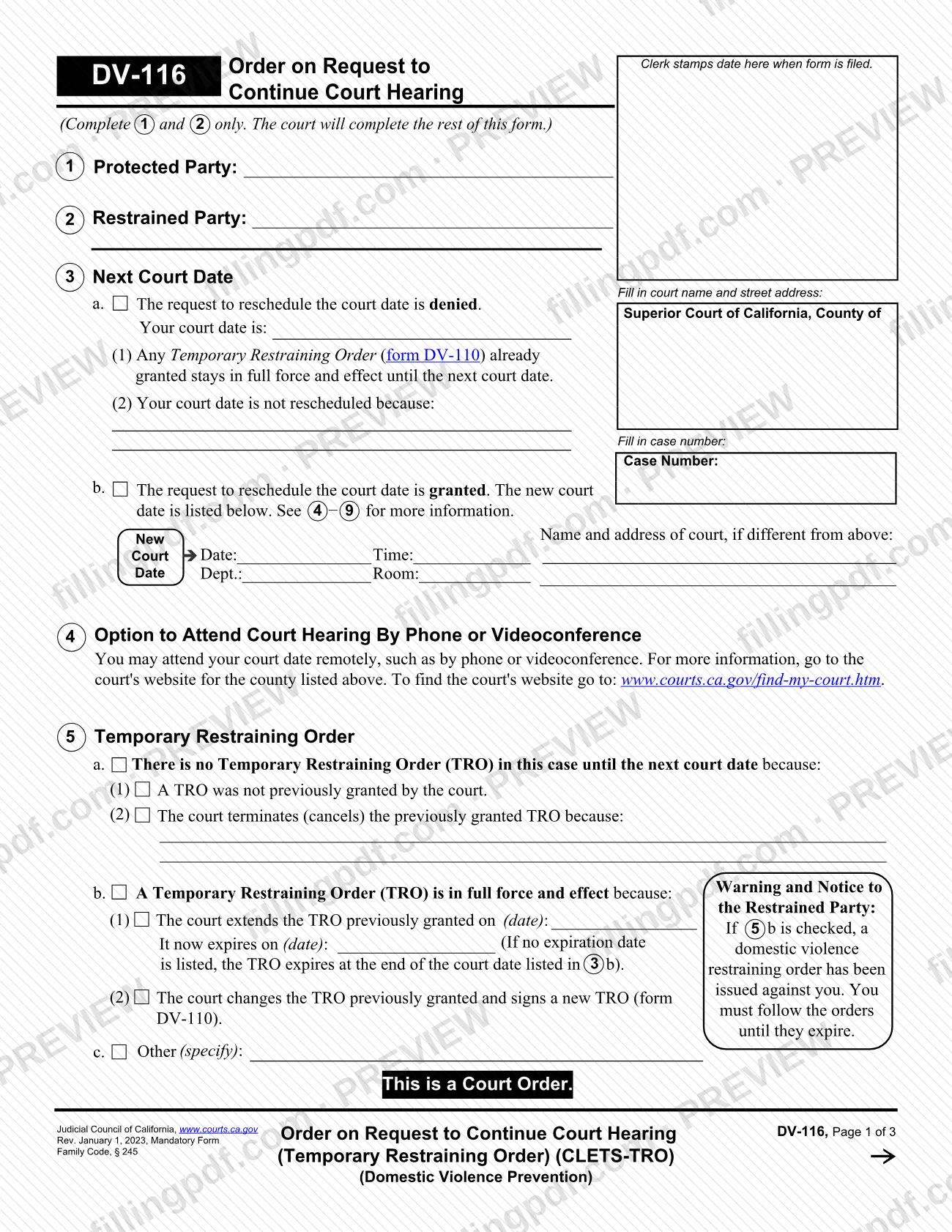
DV-116 is the Judicial Council of California order that tells the parties whether a request to reschedule a domestic violence prevention court date was granted or denied, and whether a temporary restraining order (TRO) stays in effect. The person preparing the form completes only items 1 and 2; the court completes everything else, including the next court date, the TRO status and how the order must be served. On this page you can fill out the form online on FillingPDF and download or print the completed PDF; the official PDF is published by the California courts at courts.ca.gov.
Last updated
What is DV-116?
Form DV-116, Order on Request to Continue Hearing (Temporary Restraining Order) (CLETS-TRO) (Domestic Violence Prevention) is the California court order that grants or denies a request to reschedule a domestic violence prevention hearing and states what happens to any temporary restraining order (TRO) until the next court date.
The Judicial Council of California publishes it as a Mandatory Form, citing Family Code, § 245, and the form prints "This is a Court Order" on each page. It is a three-page form. The party preparing it fills in item 1 (Protected Party) and item 2 (Restrained Party); the court completes the rest.
The court's part works like this:
- Item 3 either denies the request, so any TRO granted on form DV-110 stays in full force until the next court date, or grants it and lists the new date, time, department and room.
- Item 4 explains the option to attend by phone or videoconference.
- Item 5 says whether the TRO ends, is extended, or is changed with a new DV-110.
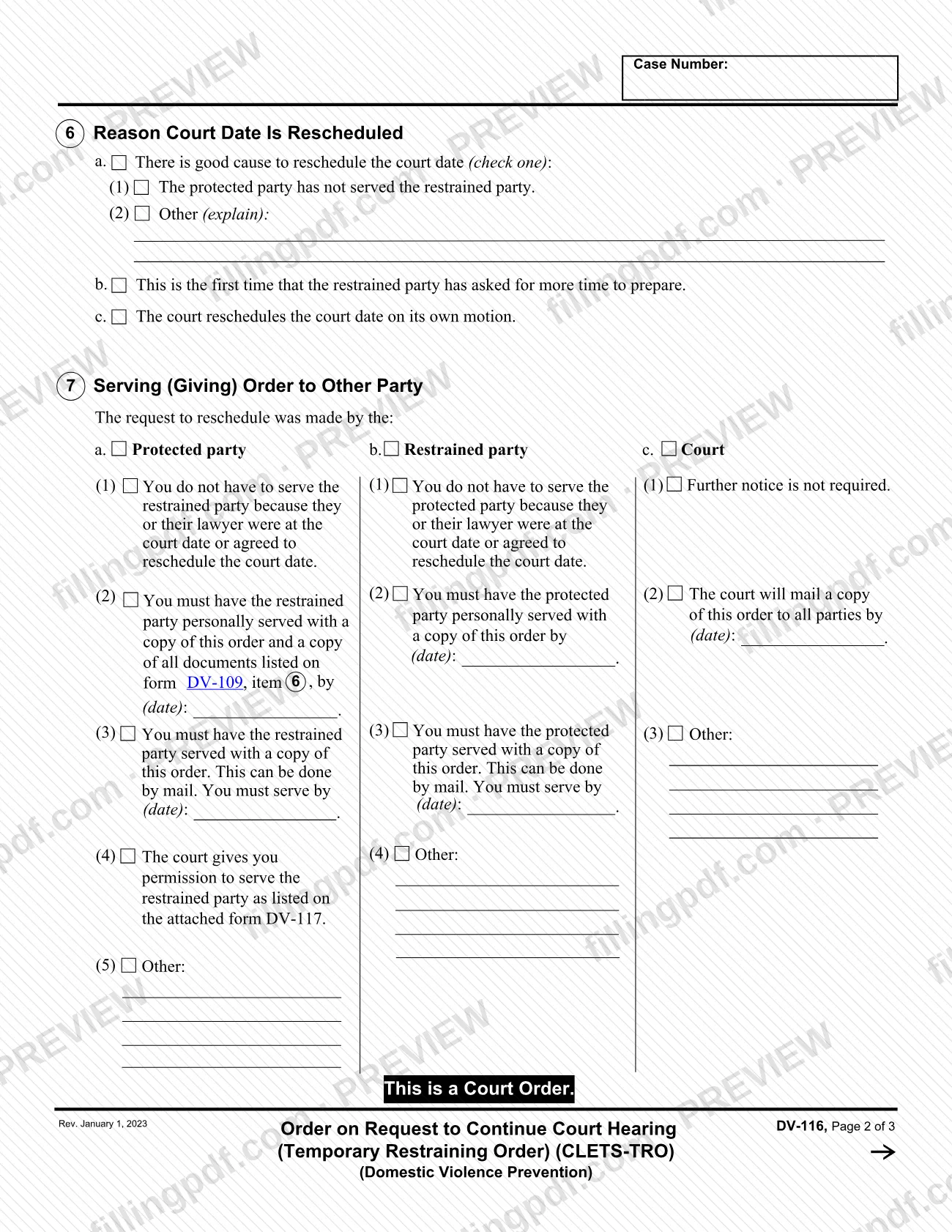
- Item 6 gives the reason for rescheduling.
- Items 7 and 8 say who must serve the order and by when.
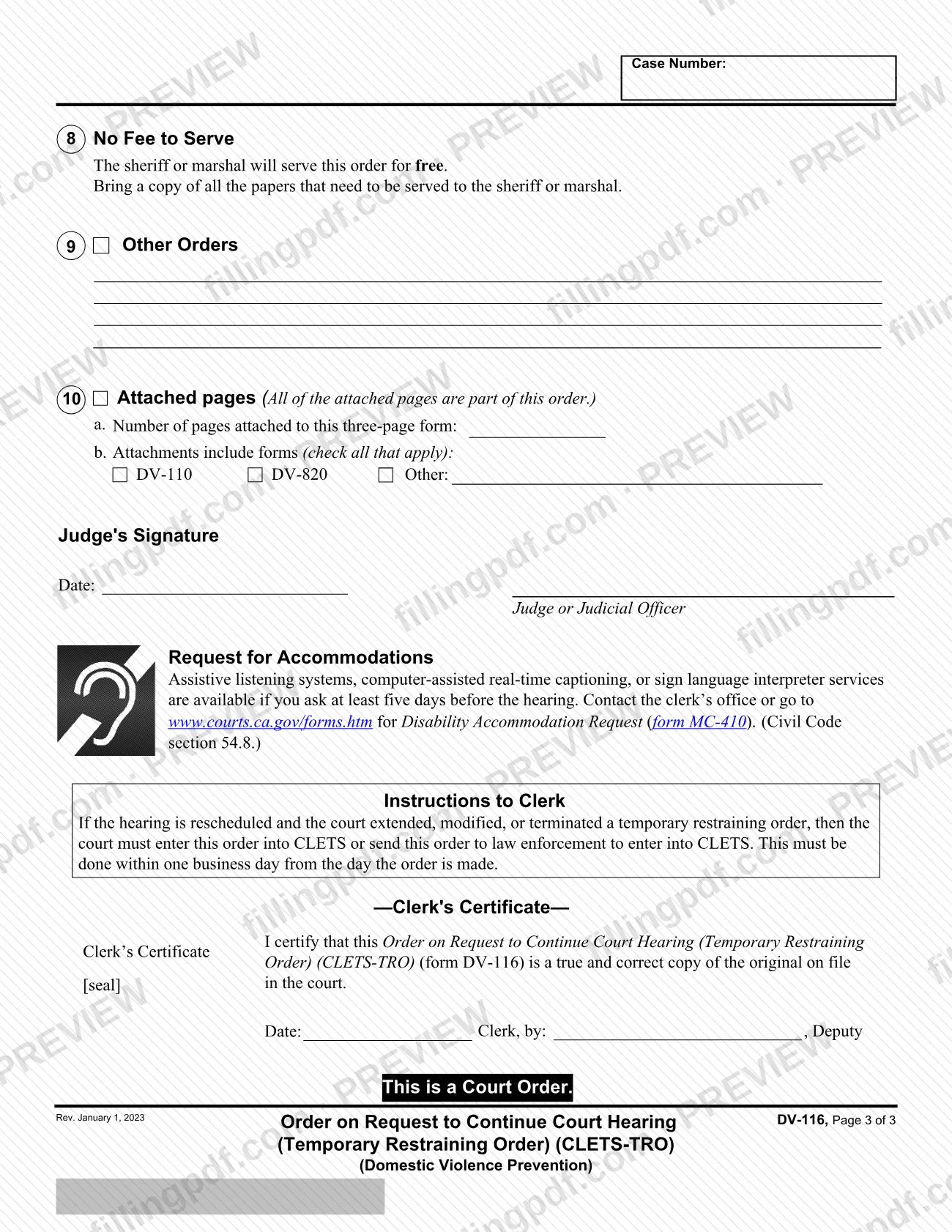
- Items 9 and 10 cover other orders and attached pages.
The Judicial Council's self-help page describes the form as telling you that your court date has been rescheduled and whether a TRO is in effect. It lists versions in Chinese Simplified, Korean, Spanish and Vietnamese. Form DV-116 does not create a new restraining order by itself: a changed TRO is signed on form DV-110.
Who needs to file DV-116?
The protected party and the restrained party named on the form are the people it affects. Item 7 shows the three ways a request to reschedule can arise: the protected party asks, the restrained party asks, or the court reschedules on its own motion. Item 6 also records whether this is the first time the restrained party has asked for more time to prepare.
- Protected party: named in item 1. If the protected party made the request, item 7 says whether the restrained party must be personally served or served by mail, or whether service is unnecessary because they or their lawyer attended or agreed to the new date.
- Restrained party: named in item 2. If the restrained party made the request, item 7 sets the service duty toward the protected party. If item 5 b is checked, the form warns that a domestic violence restraining order has been issued against the restrained party, who must follow its orders until they expire.
- The court: completes items 3 through 10, signs as judge or judicial officer, and the clerk handles the Clerk's Certificate.
The form's own instruction to the preparer is to complete 1 and 2 only.
When to file DV-116
Form DV-116 is used when someone asks the court to continue (reschedule) a domestic violence prevention court date, or when the court reschedules on its own. The form sets no filing deadline of its own for the request, and the clerk stamps the date in the box at the top when it is filed.
Other dates on the form come from the court's decision:
- Item 7 may set a date by which the order must be served, depending on who requested the change and the type of service.
- If a TRO is extended in item 5 b(1), the order lists the new expiration date; if no expiration date is listed, the TRO expires at the end of the court date in item 3 b.
- The court must enter an order that extends, modifies or terminates a TRO into CLETS, or send it to law enforcement for entry, within one business day of the day it is made.
- A request for accommodations, such as assistive listening systems, real-time captioning or a sign language interpreter, should be made at least five days before the hearing.
Documents you need
- Form DV-110, Temporary Restraining Order: attach it only if the court changes the TRO and signs a new one under item 5 b(2); mark DV-110 in item 10 b.
- Form DV-117: attach it only if the court gives permission to serve the restrained party as listed on it under item 7 a(4).
- Copies of the documents listed on form DV-109, item 6: the restrained party must be personally served with a copy of this order and these documents when item 7 a(2) is checked.
- A copy of all papers that need to be served: bring them to the sheriff or marshal if you use the free service under item 8.
- Other attachments the court lists in item 10 b, such as DV-820: each attached page is part of the order and counted in item 10 a.
How to fill out DV-116
Enter the protected party
In item 1, Protected Party, enter the name of the person protected by the order. The form tells you to complete only items 1 and 2.
Enter the restrained party
In item 2, Restrained Party, enter the name of the person the order restrains. Leave the rest of the form for the court.
Leave the court's name and case number
The court fills in its name and street address and the case number at the top of item 3 and on pages 2 and 3, and the clerk stamps the filing date in the box at the top of page 1.
Review the next court date
In item 3, the court either denies the request, so any DV-110 TRO stays in force until your court date, or grants it and lists the new date, time, department and room.
Note remote attendance in item 4
Item 4 says you may attend remotely, such as by phone or videoconference. Check the court's website for the county listed, using www.courts.ca.gov/find-my-court.htm.
Check the TRO status
In item 5, read whether there is no TRO, whether the court terminates or extends it, or changes it with a new form DV-110. Note any expiration date listed.
Read the reason for rescheduling
Item 6 records good cause: the protected party has not served the restrained party, or another explanation. It also shows whether this is the first time the restrained party asked for more time or whether the court acted on its own motion.
Follow the service instructions
Item 7 depends on who made the request: protected party, restrained party or court. Find the checked box and the date by which service must be completed; item 8 says the sheriff or marshal serves for free.
Check other orders and attachments
Item 9 holds any other orders. In item 10, the court enters the number of attached pages and checks attached forms such as DV-110 or DV-820.
Confirm the judge's signature
The judge or judicial officer signs and dates the order. If you need accommodations, contact the clerk's office or use form MC-410 at least five days before the hearing.
Review and download the completed PDF
Check that the names in items 1 and 2 are correct, then download or print the completed PDF from FillingPDF. Return it to the court and serve it as the order directs under How to submit.
How to submit DV-116
Form DV-116 is a court order, so it moves through the court rather than a separate agency channel. The form names the clerk's stamp, the court's own service instructions and the sheriff or marshal; it prints no mailing address or online portal.
- Court clerk: the form says the clerk stamps the date in the box at the top when it is filed. Items 1 and 2 are completed first; the court completes the rest. Find the court's website, address and remote-attendance details at www.courts.ca.gov/find-my-court.htm.
- Service on the other party: item 7 states who must serve the order and by what date, by personal service or by mail depending on the box checked. If item 7 c is checked, the court mails a copy of the order to all parties by the date it lists.
- Sheriff or marshal: under item 8, the sheriff or marshal serves the order for free. Bring a copy of all the papers that need to be served.
- Attachments: item 10 records the pages attached, which may include form DV-110.
For accommodations, contact the clerk's office or use Disability Accommodation Request (form MC-410). FillingPDF lets you fill out and download the PDF; submission follows the court's channels above.
Common mistakes to avoid
- Filling in items 3 through 10 yourself; the form says to complete only items 1 and 2 and that the court completes the rest.
- Assuming a TRO ends when the court denies the request to reschedule; under item 3 a(1), a granted TRO stays in full force until the next court date.
- Missing the service date in item 7, or serving by mail when the box checked requires personal service.
- Not serving the other party when item 7 requires it, assuming no service is needed even though neither they nor their lawyer attended or agreed to the new date.
- Treating an extended TRO as expiring on a guessed date; if item 5 b(1) lists no expiration date, it ends at the end of the court date in item 3 b.
- As the restrained party, ignoring the order after item 5 b is checked; the form warns you must follow the orders until they expire.
- Asking for a sign language interpreter or captioning fewer than five days before the hearing.
- Going to the sheriff or marshal for service without a copy of all the papers to be served.
Frequently asked questions
What is form DV-116 used for?
DV-116 is the California court order that tells the parties whether a request to continue (reschedule) a domestic violence prevention hearing was granted or denied. It also states whether a temporary restraining order stays in effect, ends, is extended or is changed.
Who fills out the DV-116 order?
The person preparing it completes only item 1 (Protected Party) and item 2 (Restrained Party). The court completes everything else, including the next court date, TRO status, service instructions and the judge's signature.
What happens to my TRO if the court denies the DV-116 request?
Any temporary restraining order already granted on form DV-110 stays in full force and effect until the next court date, according to item 3 a(1). The court explains in item 3 a(2) why the date was not rescheduled.
Do I have to serve the DV-116 order on the other party?
It depends on item 7. You do not have to serve the other party if they or their lawyer were at the court date or agreed to reschedule. Otherwise item 7 says whether you need personal service or service by mail and the date. If the court requested the change, it may mail the order to all parties.
Can I attend my rescheduled hearing by phone or video after DV-116?
Possibly. Item 4 says you may attend remotely, such as by phone or videoconference. For details, go to the website of the court in the county listed on the form; www.courts.ca.gov/find-my-court.htm helps you find it.
Is there a fee to serve the DV-116 order?
The sheriff or marshal serves this order for free under item 8. Bring a copy of all the papers that need to be served to the sheriff or marshal.
Is DV-116 available in Spanish or other languages?
Yes. The Judicial Council's self-help page lists form DV-116 in Chinese Simplified, Korean, Spanish and Vietnamese. The English form remains the version published at courts.ca.gov/documents/dv116.pdf.
Can I fill out DV-116 online on FillingPDF?
You can fill out the DV-116 PDF online on FillingPDF and download or print it. FillingPDF is an independent service and does not file the form with the court, serve it or deliver it; you use the court's channels.
Ready to fill out DV-116?
Fill out DV-116 now