
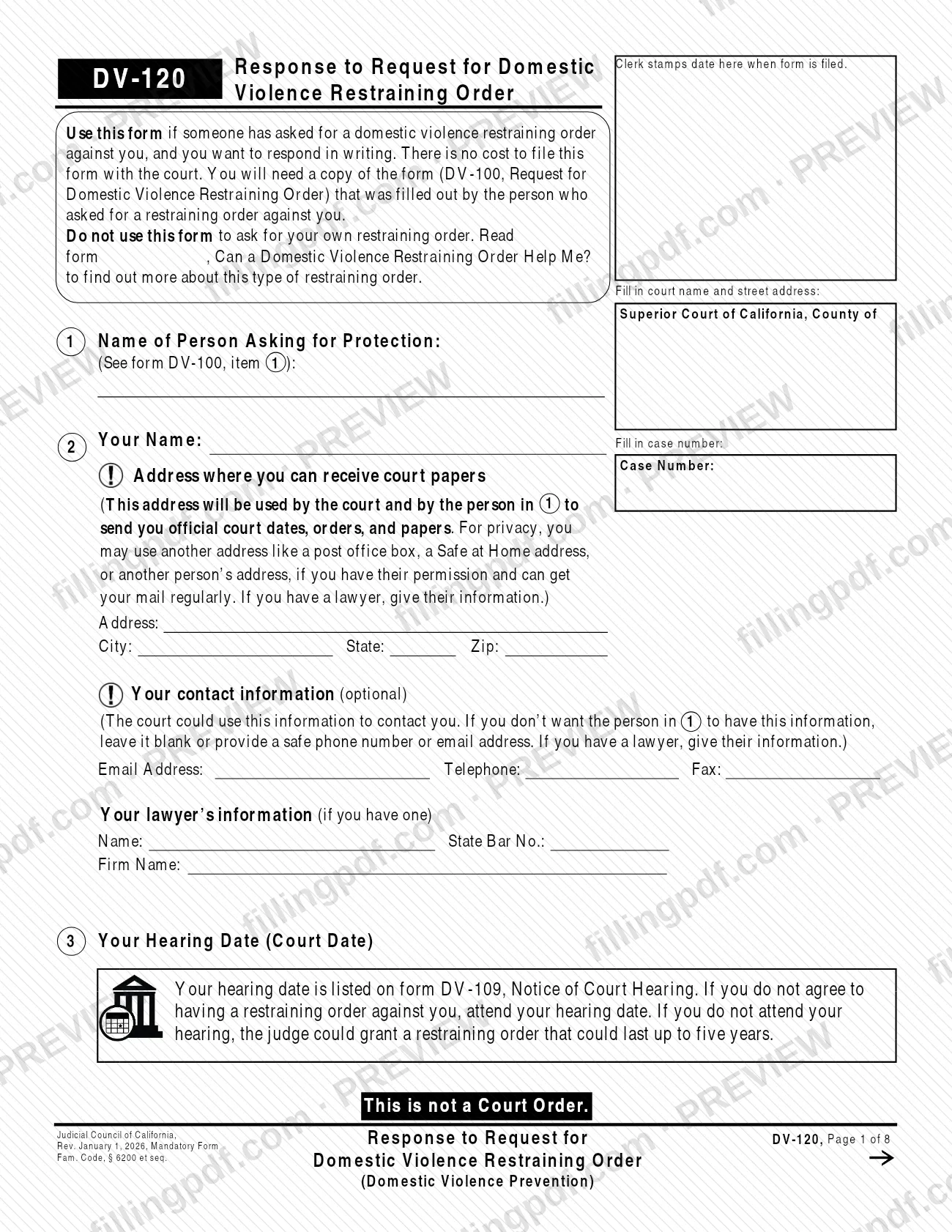
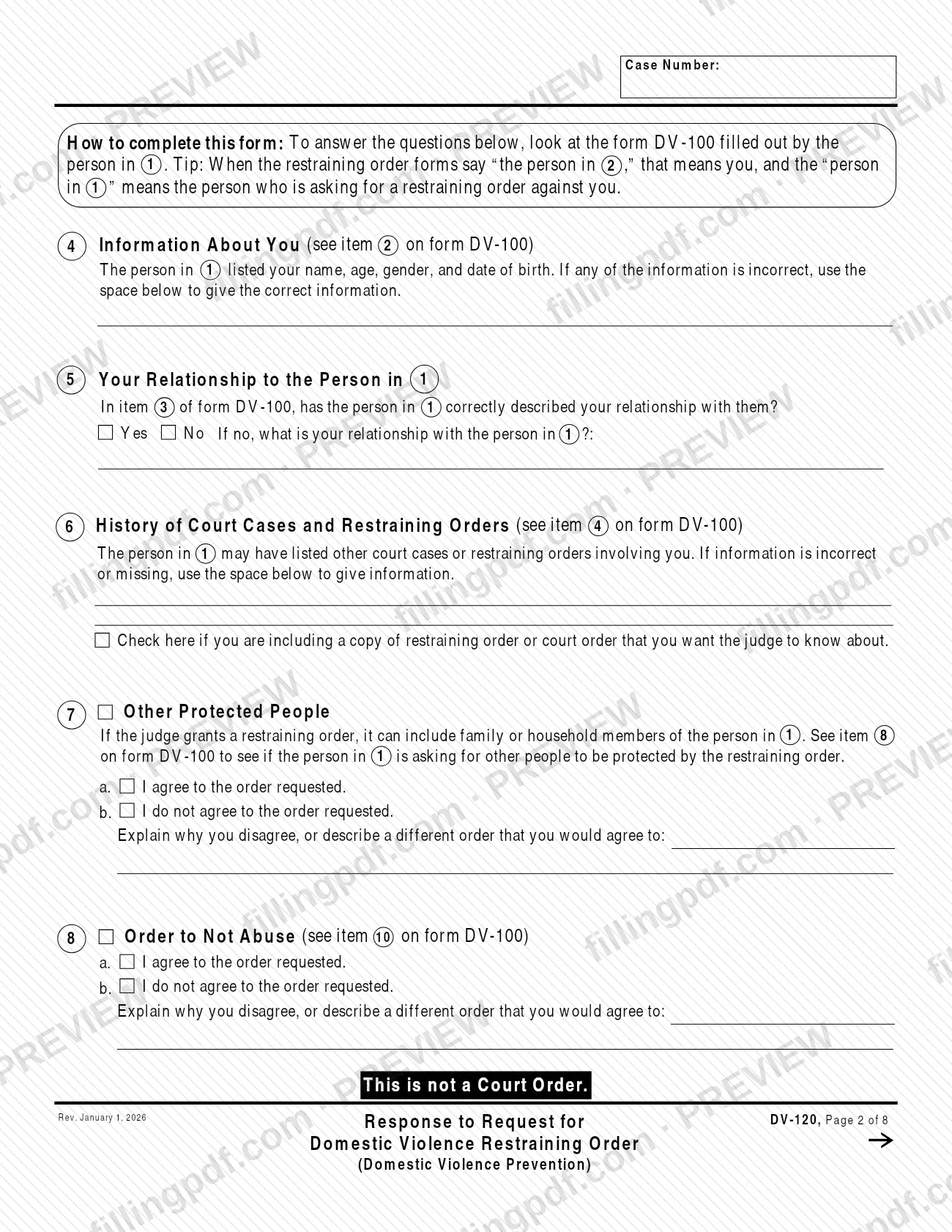
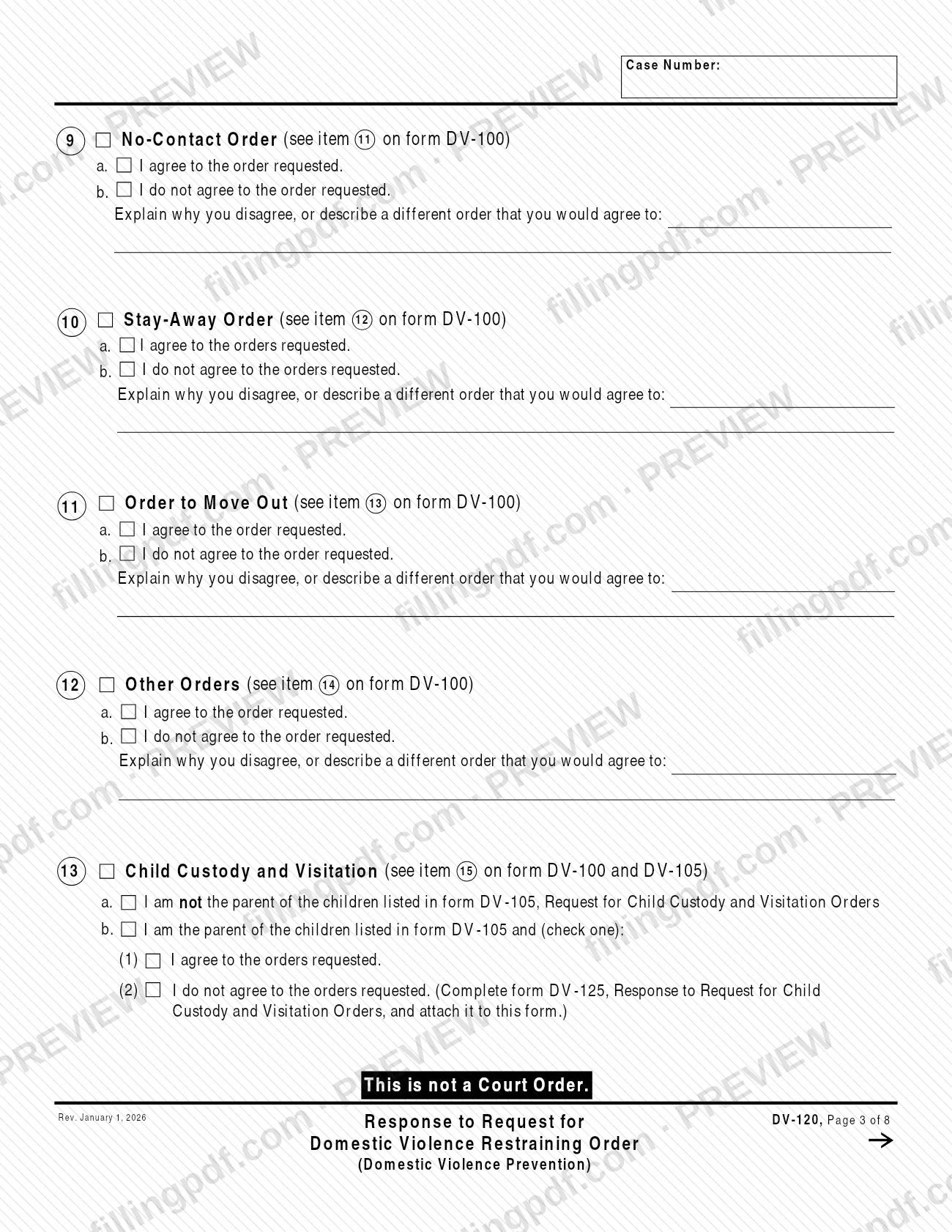
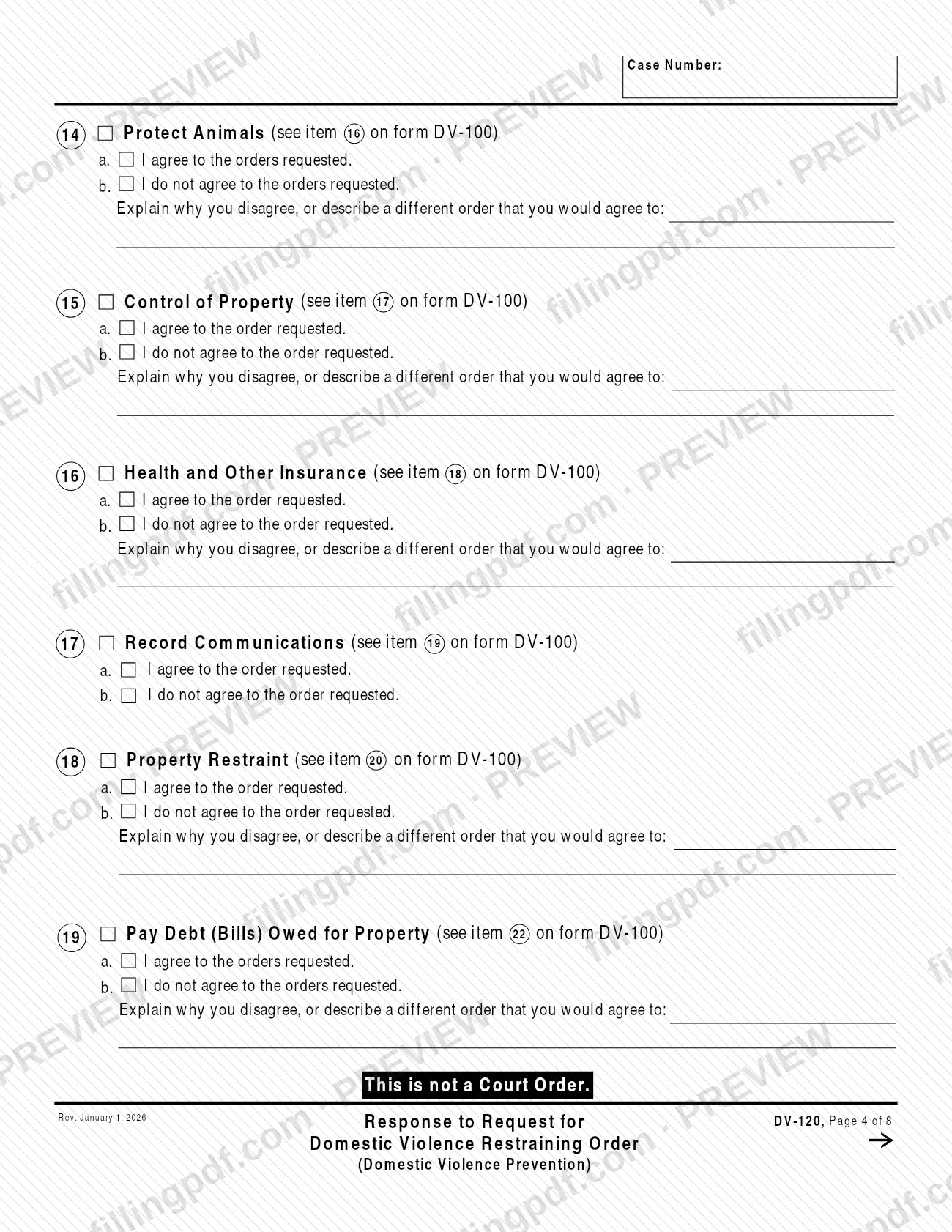
The DV-120 form, Response to Request for Domestic Violence Restraining Order, is the Judicial Council of California form you use when someone has asked a California court for a domestic violence restraining order against you and you want to respond in writing. It lets you agree or disagree, item by item, with each order requested on form DV-100. On this page you can fill out the form online on FillingPDF and download or print the completed PDF; the official PDF is published by the Judicial Council at courts.ca.gov.
Last updated
What is DV-120?
Form DV-120, Response to Request for Domestic Violence Restraining Order, is the Judicial Council of California mandatory form on which the person named in a restraining order request tells the court, in writing, which of the requested orders they agree to and which they oppose.
The form answers form DV-100, Request for Domestic Violence Restraining Order, which was filled out by the person asking for protection. The form calls that person "the person in 1" and you "the person in 2." Its items follow DV-100 order by order: name and relationship, court cases, other protected people, orders to not abuse, no-contact, stay-away and move-out, other orders, child custody and visitation, animals, property, insurance, recorded communications, debts and expenses, child and spousal support, lawyer's fees, batterer intervention program, wireless phone account, firearms, body armor, and the order not to look for protected people. For most orders you check "I agree" or "I do not agree" and explain.
The form cites Family Code section 6200 et seq. (Domestic Violence Prevention) and states that there is no cost to file it with the court. It is not a Court Order. It is not for asking for your own restraining order; for that, the form points to form DV-500-INFO, Can a Domestic Violence Restraining Order Help Me? The Judicial Council also offers form DV-120 in Chinese Simplified, Korean, Spanish, Tagalog and Vietnamese.
Who needs to file DV-120?
Use Form DV-120 if someone has asked for a domestic violence restraining order against you and you want to respond in writing. The form tells you to have a copy of form DV-100, Request for Domestic Violence Restraining Order, filled out by the person who asked for the order, because you answer it item by item.
- Parents named in form DV-105. If you are the parent of the children listed in form DV-105, Request for Child Custody and Visitation Orders, you check whether you agree to the custody and visitation orders. If you do not agree, you also complete form DV-125.
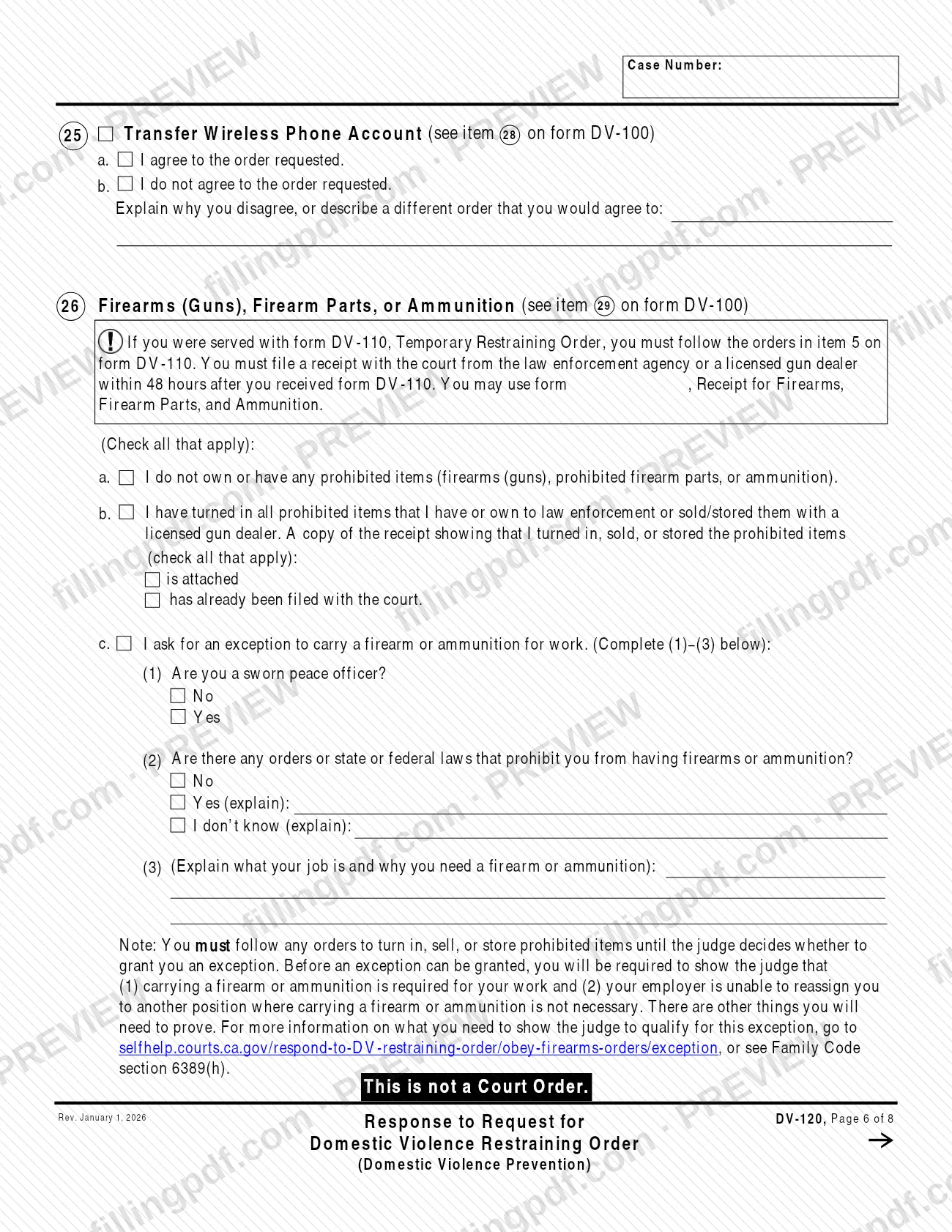
- People who were served with form DV-110. If you received the Temporary Restraining Order, items 26 and 27 on firearms and body armor apply to you.
- Lawyers. If you have a lawyer, the form has spaces for your lawyer's information and signature.
Do not use this form to ask for your own restraining order. The form directs you to form DV-500-INFO to learn about that type of restraining order. The form does not say that anyone else may sign for you: item 32 is your own declaration under penalty of perjury.
When to file DV-120
File Form DV-120 after someone has asked for a domestic violence restraining order against you and before your hearing. Your hearing date is listed on form DV-109, Notice of Court Hearing. The form tells you to attend that date if you do not agree to a restraining order, because if you do not attend, the judge could grant a restraining order that could last up to five years.
The form prints no separate filing deadline for itself. It does set a timing rule for related papers: if the other person asked for child support, spousal support or lawyer's fees, you must file form FL-150, Income and Expense Declaration (or form FL-155 where you qualify) before your court date. If you were served with form DV-110, the firearms receipt must be filed with the court within 48 hours after you received that form.
Documents you need
- A copy of form DV-100, Request for Domestic Violence Restraining Order, filled out by the person asking for the order; you need it to answer the items on DV-120.
- Form DV-125, Response to Request for Child Custody and Visitation Orders: attach it if you are the parent of the children in form DV-105 and you do not agree to the orders requested (item 13).
- Form FL-150, Income and Expense Declaration: required if the other person asked for child support, spousal support or lawyer's fees; file it before your court date.
- Form FL-155: may replace FL-150 if the other person is only asking for child support and form DV-570 shows you are eligible; file it before your court date.
- A copy of any restraining order or court order you want the judge to know about, if you check the box in item 6.
- A receipt from law enforcement or a licensed gun dealer, if you check item 26b and the receipt is attached; form DV-800/JV-270 may be used.
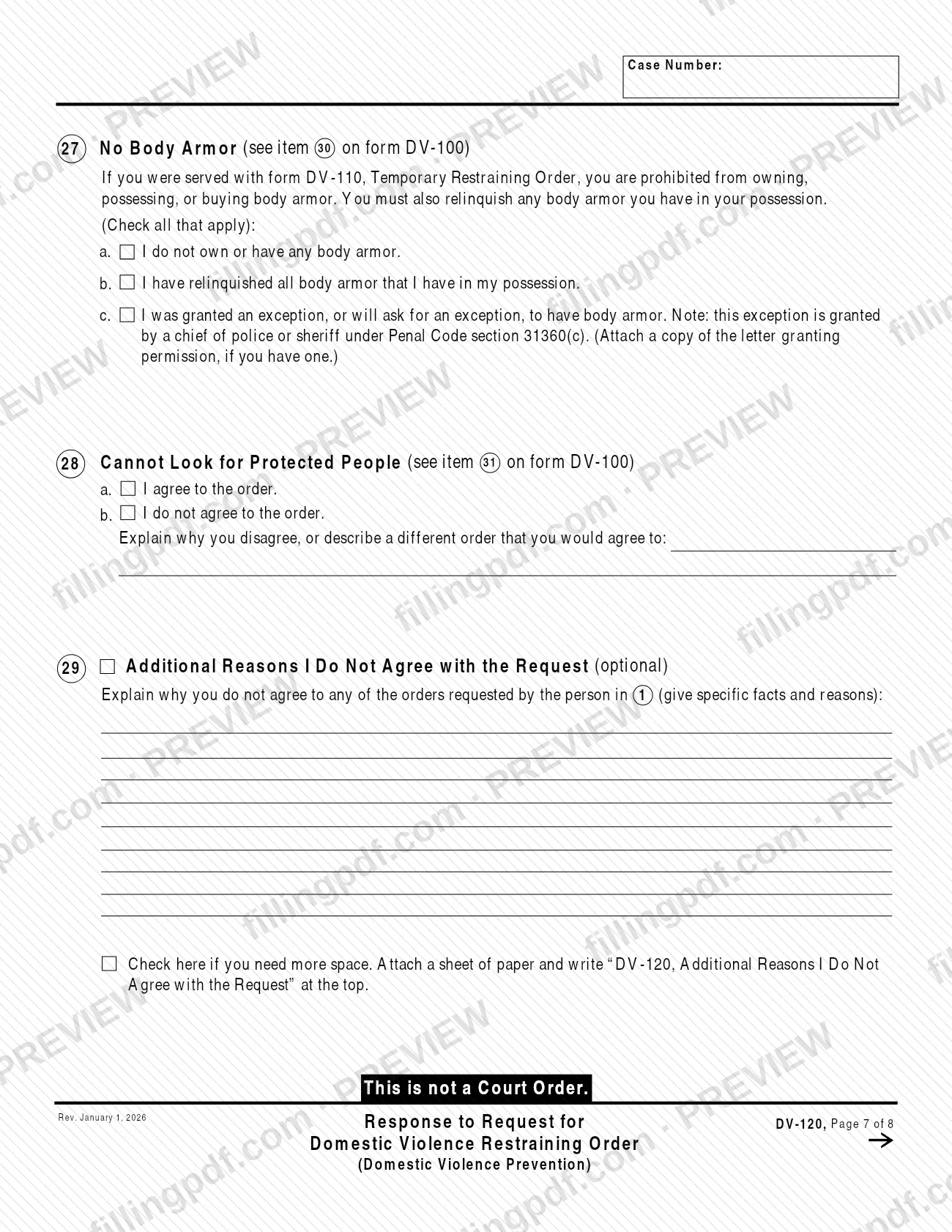
- A copy of the letter granting permission to have body armor, if you have one and check item 27c.
- An extra sheet headed "DV-120, Additional Reasons I Do Not Agree with the Request", if you need more space for item 29.
- Form DV-250, Proof of Service by Mail, completed by the person who mails your forms to the person in 1, filed with the court.
How to fill out DV-120
Enter the court and case details
At the top of page 1, fill in the court name and street address (Superior Court of California, County of) and the case number. Have the DV-100 you were given open beside you.
Complete items 1 and 2
Item 1: enter the name of the person asking for protection, as in item 1 of form DV-100. Item 2: enter your name and an address where you can receive court papers; a P.O. box, Safe at Home address or another person's address (with permission) may be used.
Add contact and lawyer information
Email, telephone and fax are optional; leave them blank or give a safe number if you do not want the person in 1 to have them. If you have a lawyer, enter their name, State Bar No. and firm name.
Note your hearing date
Item 3 refers to your hearing date on form DV-109, Notice of Court Hearing. There is nothing to enter, but make a note of it.
Correct your information and relationship
Item 4: correct your name, age, gender or date of birth if DV-100 got it wrong. Item 5: check Yes or No on the relationship described in item 3 of DV-100 and, if No, describe it.
Add court cases and other protected people
Item 6: give corrected or missing court cases or restraining orders, and check the box if you attach a copy. Item 7: check a (agree) or b (do not agree) on the other people the order would protect, and explain if you disagree.
Respond to the conduct orders
Items 8 to 12 cover orders to not abuse, no-contact, stay-away, move out and other orders. For each, check agree or do not agree and explain why or describe an order you would accept.
Answer custody and visitation
Item 13: check a if you are not the parent of the children in form DV-105. Check b if you are, then (1) agree or (2) do not agree; if (2), complete form DV-125 and attach it.
Respond to property and money orders
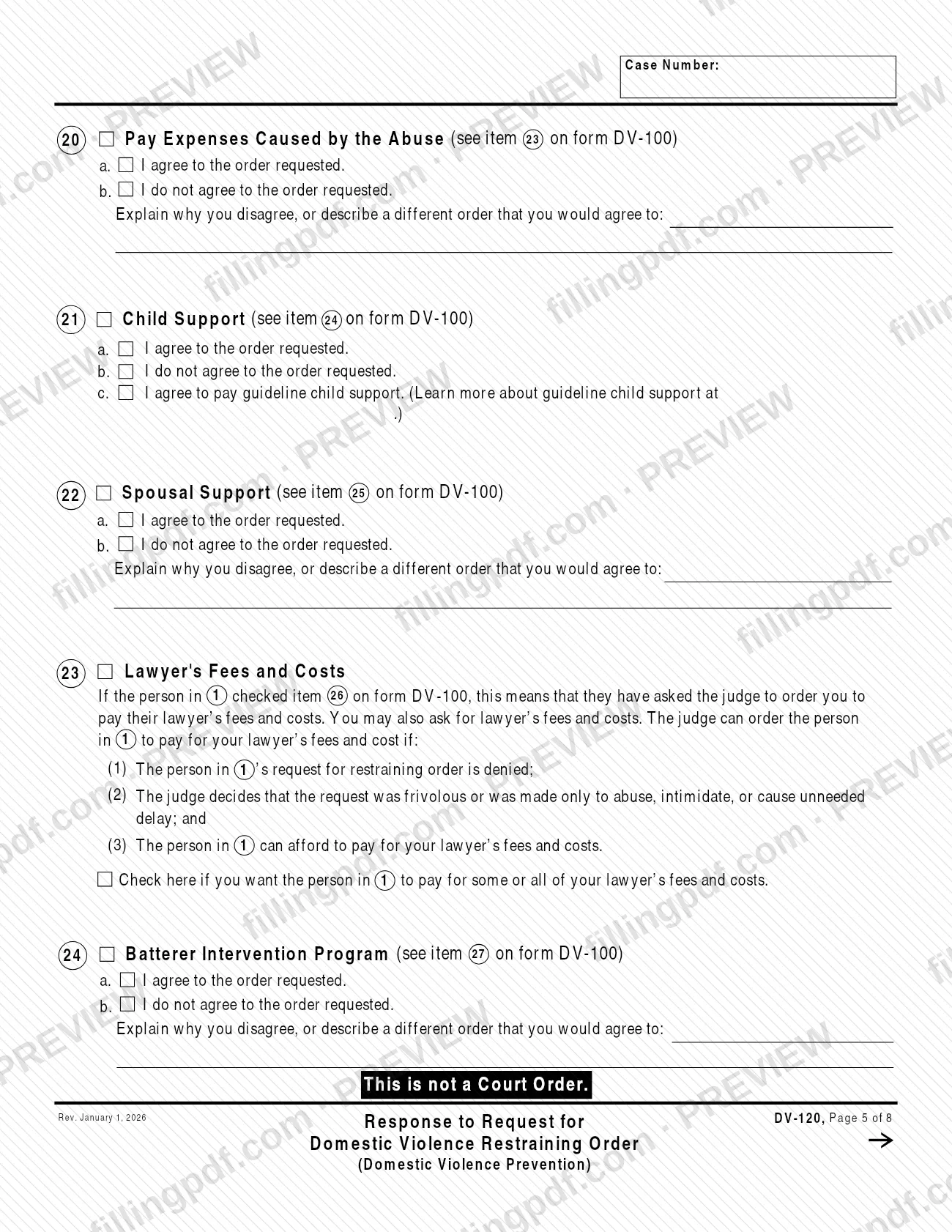
Items 14 to 20 cover animals, control of property, insurance, recording communications, property restraint, debts and expenses caused by the abuse. Item 21 (child support) also lets you check c to agree to pay guideline child support; item 22 covers spousal support.
Complete lawyer's fees through body armor
Item 23: check the box if you want the person in 1 to pay some or all of your lawyer's fees. Item 24 is the batterer intervention program and item 25 the wireless phone account. In item 26 check all firearm statements that apply, and in item 27 all body armor statements that apply.
Finish items 28 to 31
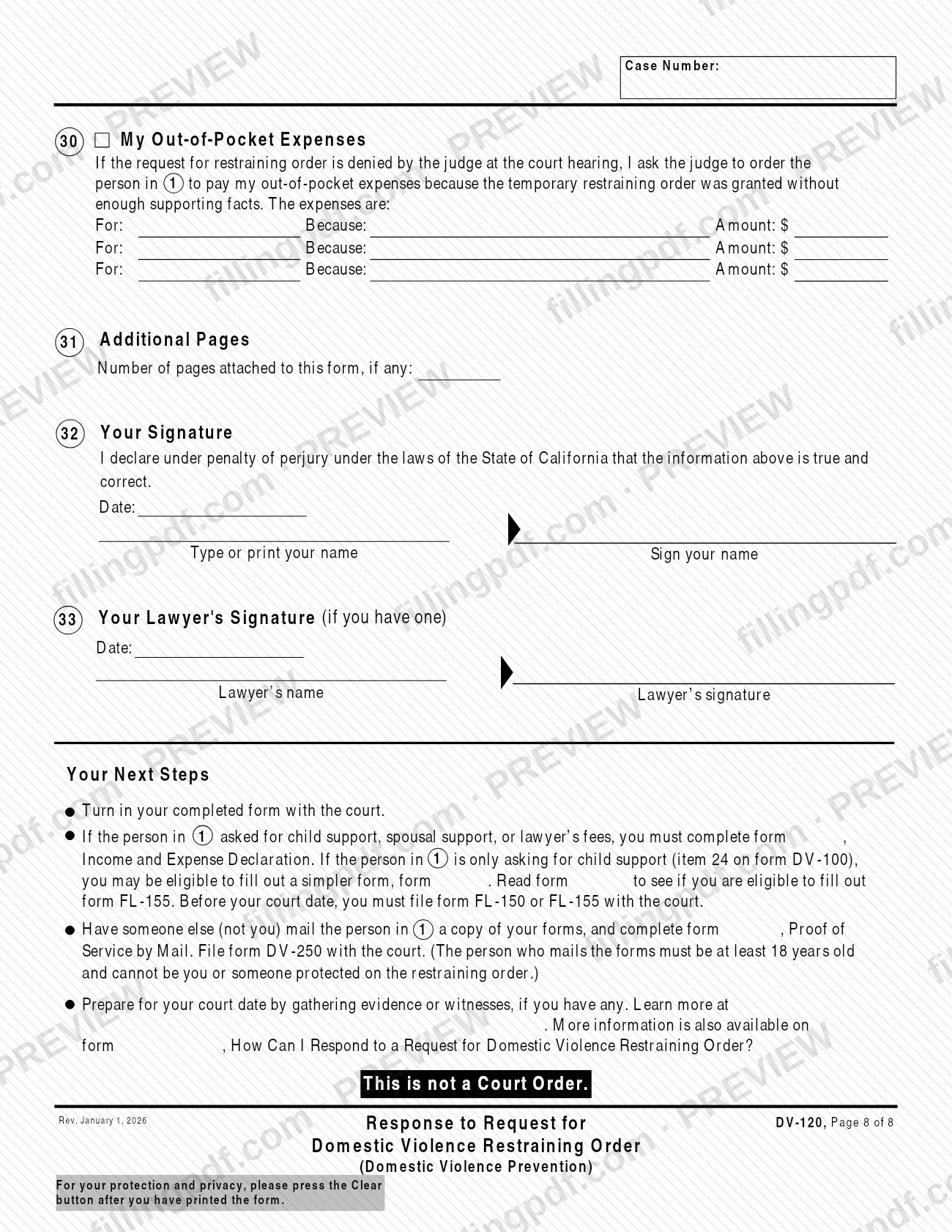
Item 28: agree or not with the order not to look for protected people. Item 29 (optional): give specific facts and reasons, attaching a sheet if needed. Item 30: list out-of-pocket expenses if you ask for them. Item 31: enter the number of pages attached.
Sign, review and download the PDF
Item 32: type or print your name, sign and date the declaration under penalty of perjury; item 33 is for your lawyer's signature, if any. Check every item against DV-100, then download or print the completed PDF from FillingPDF and follow the next steps listed under How to submit.
How to submit DV-120
The form says to turn in your completed form with the court; it names no other channel. The court is the Superior Court of California, County of the county where the case is filed, which you write at the top of page 1.
- Filing with the court. Turn in the completed DV-120 with any attachments. The form states there is no cost to file it. The Clerk stamps the date in the box at the top of page 1 when it is filed.
- Copy to the other person. Have someone else, not you, mail the person in 1 a copy of your forms. That person must be at least 18 years old and cannot be you or someone protected on the restraining order. They complete form DV-250, Proof of Service by Mail, and you file it with the court.
- Income forms. If child support, spousal support or lawyer's fees were requested, complete form FL-150, or form FL-155 if the only request is child support and you are eligible under form DV-570, and file it before your court date.
For court locations and help, see selfhelp.courts.ca.gov/respond-domestic-violence-restraining-order or form DV-120-INFO, How Can I Respond to a Request for Domestic Violence Restraining Order? FillingPDF lets you fill out and download the PDF; submission follows the channels above.
Common mistakes to avoid
- Not attending the hearing listed on form DV-109; the form warns the judge could grant a restraining order that could last up to five years.
- Using DV-120 to ask for your own restraining order; the form says not to, and points to form DV-500-INFO.
- Mailing the copy to the other person yourself; the form says someone else, at least 18 and not protected on the order, must mail it and complete form DV-250.
- Checking "I do not agree" on custody without attaching form DV-125 when you are the parent of the children in form DV-105.
- Skipping form FL-150 or FL-155 when child support, spousal support or lawyer's fees were requested; it must be filed before your court date.
- Not filing the firearms receipt within 48 hours after receiving form DV-110 when you were served with it.
- Giving only "I do not agree" without the explanation or alternative order the item asks for.
- Signing item 32 without checking the facts; it is a declaration under penalty of perjury under California law.
- Using a home address you do not want the other person to see; the form allows a P.O. box, Safe at Home address or another person's address with permission.
Frequently asked questions
What is the DV-120 form used for?
The DV-120 form is the California court form for responding in writing when someone has asked for a domestic violence restraining order against you. You use it to say which orders on form DV-100 you agree to, which you do not, and why.
Does it cost anything to file Form DV-120?
No. The form states there is no cost to file it with the court. Related papers, such as form DV-250 proof of service, are filed separately, and the form lists no fee for them either.
Do I have to go to the hearing if I file Form DV-120?
If you do not agree to having a restraining order against you, the form says to attend your hearing date, which is listed on form DV-109. If you do not attend, the judge could grant a restraining order that could last up to five years.
Can I fill out Form DV-120 online?
You can fill out the PDF online on FillingPDF and download or print it. FillingPDF is an independent service and does not file the form with the court; you turn it in to the court yourself, as the form directs.
Who can mail my response to the other person?
Someone else, not you. The form says the person who mails a copy must be at least 18 years old and cannot be you or someone protected on the restraining order. They complete form DV-250, Proof of Service by Mail, and you file it with the court.
What if I do not agree with the custody orders requested?
In item 13, check that you are the parent of the children in form DV-105 and that you do not agree. Then complete form DV-125, Response to Request for Child Custody and Visitation Orders, and attach it to DV-120.
Do I need to file an income and expense form with DV-120?
Only if the other person asked for child support, spousal support or lawyer's fees. Then you must complete form FL-150, or the simpler FL-155 if only child support is requested and you are eligible under form DV-570, and file it before your court date.
What do I do about firearms if I was served with form DV-110?
You must follow the orders in item 5 of form DV-110 and file a receipt from law enforcement or a licensed gun dealer within 48 hours after you received it. Form DV-800/JV-270, Receipt for Firearms, Firearm Parts, and Ammunition, may be used.
Is there a Spanish version of Form DV-120?
Yes. The Judicial Council of California self-help site offers form DV-120 in Spanish, as well as Chinese Simplified, Korean, Tagalog and Vietnamese. This page covers the English-language form.
Ready to fill out DV-120?
Fill out DV-120 now