
EJ-130 is the Writ of Execution published by the Judicial Council of California. It directs the sheriff or marshal of a county to enforce a judgment, whether the judgment is for money, for possession of property or for a sale. Judgment creditors, and the attorneys who act for them, use it after a judgment has been entered. On this page you can fill out the form online on FillingPDF and download or print the completed PDF; the official PDF and its latest revision are published by the Judicial Council at courts.ca.gov.
Last updated
What is EJ-130?
Form EJ-130, Writ of Execution, is the Judicial Council of California form that tells the sheriff or marshal of a county to enforce a judgment, covering money judgments by execution and judgments for possession or sale of personal or real property.
The Judicial Council's self-help page describes it as the form that tells the sheriff to take action to enforce a judgment, used with instructions to the sheriff to levy bank accounts, garnish wages or take possession of personal property. It is marked "Optional Form" and the revision printed on it is Rev. July 1, 2026.
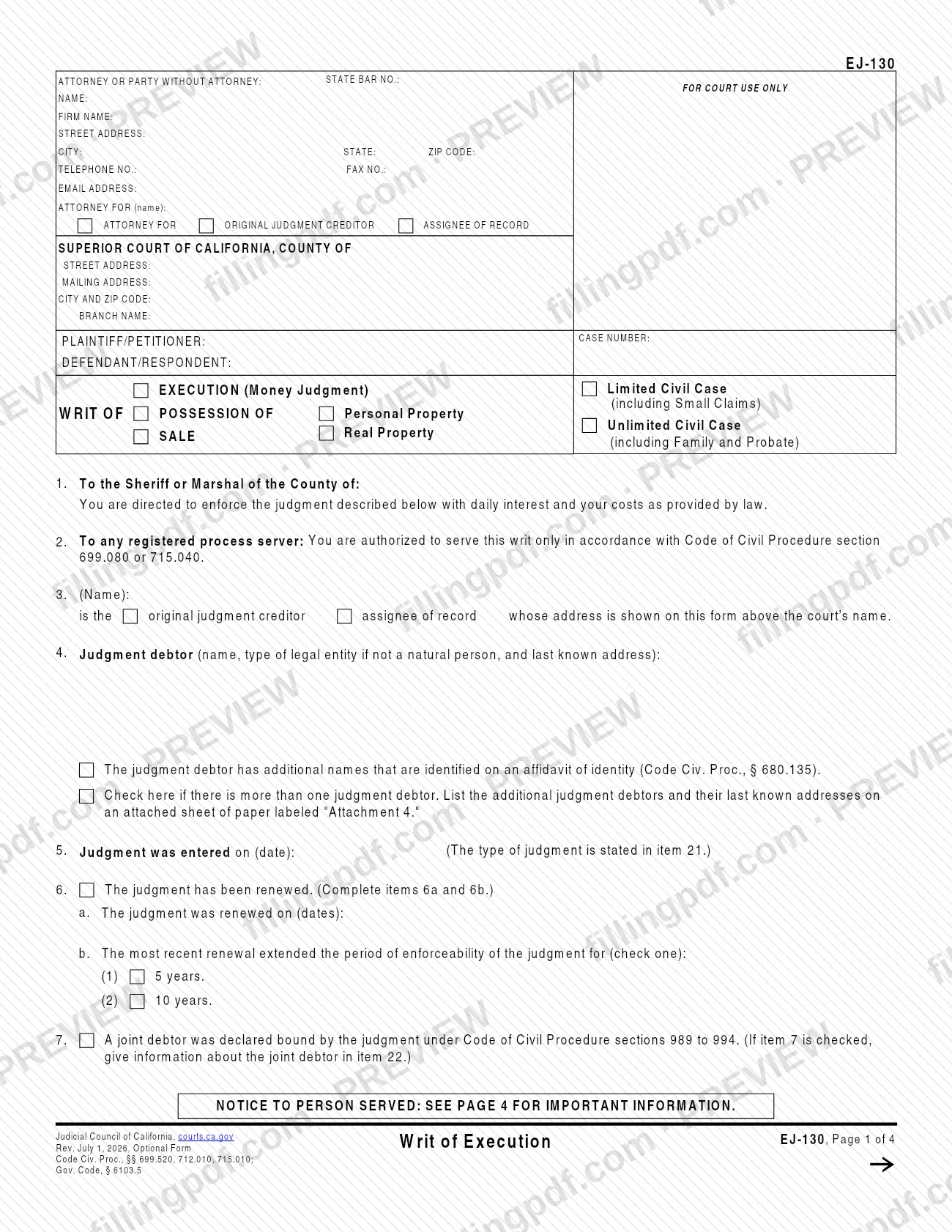
On page 1 the filer checks the type of writ (Execution (Money Judgment), Possession of Personal Property or Real Property, or Sale) and the case type (limited civil case, including small claims, or unlimited civil case, including family and probate). The form then identifies the judgment debtor and the date of judgment, any renewal, and the amounts due: judgment total, costs after judgment, credits, remaining principal, accrued interest, the issuance fee and daily interest. Pages 3 and 4 cover the kind of judgment, joint debtors, and the details of writs of possession or sale.
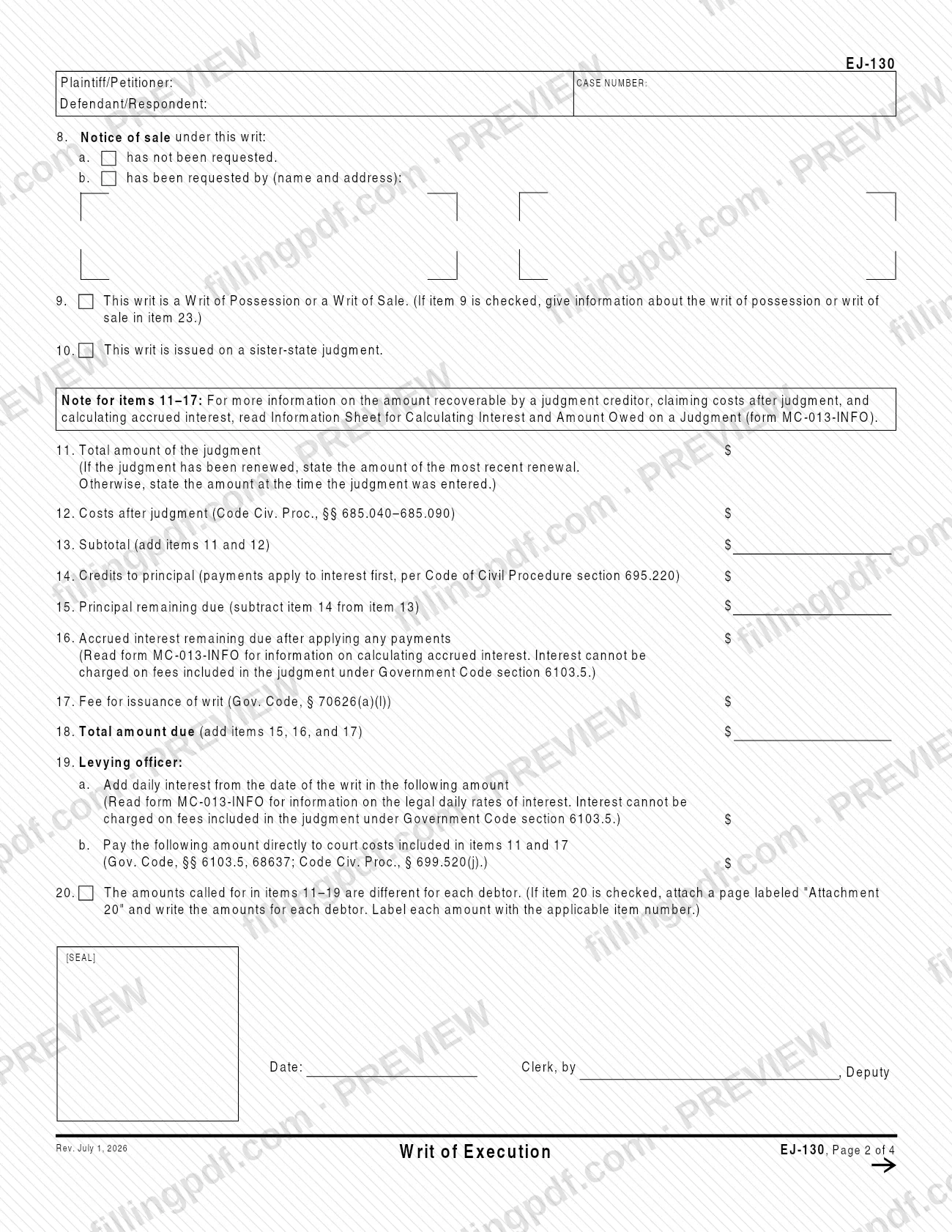
The form is issued by the court clerk, whose date, seal and deputy signature appear on page 2. Page 4 is a notice to the person served. Translated versions of EJ-130 in Chinese Simplified, Korean, Spanish and Vietnamese are listed on the Judicial Council's self-help page.
Who needs to file EJ-130?
The main users are judgment creditors who want a sheriff or marshal to enforce a California judgment. The form is completed by an attorney or by a party without an attorney, and it identifies whether the creditor named in item 3 is the original judgment creditor or an assignee of record.
Other situations the form covers:
- Judgments for money, possession or sale. Page 1 offers Execution (Money Judgment), Writ of Possession of personal or real property, and Sale of personal or real property.
- Several debtors. If there is more than one judgment debtor, the additional debtors go on an attached sheet labeled "Attachment 4."
- Joint debtors. When a joint debtor was declared bound under Code of Civil Procedure sections 989 to 994, items 7 and 22 give the details.
- Renewed judgments. Item 6 applies when the judgment has been renewed.
- Sister-state judgments. Item 10 applies when the writ is issued on a sister-state judgment.
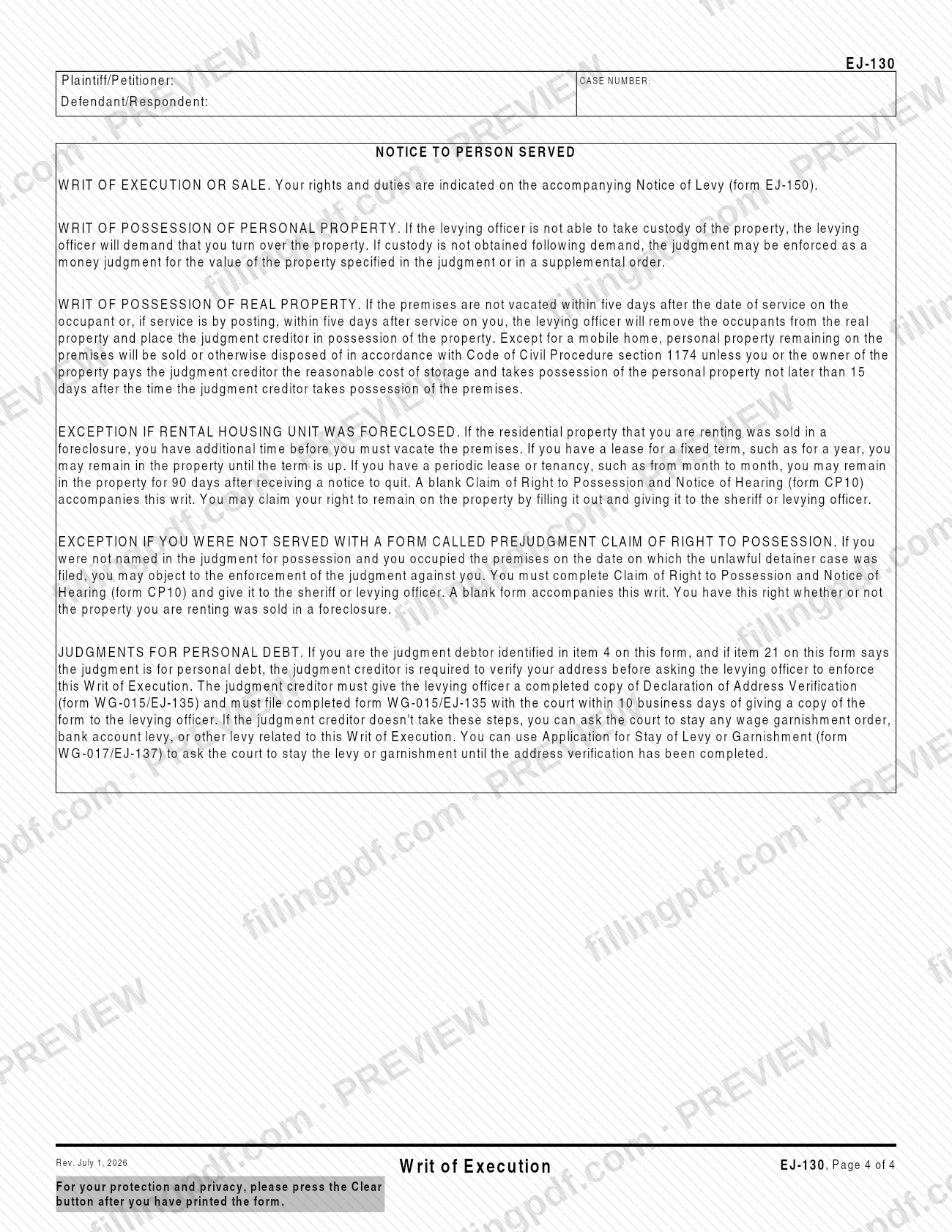
Page 4 is addressed to the person served, such as a judgment debtor or an occupant of premises. It explains their rights and duties and points to the accompanying Notice of Levy (form EJ-150), and for possession of real property to a blank Claim of Right to Possession and Notice of Hearing (form CP10).
When to file EJ-130
The writ is requested after a judgment has been entered, because item 5 asks for the date of judgment and the amounts in items 11 to 19 are calculated from that judgment. The form prints no due date of its own.
If the judgment has been renewed, item 6 asks for the renewal dates and whether the latest renewal extended enforceability for 5 or 10 years. Item 19a asks for daily interest from the date of the writ, so the amounts should be current when the writ is prepared.
For a judgment for personal debt (item 21c), the judgment creditor must complete the Declaration of Address Verification (form WG-015/EJ-135) before asking the sheriff to enforce the writ. Page 4 says the creditor must give a copy to the levying officer and file the completed form with the court within 10 business days of doing so.
Documents you need
- Attachment 4, a sheet labeled "Attachment 4": list additional judgment debtors and their last known addresses, only if there is more than one judgment debtor.
- Attachment 20, a page labeled "Attachment 20": write the amounts for each debtor, labeled with the item number, only if the amounts in items 11-19 differ for each debtor.
- Attachment 22, a sheet labeled "Attachment 22": list additional joint debtors or itemized costs, only if you need more space than item 22 provides.
- Attachment 23e: the description of the property, for a writ of possession or sale where item 23e is checked.
- Declaration of Address Verification (form WG-015/EJ-135): required before asking the sheriff to enforce the writ only when item 21c is checked (personal debt); also filed with the court within 10 business days.
- Notice of Levy (form EJ-150) accompanies the writ for service on the person served, as page 4 states for a writ of execution or sale.
How to fill out EJ-130
Enter attorney or party details
At the top of page 1, enter the name, State Bar number, firm, address, telephone, fax and email of the attorney or party without an attorney, and check whether the filer is for the original judgment creditor or assignee of record.
Enter court and case information
Fill in the Superior Court county, street and mailing address, branch, plaintiff/petitioner, defendant/respondent and case number. Check the writ type and whether the case is limited or unlimited civil.
Complete items 1 to 3
In item 1 enter the county of the sheriff or marshal. In item 3 enter the name of the judgment creditor and check original judgment creditor or assignee of record.
Identify the judgment debtor
In item 4 enter the debtor's name, type of legal entity if not a natural person, and last known address. Check the boxes for an affidavit of identity or for more than one debtor, and attach Attachment 4 if needed.
Give judgment date and renewal
Item 5: the date judgment was entered. If renewed, check item 6, give the renewal dates in 6a and check 5 or 10 years in 6b. Check item 7 if a joint debtor was declared bound.
Complete notice of sale and writ type
Item 8: check that notice of sale has not been requested, or has been requested by the name and address you give. Check item 9 for a writ of possession or sale and item 10 for a sister-state judgment.
Calculate the amounts
Enter items 11 to 18 in order: judgment total, costs after judgment, subtotal, credits to principal, principal remaining, accrued interest, issuance fee and total amount due. Use form MC-013-INFO for interest.
Add daily interest and court costs
Item 19a: the daily interest amount from the date of the writ. Item 19b: the amount to pay directly to court costs included in items 11 and 17. Check item 20 and attach Attachment 20 if amounts differ by debtor.
Select the kind of judgment
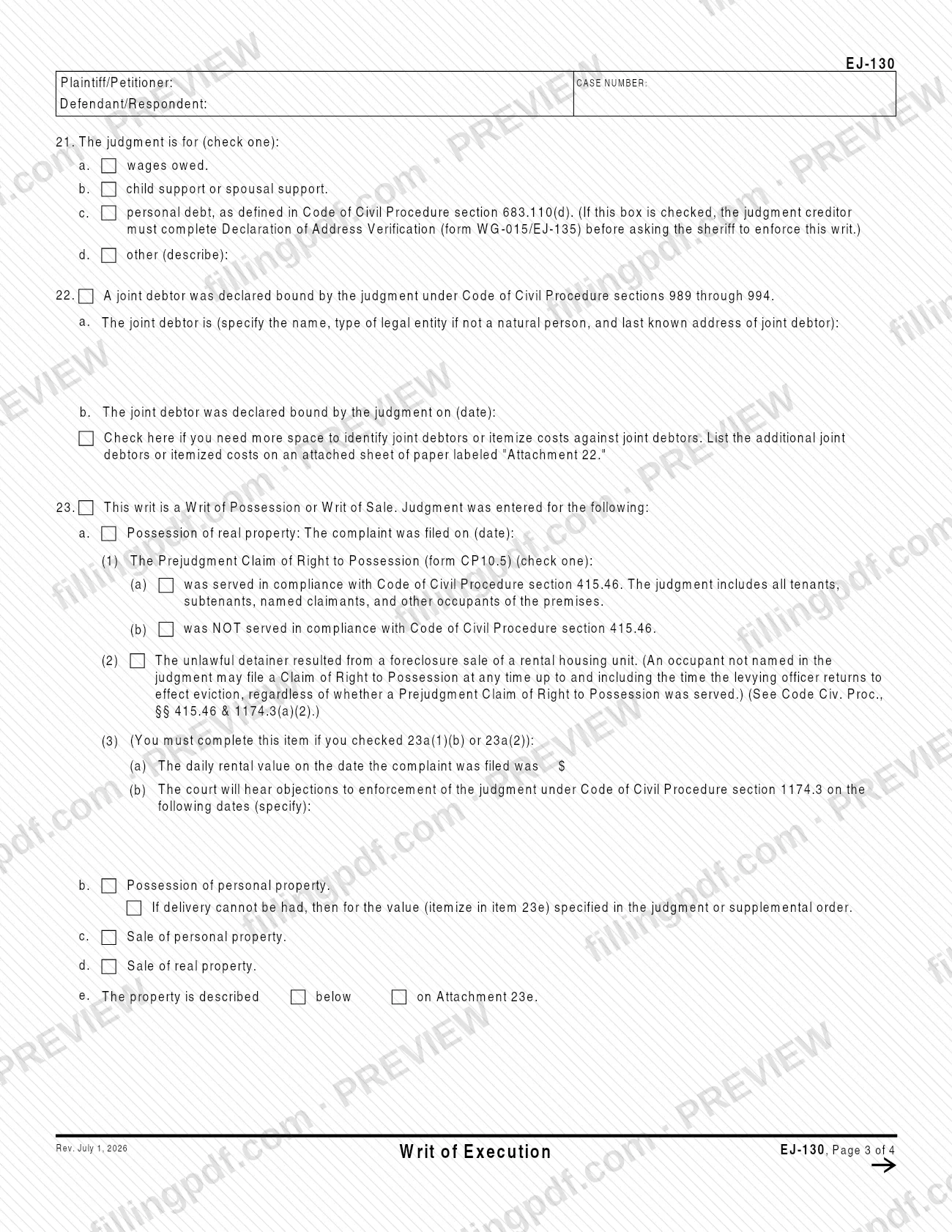
Page 3, item 21: check one of wages owed, child support or spousal support, personal debt, or other (describe). Remember form WG-015/EJ-135 if you check personal debt.
Add joint debtor information
Item 22: if a joint debtor was declared bound, give the name, entity type and last known address in 22a and the date in 22b. Use Attachment 22 for more space.
Complete possession or sale details
Item 23: for a writ of possession or sale, check what the judgment was for, complete 23a(1) to 23a(3) for real property, and describe property on Attachment 23e if you check 23e.
Review and download the completed PDF
Check names, case number, dates and totals, and that every checked item has its details or attachment. Download or print the completed PDF from FillingPDF; the court clerk completes the date, seal and deputy signature.
How to submit EJ-130
The form names no portal, mailing address or filing counter. It is directed in item 1 to the Sheriff or Marshal of the County you enter, and it is issued by the court clerk: page 2 carries the clerk's date, seal and deputy signature. Check with the clerk of the court that entered the judgment for how that court accepts the request.
What the form itself says about delivery and service:
- Levying officer. Item 1 directs the sheriff or marshal to enforce the judgment with daily interest and costs as provided by law.
- Process servers. Item 2 authorizes a registered process server to serve the writ only in accordance with Code of Civil Procedure section 699.080 or 715.040.
- Personal debt judgments. Give the levying officer a completed Declaration of Address Verification (form WG-015/EJ-135) and file it with the court within 10 business days.
- Package with the writ. Page 4 refers to the Notice of Levy (form EJ-150) and, for possession of real property, a blank form CP10.
Issuance of the writ carries a fee (item 17); ask the court clerk for the current amount. FillingPDF lets you fill out and download the PDF; submission follows the court's and the levying officer's channels described above.
Common mistakes to avoid
- Checking item 21c (personal debt) without completing Declaration of Address Verification (form WG-015/EJ-135) before asking the sheriff to enforce the writ.
- Checking item 7 or item 9 without giving the joint debtor details in item 22 or the writ of possession or sale details in item 23.
- Listing more than one judgment debtor in item 4 without an attached sheet labeled "Attachment 4."
- Checking item 20 (different amounts per debtor) without attaching a page labeled "Attachment 20" with each amount labeled by item number.
- Checking item 6 for a renewed judgment but skipping the renewal dates (6a) or the 5-year or 10-year extension (6b), or using the original amount in item 11 instead of the most recent renewal amount.
- Computing item 14 without applying payments to interest first, or charging interest on fees included in the judgment under Government Code section 6103.5.
- Checking 23a(1)(b) or 23a(2) but not completing item 23a(3), the daily rental value and the hearing dates for objections.
- Leaving item 3 unmarked as to whether the creditor is the original judgment creditor or assignee of record.
Frequently asked questions
What is the EJ-130 form?
EJ-130 is the Judicial Council of California's Writ of Execution. It tells the sheriff or marshal of a county to enforce a judgment, whether for money, possession of personal or real property, or sale of property. It is used with instructions to the sheriff to levy bank accounts, garnish wages or take property.
Can I fill out the EJ-130 form online?
Yes. You can fill out the fillable PDF online on FillingPDF and download or print it. FillingPDF is an independent service and does not file the writ or deliver it to a sheriff, marshal or court; those steps follow the court's and levying officer's channels.
Who signs and issues the Writ of Execution?
The court clerk issues it: page 2 has the clerk's date, seal and deputy signature. The attorney or party without an attorney completes the rest of the form, including the creditor and debtor details and the amounts due.
What do I need if the judgment is for personal debt?
If you check item 21c, you must complete Declaration of Address Verification (form WG-015/EJ-135) before asking the sheriff to enforce the writ. You also file it with the court within 10 business days of giving a copy to the levying officer.
What is the fee line in item 17 of EJ-130?
Item 17 is the fee for issuance of the writ, under Government Code section 70626(a)(1), and it is added into the total in item 18. The form does not print the amount, so ask the court clerk for the current fee.
How do I calculate the interest on EJ-130?
Item 16 is accrued interest remaining due after applying payments, and item 19a is the daily interest from the date of the writ. The form points to Information Sheet MC-013-INFO for calculations and notes that interest cannot be charged on fees included under Government Code section 6103.5.
What happens if occupants do not leave after a writ of possession of real property?
Page 4 says that if the premises are not vacated within five days after service on the occupant, or after service by posting, the levying officer will remove the occupants and place the judgment creditor in possession.
Is EJ-130 available in Spanish or other languages?
Yes. The Judicial Council's self-help page lists EJ-130 in Chinese Simplified, Korean, Spanish and Vietnamese. This page covers the English form, Rev. July 1, 2026.
Ready to fill out EJ-130?
Fill out EJ-130 now