
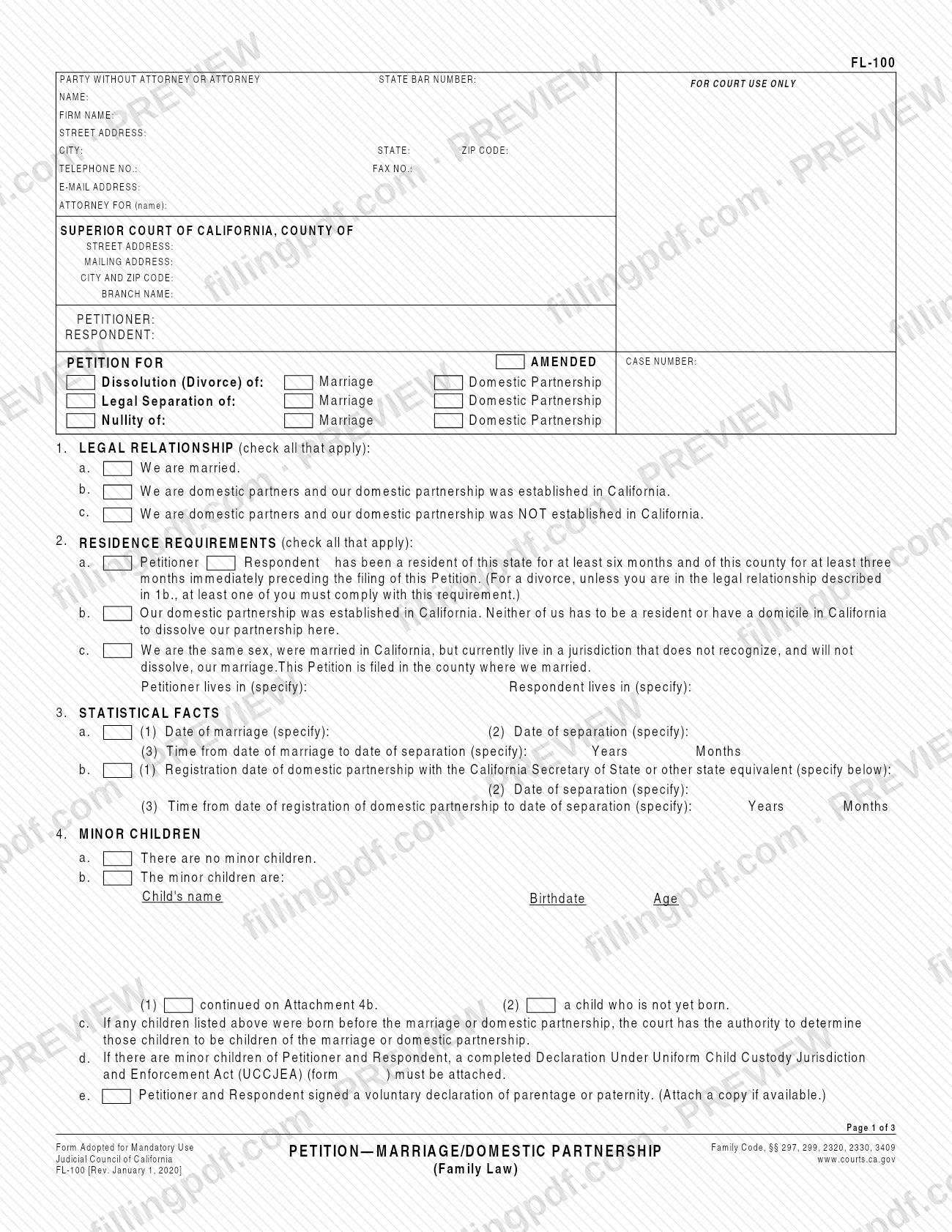
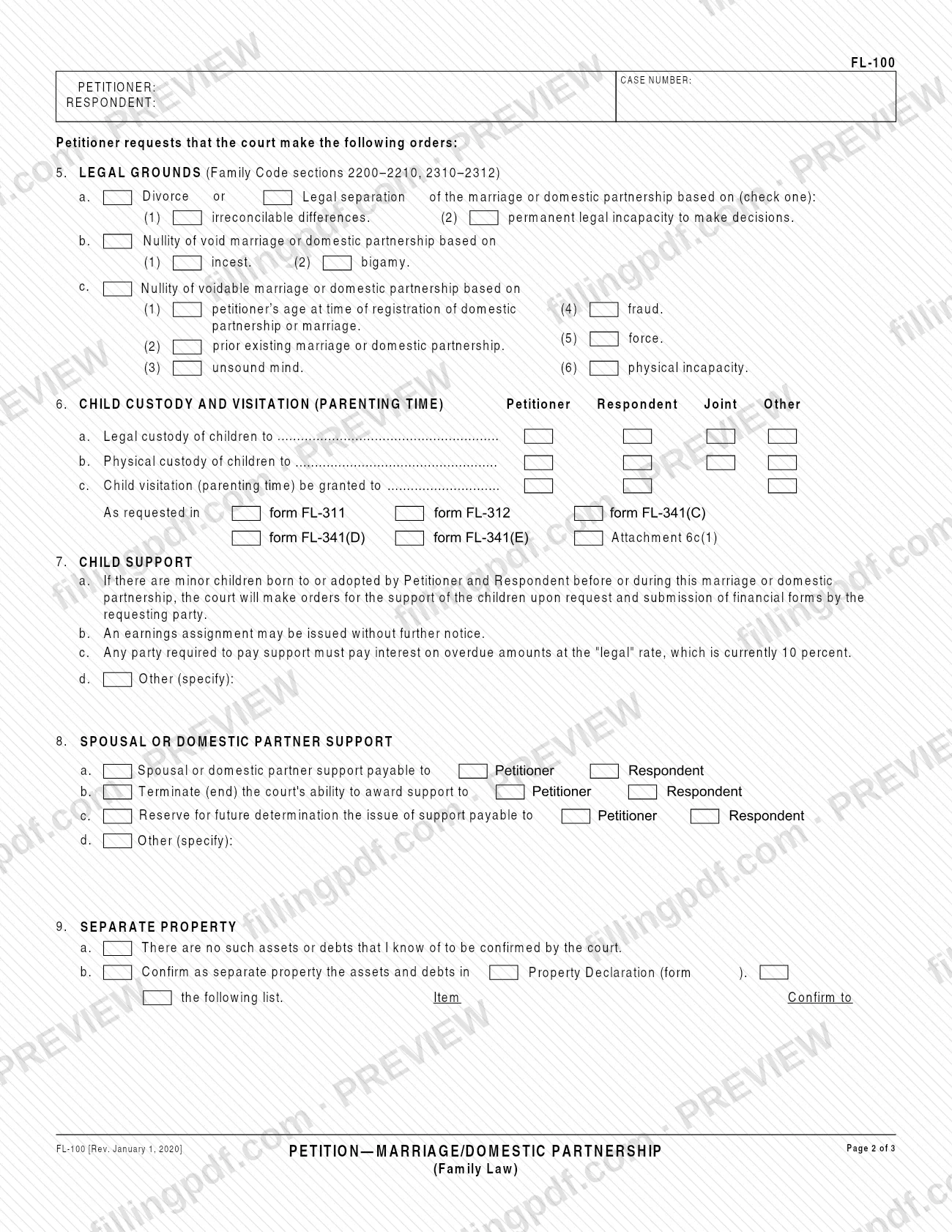
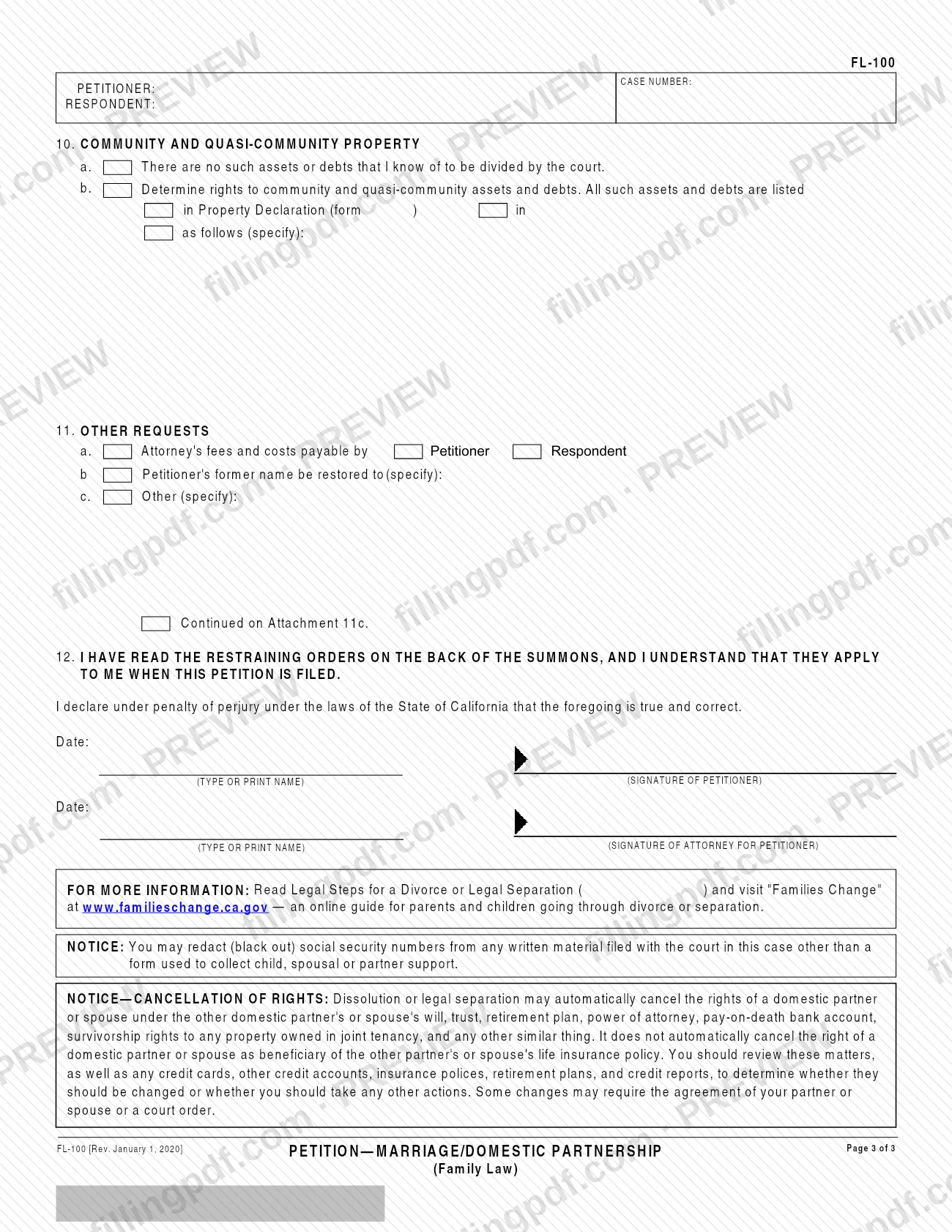
FL-100 is the Petition—Marriage/Domestic Partnership (Family Law), the Judicial Council of California form that starts a divorce (dissolution), legal separation or nullity case for spouses, registered domestic partners, or both. The petitioner uses it to state the legal relationship, the residence facts, any minor children and every order the court is asked to make. On this page you can fill out the form online on FillingPDF and download or print the completed PDF; the form is published by the California courts at courts.ca.gov.
Last updated
What is FL-100?
Form FL-100, Petition—Marriage/Domestic Partnership (Family Law), is the Judicial Council of California form used to start a case for dissolution (divorce), legal separation or nullity of a marriage or domestic partnership and to state the orders the petitioner requests.
The caption names the Superior Court of California, county and branch, the Petitioner and the Respondent. A box at the top shows whether the filing is a petition for dissolution, legal separation or nullity, of a marriage, a domestic partnership, or both, and whether it is an amended petition with a case number. The California courts' self-help page describes the form as the one that identifies all the issues you want to include in a judgment.
The petition has 12 numbered items:
- Legal relationship, residence requirements and statistical facts (items 1 to 3).
- Minor children (item 4).
- Legal grounds under Family Code sections 2200–2210 and 2310–2312 (item 5).
- Requested orders on custody and visitation, child support, spousal or domestic partner support, separate property, and community and quasi-community property (items 6 to 10).
- Other requests, such as attorney's fees and costs or restoring a former name (item 11).
- An acknowledgment of the restraining orders on the back of the summons (item 12), followed by the signature under penalty of perjury.
The form is adopted for mandatory use and cites Family Code sections 297, 299, 2320, 2330 and 3409. It is available in Arabic, Chinese Simplified, Korean, Spanish and Vietnamese on the self-help page.
Who needs to file FL-100?
The petitioner, meaning the spouse or registered domestic partner who starts the case, completes Form FL-100. The other spouse or partner is named as the Respondent. The California courts' self-help page says the form is for people who are married, registered domestic partners, or both.
The form lets you check the case type (dissolution, legal separation or nullity) and the legal relationship that applies: married, domestic partners whose partnership was established in California, or domestic partners whose partnership was not established in California.
Residence rules on the form depend on your situation:
- Generally, the Petitioner or the Respondent has been a resident of California for at least six months and of the county for at least three months immediately before filing. For a divorce, at least one of you must meet this unless you are in the legal relationship described in item 1b.
- If the domestic partnership was established in California, neither of you has to be a resident or have a domicile in California to dissolve it there.
- Same-sex couples married in California who live where the marriage is not recognized and cannot be dissolved file in the county where they married.
An attorney may sign for the petitioner in the attorney block; a party without an attorney completes the form personally.
When to file FL-100
File Form FL-100 when you are ready to start a divorce, legal separation or nullity case. It is the document that opens the case, so no due date is printed on it. The residence requirement in item 2 is measured at filing: for most petitions, at least six months in California and three months in the county immediately before the petition is filed.
If you are changing a petition that is already on file, check the PETITION FOR AMENDED box and enter the existing case number.
The statistical facts in item 3 depend on the date of marriage or the registration date of the domestic partnership and the date of separation, so have those dates ready before you begin.
Documents you need
- Form FL-105, Declaration Under Uniform Child Custody Jurisdiction and Enforcement Act (UCCJEA): a completed copy must be attached if there are minor children of the Petitioner and Respondent.
- A copy of the voluntary declaration of parentage or paternity, if you and the Respondent signed one and a copy is available (item 4e).
- Attachment 4b, if there are more children than fit in the list of minor children in item 4b.
- The custody or visitation forms or Attachment 6c(1), only if item 6c says visitation is requested as set out in them (FL-311, FL-312, FL-341(C), FL-341(D), FL-341(E)).
- Property Declaration (form FL-160) as Attachment 9b or 10b, or the list written on the form, if you ask the court to confirm separate property or determine community and quasi-community property.
- Attachment 11c, only if your other requests in item 11c continue beyond the space on the form.
How to fill out FL-100
Complete the attorney and court caption
At the top of page 1, enter your name, address, telephone, fax and email, or the attorney's details, then the county, court addresses and branch. Enter the Petitioner and Respondent names and, for an amended petition, the case number.
Select the type of petition
Check Dissolution (Divorce), Legal Separation or Nullity, and for each one mark Marriage or Domestic Partnership. Check PETITION FOR AMENDED only if you are amending a petition already filed.
Describe your legal relationship
In item 1, check all that apply: we are married (1a), domestic partners with the partnership established in California (1b), or established elsewhere (1c).
State the residence requirements
In item 2, check all that apply and mark whether the Petitioner, the Respondent or both meet the six-month state and three-month county rule. Use 2b or 2c if the domestic partnership was established in California or you are a same-sex couple married in California; enter where each of you lives where the form asks.
Enter the statistical facts
For a marriage, complete item 3a with the date of marriage, the date of separation and the years and months between them. For a domestic partnership, complete item 3b with the registration date, the date of separation and the time between them.
List any minor children
In item 4, check 4a if there are none, or list each child's name, birthdate and age under 4b and check the box for a child not yet born or a continuation on Attachment 4b. Check 4e if you both signed a voluntary declaration of parentage, and attach Form FL-105 if there are minor children.
Choose the legal grounds
In item 5, check one ground for a divorce or legal separation (5a), or the ground for nullity of a void (5b) or voidable (5c) marriage or domestic partnership.
Request custody and visitation orders
In item 6, mark Petitioner, Respondent, Joint or Other for legal custody (6a), physical custody (6b) and visitation (6c). For 6c, check the form or attachment that sets out the request.
Review child support and spousal support
Item 7 states the child support terms; use 7d for anything else. In item 8, check whether support is payable to the Petitioner or Respondent (8a), whether the court's ability to award support ends (8b) or is reserved (8c), or give details in 8d.
Address separate and community property
In item 9, check 9a if there are no assets or debts to confirm, or confirm separate property in Form FL-160 or the list (9b). In item 10, check 10a or ask the court to determine community and quasi-community rights in Form FL-160 or the list (10b).
Add other requests
In item 11, check whether attorney's fees and costs are payable by the Petitioner or Respondent (11a), enter the former name to restore (11b), or specify other requests in 11c.
Review, sign and download the PDF
Item 12 confirms you read the restraining orders on the back of the summons. Enter the date, type or print your name, sign as Petitioner, and have your attorney sign if you have one. Check every item, then download or print the completed PDF from FillingPDF.
How to submit FL-100
Form FL-100 is filed with the Superior Court of California for the county you name in the caption; the form prints no other channel, address or portal.
- Court named on the form: enter the county, the court's street and mailing addresses and the branch name in the caption at the top of page 1.
- Same-sex couples married in California who live where the marriage is not recognized file in the county where they married (item 2c).
- Attachments: include Form FL-105 when there are minor children, any attachments you refer to in items 4b, 6c, 9b, 10b and 11c, and a copy of a voluntary declaration of parentage if you have one.
- Redaction: you may black out social security numbers on written material filed in the case, other than a form used to collect child, spousal or partner support.
Item 12 refers to the restraining orders on the back of the summons, which apply to the petitioner when the petition is filed. For more information the form points to Legal Steps for a Divorce or Legal Separation (form FL-107-INFO) and to www.familieschange.ca.gov. FillingPDF lets you fill out and download the PDF; submission follows the court channels above.
Common mistakes to avoid
- Filing without a completed Form FL-105 when the Petitioner and Respondent have minor children; item 4d says it must be attached.
- Checking more than one ground in item 5a; the form says to check one for divorce or legal separation.
- Leaving item 1 incomplete when more than one answer applies; the form says to check all that apply.
- Relying on the residence rule without checking it: the Petitioner or Respondent needs at least six months in California and three months in the county before filing, unless item 2b or 2c applies.
- Choosing items 9b or 10b without listing the assets and debts in Form FL-160 or on the form's own list.
- Signing without reading the restraining orders on the back of the summons, which item 12 says apply to you when the petition is filed.
- Assuming dissolution or legal separation automatically cancels a spouse's or partner's rights as life insurance beneficiary; the form's notice says it does not.
- Overlooking the other accounts and documents the notice says to review after filing, such as wills, trusts, retirement plans, powers of attorney and pay-on-death bank accounts.
Frequently asked questions
What is the FL-100 form?
The FL-100 is the Judicial Council of California's Petition—Marriage/Domestic Partnership (Family Law). It starts a divorce, legal separation or nullity case for married couples, registered domestic partners, or both, and lists the issues and orders the petitioner asks the court to decide.
Who files Form FL-100, the petitioner or the respondent?
The petitioner files it. That is the spouse or domestic partner who starts the case and signs the petition under penalty of perjury. The other spouse or partner is named as the Respondent in the caption, and an attorney may sign for the petitioner.
Do I have to live in California to file for divorce on Form FL-100?
For a divorce, the Petitioner or Respondent must generally have lived in California at least six months and in the county at least three months before filing. A domestic partnership established in California can be dissolved there even if neither partner lives in California.
Do I need to attach anything to the FL-100?
Yes, if you have minor children together: attach a completed Form FL-105 (UCCJEA declaration). Also attach a copy of any voluntary declaration of parentage if available, and any attachments or Form FL-160 you refer to in items 4b, 6c, 9b, 10b and 11c.
Is Form FL-100 available in Spanish or other languages?
Yes. The California courts' self-help page offers form FL-100 in Arabic, Chinese Simplified, Korean, Spanish and Vietnamese. The English version is the one printed here, and it is the version revised January 1, 2020.
Can I fill out the FL-100 online?
You can fill out the FL-100 PDF online on FillingPDF and download or print it. FillingPDF is an independent service and does not file the petition with a court; you file the completed form with the Superior Court of the county named in the caption.
Does a divorce cancel my spouse's rights under my will or insurance?
The form's notice says dissolution or legal separation may automatically cancel rights under the other person's will, trust, retirement plan, power of attorney, pay-on-death bank account and joint tenancy survivorship. It does not automatically cancel the right to be a life insurance beneficiary.
Which legal grounds can I choose on Form FL-100?
For a divorce or legal separation, check one: irreconcilable differences or permanent legal incapacity to make decisions. For nullity, item 5 lists incest and bigamy for a void marriage or partnership, and age, prior marriage or partnership, unsound mind, fraud, force or physical incapacity for a voidable one.
Ready to fill out FL-100?
Fill out FL-100 now