
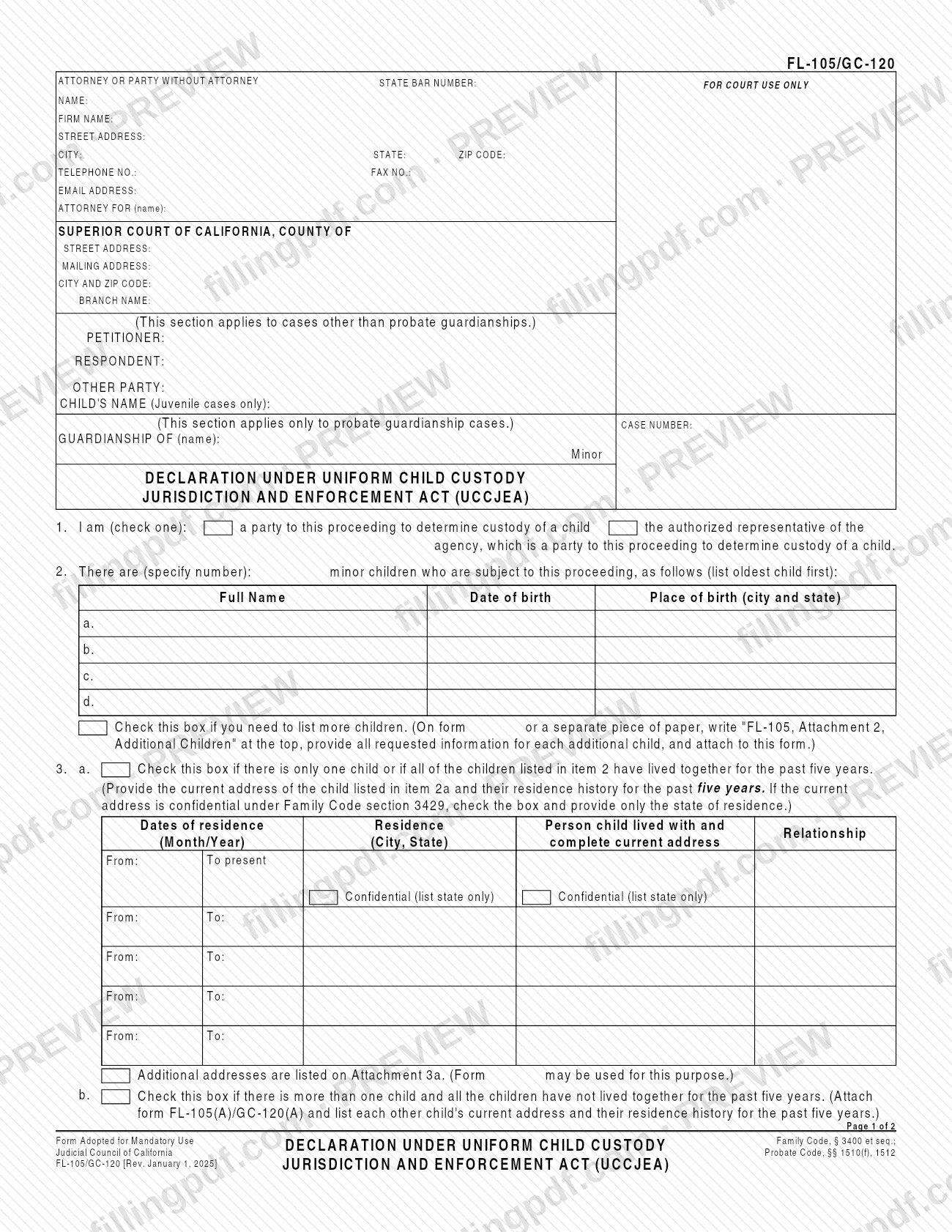
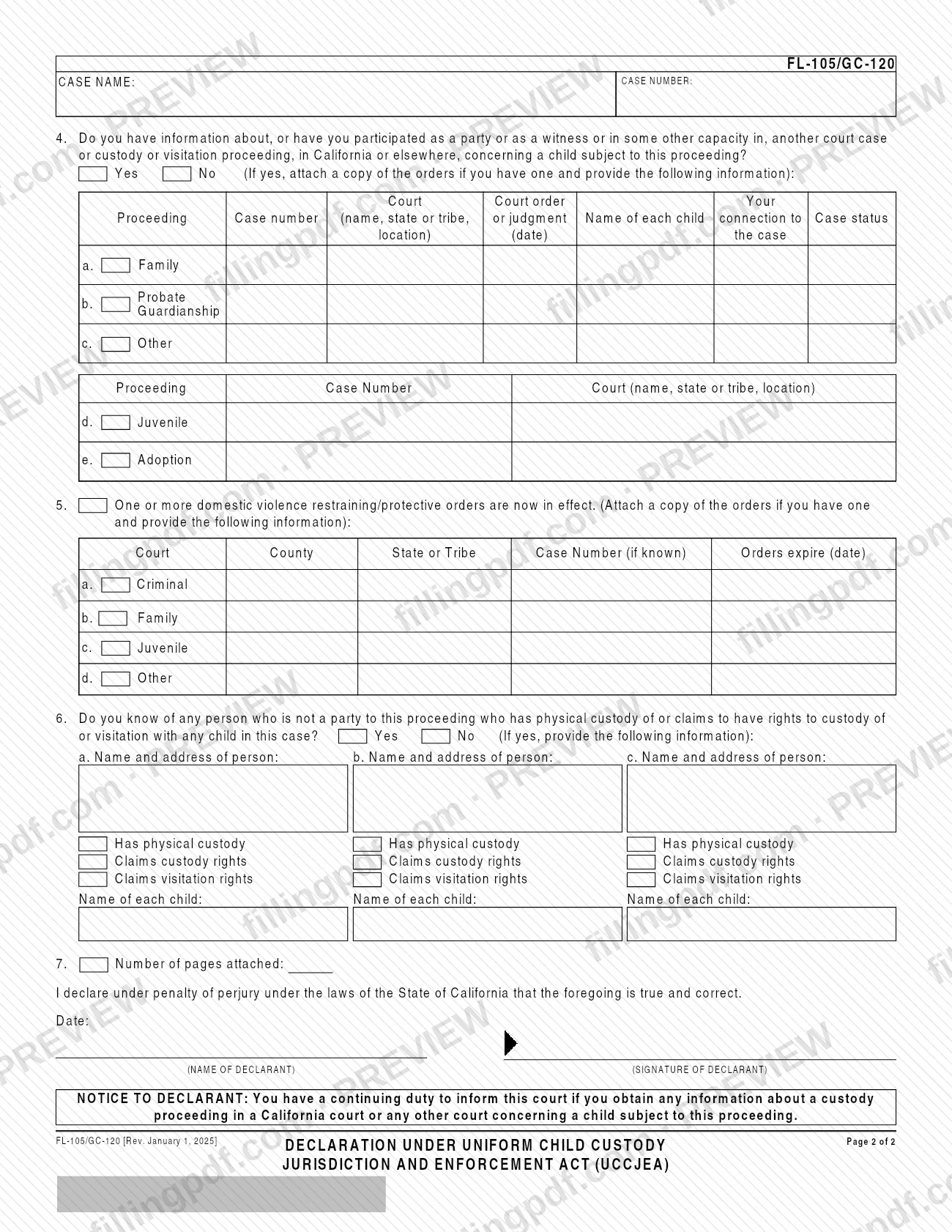
FL-105 is the Declaration Under Uniform Child Custody Jurisdiction and Enforcement Act (UCCJEA), a Judicial Council of California form that gives the court information about the children in a custody proceeding. It carries a second number, GC-120, because the same form is used in probate guardianship cases. You can fill out the form online on FillingPDF and download or print the completed PDF; the Judicial Council publishes the official PDF at courts.ca.gov.
Last updated
What is FL-105/GC-120?
Form FL-105/GC-120, Declaration Under Uniform Child Custody Jurisdiction and Enforcement Act (UCCJEA), is the Judicial Council of California form in which a party to a custody proceeding states, under penalty of perjury, where each child was born and has lived and what other cases involve the child.
The Judicial Council's self-help page describes it as the way to give the court important information about the children you have with your spouse or domestic partner, which the court considers before making child custody and visitation orders. The form is marked "Form Adopted for Mandatory Use" and cites Family Code, § 3400 et seq. and Probate Code, §§ 1510(f) and 1512.
The declaration has seven numbered items:
- the declarant's capacity (item 1);
- the children, listed oldest first (item 2);
- their addresses for the past five years (item 3);
- other custody, visitation, probate guardianship, juvenile or adoption cases (item 4);
- domestic violence restraining or protective orders now in effect (item 5);
- non-parties who have physical custody or claim custody or visitation rights (item 6);
- the number of attached pages (item 7).
Two companion pieces appear on the form itself: FL-105(A)/GC-120(A), attached when the children have not all lived together for the past five years, and MC-020, which may be used for additional children or addresses. The Judicial Council also offers the form in Chinese Simplified, Korean, Spanish and Vietnamese.
Who needs to file FL-105/GC-120?
The declaration is completed by a party to a proceeding to determine custody of a child, or by the authorized representative of an agency that is a party to such a proceeding. Item 1 asks you to check which of the two you are.
The caption has two sections. One applies to cases other than probate guardianships, where the parties appear as petitioner, respondent or other party (with the child's name for juvenile cases only). The other applies only to probate guardianship cases and asks for the name of the minor.
The form does not say who may sign on behalf of someone else beyond the agency representative in item 1. The signature block asks for the declarant's name and signature, and the declaration is made under penalty of perjury under California law.
The Judicial Council's self-help page describes the form as information about the children you have with your spouse or domestic partner, so it fits custody and visitation cases of that kind. It also serves probate guardianship cases, which is why it carries the GC-120 number.
When to file FL-105/GC-120
The form prints no due date of its own. You complete it for a proceeding to determine custody of a child, and the court uses it before making custody and visitation orders.
The notice at the bottom of page 2 adds a continuing duty: if you obtain any information about a custody proceeding in a California court or any other court concerning a child subject to this proceeding, you must inform the court. Item 4 asks about such proceedings and item 5 about domestic violence orders currently in effect, so check those answers against what you know on the day you sign.
The Judicial Council's self-help page lists January 1, 2025 as the effective date of the current revision.
Documents you need
- Copy of any court orders you have for the cases listed in item 4 (family, probate guardianship, juvenile, adoption or other proceedings concerning a child in this case).
- Copy of any domestic violence restraining or protective orders you have, when item 5 applies because such orders are now in effect.
- Form FL-105(A)/GC-120(A), when you check item 3b because there is more than one child and the children have not all lived together for the past five years.
- Attachment 2, Additional Children, when you check the box in item 2 to list more children; use form MC-020 or a separate paper headed "FL-105, Attachment 2, Additional Children."
- Attachment 3a, when additional addresses are needed for the residence history in item 3a; form MC-020 may be used for this.
How to fill out FL-105/GC-120
Complete the caption at the top
Enter the attorney or party information, the Superior Court of California county and address, the case name and the case number. Fill in the petitioner, respondent and other party for cases other than probate guardianships, or the minor's name for a guardianship.
Check your capacity in item 1
Check whether you are a party to this proceeding to determine custody of a child, or the authorized representative of the agency that is a party.
List the children in item 2
Enter the number of minor children, then each child's full name, date of birth and place of birth (city and state), oldest child first, on lines a through d. If you need more lines, check the box and attach an additional page headed "FL-105, Attachment 2, Additional Children."
Give residence history in item 3
Check 3a if there is one child or all children have lived together for the past five years, then enter dates of residence (Month/Year), city and state, and the person the child lived with with their relationship and current address. Check 3b instead if the children have not lived together, and attach FL-105(A)/GC-120(A).
Handle confidential addresses
If the current address is confidential under Family Code section 3429, check the Confidential (list state only) box and give only the state of residence.
Report other cases in item 4
Check Yes or No for any other court case or custody or visitation proceeding concerning a child in this proceeding. If Yes, give the case number, court, order date, child's name, your connection and case status for each family, probate guardianship, other, juvenile or adoption case, and attach orders you have.
Report protective orders in item 5
Check the box if domestic violence restraining or protective orders are now in effect, then list the court, county, state or tribe, case number if known and expiration date for each criminal, family, juvenile or other order. Attach copies you have.
Identify other claimants in item 6
Check Yes or No for any non-party who has physical custody of, or claims custody or visitation rights to, a child. If Yes, give each person's name and address, check what applies and name each child.
Enter the page count in item 7
Write the number of pages attached, including any MC-020 pages, Attachment 2 or 3a, and FL-105(A)/GC-120(A).
Sign, review and download the PDF
Enter the date, the declarant's printed name and signature under the penalty of perjury statement, and read the notice about your continuing duty to inform the court. Check every item, then download or print the completed PDF from FillingPDF.
How to submit FL-105/GC-120
The form prints no filing address, portal or appointment rule. It is captioned for a specific court, "Superior Court of California, County of," with a case number, so the completed declaration belongs in that court's case. Ask the court handling your case how it accepts filings.
- Signature: sign and date the declaration at the bottom of page 2 with the declarant's name and signature.
- Attachments: include the pages you list in item 7, such as copies of orders (items 4 and 5), Attachment 2 or 3a, or form FL-105(A)/GC-120(A).
- Confidential address: if a child's current address is confidential under Family Code section 3429, check the box in item 3a and list only the state.
FillingPDF lets you fill out and download the PDF; submission follows the channels that apply in your court.
Common mistakes to avoid
- Listing the children out of order in item 2; the form asks for the oldest child first.
- Checking item 3a when the children have not all lived together for the past five years; that situation calls for item 3b and form FL-105(A)/GC-120(A).
- Giving a full street address in item 3a when the current address is confidential under Family Code section 3429; the form says to check the box and list the state only.
- Leaving out the title "FL-105, Attachment 2, Additional Children" on the extra page when more than four children are listed.
- Omitting a copy of the court orders for a case reported in item 4 or a protective order reported in item 5, when you have one.
- Leaving the number of attached pages blank in item 7 after adding attachments.
- Signing without the declarant's name or date, though the declaration is made under penalty of perjury.
- Forgetting the continuing duty to tell the court about any new custody proceeding you learn of after you sign.
Frequently asked questions
What is form FL-105 used for?
FL-105 is the Judicial Council of California declaration under the UCCJEA. A party to a custody proceeding uses it to give the court the children's birth details, five-year residence history, other court cases, protective orders and other people claiming custody or visitation.
Who has to complete the FL-105 declaration?
A party to the proceeding to determine custody of a child, or the authorized representative of an agency that is a party. Item 1 asks you to check which one you are, and the declarant signs under penalty of perjury under California law.
Is FL-105 the same as GC-120?
They are one form with two numbers: FL-105/GC-120. The family case caption applies to cases other than probate guardianships, and a separate caption section applies only to probate guardianship cases, where you give the minor's name.
What if the child's address is confidential?
If the current address is confidential under Family Code section 3429, check the Confidential (list state only) box in item 3a and give only the state of residence instead of the full address.
When do I need form FL-105(A)/GC-120(A)?
Check item 3b and attach FL-105(A)/GC-120(A) when there is more than one child and the children have not all lived together for the past five years. List each other child's current address and five-year residence history there.
What do I attach to FL-105?
Attach copies of orders you have for cases in item 4 and protective orders in item 5. Add Attachment 2 (more children), Attachment 3a (more addresses, on MC-020 or plain paper) or FL-105(A)/GC-120(A) if they apply, and write the page count in item 7.
Do I have to update the court after I sign FL-105?
Yes. The notice on page 2 says you have a continuing duty to inform the court if you obtain information about a custody proceeding in a California court or any other court concerning a child subject to this proceeding.
Is FL-105 available in Spanish?
Yes. The Judicial Council's self-help page offers FL-105 in Spanish, Chinese Simplified, Korean and Vietnamese. Use the version your court accepts and check with the court clerk if you are unsure.
Can I fill out FL-105 online on FillingPDF?
Yes. You can fill out the FL-105 PDF online on FillingPDF and download or print it. FillingPDF does not file it with the court or connect to the Judicial Council; you submit the completed declaration through the court handling your case.
Ready to fill out FL-105/GC-120?
Fill out FL-105/GC-120 now