
FL-110 is the Summons (Family Law) published by the Judicial Council of California. It tells the respondent, your spouse or domestic partner, that a court case has started, states the 30-calendar-day deadline to file a Response (form FL-120), and carries the standard family law restraining orders on page 2. On this page you can fill out the form online on FillingPDF and download or print the completed PDF; the official PDF is published by the Judicial Council at courts.ca.gov.
Last updated
What is FL-110?
Form FL-110, Summons (Family Law), is the Judicial Council of California form that notifies the respondent that a family law case has been filed, explains the 30-day deadline to respond, and sets out standard restraining orders that apply to both spouses or domestic partners.
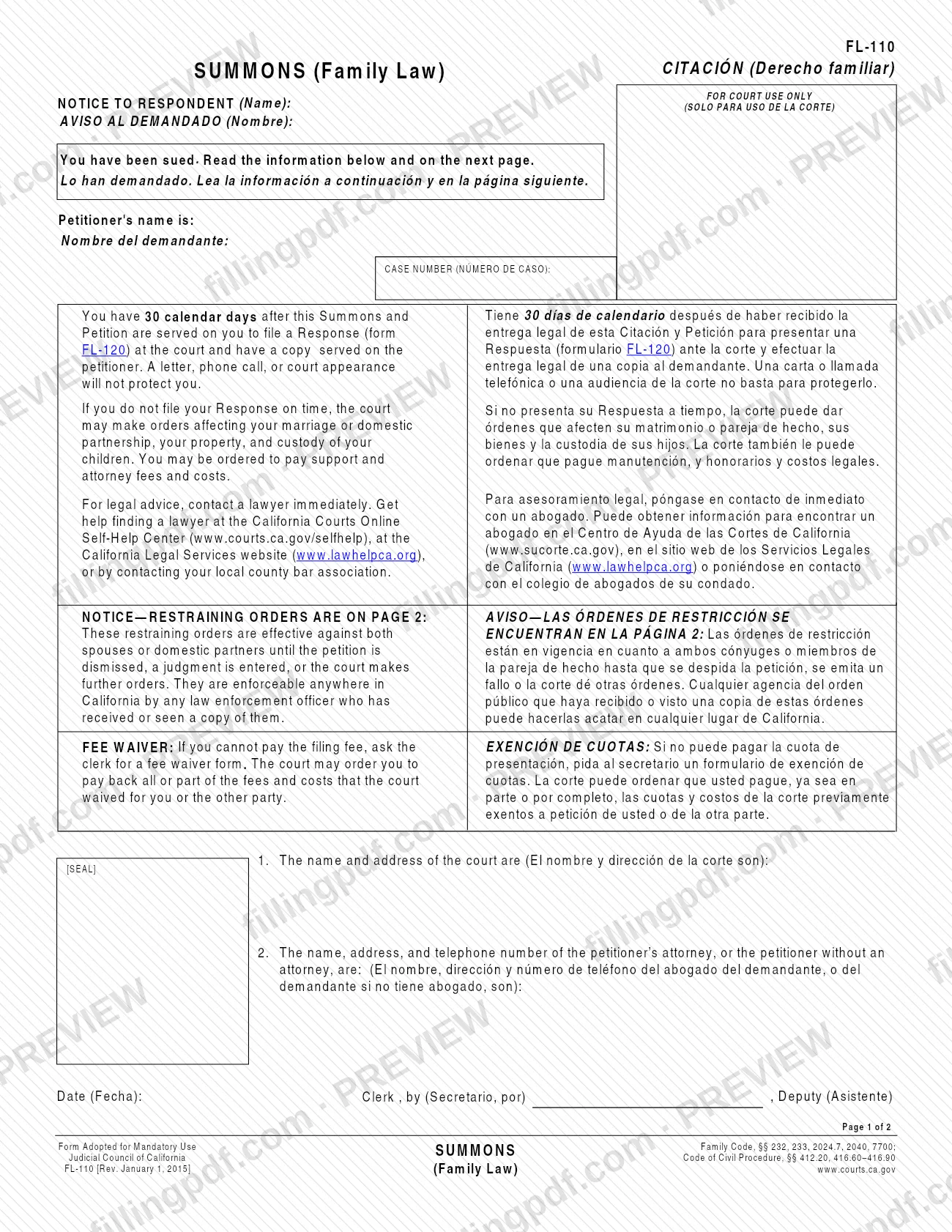
The form is printed in English and Spanish side by side. Page 1 opens with "You have been sued" and names the respondent, the petitioner and the case number. It tells the respondent that a letter, phone call or court appearance will not protect them, and that if no Response is filed on time the court may make orders affecting the marriage or domestic partnership, property and custody of children, and may order support and attorney fees and costs. It also carries a fee waiver notice, a seal area, item 1 (the name and address of the court), item 2 (the petitioner's attorney, or the petitioner without an attorney) and a line for the date, the clerk and the deputy.
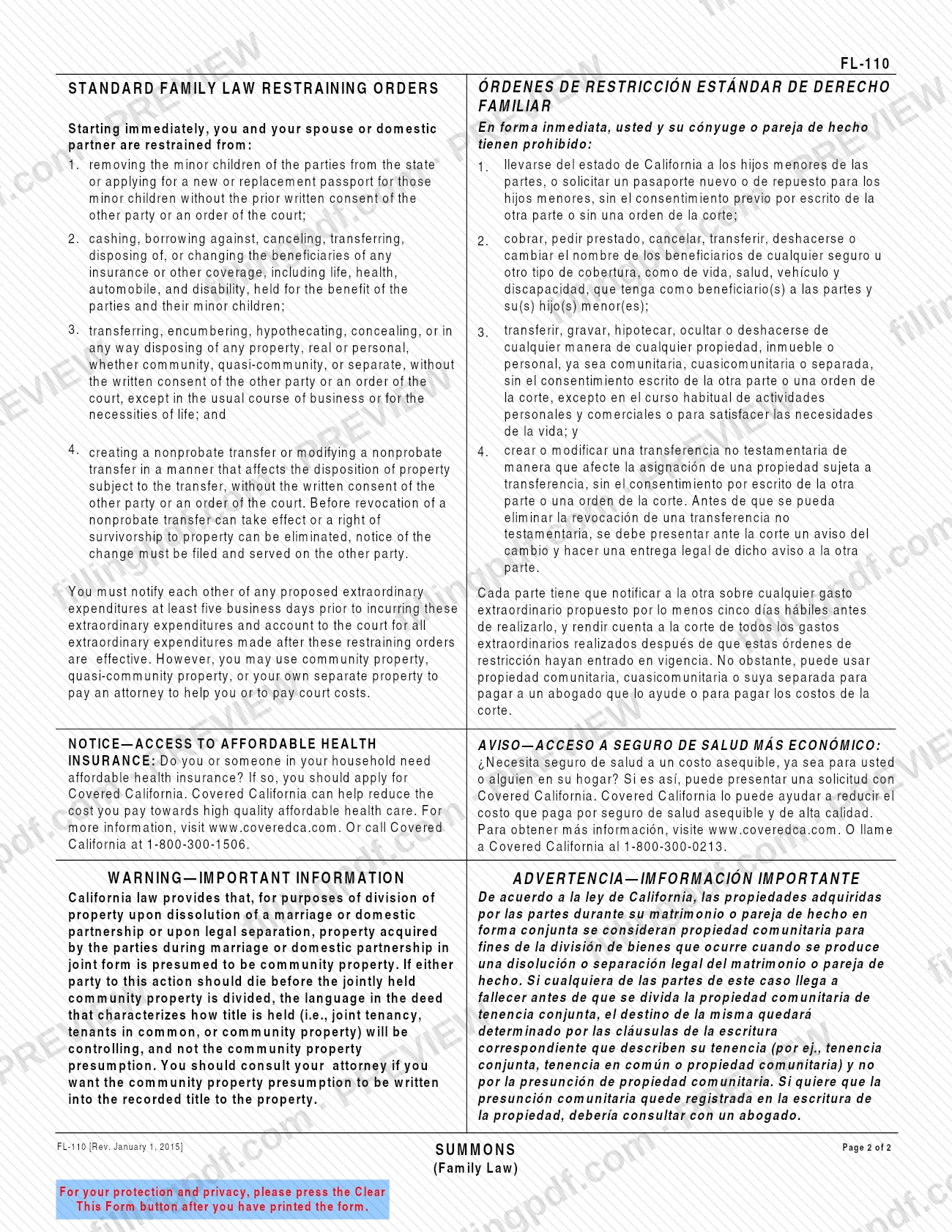
Page 2 contains the standard family law restraining orders, a notice about Covered California health coverage and a warning about how jointly held property is treated if a party dies before community property is divided.
FL-110 is the summons that accompanies the petition. The respondent answers with a Response on form FL-120. The form is adopted for mandatory use and cites Family Code sections 232, 233, 2024.7, 2040 and 7700 and Code of Civil Procedure sections 412.20 and 416.60–416.90. The California Courts Self-Help Center also lists the form in Arabic, Chinese Simplified, Korean and Vietnamese.
Who needs to file FL-110?
The form is addressed to the respondent, the spouse or domestic partner who is being sued in a family law case. It is the summons that the petitioner's side serves together with the petition, and item 2 lists the petitioner's attorney or, if there is none, the petitioner.
- Respondents who receive the Summons and Petition must read both pages. The 30-calendar-day period to file a Response (form FL-120) runs from the day they are served.
- Petitioners and their attorneys appear on the form in item 2 with name, address and telephone number. The form has a line for the clerk's date and signature and a seal area for the court.
- Both spouses or domestic partners are bound by the restraining orders on page 2 once they take effect.
The form does not say who may sign for another person or act as a representative. For legal advice it directs you to a lawyer, the California Courts Online Self-Help Center (www.courts.ca.gov/selfhelp), the California Legal Services website (www.lawhelpca.org) or your local county bar association.
When to file FL-110
The respondent has 30 calendar days after the Summons and Petition are served to file a Response (form FL-120) at the court and have a copy served on the petitioner. A letter, phone call or court appearance does not protect the respondent. If no Response is filed on time, the court may make orders about the marriage or domestic partnership, property and custody of children, and may order support and attorney fees and costs.
The restraining orders on page 2 apply starting immediately and stay in effect against both spouses or domestic partners until the petition is dismissed, a judgment is entered, or the court makes further orders. Under them, each party must notify the other of any proposed extraordinary expenditure at least five business days before making it. The form prints no separate due date for issuing the Summons itself.
Documents you need
- The Petition, served together with the Summons; the form says the 30-day period to respond runs from service of the Summons and Petition.
- Form FL-120, Response, which the respondent files at the court, with a copy served on the petitioner, within 30 calendar days after service.
- A fee waiver form from the court clerk, only if you cannot pay the filing fee.
How to fill out FL-110
Enter the respondent's name
In the box labeled NOTICE TO RESPONDENT (Name), enter the name of the spouse or domestic partner who is being sued.
Enter the petitioner's name
Next to Petitioner's name is, enter the name of the person who filed the petition.
Enter the case number
Write the case number in the CASE NUMBER box at the top right of page 1.
Complete item 1, the court
In item 1, enter the name and address of the court where the case is filed.
Complete item 2, the petitioner's contact
In item 2, enter the name, address and telephone number of the petitioner's attorney, or of the petitioner if there is no attorney.
Leave the clerk's areas for the court
The FOR COURT USE ONLY area, the seal, and the Date, Clerk, by and Deputy line are for the court clerk; do not fill them in yourself.
Check page 2 restraining orders
Page 2 has no entries. It prints the standard family law restraining orders, the Covered California notice and the property warning, and it must stay with page 1.
Review and download the completed PDF
Check the names, case number, court and petitioner details, then download or print the completed PDF from FillingPDF and keep both pages together for service and filing as described under How to submit.
How to submit FL-110
The form names no portal, mailing address or other channel for the Summons itself. What it does state is how the papers move: the Summons and Petition are served on the respondent, and the respondent files a Response (form FL-120) at the court and has a copy served on the petitioner.
- Court named in item 1: the court's name and address are entered in item 1, so use that court for filing questions and procedures.
- Fee waiver: if you cannot pay the filing fee, ask the clerk for a fee waiver form. The court may order you to pay back all or part of the fees and costs it waived.
- Help: the form points to the California Courts Online Self-Help Center (www.courts.ca.gov/selfhelp), the California Legal Services website (www.lawhelpca.org) and your local county bar association.
The clerk completes the date and signature line and the court seal area. FillingPDF lets you fill out and download the PDF; submission follows the court's channels and the service rules above.
Common mistakes to avoid
- Relying on a letter, phone call or court appearance to answer the case; the form states these will not protect the respondent.
- Missing the 30-calendar-day period after the Summons and Petition are served, which lets the court make orders on marriage, property, custody, support and fees.
- Filing a Response (form FL-120) at the court without having a copy served on the petitioner.
- Printing or reading only page 1; the standard family law restraining orders are on page 2.
- Making an extraordinary expenditure without giving the other party at least five business days' notice.
- Transferring, hiding or disposing of property, or changing insurance beneficiaries, without written consent or a court order, which the page 2 restraining orders prohibit.
- Leaving item 1 or item 2 incomplete, so the court's name and address or the petitioner's attorney or the petitioner's contact details are missing.
- Waiting to ask the clerk for a fee waiver form when you cannot pay the filing fee.
Frequently asked questions
What is form FL-110?
FL-110 is the Summons (Family Law) from the Judicial Council of California. It tells the respondent that a family law case has started, states the 30-calendar-day deadline to file a Response (form FL-120), and sets standard restraining orders that apply to both spouses or domestic partners.
How long do I have to respond to a family law summons in California?
You have 30 calendar days after the Summons and Petition are served on you to file a Response (form FL-120) at the court and serve a copy on the petitioner. The form says a letter, phone call or court appearance will not protect you.
What happens if I do not respond to form FL-110?
If you do not file your Response on time, the court may make orders affecting your marriage or domestic partnership, your property and custody of your children. You may also be ordered to pay support and attorney fees and costs.
What restraining orders are on page 2 of FL-110?
They bar both parties from removing minor children from California or applying for their passports without consent or a court order, changing insurance coverage or beneficiaries, disposing of property except in the usual course of business or for life's necessities, and making certain nonprobate transfers without consent or an order. They stay in effect until the petition is dismissed, a judgment is entered or the court orders otherwise.
Can I get a fee waiver if I cannot pay the filing fee?
Yes, you can ask the clerk for a fee waiver form. The court may later order you to pay back all or part of the fees and costs it waived for you or the other party.
Can I fill out FL-110 online?
You can fill out the FL-110 PDF online on FillingPDF and download or print it. FillingPDF is an independent service and does not file or serve the form; the court and service rules on the form apply.
Is FL-110 available in languages other than English?
The form itself prints English and Spanish side by side. The California Courts Self-Help Center also lists FL-110 in Arabic, Chinese Simplified, Korean and Vietnamese.
What is the difference between FL-110 and FL-120?
FL-110 is the Summons served with the petition to tell the respondent a case has started. FL-120 is the Response the respondent files at the court, within 30 calendar days of service, with a copy served on the petitioner.
Ready to fill out FL-110?
Fill out FL-110 now