
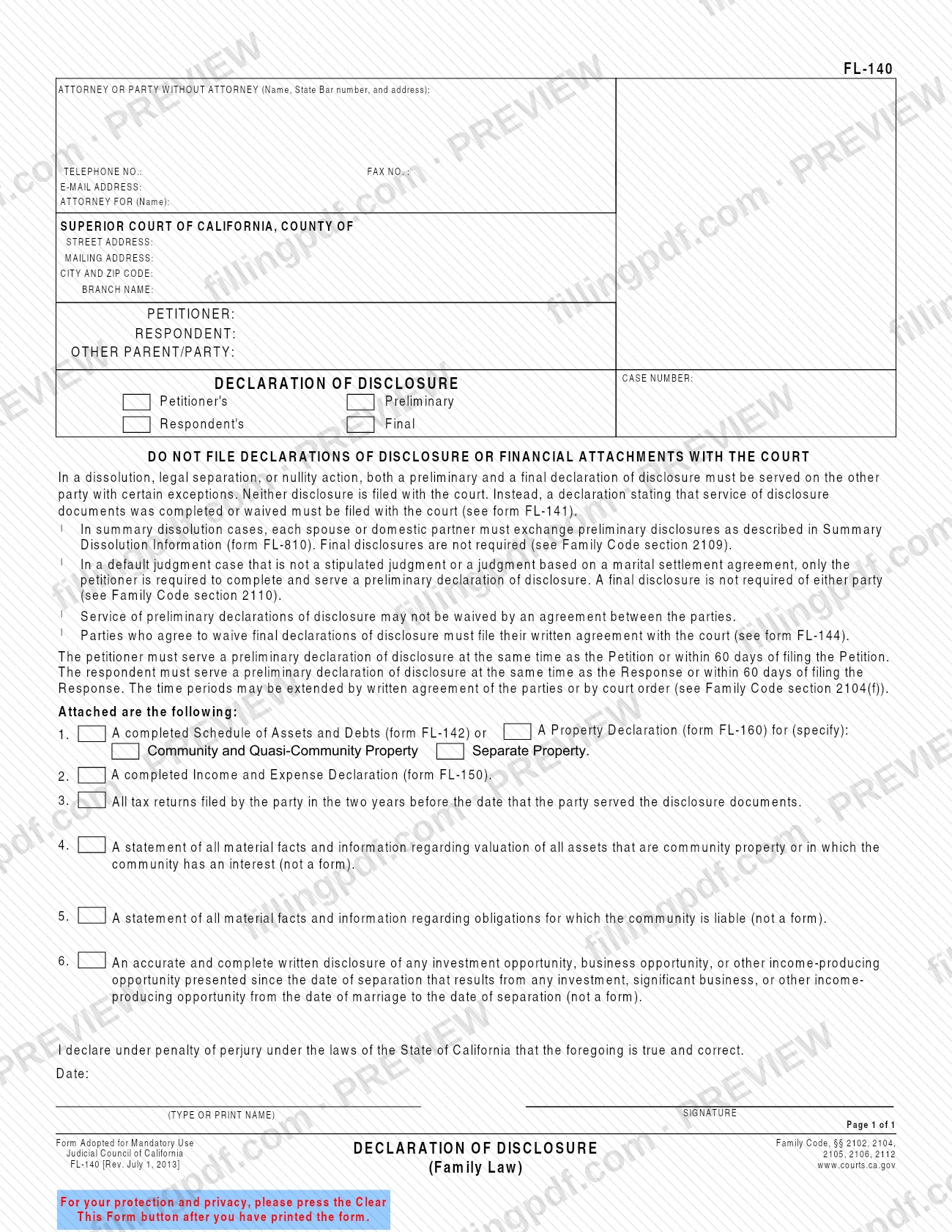
FL-140 is the Declaration of Disclosure, a Judicial Council of California family law form that works as the cover page for the financial disclosures spouses or domestic partners exchange in a dissolution, legal separation, or nullity action. It lists the financial documents and information the signing party attaches and declares them true under penalty of perjury. On this page you can fill out the form online on FillingPDF and download or print the completed PDF. The form is not filed with the court: it is served on the other party, and the court receives a separate declaration of service.
Last updated
What is FL-140?
Declaration of Disclosure (FL-140) is the Judicial Council of California form on which a party to a dissolution, legal separation, or nullity action lists the financial documents and information given to the other party as the preliminary or final set of disclosures.
The form is adopted for mandatory use and cites Family Code sections 2102, 2104, 2105, 2106 and 2112. It has boxes identifying the declaration as the petitioner's or respondent's, preliminary or final. It then lists what is attached: a Schedule of Assets and Debts (form FL-142) or a Property Declaration (form FL-160), an Income and Expense Declaration (form FL-150), tax returns, and three written statements that are not forms. The party signs it under penalty of perjury under California law.
The form says in capital letters that declarations of disclosure and financial attachments are not filed with the court. Both a preliminary and a final declaration must be served on the other party, with certain exceptions. What goes to the court is a declaration that service of the disclosure documents was completed or waived (form FL-141).
The California courts' self-help page also offers form FL-140 in Spanish. The page shows an effective date of July 1, 2013.
Who needs to file FL-140?
In a dissolution, legal separation, or nullity action, both parties must serve a preliminary and a final declaration of disclosure on the other party, with certain exceptions. The petitioner completes the petitioner's declaration and the respondent completes the respondent's. A party without an attorney enters their own information at the top of the form.
The form lists these exceptions:
- Summary dissolution: each spouse or domestic partner exchanges preliminary disclosures as described in Summary Dissolution Information (form FL-810). Final disclosures are not required (Family Code section 2109).
- Default judgment that is not a stipulated judgment or a judgment based on a marital settlement agreement: only the petitioner completes and serves a preliminary declaration of disclosure. Neither party owes a final disclosure (Family Code section 2110).
- Waiver of final declarations: parties who agree to waive them must file their written agreement with the court (form FL-144).
Service of preliminary declarations of disclosure may not be waived by an agreement between the parties.
When to file FL-140
The petitioner must serve a preliminary declaration of disclosure at the same time as the Petition or within 60 days of filing the Petition. The respondent must serve one at the same time as the Response or within 60 days of filing the Response. The parties can extend these periods by written agreement, or the court can extend them by order (Family Code section 2104(f)).
The form sets no date for the final declaration of disclosure. It states only that a final declaration must be served, with the exceptions for summary dissolution, certain default judgments, and a filed waiver agreement. Because the form itself is not filed with the court, the timing that matters is the service deadline. Once service is completed or waived, a declaration to that effect (form FL-141) is what you file.
Documents you need
- Item 1: a completed Schedule of Assets and Debts (form FL-142) or a Property Declaration (form FL-160), specifying whether it covers community and quasi-community property or separate property.
- Item 2: a completed Income and Expense Declaration (form FL-150).
- Item 3: all tax returns filed by the party in the two years before the date the party served the disclosure documents.
- Item 4: a statement of all material facts and information regarding valuation of all assets that are community property or in which the community has an interest (not a form).
- Item 5: a statement of all material facts and information regarding obligations for which the community is liable (not a form).
- Item 6: an accurate and complete written disclosure of any investment, business, or other income-producing opportunity presented since the date of separation, as described on the form (not a form).
How to fill out FL-140
Enter attorney or party information
At the top, enter the name, State Bar number, and address of the attorney or party without an attorney, plus telephone, fax, e-mail address, and the name of the party the attorney represents.
Complete the court caption
Enter the county of the Superior Court of California, its street address, mailing address, city and ZIP code, and branch name, exactly as they appear on your case papers.
Name the parties and case number
Enter the names of the petitioner, the respondent, and any other parent or party, then the case number.
Mark whose declaration this is
Check the box that matches the declaration you are making: the petitioner's or respondent's, preliminary or final. Check the exceptions at the top of the form before choosing.
Complete item 1 property schedule
Attach a completed Schedule of Assets and Debts (form FL-142) or a Property Declaration (form FL-160), and specify whether it covers community and quasi-community property or separate property.
Confirm items 2 and 3
Attach a completed Income and Expense Declaration (form FL-150) for item 2. For item 3, attach all tax returns you filed in the two years before the date you serve the disclosure documents.
Prepare the item 4 and 5 statements
Attach a statement of all material facts about the valuation of assets that are community property or in which the community has an interest (item 4), and one about obligations for which the community is liable (item 5). Neither is a form.
Prepare the item 6 disclosure
Attach an accurate and complete written disclosure of any investment, business, or other income-producing opportunity presented since the date of separation, as item 6 describes. It is not a form.
Date, print your name and sign
Enter the date, type or print your name, and sign above it. The declaration is made under penalty of perjury under California law.
Review and download the completed PDF
Check that every item you attached matches the list on the form and that the caption matches your case. Download or print the completed PDF from FillingPDF, then serve it as described under How to submit; it is not filed with the court.
How to submit FL-140
FL-140 is not filed with the court; it is served on the other party. The court receives only a separate declaration about service.
- Serve the other party: give the signed FL-140, with its financial attachments, to the other party in the case. The form says both a preliminary and a final declaration must be served, with certain exceptions. It does not describe the methods of service.
- File the proof with the court: file a declaration stating that service of the disclosure documents was completed or waived (form FL-141). The form prints no address, because filing goes to the Superior Court named in the caption of your case.
- Waiver of final disclosures: if both parties agree, file their written agreement with the court (form FL-144). Preliminary disclosure cannot be waived by agreement.
The form carries a warning not to file declarations of disclosure or financial attachments with the court. The Judicial Council's self-help page for FL-140 is at https://selfhelp.courts.ca.gov/jcc-form/FL-140. FillingPDF lets you fill out and download the PDF; submission follows the channels above.
Common mistakes to avoid
- Filing the declaration of disclosure or its financial attachments with the court; the form warns not to. Only the declaration of service (form FL-141) is filed.
- Trying to waive the preliminary declaration of disclosure by agreement; the form says service of preliminary declarations may not be waived by an agreement between the parties.
- Waiving final declarations by agreement but not filing the written agreement with the court (form FL-144).
- Serving the preliminary declaration after the 60-day period from filing the Petition or Response without a written agreement or court order extending it.
- Choosing form FL-142 or FL-160 in item 1 without specifying whether it covers community and quasi-community property or separate property.
- Leaving out attachments listed on the form, such as the Income and Expense Declaration (form FL-150), the tax returns for the two prior years, or the three written statements.
- Treating items 4, 5 and 6 as forms to download; the form says each is a statement, not a form.
- Leaving the date, printed name or signature blank, even though the declaration is made under penalty of perjury.
Frequently asked questions
What is the FL-140 form?
FL-140 is the Declaration of Disclosure issued by the Judicial Council of California. It is the cover page listing the financial documents and information you give your spouse or domestic partner as the preliminary or final set of disclosures in a dissolution, legal separation, or nullity action.
Do I file the FL-140 with the court?
No. The form warns not to file declarations of disclosure or financial attachments with the court. You serve them on the other party, and you file a declaration stating that service was completed or waived (form FL-141).
When do I have to serve the preliminary declaration of disclosure?
The petitioner serves it with the Petition or within 60 days of filing it. The respondent serves it with the Response or within 60 days of filing it. A written agreement of the parties or a court order can extend these periods.
Can we agree to skip the declaration of disclosure?
Only for the final declaration. Parties who agree to waive final declarations must file their written agreement with the court (form FL-144). The form says service of preliminary declarations may not be waived by an agreement between the parties.
What do I attach to the FL-140?
Form FL-142 or FL-160 for property, an Income and Expense Declaration (form FL-150), all tax returns filed in the two years before service, and statements on asset valuation, community obligations, and income-producing opportunities since separation. The last three are not forms.
Is a final declaration of disclosure always required?
No. It is not required in summary dissolution cases (Family Code section 2109) or in a default judgment case that is not a stipulated judgment or based on a marital settlement agreement (section 2110). It can also be waived by filing form FL-144.
Can I fill out the FL-140 online?
Yes. You can fill out the FL-140 PDF online on FillingPDF and download or print it. FillingPDF is an independent service and does not serve or file anything; you serve the form on the other party and file proof of service with the court yourself.
Is there a Spanish version of the FL-140?
Yes. The Judicial Council of California's self-help page for FL-140 offers the form in Spanish as well as English. You can find it at selfhelp.courts.ca.gov/jcc-form/FL-140.
Ready to fill out FL-140?
Fill out FL-140 now