
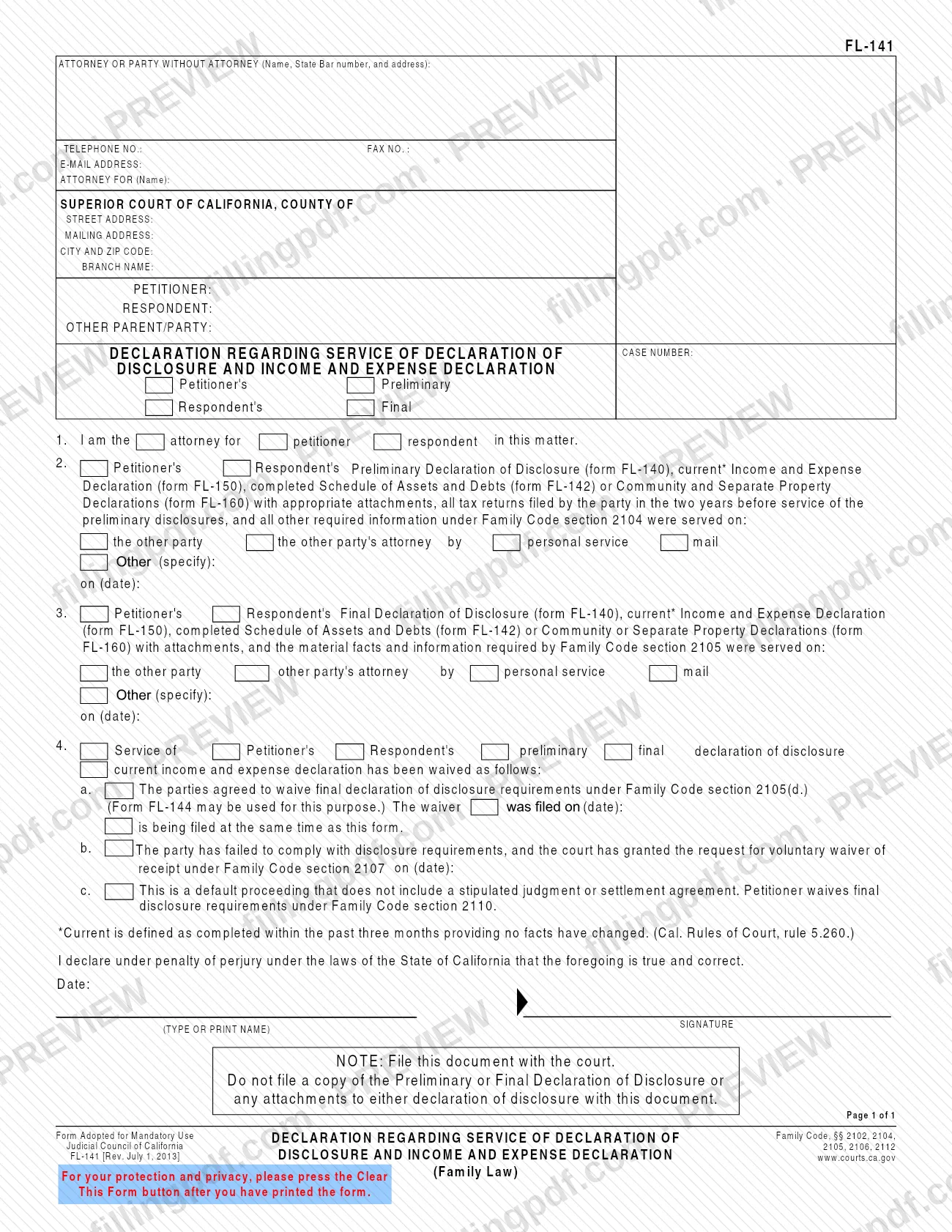
FL-141 is the Judicial Council of California declaration that tells the court the preliminary or final Declaration of Disclosure and the Income and Expense Declaration were served on the other party, or that service was waived. It is used in California family law cases such as divorce. On this page you can fill out the form online on FillingPDF and download or print the completed PDF. The Judicial Council publishes the official PDF at courts.ca.gov, and the declaration itself is filed with the court.
Last updated
What is FL-141?
Form FL-141, Declaration Regarding Service of Declaration of Disclosure and Income and Expense Declaration, is a Judicial Council of California form on which a declarant states, under penalty of perjury, that the financial disclosure documents were served in a family law case, or that service was waived.
The California courts' self-help page describes its purpose as telling the court that you had the first or final set of financial documents served on your spouse or domestic partner. The form is the proof of service of those disclosures; it is not the disclosure itself.
The form covers four situations:
- Item 2: service of the preliminary Declaration of Disclosure (form FL-140), a current Income and Expense Declaration (form FL-150), a completed Schedule of Assets and Debts (form FL-142) or Community and Separate Property Declarations (form FL-160), the tax returns filed in the two years before service, and the other information required by Family Code section 2104.
- Item 3: service of the final Declaration of Disclosure with the same attachments and the material facts and information required by Family Code section 2105.
- Item 4: service waived by agreement (Family Code section 2105(d)), by court order (section 2107), or in a default proceeding (section 2110).
The form is adopted for mandatory use and cites Family Code sections 2102, 2104, 2105, 2106 and 2112. A Spanish version is available on the California courts' self-help site.
Who needs to file FL-141?
The person who served the disclosure documents in a California family law case completes FL-141, naming the petitioner or respondent whose Declaration of Disclosure was served. Item 1 of the form is a statement that the declarant is the attorney for the petitioner or respondent, and the header has a space for an attorney or a party without an attorney.
You may use it in these situations:
- You served a preliminary Declaration of Disclosure with the required attachments (item 2).
- You served a final Declaration of Disclosure with the required attachments (item 3).
- Service of a preliminary or final declaration of disclosure, or of the current income and expense declaration, has been waived (item 4): by the parties' agreement, by a court order granting a voluntary waiver of receipt, or in a default proceeding without a stipulated judgment or settlement agreement.
The form is not a place to file the disclosures. Its note says not to file a copy of the Preliminary or Final Declaration of Disclosure, or any attachments, with it.
When to file FL-141
File FL-141 after the disclosure documents have been served, or after service has been waived, since the form records the date of service or waiver. The form prints no separate due date. Item 2 covers the preliminary disclosures and item 3 the final disclosures, so the declaration can be made for either set.
The service dates you enter must be accurate. The form defines "current" for an Income and Expense Declaration as completed within the past three months, providing no facts have changed (Cal. Rules of Court, rule 5.260). If you rely on a waiver agreement under item 4a, the form asks whether it was filed on a stated date or is being filed at the same time as this form. For any court deadline in your case, check with the court or the self-help site.
Documents you need
- Waiver of final declaration of disclosure requirements, only if you check item 4a: the form asks the date it was filed or says it is being filed at the same time as FL-141. Form FL-144 may be used for this purpose.
How to fill out FL-141
Enter attorney or party information
At the top, enter the name, State Bar number and address of the attorney or party without an attorney, plus telephone, fax and e-mail if you wish, and whom you are the attorney for.
Complete the court and case caption
Enter the county of the Superior Court of California, its street and mailing addresses, city and ZIP code, and branch name. Then enter the petitioner, respondent, other parent/party and the case number.
Mark the title boxes
Check which declaration was served under the title: Petitioner's or Respondent's, and Preliminary or Final.
Complete item 1
Check whether you are the attorney for the petitioner or for the respondent in this matter.
Complete item 2 for preliminary disclosures
Check Petitioner's or Respondent's, then check whether service was on the other party or the other party's attorney and whether it was by personal service, mail or other (specify). Enter the date of service.
Complete item 3 for final disclosures
Use this item for the final Declaration of Disclosure. Check Petitioner's or Respondent's, the person served, the method (personal service, mail or other) and the date of service.
Complete item 4 if service was waived
Check Petitioner's or Respondent's and which declaration was waived: preliminary, final or current income and expense declaration. Then complete only the reason in 4a, 4b or 4c that applies.
Enter waiver dates in item 4
For 4a, enter the date the parties' waiver was filed or check that it is being filed with this form. For 4b, enter the date the court granted the waiver. For 4c, check the default proceeding statement.
Date, sign and print your name
Enter the date, sign above the signature line and type or print your name under the declaration made under penalty of perjury under California law.
Review and download the completed PDF
Check that the case number, party names and dates match your case and that no disclosure documents are attached. Download or print the PDF from FillingPDF, then file it with the court as described under How to submit.
How to submit FL-141
The form states one instruction: "File this document with the court." File it with the Superior Court of California named at the top of the form, in the county and branch where your case is pending. The form prints no address, portal or other channel; ask the court clerk or check the court's website for how that court accepts filings.
What to send:
- The signed and dated FL-141 only.
- Do not attach or file a copy of the Preliminary or Final Declaration of Disclosure or any attachments to either declaration. The form's note says not to file them with this document.
- If you check item 4a and the waiver is being filed at the same time, file it with this form. Form FL-144 may be used for that waiver.
The PDF has a Clear This Form button; the form advises pressing it after printing, for your protection and privacy. FillingPDF lets you fill out and download the PDF; submission follows the court's channels above.
Common mistakes to avoid
- Filing a copy of the Preliminary or Final Declaration of Disclosure, or its attachments, with FL-141; the form's note says not to.
- Not filing the signed FL-141 with the court after serving the documents; the form says to file it with the court.
- Leaving the service date blank in item 2 or item 3 after checking the person served and the method of service.
- Treating an Income and Expense Declaration as current when it was completed more than three months ago or the facts have changed.
- Checking item 4a without entering the date the waiver was filed or without checking that it is being filed with this form.
- Using item 4c outside a default proceeding, or when the case includes a stipulated judgment or settlement agreement.
- Omitting the date, signature or printed name at the bottom, which the declaration under penalty of perjury requires.
- Not marking whether it is the petitioner's or respondent's declaration, or preliminary or final, so the form does not identify what was served.
Frequently asked questions
What is form FL-141 used for?
FL-141 is the Judicial Council of California declaration that tells the court the preliminary or final Declaration of Disclosure and the Income and Expense Declaration were served on the other party, or that service was waived. It is the proof of service, not the disclosure itself.
Do I file my disclosure documents with FL-141?
No. The form's note says to file FL-141 with the court and not to file a copy of the Preliminary or Final Declaration of Disclosure or any attachments to either declaration with it.
Can I fill out FL-141 online?
Yes. You can fill out the FL-141 PDF online on FillingPDF and download or print it. FillingPDF is independent and does not file it; you file the signed form with the court.
What does "current" mean for the Income and Expense Declaration?
The form defines current as completed within the past three months, providing no facts have changed, citing California Rules of Court, rule 5.260. The footnote applies to the Income and Expense Declaration (form FL-150) listed in items 2 and 3.
What if service of the disclosures was waived?
Use item 4. Check 4a if the parties agreed to waive final disclosure under Family Code section 2105(d), 4b if the court granted a waiver under section 2107, or 4c for a default proceeding without a stipulated judgment or settlement agreement.
Is there a Spanish version of FL-141?
Yes. The California courts' self-help page for FL-141 offers the form in Spanish as well as English. The English revision on this page is Rev. July 1, 2013.
Where do I file FL-141?
File it with the court that is hearing your case, which is the Superior Court of California named at the top of the form. The form prints no address, so ask that court's clerk or check its website for how it takes filings.
Which form can be used for the waiver in item 4a?
The form says Form FL-144 may be used for the parties' waiver of final declaration of disclosure requirements. Item 4a asks for the date the waiver was filed or whether it is being filed at the same time as FL-141.
Ready to fill out FL-141?
Fill out FL-141 now