
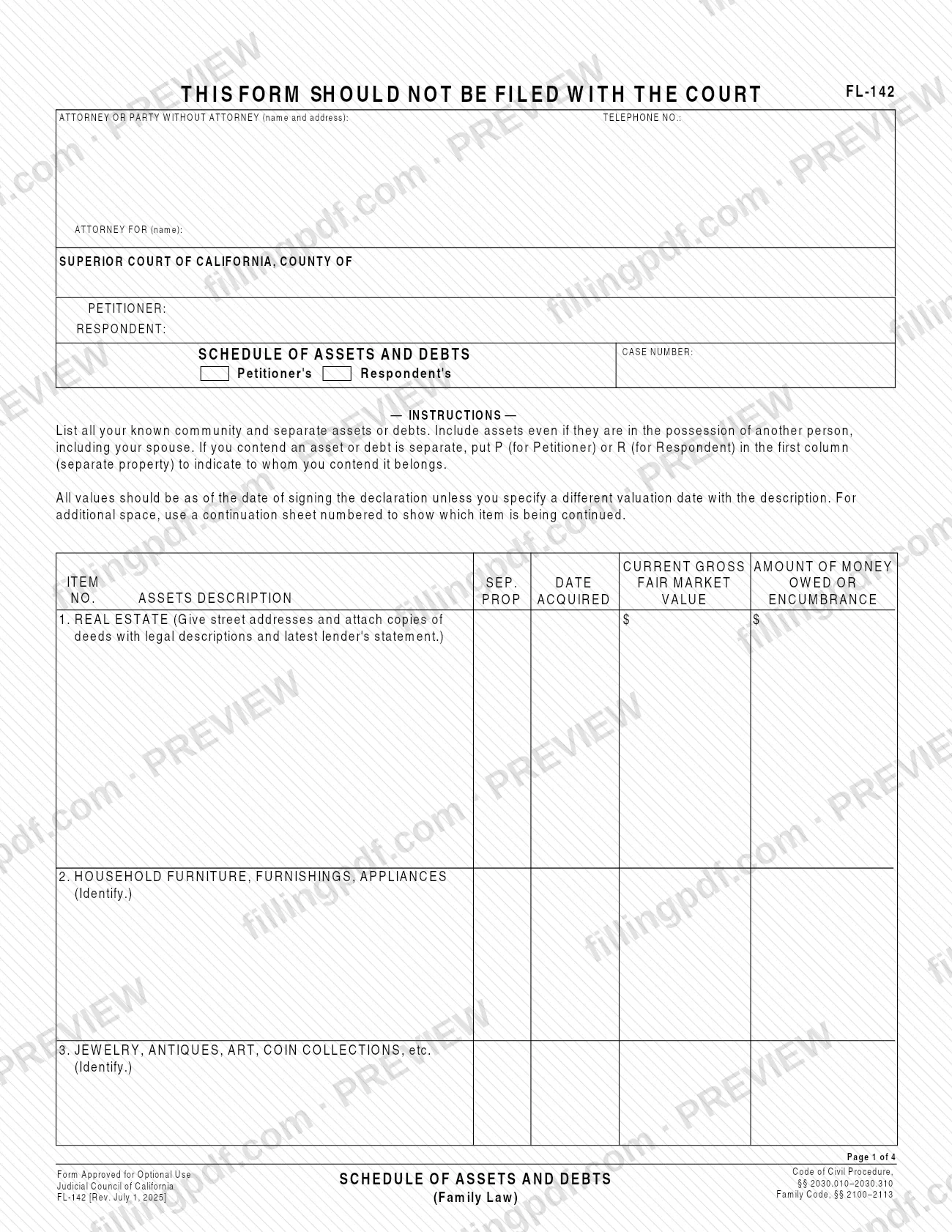
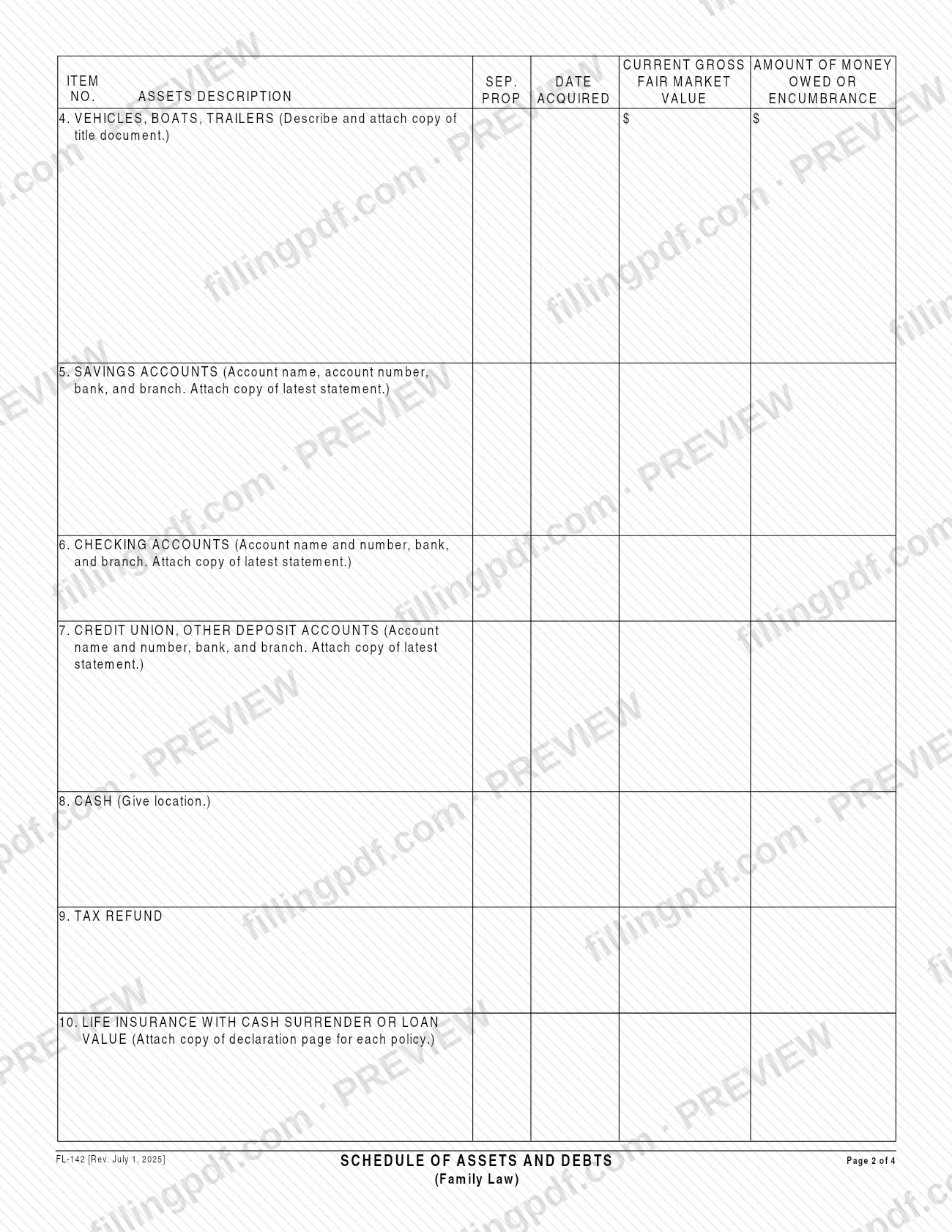
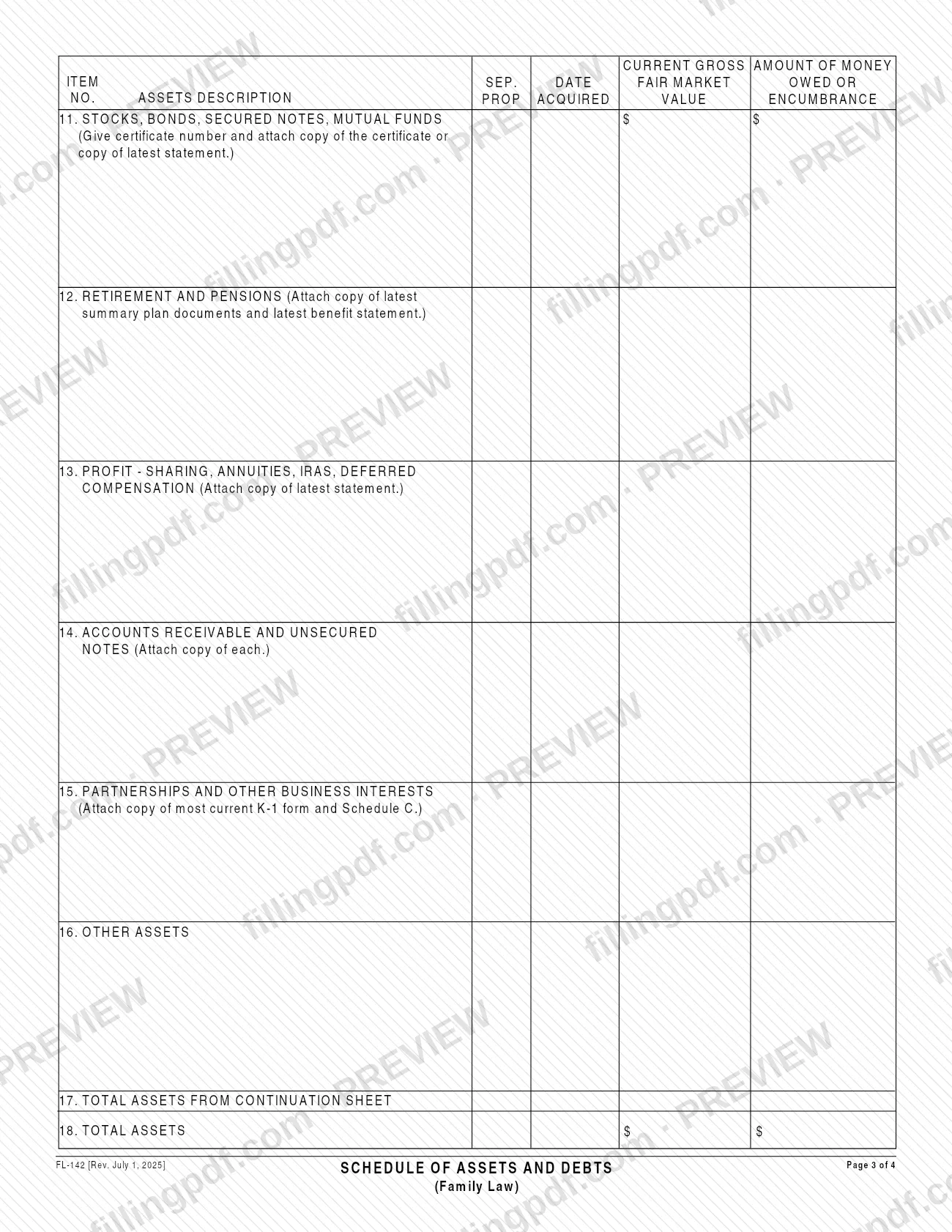
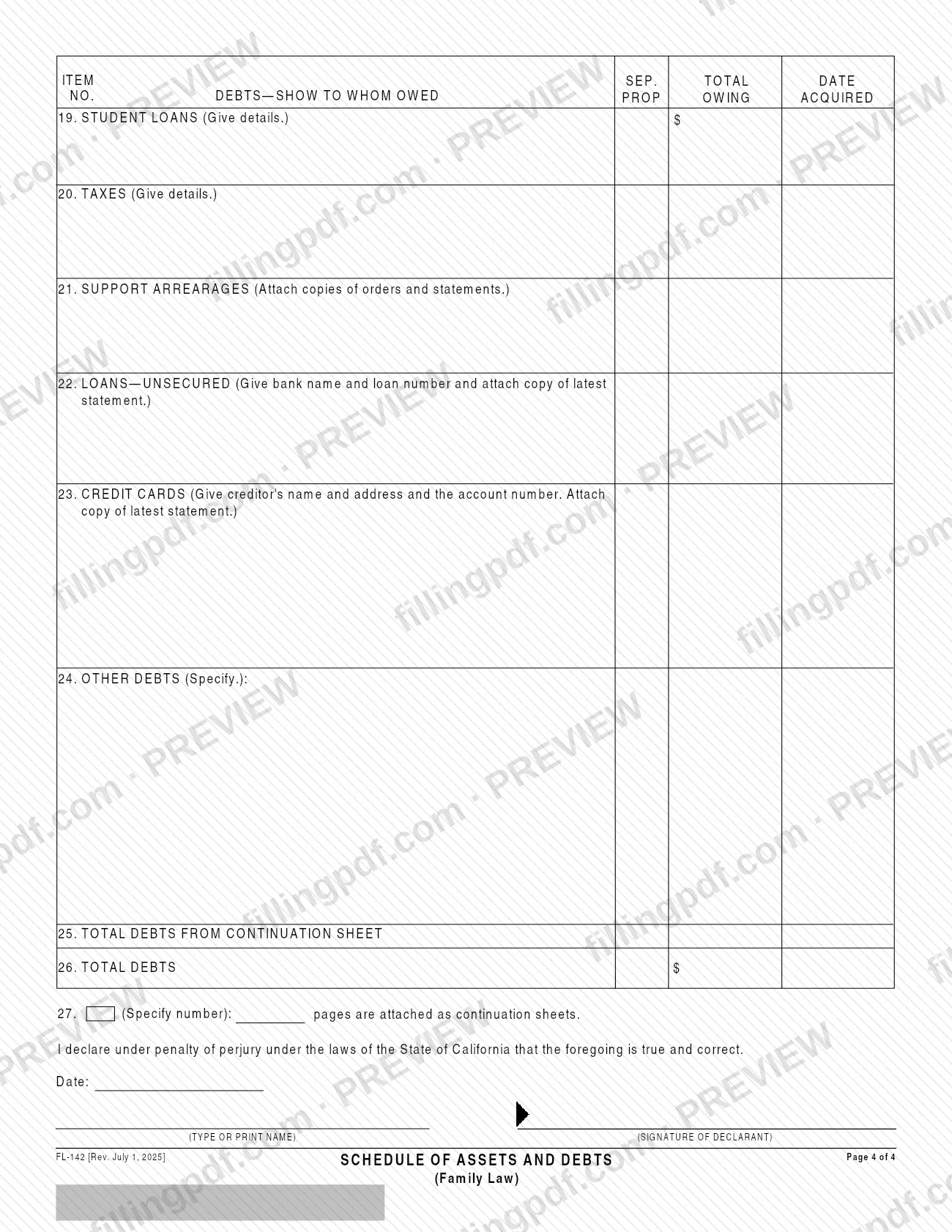
FL-142 is the Schedule of Assets and Debts, a family law form published by the Judicial Council of California on which you list your known community and separate property and debts. It is used as an attachment to the Declaration of Disclosure (form FL-140), or you may use Property Declaration (form FL-160) instead. On this page you can fill out the form online on FillingPDF and download or print the completed PDF; the form itself says it should not be filed with the court, and the official PDF is published by the Judicial Council at courts.ca.gov.
Last updated
What is FL-142?
Form FL-142, Schedule of Assets and Debts, is a Judicial Council of California family law form on which you list all your known community and separate assets and debts.
The form is a four-page schedule. Items 1 through 16 cover assets: real estate, household furniture and appliances, jewelry and art, vehicles, bank and other deposit accounts, cash, tax refund, life insurance, stocks and bonds, retirement and pensions, annuities and IRAs, accounts receivable, business interests and other assets. For each one you give a description, the date acquired, the current gross fair market value and the amount of money owed or encumbrance. Items 19 through 24 cover debts: student loans, taxes, support arrearages, unsecured loans, credit cards and other debts, with the total owing and the date acquired. Totals appear on items 18 and 26.
If you contend an asset or debt is separate property, you mark P (Petitioner) or R (Respondent) in the first column. The form states that assets must be listed even if another person, including your spouse, holds them.
The Judicial Council's self-help page explains that FL-142 can be used as an attachment to the Declaration of Disclosure (form FL-140), or that you may use Property Declaration (form FL-160) instead. The form is approved for optional use and cites Code of Civil Procedure, sections 2030.010–2030.310, and Family Code, sections 2100–2113. A Spanish version is listed on the self-help page. The form carries the notice that it should not be filed with the court.
Who needs to file FL-142?
The main users are the parties in a California family law case, the Petitioner and the Respondent, who need to list all their known community and separate property and debts. The form has a header for an attorney or a party without an attorney, so it can be completed by either.
The Judicial Council's self-help page ties the form to two situations:
- You are preparing the Declaration of Disclosure (form FL-140) and want to attach a schedule of your property and debts.
- You are using Property Declaration (form FL-160) instead; the page presents FL-160 as the alternative to FL-142.
The person who signs is the declarant, who declares under penalty of perjury under the laws of the State of California that the schedule is true and correct. The form is approved for optional use. It lists no exclusions of its own, and it does not say who may sign for someone else, so ask the court or an attorney if another person would complete it for you.
When to file FL-142
FL-142 has no due date printed on it, and it is not filed on its own. It accompanies the Declaration of Disclosure (form FL-140) as an attachment, so you complete it when you prepare that declaration, or you use Property Declaration (form FL-160) instead.
The form says all values should be as of the date of signing the declaration, unless you give a different valuation date next to the item's description. Gather your latest statements, deeds, titles and similar documents first, because many items ask for a copy. The current revision, Rev. July 1, 2025, is shown as effective July 1, 2025 on the Judicial Council's self-help page.
Documents you need
- Item 1, real estate: copies of deeds with legal descriptions and the latest lender's statement for each property.
- Item 4, vehicles, boats, trailers: a copy of the title document for each one.
- Items 5, 6 and 7, savings, checking, credit union and other deposit accounts: a copy of the latest statement for each account.
- Item 10, life insurance with cash surrender or loan value: a copy of the declaration page for each policy.
- Item 11, stocks, bonds, secured notes, mutual funds: a copy of the certificate or of the latest statement, with the certificate number.
- Item 12, retirement and pensions: copies of the latest summary plan documents and the latest benefit statement.
- Item 13, profit-sharing, annuities, IRAs, deferred compensation: a copy of the latest statement.
- Item 14, accounts receivable and unsecured notes: a copy of each one.
- Item 15, partnerships and other business interests: a copy of the most current K-1 form and Schedule C.
- Item 21, support arrearages: copies of the orders and statements.
- Item 22, unsecured loans: a copy of the latest statement for each loan.
- Item 23, credit cards: a copy of the latest statement for each card.
- Continuation sheets, only if you need more space: number each sheet to show which item it continues.
How to fill out FL-142
Enter attorney, court and case details
At the top of page 1, enter the attorney or party without attorney (name, address, telephone), the attorney for, the county of the Superior Court of California, the Petitioner, the Respondent and the case number.
Mark separate property
For any item you contend is separate, put P (for Petitioner) or R (for Respondent) in the first column, SEP. PROP, to show to whom you say it belongs.
Choose the valuation date
Give values as of the date you sign the declaration. If you use another date for an item, write that valuation date with its description.
List real estate, furnishings and valuables
Item 1: street addresses of real estate. Item 2: household furniture, furnishings and appliances. Item 3: jewelry, antiques, art and coin collections. For each, enter the description, date acquired, current gross fair market value and the amount owed or encumbrance.
List vehicles, accounts and cash
Item 4: vehicles, boats and trailers. Items 5 to 7: savings, checking, credit union and other deposit accounts, with account name and number, bank and branch. Item 8: cash and its location.
List refunds, insurance and securities
Item 9: tax refund. Item 10: life insurance with cash surrender or loan value. Item 11: stocks, bonds, secured notes and mutual funds, with the certificate number.
List retirement and business assets
Item 12: retirement and pensions. Item 13: profit-sharing, annuities, IRAs and deferred compensation. Item 14: accounts receivable and unsecured notes. Item 15: partnerships and other business interests. Item 16: any other assets.
Total your assets
Item 17: enter the total assets from any continuation sheet. Item 18: enter total assets in the fair market value and the amount owed or encumbrance columns.
List your debts
Items 19 to 24: student loans, taxes, support arrearages, unsecured loans, credit cards and other debts. Show to whom each is owed, the total owing and the date acquired; for credit cards give the creditor's name and address and the account number.
Total your debts
Item 25: enter total debts from the continuation sheet. Item 26: enter the total debts.
Add and count continuation sheets
If you need more space, use a continuation sheet numbered to show which item is being continued. On item 27, specify the number of pages attached as continuation sheets.
Review, sign and download the PDF
Enter the date, print your name and sign as declarant under the penalty-of-perjury statement. Check every item, then download or print the completed PDF from FillingPDF and gather the copies the items require.
How to submit FL-142
The form names no filing channel, mailing address or portal, and it is printed with the notice THIS FORM SHOULD NOT BE FILED WITH THE COURT. The Judicial Council's self-help page describes it as a list of all your known property and debt that can be used as an attachment to Declaration of Disclosure (form FL-140), or you may use Property Declaration (form FL-160) instead.
- Do not file it with the court: the form says so on its first page.
- Attach it to FL-140: if you use FL-142 as the attachment, it travels with that declaration; check the instructions for FL-140, or ask your attorney or the court clerk, how the schedule is to be delivered in your case.
- Include the supporting copies: items on the form call for copies of deeds, statements, title documents and similar records.
- Continuation sheets: if you need more room, number each sheet to show which item it continues and enter the number of such pages on item 27.
FillingPDF lets you fill out and download the PDF; submission follows the channels the agency and your case require.
Common mistakes to avoid
- Filing the form with the court when the first page says it should not be filed with the court.
- Leaving out an asset because another person, including your spouse, holds it; the instructions say to list assets even then.
- Forgetting to enter P or R in the first column (SEP. PROP) for an item you contend is separate property.
- Using values that are not as of the date of signing the declaration without writing a different valuation date next to the description.
- Skipping the copies an item calls for, such as deeds, latest statements, title documents or the K-1 and Schedule C.
- Adding extra pages without numbering them to show which item they continue, or not entering their number on item 27.
- Not carrying continuation-sheet amounts into item 17 (total assets) or item 25 (total debts) before totaling on items 18 and 26.
- Signing without the date or without a printed name; the declaration under penalty of perjury has a date, a printed name and the declarant's signature.
Frequently asked questions
What is form FL-142?
FL-142 is the Schedule of Assets and Debts, a Judicial Council of California family law form for listing all your known community and separate assets and debts. Each item gets a description, the date acquired, a value or amount owing and, if you claim separate property, a P or R.
Do I file FL-142 with the court?
No. The first page of the form says it should not be filed with the court. The Judicial Council's self-help page says it can be used as an attachment to the Declaration of Disclosure (form FL-140), so follow the instructions for that form on delivery.
What is the difference between FL-142 and FL-160?
Both list property and debts. The Judicial Council's self-help page says you can use FL-142 as an attachment to the Declaration of Disclosure (form FL-140), or you may use Property Declaration (form FL-160) instead of it.
How do I show that an asset is separate property?
Put P (for Petitioner) or R (for Respondent) in the first column, SEP. PROP, next to the item, to show to whom you contend it belongs. Leave the column blank for items you do not claim as separate property.
What documents do I attach to FL-142?
Several items ask for copies: deeds and the latest lender's statement for real estate, title documents for vehicles, latest statements for accounts, loans and cards, life insurance declaration pages, and the K-1 and Schedule C for business interests. See the list above.
What date should I use for values on FL-142?
Use the date you sign the declaration. The form says all values should be as of that date unless you specify a different valuation date with the item's description.
What if I run out of space on the schedule?
Use a continuation sheet numbered to show which item it continues. Enter the number of continuation pages on item 27, and carry the continuation totals into items 17 (assets) and 25 (debts).
Is there a Spanish version of FL-142?
Yes. The Judicial Council's self-help page offers form FL-142 in Spanish alongside the English form. The English form is the version used on this page.
Can I fill out FL-142 online?
You can fill out the FL-142 PDF online on FillingPDF and download or print it. FillingPDF is an independent service, not the Judicial Council, and it does not file or deliver the form; the form itself says not to file it with the court.
Ready to fill out FL-142?
Fill out FL-142 now