
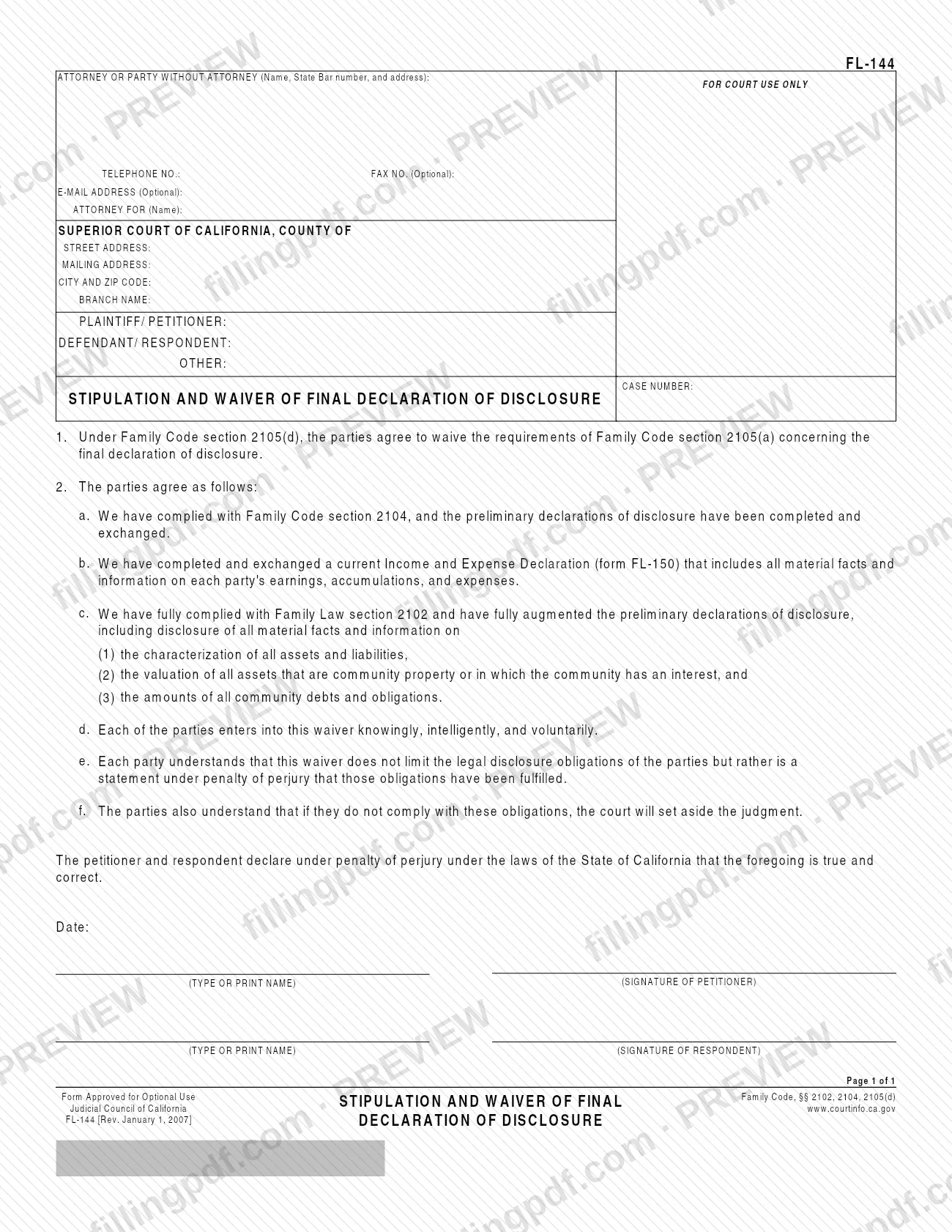
FL-144 is the Judicial Council of California form on which both spouses or domestic partners agree to waive the final declaration of disclosure under Family Code section 2105(d). By signing, each party states under penalty of perjury that the preliminary declarations were exchanged, that a current Income and Expense Declaration (form FL-150) was exchanged, and that the disclosure duties have been met. On this page you can fill out the form online on FillingPDF and download or print the completed PDF; the official PDF is published by the Judicial Council at courts.ca.gov.
Last updated
What is FL-144?
Form FL-144, Stipulation and Waiver of Final Declaration of Disclosure, is a one-page Judicial Council of California form on which the parties to a family law case agree to waive the requirements of Family Code section 2105(a) concerning the final declaration of disclosure.
The form is a stipulation made under Family Code section 2105(d). The California courts' self-help page describes its purpose as telling the court that you and your spouse or domestic partner exchanged the preliminary (first) declaration of disclosure and agree not to exchange the final declaration of disclosure documents with each other.
In paragraph 2 the parties state that:
- they complied with Family Code section 2104 and the preliminary declarations of disclosure were completed and exchanged;
- they exchanged a current Income and Expense Declaration (form FL-150) covering each party's earnings, accumulations and expenses;
- they complied with section 2102 and fully augmented the preliminary declarations, including the characterization of all assets and liabilities, the valuation of community property assets and the amounts of all community debts and obligations;
- each party enters the waiver knowingly, intelligently and voluntarily.
The form also says that the waiver does not limit the parties' legal disclosure obligations. It is a statement under penalty of perjury that those obligations have been fulfilled. The form is approved for optional use and carries the caption of a Superior Court of California case.
Who needs to file FL-144?
The petitioner and the respondent in a California family law case use Form FL-144 when they both want to skip the final declaration of disclosure. It is a joint stipulation: the form has a signature line for each party, and both declare under penalty of perjury that the statements in it are true and correct.
The form fits parties who can truthfully state all of the following:
- the preliminary declarations of disclosure were completed and exchanged;
- a current Income and Expense Declaration (form FL-150) was completed and exchanged;
- the preliminary declarations were fully augmented to cover characterization, valuation and community debts.
If the parties cannot truthfully make those statements, the form is not the right document, because each one is signed under penalty of perjury. The form also warns that if the parties do not comply with their disclosure obligations, the court will set aside the judgment. An attorney's name and State Bar number can appear in the caption when a party has one, and a party without an attorney enters their own name and address there. The form does not say that an attorney or other representative may sign in a party's place.
When to file FL-144
Use Form FL-144 once the parties have completed and exchanged the preliminary declarations of disclosure and a current Income and Expense Declaration (form FL-150), and have fully augmented the preliminary declarations. Those events are what the parties certify in paragraph 2, so the form cannot truthfully be signed before them. The form prints no separate due date and no filing window of its own. It carries a case number and the caption of the Superior Court, so it belongs to a case that is already open. Check the court handling your case or the California courts' self-help page for FL-144 about when the court expects the stipulation.
How to fill out FL-144
Enter attorney or party information
In the top box, enter the name, State Bar number and address of the attorney or party without attorney, plus the telephone number. FAX NO. and E-MAIL ADDRESS are marked optional.
Name the attorney's client
In ATTORNEY FOR (Name), enter the party the attorney represents. A party without an attorney can leave this blank.
Complete the court information
Enter the county after SUPERIOR COURT OF CALIFORNIA, COUNTY OF, then the street address, mailing address, city and ZIP code, and branch name of the court.
Enter the parties and case number
Fill in PLAINTIFF/PETITIONER, DEFENDANT/RESPONDENT, OTHER if it applies, and the CASE NUMBER. Leave FOR COURT USE ONLY empty.
Read the printed stipulation
Paragraphs 1 and 2 (a through f) are preprinted. Confirm together that every statement is true, including the exchange of declarations and the FL-150, before you sign.
Enter the date
Enter the date on the Date line above the signature block.
Print names and sign as petitioner
The petitioner types or prints their name and signs on the line marked SIGNATURE OF PETITIONER.
Print names and sign as respondent
The respondent types or prints their name and signs on the line marked SIGNATURE OF RESPONDENT.
Review and download the completed PDF
Check the caption, case number, date and both names. Download or print the completed PDF from FillingPDF and deliver it to the court as described under How to submit.
How to submit FL-144
The form names no filing channel, address or portal of its own. It is a court paper with the caption of a Superior Court of California, a case number and a box marked FOR COURT USE ONLY, so it is meant for the court that has your case.
- Complete and sign: both the petitioner and the respondent type or print their names and sign above the lines provided, and one date is entered at the top of the signature block.
- Deliver to the court: use the filing method of the Superior Court in the county named in the caption. Ask that court's clerk, or see the California courts' self-help page for FL-144, at https://selfhelp.courts.ca.gov/jcc-form/FL-144, for how it accepts filings.
- Privacy: the form tells you to press the Clear This Form button after printing it.
FillingPDF lets you fill out and download the PDF; submission follows the court's channels above.
Common mistakes to avoid
- Signing the form before the preliminary declarations of disclosure have been completed and exchanged; paragraph 2a states that they were.
- Signing without having exchanged a current Income and Expense Declaration (form FL-150); paragraph 2b says both parties did.
- Having only one party sign. The form is a stipulation of both parties, with a signature line for the petitioner and one for the respondent.
- Treating the waiver as a release from disclosure duties. The form says it does not limit them and is a statement under penalty of perjury that they were fulfilled.
- Skipping the full augmentation of the preliminary declarations on characterization, valuation and community debts that paragraph 2c states was done.
- Ignoring the warning in paragraph 2f that the court will set aside the judgment if the parties do not comply with their disclosure obligations.
- Leaving the case number, county or party names blank in the caption, so the form cannot be matched to the case.
- Writing in the FOR COURT USE ONLY space, which is reserved for the court.
Frequently asked questions
What is the FL-144 form used for?
FL-144 is the Judicial Council of California stipulation by which both parties waive the final declaration of disclosure under Family Code section 2105(d). It tells the court that the preliminary declarations were exchanged and that the parties agree not to exchange final declaration of disclosure documents.
Who has to sign Form FL-144?
Both the petitioner and the respondent sign. The form has a type-or-print name line and a signature line for each, and they declare under penalty of perjury under California law that the statements in the form are true and correct.
Does FL-144 cancel the disclosure requirements?
No. The form says the waiver does not limit the parties' legal disclosure obligations. It is a statement under penalty of perjury that those obligations have been fulfilled, so the disclosures must actually have been exchanged first.
What happens if the parties did not comply with disclosure?
The form states that if the parties do not comply with their disclosure obligations, the court will set aside the judgment. Each party signs acknowledging this in paragraph 2f.
Do I need to exchange an FL-150 before signing FL-144?
Yes. In paragraph 2b the parties state that they completed and exchanged a current Income and Expense Declaration (form FL-150) covering each party's earnings, accumulations and expenses. The FL-150 itself is not printed as an attachment to FL-144.
Is Form FL-144 mandatory?
The form is marked Form Approved for Optional Use by the Judicial Council of California. It applies when the parties choose to waive the final declaration of disclosure under Family Code section 2105(d).
Where do I file FL-144?
The form prints no filing address. It carries the caption of a Superior Court of California and a case number, so ask the court handling your case how it accepts filings. The California courts' self-help page for FL-144 also describes the form.
Can I fill out FL-144 online?
You can fill out the FL-144 PDF online on FillingPDF and download or print it. FillingPDF is an independent service and does not file the form with the court; you deliver it through the court's channels.
Ready to fill out FL-144?
Fill out FL-144 now