
FL-145 is the Judicial Council of California's standard set of written questions for family law cases, such as a divorce. One party checks the questions to ask, and the other party must answer them under oath. On FillingPDF you can fill out the form online and download or print the completed PDF. The official PDF and its revision date are published by the California courts at courts.ca.gov, and the form itself prints no court address for returning it.
Last updated
What is FL-145?
Form Interrogatories—Family Law (FL-145) is the Judicial Council of California form containing 21 standard written questions that one party in a family law case asks the other, so that relevant information is exchanged before trial without unreasonable expense to the answering party.
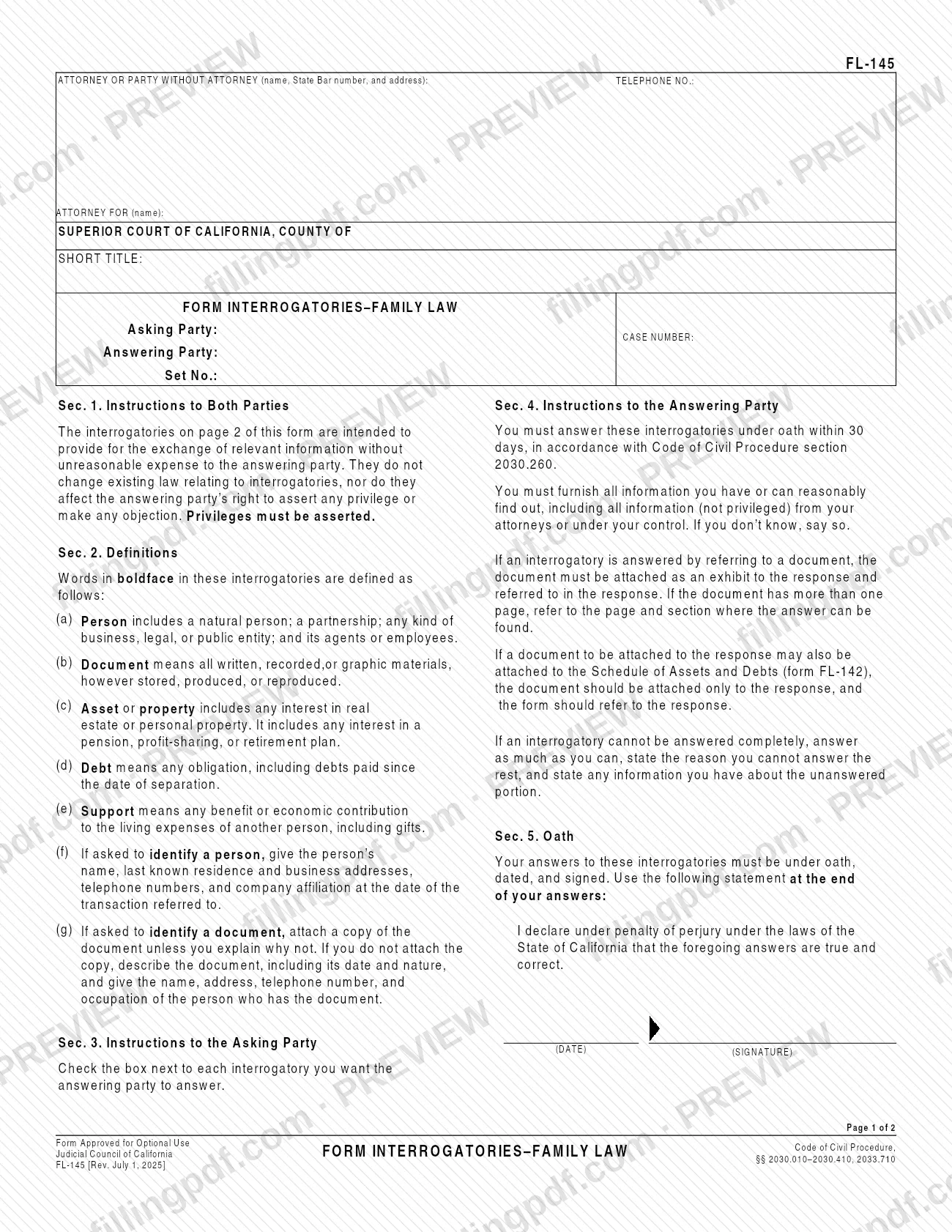
The form is approved for optional use and cites Code of Civil Procedure sections 2030.010–2030.410 and 2033.710. Page 1 holds the caption (court, case title, case number, Asking Party, Answering Party and Set No.) and five sections: instructions to both parties, definitions, instructions to the asking party, instructions to the answering party, and the oath. Page 2 lists the numbered interrogatories.
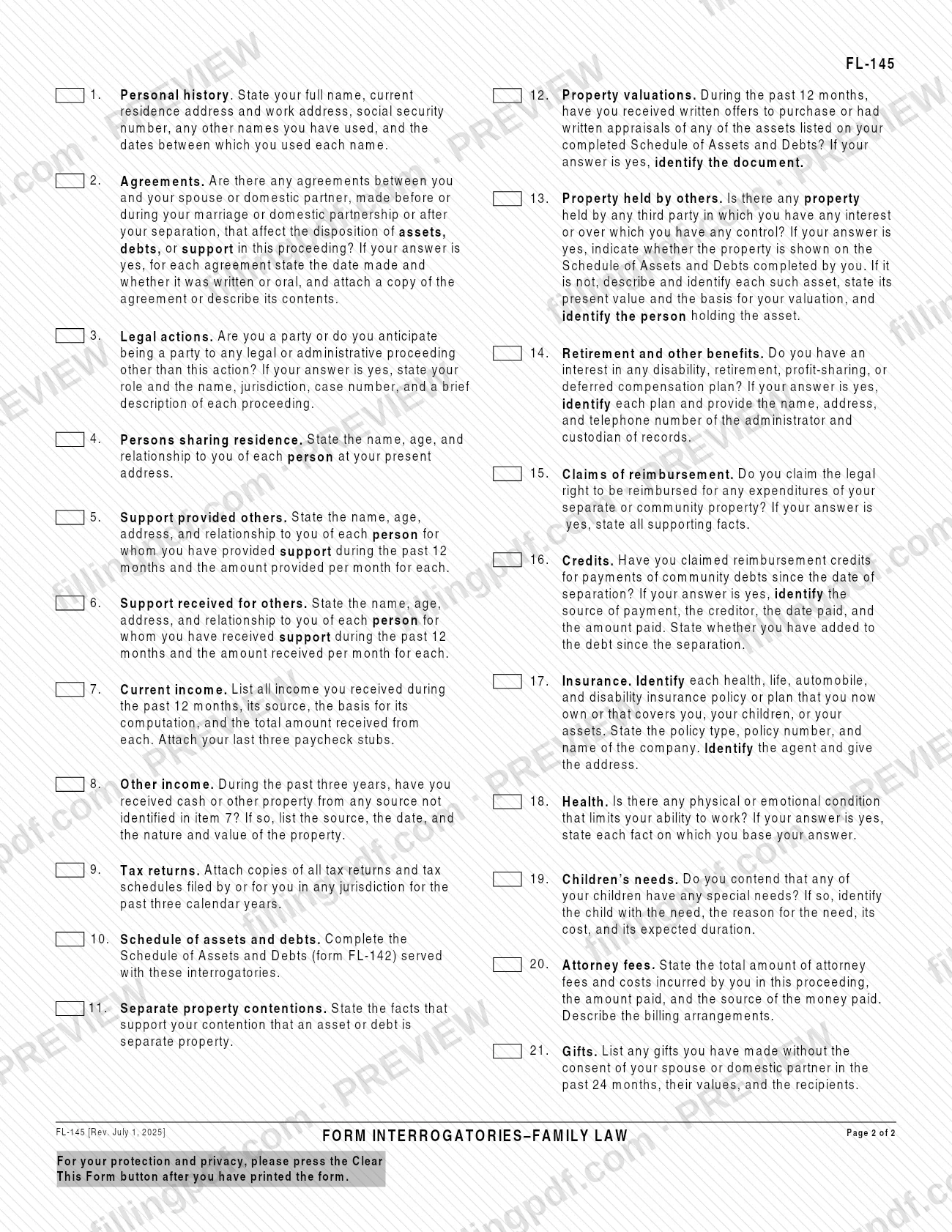
The questions cover personal history, agreements between spouses or domestic partners, other legal actions, persons sharing the residence, support given and received, current and other income, tax returns, the Schedule of Assets and Debts, separate property contentions, property valuations, property held by others, retirement and other benefits, reimbursement claims and credits, insurance, health, children's needs, attorney fees and gifts.
The form does not change existing law on interrogatories and does not affect the answering party's right to assert a privilege or make an objection; privileges must be asserted. Interrogatory 10 refers to the Schedule of Assets and Debts (form FL-142), which is served with the interrogatories. The California courts' self-help page also offers FL-145 in Spanish.
Who needs to file FL-145?
Two roles use FL-145. The asking party, the spouse or domestic partner who wants information from the other side, checks the box next to each interrogatory the other party must answer. The answering party, the person who receives the set, answers the checked questions under oath.
The self-help page for the form describes its purpose as telling your spouse or domestic partner to answer specific questions and give documents before trial, and it links the form to the divorce how-to instructions and divorce form packets.
The instructions place the answering party's duties on that party: you must furnish all information you have or can reasonably find out, including non-privileged information from your attorneys or under your control. If you are asked about a person, document, asset, debt or support, the form's definitions in Section 2 apply to the words printed in boldface.
The form does not say who may sign for another person; the oath is to be dated and signed by the answering party. It is not a substitute for the Schedule of Assets and Debts (form FL-142), which is a separate form.
When to file FL-145
The answering party must answer FL-145 under oath within 30 days, in accordance with Code of Civil Procedure section 2030.260, as stated in Section 4 of the form. The form does not print the date from which the 30 days run, so check that section of the Code of Civil Procedure or the court's self-help page for the starting point.
The asking party prepares the set first: before it goes to the other side, the asking party checks the interrogatories wanted and, for interrogatory 10, includes the Schedule of Assets and Debts (form FL-142) to be served with the interrogatories. The form sets no other deadline and no renewal cycle.
Documents you need
- Last three paycheck stubs, attached to your answer to interrogatory 7 (current income), when the asking party checks that interrogatory.
- Copies of all tax returns and tax schedules filed by or for you in any jurisdiction for the past three calendar years, for interrogatory 9, when it is checked.
- A copy of any agreement between you and your spouse or domestic partner that affects assets, debts or support, or a description of its contents, for interrogatory 2.
- The Schedule of Assets and Debts (form FL-142) completed by you, when interrogatory 10 is checked; the asking party serves it with the interrogatories.
- A copy of any document you are asked to identify, unless you explain why not; if you do not attach it, describe its date and nature and give the holder's name, address, telephone number and occupation.
- Any document you refer to in an answer, attached as an exhibit to the response; if it is also attached to FL-142, attach it only to the response.
How to fill out FL-145
Enter attorney or party information
At the top, enter the name, State Bar number and address of the attorney or party without attorney, the telephone number, and the name of the party the attorney represents.
Identify the court and case
Enter the county of the Superior Court of California, the short title and the case number.
Name the asking and answering parties
Enter the Asking Party and the Answering Party, and the Set No. so each set of interrogatories can be told apart.
Check the interrogatories to be answered
Asking party: check the box next to each interrogatory (items 1 through 21 on page 2) that you want the answering party to answer.
Prepare the Schedule of Assets and Debts
If you check interrogatory 10, include the Schedule of Assets and Debts (form FL-142), which is served with these interrogatories and completed by the answering party.
Answer each checked interrogatory
Answering party: respond to every checked item with all information you have or can reasonably find out. If you don't know, say so; if you cannot answer completely, answer as much as you can and state why.
Identify persons and documents correctly
When asked to identify a person, give the name, last known residence and business addresses, telephone numbers and company affiliation at the date of the transaction. When asked to identify a document, attach a copy or explain why not.
Attach documents as exhibits
Attach the paycheck stubs (item 7), tax returns (item 9) and any agreement or document you rely on, and refer to the page and section in the response.
Date and sign the oath
Write the date and your signature under the statement: I declare under penalty of perjury under the laws of the State of California that the foregoing answers are true and correct.
Review, download and print the PDF
Check that the caption, set number, answers and exhibits match, then download or print the completed PDF from FillingPDF and deliver it through the parties' channels described under How to submit.
How to submit FL-145
FL-145 is exchanged between the parties rather than sent to a printed address: the form names no court address, portal or appointment rule.
- Asking party: complete the caption, check the interrogatories wanted, and serve the set on the answering party. If you check interrogatory 10, serve the Schedule of Assets and Debts (form FL-142) with the interrogatories.
- Answering party: respond to each checked interrogatory within 30 days, under oath, with the dated and signed declaration printed in Section 5. Attach any document you refer to as an exhibit to the response.
If a document may also be attached to FL-142, attach it only to the response and have the form refer to the response. The form does not state how service must be made or whether the response is filed with the court, so follow the Code of Civil Procedure sections it cites and the court's local rules. The California courts' self-help page at https://selfhelp.courts.ca.gov/jcc-form/FL-145 gives general guidance. FillingPDF lets you fill out and download the PDF; submission follows the channels above.
Common mistakes to avoid
- Answering without the oath: the answers must be under oath, dated and signed, ending with the declaration under penalty of perjury printed in Section 5.
- Missing the 30-day period for answering stated in Section 4 and Code of Civil Procedure section 2030.260.
- Referring to a document in an answer without attaching it as an exhibit to the response and citing it there.
- Attaching a document to both the response and the Schedule of Assets and Debts (form FL-142); attach it only to the response.
- Leaving an interrogatory blank because you do not have the answer; the form says to say so if you don't know, and to answer as much as you can and state why you cannot answer the rest.
- Giving only what you personally remember instead of all information you have or can reasonably find out, including non-privileged information from your attorneys or under your control.
- Checking interrogatory 10 without serving the Schedule of Assets and Debts (form FL-142) with the set.
- Omitting the last three paycheck stubs (interrogatory 7) or the past three calendar years of tax returns (interrogatory 9) when those items are checked.
- Assuming a privilege is protected automatically; the form states that privileges must be asserted.
Frequently asked questions
What is form FL-145 used for?
FL-145, Form Interrogatories—Family Law, is a Judicial Council of California form of 21 standard questions one party in a family law case asks the other. It exchanges relevant information before trial, and the answering party must answer under oath.
How long do I have to answer FL-145?
You must answer under oath within 30 days, in accordance with Code of Civil Procedure section 2030.260. The form does not print the date the 30 days start from, so check that section or the court's self-help page for how the period is counted.
Who fills out the FL-145 form, the asking or answering party?
Both. The asking party completes the caption and checks the interrogatories wanted. The answering party answers the checked items, attaches the documents required, and dates and signs the oath at the end of the answers.
What wording does the oath on FL-145 require?
Answers must be under oath, dated and signed. The form says to use this statement at the end: I declare under penalty of perjury under the laws of the State of California that the foregoing answers are true and correct.
What do I attach to my FL-145 answers?
It depends on the items checked: your last three paycheck stubs for item 7, tax returns for the past three calendar years for item 9, and a copy or description of agreements for item 2. Any document you refer to is attached as an exhibit to the response.
Do I have to complete form FL-142 with FL-145?
Only if interrogatory 10 is checked. It tells the answering party to complete the Schedule of Assets and Debts (form FL-142), which is served with the interrogatories. FL-142 is a separate form from FL-145.
Is there a Spanish version of FL-145?
Yes. The California courts' self-help page for Form Interrogatories—Family Law (FL-145) offers the form in Spanish, with the same effective date shown for the English form, July 1, 2025.
Can I fill out FL-145 online?
You can fill out the FL-145 PDF online on FillingPDF and download or print it. FillingPDF is an independent service; it does not serve or file the interrogatories or your answers, which follow the court's rules and the parties' channels.
Ready to fill out FL-145?
Fill out FL-145 now