
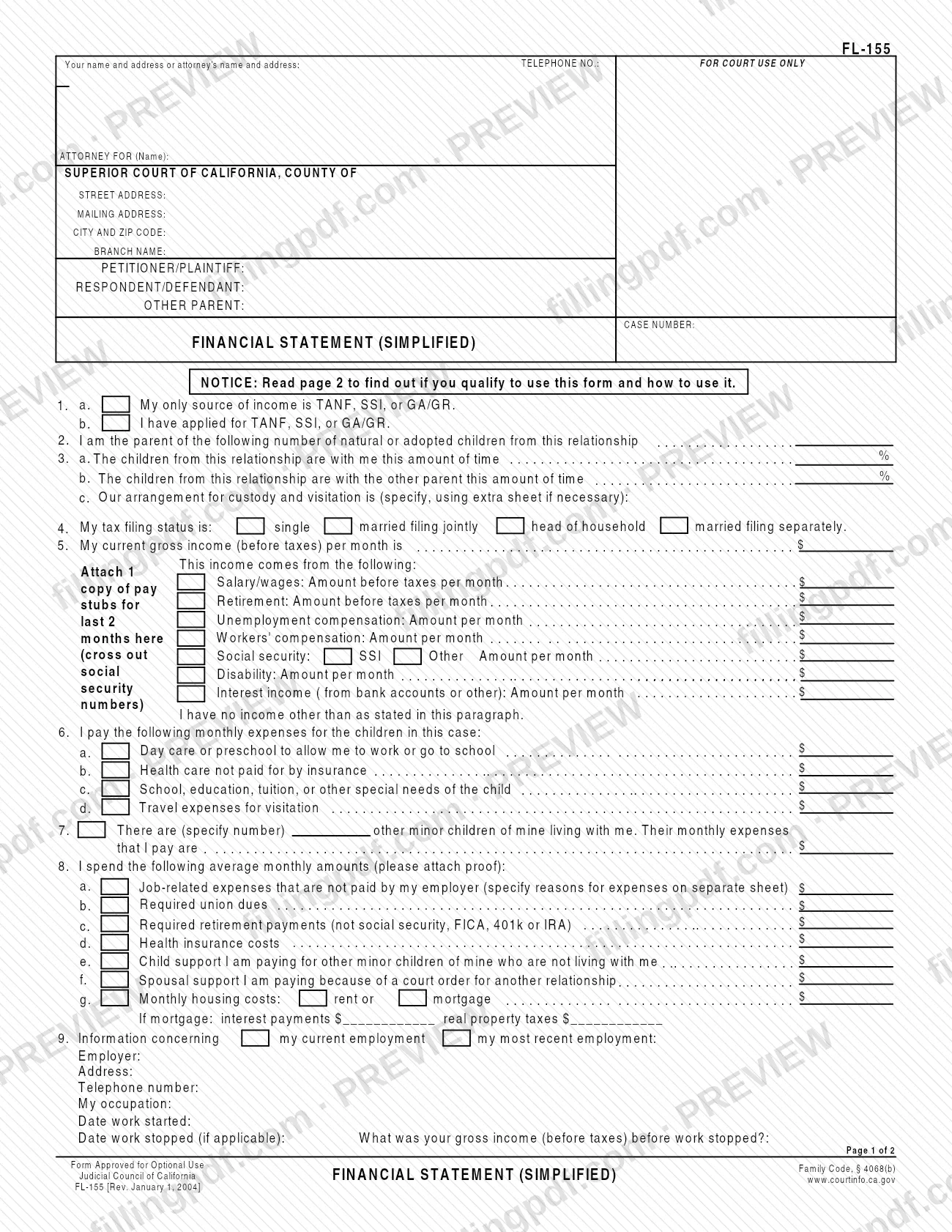
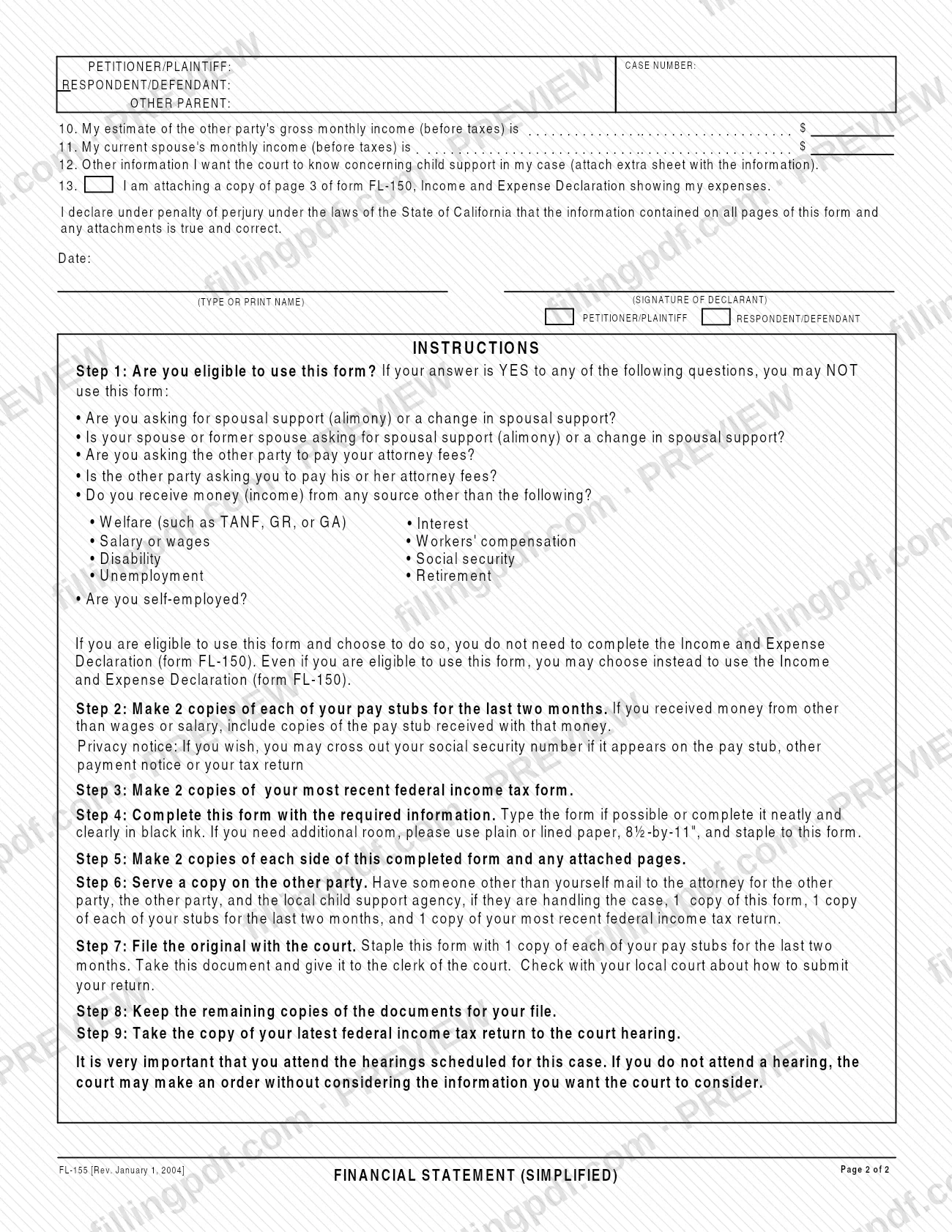
FL-155 is the Financial Statement (Simplified) published by the Judicial Council of California. It lets a parent give the court and the other party a short summary of income and expenses before child support orders are made. It is meant for people whose finances are simple, and it replaces the longer Income and Expense Declaration (form FL-150) for those who qualify. On this page you can fill out the form online on FillingPDF and download or print the completed PDF; the official PDF is published by the Judicial Council at courts.ca.gov.
Last updated
What is FL-155?
Form FL-155, Financial Statement (Simplified), is a Judicial Council of California form on which a parent declares monthly income, children's expenses and personal expenses so the court can consider them when making child support orders.
The form is approved for optional use under Family Code, § 4068(b). Its heading carries the court name, case number and the parties' roles (Petitioner/Plaintiff, Respondent/Defendant, Other Parent). Page 1 collects your tax filing status, gross monthly income by source, the children's expenses you pay, your own monthly expenses and your employment details. Page 2 asks for your estimate of the other party's income, your current spouse's income, any other information you want the court to know about child support, and a declaration under penalty of perjury. Page 2 also holds the instructions.
FL-155 is the short alternative to the Income and Expense Declaration (form FL-150). If you are eligible and choose FL-155, you do not need to complete FL-150. Even if you are eligible, you may use FL-150 instead. Line 13 lets you attach page 3 of FL-150 to show your expenses.
The form is not for cases involving spousal support, attorney fees, self-employment or income from sources other than those listed in the instructions.
Who needs to file FL-155?
Parents in a California family court case who need to give the court their financial information for child support may use FL-155 if they qualify. Use is optional: even a qualifying person may complete form FL-150 instead.
Under Step 1 of the form's instructions, you may NOT use FL-155 if the answer is YES to any of these questions:
- Are you asking for spousal support (alimony) or a change in spousal support?
- Is your spouse or former spouse asking for spousal support or a change in it?
- Are you asking the other party to pay your attorney fees?
- Is the other party asking you to pay his or her attorney fees?
- Do you receive income from any source other than welfare (TANF, GR or GA), salary or wages, disability, unemployment, interest, workers' compensation, Social Security or retirement?
- Are you self-employed?
Line 1 is for people whose only income is TANF, SSI or GA/GR, or who have applied for those benefits. The form has one declarant signature block, marked Petitioner/Plaintiff or Respondent/Defendant, and it does not describe anyone signing for someone else.
When to file FL-155
The form prints no due date of its own. You complete it when the court needs your financial information to make child support orders, and the instructions put the steps in this order: gather pay stubs and your latest federal tax return, complete the form, serve a copy on the other party, then file the original with the court clerk.
Bring a copy of your latest federal income tax return to the court hearing. The instructions stress that you should attend every hearing scheduled in the case: if you miss one, the court may make an order without considering the information you wanted it to consider. For the filing deadline in your case, check with your local court or the court's notices in your case.
Documents you need
- Copies of your pay stubs for the last two months: the instructions say to make 2 copies of each; you may cross out your Social Security number.
- If you received money other than wages or salary: copies of the pay stub or notice received with that money, handled like pay stubs.
- Copies of your most recent federal income tax form: make 2 copies; also take a copy to the court hearing.
- Proof of the monthly expenses you list on line 8, since the form says to attach proof.
- An extra sheet of 8½-by-11" paper if you need more room, for example for the custody and visitation arrangement (line 3c), job-related expenses (line 8a) or other information for the court (line 12).
- A copy of page 3 of form FL-150, Income and Expense Declaration, showing your expenses: only if you check the box on line 13.
How to fill out FL-155
Enter the court and case details
At the top, enter your name and address (or your attorney's), telephone number, the Superior Court county, the party names as Petitioner/Plaintiff, Respondent/Defendant and Other Parent, and the case number.
Answer line 1 on benefits
Check 1a if your only income is TANF, SSI or GA/GR, or 1b if you have applied for one of them. Leave both unchecked if neither applies.
Give children and custody details
Line 2: the number of natural or adopted children from this relationship. Line 3: the percentage of time the children are with you (3a) and with the other parent (3b), and your custody and visitation arrangement in 3c.
Select your tax filing status
Line 4: choose single, married filing jointly, head of household or married filing separately.
Report your monthly gross income
Line 5: your current gross income before taxes per month, then the amount from each source listed (salary/wages, retirement, unemployment, workers' compensation, Social Security, disability, interest). Check the box if you have no other income.
List the children's expenses
Line 6: monthly day care or preschool (6a), uninsured health care (6b), school or special needs (6c) and visitation travel (6d). Line 7: the number of other minor children living with you and their monthly expenses you pay.
Enter your monthly expenses
Line 8: job-related expenses (8a), union dues (8b), required retirement payments (8c), health insurance (8d), child support for other children not living with you (8e), court-ordered spousal support for another relationship (8f) and housing costs (8g), with mortgage interest and real property taxes if applicable. Attach proof.
Describe your employment
Line 9: choose current or most recent employment, then enter the employer, address, telephone number, your occupation, the date work started, and, if applicable, the date it stopped and your gross income before it stopped.
Estimate other incomes
Line 10: your estimate of the other party's gross monthly income before taxes. Line 11: your current spouse's monthly income before taxes.
Add other information and attachments
Line 12: other information you want the court to know about child support, on an attached extra sheet. Check line 13 if you attach page 3 of form FL-150 showing your expenses.
Sign, review and download the PDF
Enter the date, type or print your name, sign, and mark whether you are Petitioner/Plaintiff or Respondent/Defendant. Check every line, then download or print the completed PDF from FillingPDF; the form advises using Clear This Form afterward to protect your privacy.
How to submit FL-155
FL-155 is filed with the clerk of the court and served on the other side; there is no mailing address printed on the form.
- File with the court: Staple the original form to 1 copy of each of your pay stubs for the last two months, then give the package to the clerk of the court. The instructions say to check with your local court about how to submit it.
- Serve the other party: Have someone other than yourself mail 1 copy of the form, 1 copy of each pay stub for the last two months and 1 copy of your most recent federal income tax return to the attorney for the other party, the other party, and the local child support agency if it is handling the case.
- Keep copies: Make 2 copies of each side of the completed form and any attached pages, and keep the remaining copies for your file.
FillingPDF lets you fill out and download the PDF; submission follows the channels above.
Common mistakes to avoid
- Using FL-155 when you are asking for or facing a spousal support request, an attorney fees request, have self-employment income or income from a source not listed; the instructions bar use in each case.
- Leaving out pay stubs for the last two months or the most recent federal income tax return that the instructions require with the form.
- Mailing the served copies yourself; the instructions say someone other than you must mail them.
- Forgetting to serve the local child support agency when it is handling the case, along with the other party and the other party's attorney.
- Listing expenses on line 8 without attaching proof, which the form asks for.
- Leaving Social Security numbers visible on pay stubs when you meant to protect them; the form allows you to cross them out.
- Not taking your latest federal tax return to the hearing, or missing the hearing, after which the court may make an order without your information.
- Filling the form in pencil or messily; the instructions ask for a typed form or neat, clear black ink.
Frequently asked questions
What is form FL-155?
FL-155 is the Financial Statement (Simplified) issued by the Judicial Council of California. You use it to give the court and the other party your income and expense information so the court can consider it before making child support orders.
Who can use FL-155 instead of FL-150?
People who answer NO to every eligibility question on page 2: no spousal support request either way, no attorney fees request either way, income only from listed sources, and no self-employment. Even if you qualify, you may choose form FL-150 instead.
What is the difference between FL-155 and FL-150?
FL-155 is the shorter statement for people with simple finances. FL-150 is the Income and Expense Declaration. If you qualify for and use FL-155, you do not need to complete FL-150, though line 13 lets you attach page 3 of FL-150 to show your expenses.
What do I attach to the FL-155?
Attach copies of your pay stubs for the last two months, and proof of the expenses you list on line 8. The instructions also call for copies of your most recent federal income tax return for service, and extra sheets where you need more room.
Where do I file the FL-155?
File the original with the clerk of the court, stapled to 1 copy of each pay stub for the last two months. The form says to check with your local court about how to submit it. It prints no mailing address.
Do I have to serve the FL-155 on the other parent?
Yes, the instructions include serving a copy. Someone other than you mails 1 copy of the form, your pay stubs and your latest federal tax return to the other party's attorney, the other party, and the local child support agency if it is handling the case.
Can I fill out FL-155 online?
You can fill out the PDF online on FillingPDF and download or print it. FillingPDF is an independent service and does not file the form with the court; you file and serve it through the court's channels.
Do I need to go to the hearing after filing FL-155?
Yes. The instructions say it is very important to attend the scheduled hearings, and to bring a copy of your latest federal income tax return. If you do not attend, the court may make an order without considering your information.
Ready to fill out FL-155?
Fill out FL-155 now