
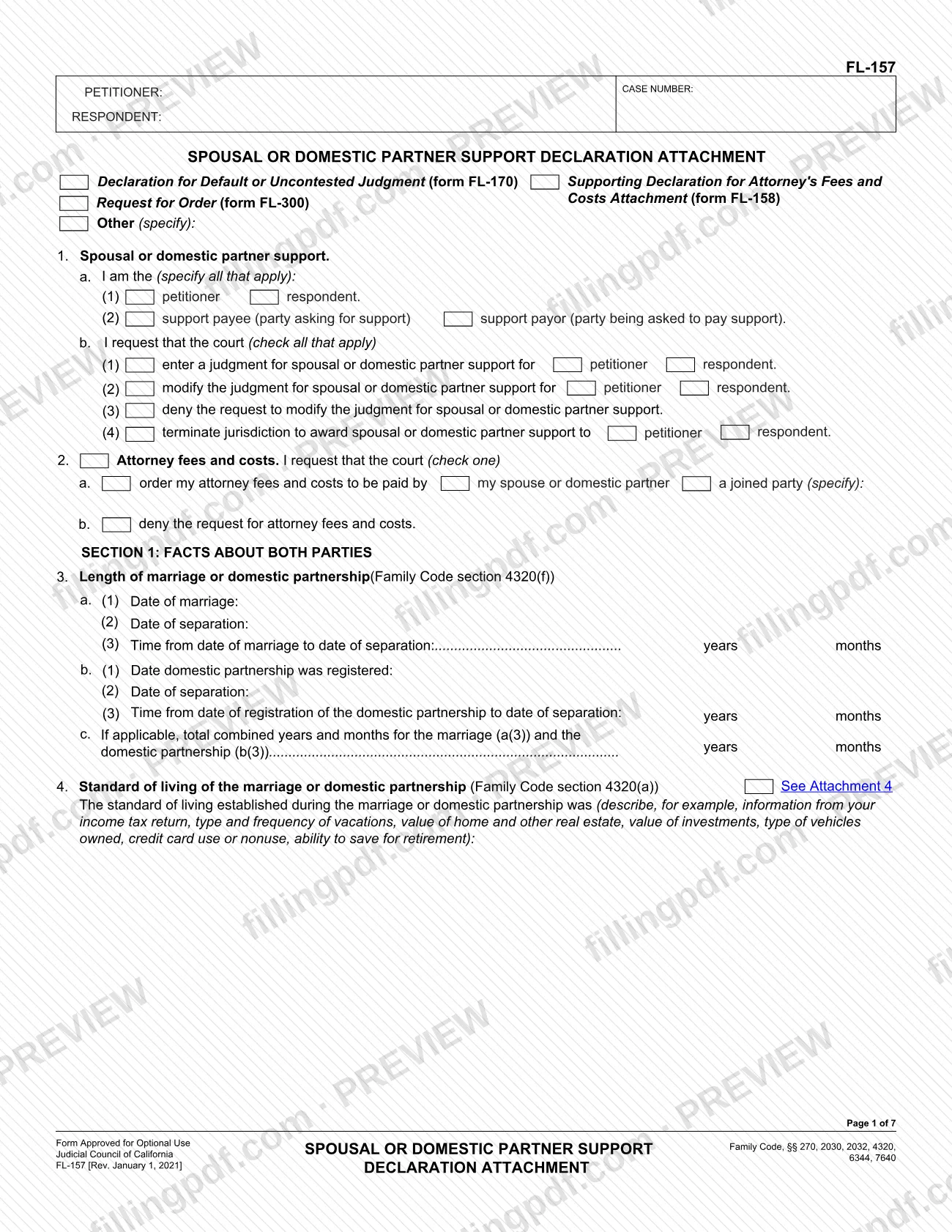
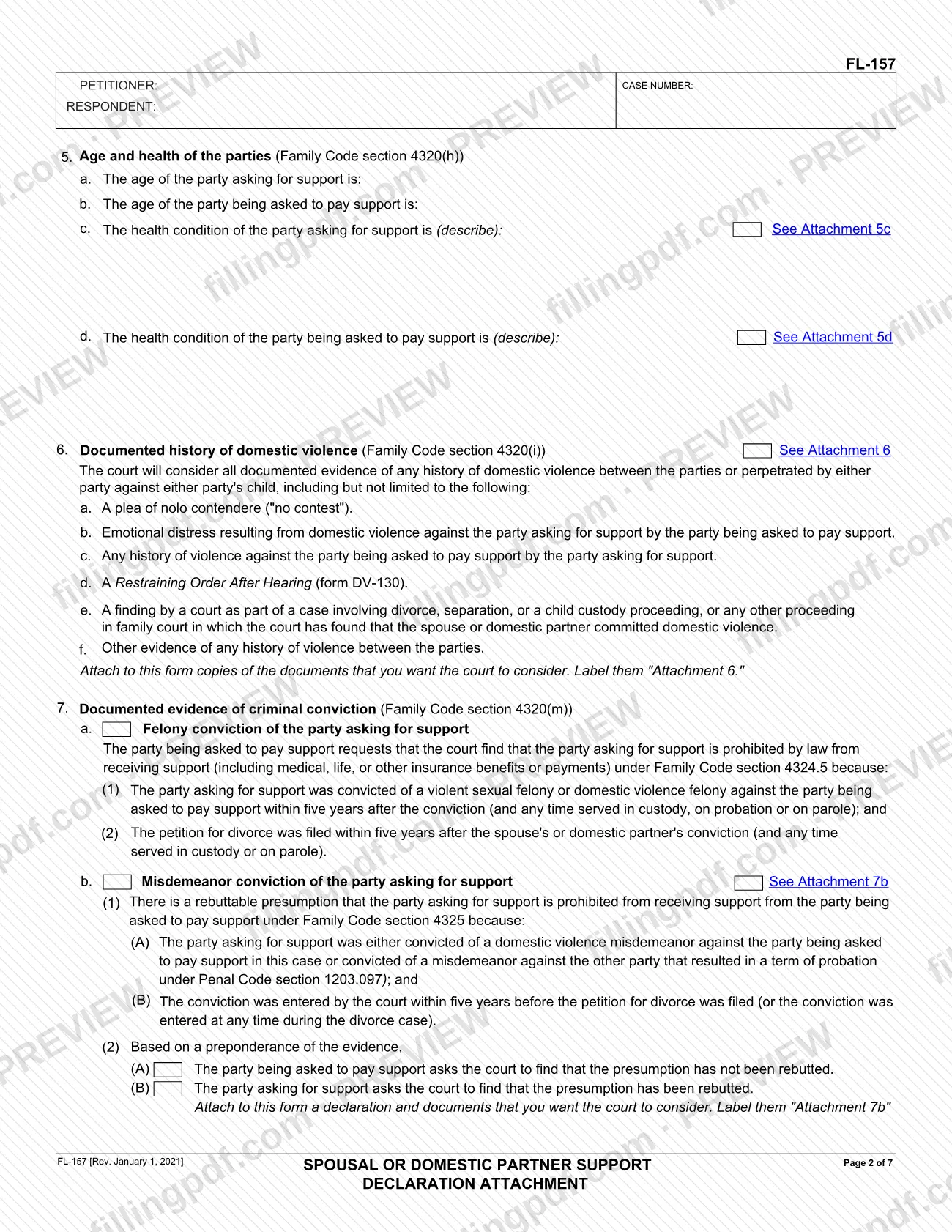
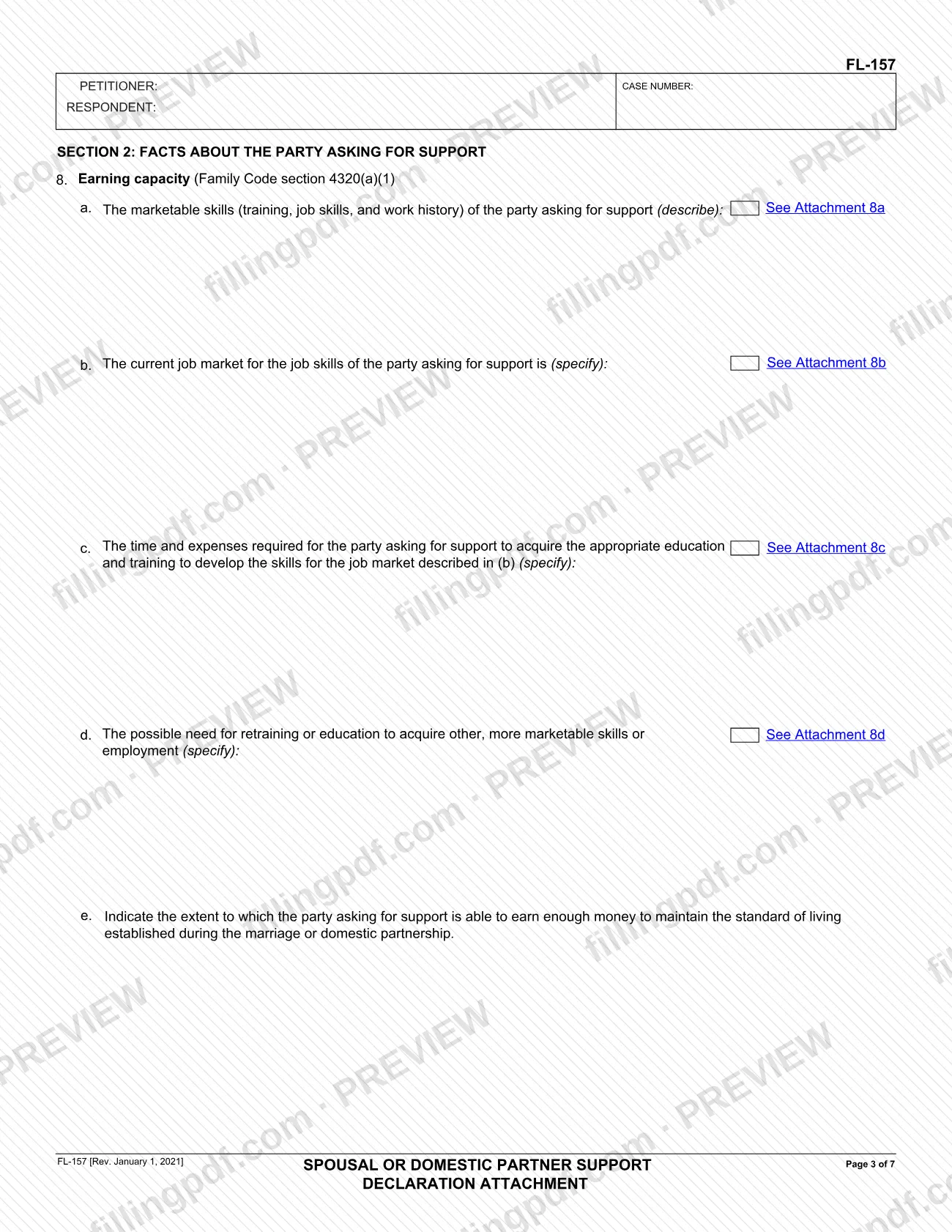
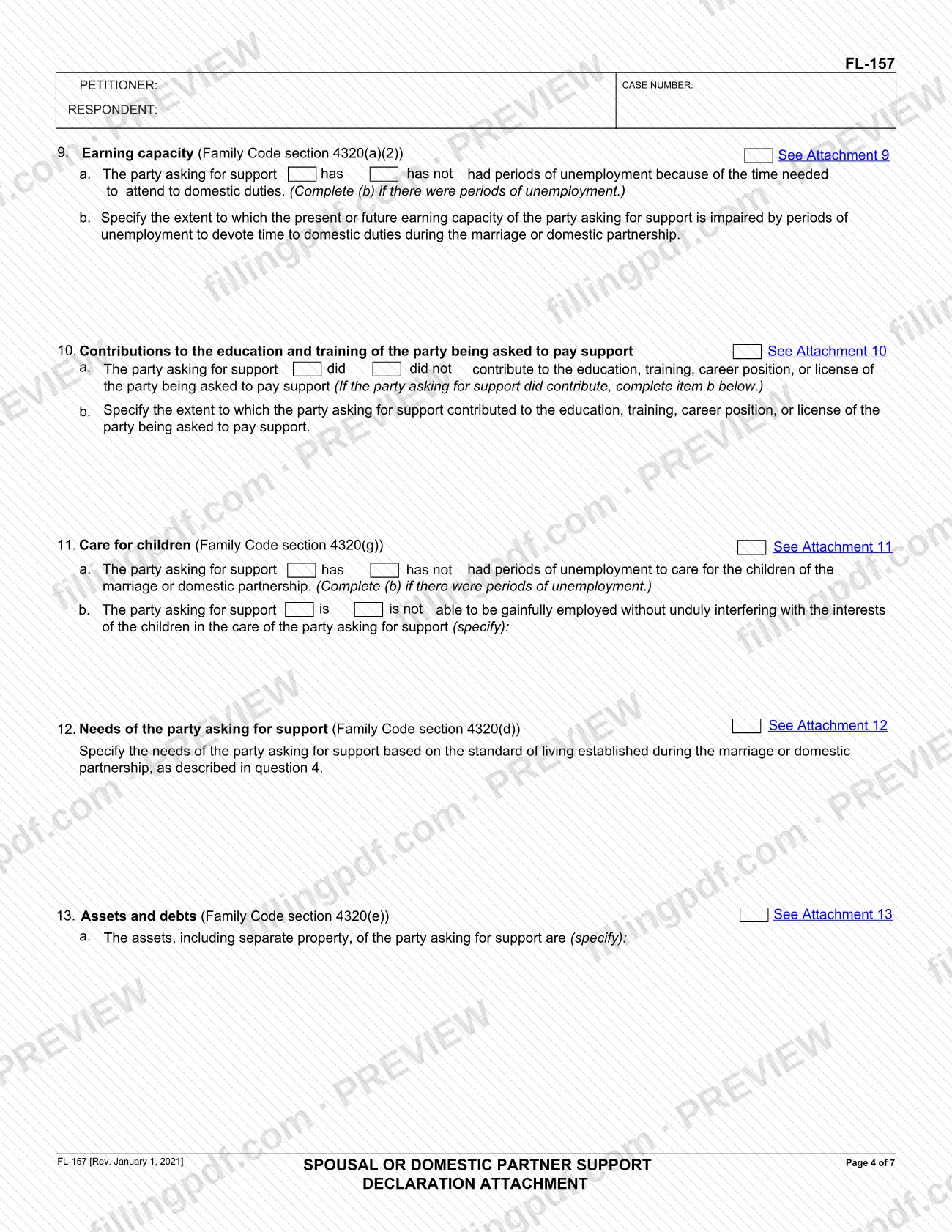
FL-157 is the Spousal or Domestic Partner Support Declaration Attachment, a form published by the Judicial Council of California. It lets a party to a California family case set out the facts that support a request for, or a challenge to, spousal or domestic partner support, organized around the factors in Family Code section 4320. The form is always attached to another form, such as Form FL-170 or Form FL-300. On this page you can fill out the form online on FillingPDF and download or print the completed PDF; the original PDF is published by the Judicial Council at courts.ca.gov.
Last updated
What is FL-157?
Form FL-157, Spousal or Domestic Partner Support Declaration Attachment, is a Judicial Council of California form on which a party explains the facts that support a request for a spousal or domestic partner support judgment, or a request to modify, deny or end such support.
The form does not stand alone. The California Courts self-help page describes it as always attached to another form, and the top of the form offers these choices: Declaration for Default or Uncontested Judgment (form FL-170), Request for Order (form FL-300), Supporting Declaration for Attorney's Fees and Costs Attachment (form FL-158), or another document you specify.
It has seven pages and four sections:
- Section 1: Facts about both parties. Length of the marriage or domestic partnership, standard of living, age and health, documented history of domestic violence, and documented evidence of criminal conviction.
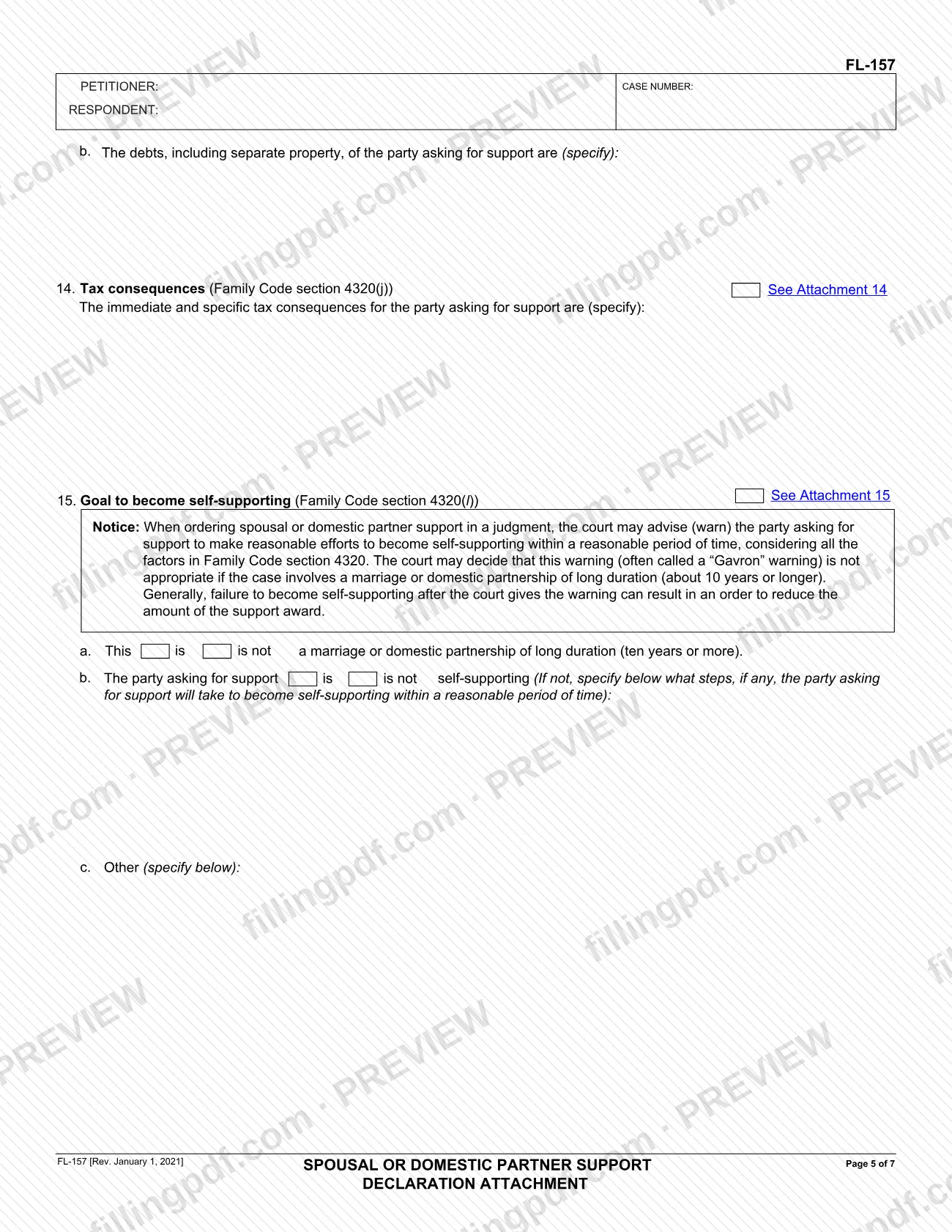
- Section 2: Facts about the party asking for support. Earning capacity, contributions to the other party's education, care for children, needs, assets and debts, tax consequences, and the goal to become self-supporting.
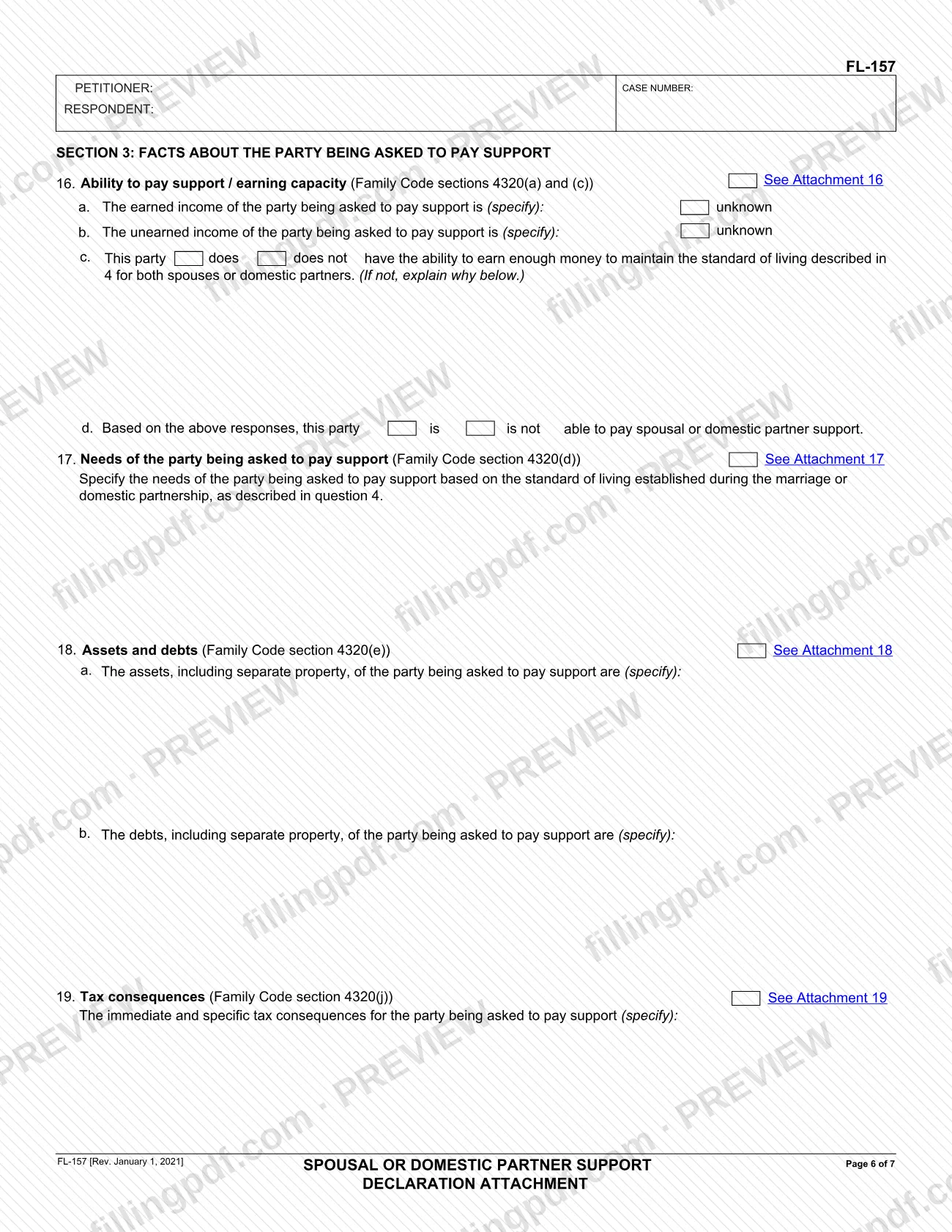
- Section 3: Facts about the party being asked to pay support. Ability to pay, needs, assets and debts, and tax consequences.
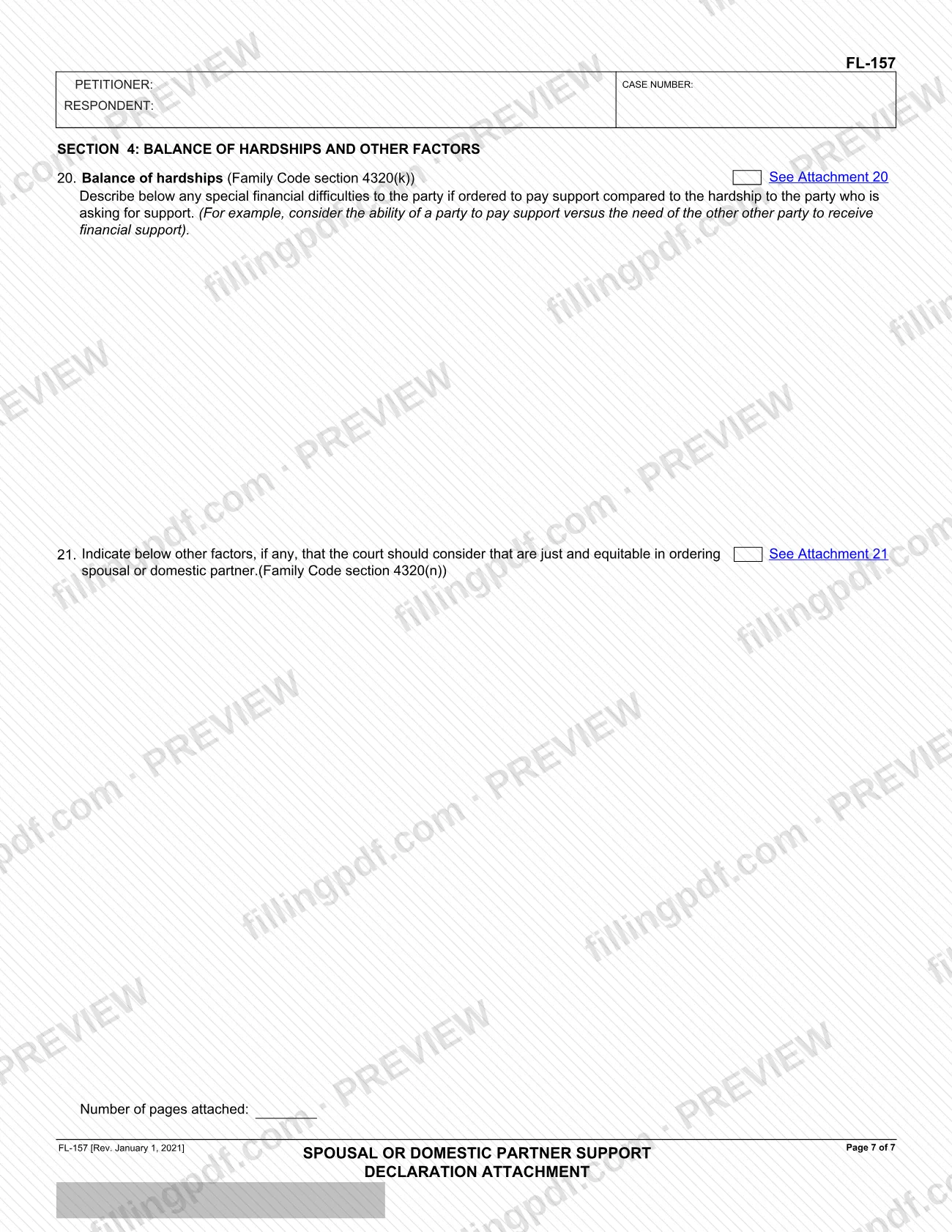
- Section 4: Balance of hardships and other factors.
Items 1 and 2 first state what you ask the court to do about support and about attorney fees and costs. Most items cite a subdivision of Family Code section 4320 and have a matching "Attachment" box for answers that do not fit on the form.
Who needs to file FL-157?
Either party in a California case involving a spouse or domestic partner uses FL-157 when the case includes a request about spousal or domestic partner support and the court needs the supporting facts. Item 1 asks you to identify yourself as petitioner or respondent and as the support payee (the party asking for support) or the support payor (the party being asked to pay support).
The form fits several requests, chosen in item 1b: entering a judgment for support, modifying a judgment for support, denying a request to modify, or terminating jurisdiction to award support. Item 2 adds a request about attorney fees and costs, including a request that a joined party pay them.
Sections 2 and 3 are written around the two roles. The party asking for support describes their own earning capacity, needs, assets and debts; the party being asked to pay describes ability to pay and needs. Item 7 is completed by the party being asked to pay support when asking the court to find that the other party is barred from support because of a conviction.
The form is a supporting attachment, not a request that starts a case. The Judicial Council marks it "Form Approved for Optional Use".
When to file FL-157
FL-157 has no due date of its own: you complete it when you submit the form it supports. The top of the form lists Form FL-170 (Declaration for Default or Uncontested Judgment), Form FL-300 (Request for Order), Form FL-158 (Supporting Declaration for Attorney's Fees and Costs Attachment) or another document you specify, and the California Courts self-help page says it is always attached to another form. Any deadline therefore comes from that form and the court handling your case. Gather the dates of marriage or registration and of separation before you start, since item 3 uses them to compute the length of the marriage or domestic partnership.
Documents you need
- Copies of documents you want the court to consider on documented domestic violence history (item 6), labeled "Attachment 6".
- A declaration and documents you want the court to consider on a misdemeanor conviction of the party asking for support (item 7b), labeled "Attachment 7b".
- Extra pages labeled with the matching attachment number (for example Attachment 4 or Attachment 8a) when your answer to an item does not fit in the space on the form.
How to fill out FL-157
Identify the case and host form
Enter petitioner, respondent and case number at the top. Check the form this attaches to (FL-170, FL-300 or FL-158) or specify another document under Other.
State your role and requests
Item 1a: mark petitioner or respondent and support payee or support payor. Item 1b: check each request that applies (enter, modify, deny a modification, or terminate jurisdiction) and mark for whom. Item 2: check one attorney fees and costs request.
Enter length of marriage or partnership
Item 3: give the dates of marriage and separation (3a), and the registration and separation dates for a domestic partnership (3b), with the time in years and months. Use 3c for a combined total if both apply.
Describe standard of living, age and health
Item 4: describe the standard of living, such as vacations, home value, investments, vehicles and savings. Item 5: give each party's age and describe each party's health, using Attachment 5c and 5d if needed.
Complete domestic violence and conviction items
Item 6: describe documented domestic violence history and attach copies labeled "Attachment 6". Item 7: complete 7a or 7b only if the party being asked to pay support is raising a conviction, and attach a declaration and documents labeled "Attachment 7b" for 7b.
Describe the earning capacity of the support seeker
Item 8: marketable skills, job market, time and expense of education or training, retraining needs, and ability to maintain the marital standard of living. Item 9: check whether there were unemployment periods for domestic duties and complete 9b if so.
Cover education, children and needs
Item 10: mark whether the party contributed to the other party's education or training and explain in 10b if so. Item 11: mark unemployment to care for children and whether gainful employment is possible. Item 12: specify needs based on the item 4 standard of living.
List assets, debts and tax consequences
Items 13 and 14: the assets and debts, including separate property, and the tax consequences for the party asking for support. Item 15: mark long duration (ten years or more), whether the party is self-supporting, and any steps planned.
Complete Section 3 for the paying party
Item 16: earned and unearned income (the form pre-fills "unknown"), ability to earn and ability to pay. Items 17 to 19: needs, assets and debts, and tax consequences for the party being asked to pay support.
Describe hardships and other factors
Item 20: describe special financial difficulties of paying compared with the hardship to the party asking for support. Item 21: list other just and equitable factors, then enter the number of pages attached.
Review and download the completed PDF
Check each item, the labels on your attachments and the page count. Download or print the completed PDF from FillingPDF and attach it to the form it supports as described under How to submit.
How to submit FL-157
FL-157 is not submitted by itself. It goes in with the form it supports, and the form prints no address, portal or fee information of its own.
- Attach it to the main form. At the top of the form, check the form it accompanies (FL-170, FL-300, FL-158) or write in the other document under Other (specify).
- Add your attachments. Copies of documents for item 6 are labeled "Attachment 6", and a declaration and documents for item 7b are labeled "Attachment 7b". Other items have an "Attachment" box for extra pages. Enter the Number of pages attached at the end of the form.
- Follow the main form's channel. Deliver the package the way the instructions for the form you attach it to direct, and check with the court handling your case for its filing rules.
The form also advises pressing the Clear This Form button after you print it, for your protection and privacy. FillingPDF lets you fill out and download the PDF; submission follows the channels above.
Common mistakes to avoid
- Submitting FL-157 on its own instead of attaching it to the form it supports, such as FL-170, FL-300 or FL-158.
- Attaching domestic violence documents for item 6 without labeling them "Attachment 6", or the item 7b declaration and documents without labeling them "Attachment 7b".
- Checking more than one box in item 2 when the form says to check one request on attorney fees and costs.
- Skipping item 9b, 10b or 11b after checking that there were periods of unemployment, or that the party contributed to education, training, career position or license; the form says to complete the follow-up item.
- Leaving out the explanation in item 15b of the steps toward becoming self-supporting when the party asking for support is not self-supporting.
- Having the wrong party complete item 7; it is a request made by the party being asked to pay support, and item 7b(2) has a separate box for each side.
- Forgetting to enter the number of pages attached at the end of the form after adding extra sheets.
- Leaving the case name and case number blank at the top of each page.
Frequently asked questions
What is form FL-157?
FL-157 is the Judicial Council of California's Spousal or Domestic Partner Support Declaration Attachment. A party uses it to explain the facts supporting a request about spousal or domestic partner support, organized around the factors in Family Code section 4320.
Can I file FL-157 by itself?
No. The California Courts self-help page says FL-157 is always attached to another form, and the form itself lists FL-170, FL-300 and FL-158, plus an Other box. It prints no separate filing address or deadline.
Which forms does FL-157 attach to?
The top of FL-157 offers Declaration for Default or Uncontested Judgment (FL-170), Request for Order (FL-300) and Supporting Declaration for Attorney's Fees and Costs Attachment (FL-158). You can also check Other and specify a different document.
Who completes item 7 about criminal convictions?
The party being asked to pay support. Item 7a asks the court to find the other party barred from support after a qualifying felony conviction, and item 7b concerns a misdemeanor conviction with a rebuttable presumption; either side marks its position in 7b(2).
What do I attach for item 6, domestic violence?
Attach copies of the documents you want the court to consider and label them "Attachment 6". The form lists examples, including a no contest plea, a Restraining Order After Hearing (form DV-130) and a court finding of domestic violence.
What does the 'long duration' box in item 15 mean?
Item 15a asks whether this is a marriage or domestic partnership of long duration, defined on the form as ten years or more. The form's notice says the court may decide a warning to become self-supporting is not appropriate for a marriage of about 10 years or longer.
Can I fill out FL-157 online?
Yes. You can fill out FL-157 online on FillingPDF and download or print the completed PDF. FillingPDF is an independent service and does not file the form with the court; you attach it to the main form and submit it through the court's channels.
Ready to fill out FL-157?
Fill out FL-157 now