
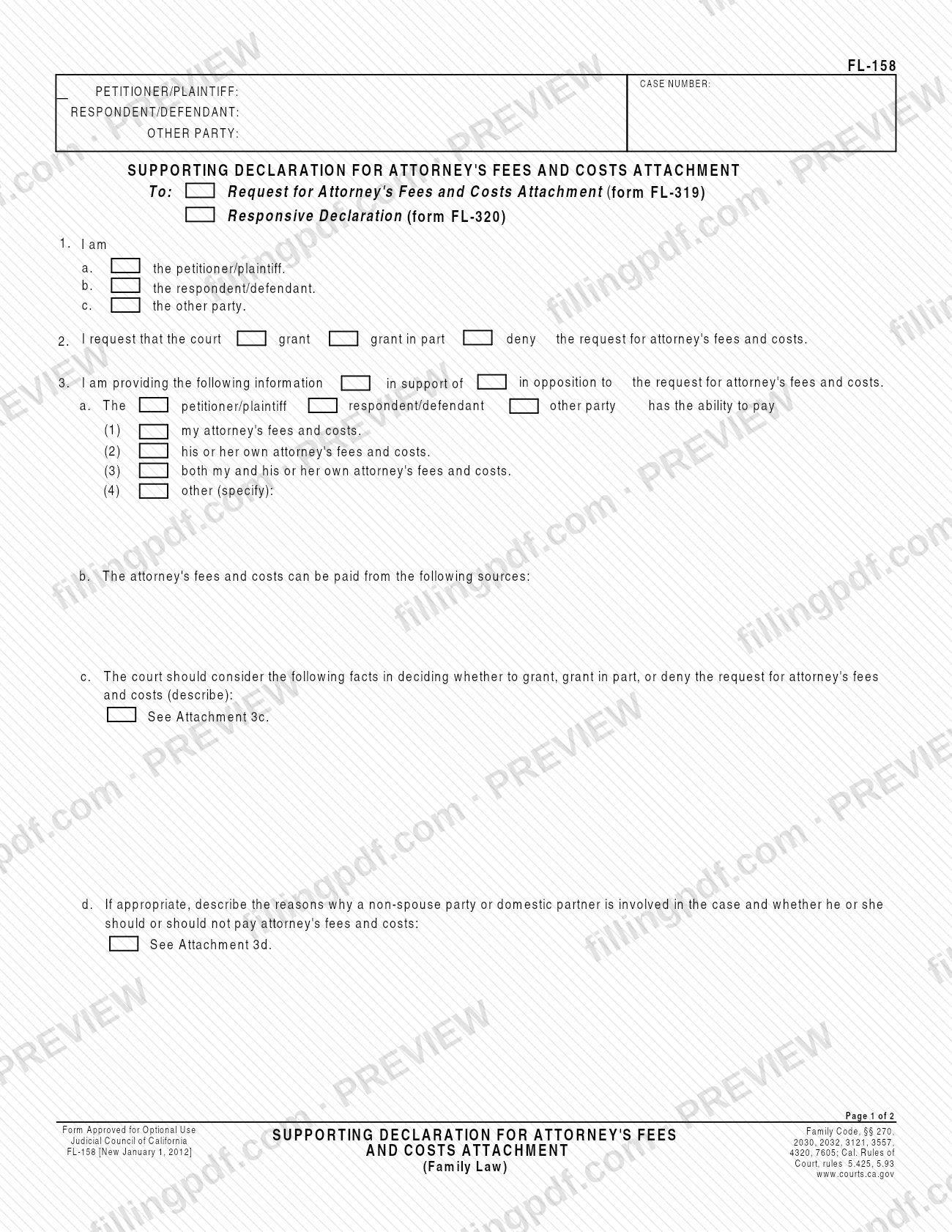
FL-158 is the Supporting Declaration for Attorney's Fees and Costs Attachment, a Family Law form approved by the Judicial Council of California. You use it to give the court your reasons for or against an award of attorney's fees and costs, and it is always attached to form FL-319 or form FL-320. On this page you can fill out the form online on FillingPDF and download or print the completed PDF; the court receives it only through the channels that apply to the form it is attached to.
Last updated
What is FL-158?
Form FL-158, Supporting Declaration for Attorney's Fees and Costs Attachment, is the Judicial Council of California family law form on which you explain why the court should or should not order you or your spouse or domestic partner to pay attorney's fees and costs.
The form is a sworn statement, not a request of its own. It is always attached to the Request for Attorney's Fees and Costs Attachment (form FL-319) or to the Responsive Declaration (form FL-320). It lets the person making the request and the person answering it each give the court their side.
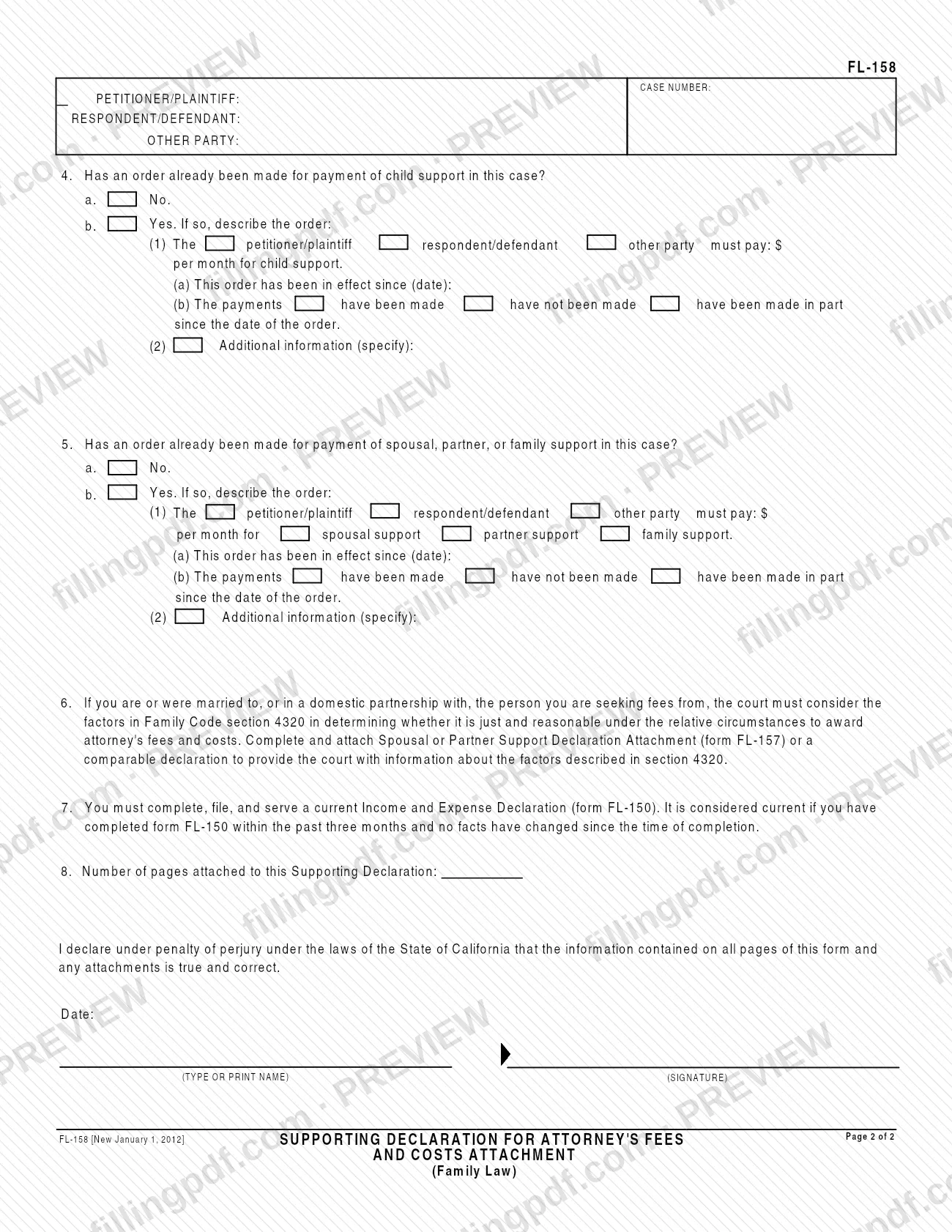
Page 1 states whether you are the petitioner/plaintiff, the respondent/defendant or the other party, and whether you ask the court to grant, grant in part or deny the request. It asks which party has the ability to pay, from what sources the fees and costs can be paid, and which facts the court should consider. Page 2 asks about existing child support and spousal, partner or family support orders. It also points to the related Spousal or Partner Support Declaration Attachment (form FL-157) and the Income and Expense Declaration (form FL-150).
The form cites Family Code sections 270, 2030, 2032, 3121, 3557, 4320 and 7605, and California Rules of Court, rules 5.425 and 5.93. The printed edition reads "New January 1, 2012", and the form is approved for optional use.
Who needs to file FL-158?
Any party in a California family law case who is asking for attorney's fees and costs, or who is responding to that request, completes Form FL-158 when the court needs information about who can pay. Item 1 asks you to check whether you are the petitioner/plaintiff, the respondent/defendant or the other party. The same form is used whether you are supporting or opposing the request, which you mark in item 3.
- If you are making the request, you attach FL-158 to Request for Attorney's Fees and Costs Attachment (form FL-319).
- If you are answering a request, you attach it to Responsive Declaration (form FL-320).
- If you are or were married to, or in a domestic partnership with, the person you seek fees from, item 6 also requires a completed FL-157 or a comparable declaration.
- If a non-spouse party or domestic partner is involved in the case, item 3d lets you explain why and whether that person should or should not pay.
FL-158 is not a standalone filing: do not submit it without the FL-319 or FL-320 it supports. The form prints no rule on signing for someone else; the declaration is made under penalty of perjury by the person who signs it.
When to file FL-158
Complete Form FL-158 when you prepare the Request for Attorney's Fees and Costs Attachment (form FL-319) or the Responsive Declaration (form FL-320), because it is always attached to one of them. It has no due date of its own printed on it, so it is filed whenever the form it supports is filed.
Item 7 sets a timing condition for a companion form: you must complete, file and serve a current Income and Expense Declaration (form FL-150). The FL-150 counts as current if you completed it within the past three months and no facts have changed since then. Check the date on any FL-150 you already have before you rely on it. For the deadline to file or answer a fee request, see the deadline that applies to FL-319 or FL-320 or the court's instructions.
Documents you need
- Request for Attorney's Fees and Costs Attachment (form FL-319): FL-158 is always attached to it when you are making the fee request.
- Responsive Declaration (form FL-320): FL-158 is always attached to it when you are responding to a fee request.
- Current Income and Expense Declaration (form FL-150): item 7 says you must complete, file and serve it; it is current if completed within the past three months and no facts have changed.
- Spousal or Partner Support Declaration Attachment (form FL-157) or a comparable declaration: item 6 requires it if you are or were married to, or in a domestic partnership with, the person you seek fees from.
- Attachment 3c: the page describing the facts the court should consider in deciding whether to grant, grant in part or deny the request, when you use item 3c.
- Attachment 3d: the page explaining why a non-spouse party or domestic partner is involved and whether that person should or should not pay, if appropriate.
How to fill out FL-158
Enter the case caption
At the top of each page, enter the CASE NUMBER and the names of the PETITIONER/PLAINTIFF, RESPONDENT/DEFENDANT and OTHER PARTY, if any.
Identify your role in the case
In item 1, check a, b or c to show whether you are the petitioner/plaintiff, the respondent/defendant or the other party.
State what you ask the court to do
In item 2, check whether you ask the court to grant, grant in part or deny the request for attorney's fees and costs.
Say whether you support or oppose
In item 3, check whether you give the information in support of or in opposition to the request. In item 3a, mark which party has the ability to pay and whose fees and costs (options 1 to 4, or specify under 4).
List the sources of payment
In item 3b, describe the sources from which the attorney's fees and costs can be paid.
Describe facts and non-spouse reasons
In item 3c, describe the facts the court should consider, using Attachment 3c if you need more room. In item 3d, if appropriate, explain why a non-spouse party or domestic partner is involved and whether that person should or should not pay, using Attachment 3d.
Report any child support order
In item 4, check a if no order has been made. If one has, check b, enter who must pay, the monthly amount, the date it took effect, whether payments were made, not made or made in part, and any additional information.
Report any spousal or family support order
In item 5, check a if no order exists. Otherwise check b and enter who pays, the monthly amount, the type of support (spousal, partner or family), the effective date, payment status and additional information.
Attach the FL-157 if item 6 applies
If you are or were married to, or in a domestic partnership with, the person you seek fees from, complete and attach form FL-157 or a comparable declaration about the Family Code section 4320 factors.
Confirm your current FL-150
Item 7 requires a current Income and Expense Declaration (form FL-150), completed within the past three months with no changed facts. Have it completed, filed and served.
Count the pages you attach
In item 8, enter the number of pages attached to this Supporting Declaration, including Attachments 3c and 3d if used.
Review, sign and download the PDF
Enter the date, type or print your name and sign below the penalty of perjury statement. Check every item, then download or print the completed PDF from FillingPDF and attach it to form FL-319 or FL-320.
How to submit FL-158
Form FL-158 is not submitted by itself. You attach it to the Request for Attorney's Fees and Costs Attachment (form FL-319) or the Responsive Declaration (form FL-320) and it goes to the court with that form. The form prints no address, portal or appointment rule of its own.
- Attach: put the signed FL-158, any Attachment 3c or 3d pages, and the number of attached pages (item 8) together with the FL-319 or FL-320.
- Companion forms: item 6 asks for FL-157 or a comparable declaration when you are or were married to, or in a domestic partnership with, the person you seek fees from. Item 7 says you must complete, file and serve a current FL-150.
- Filing and service: follow the court's instructions for the FL-319 or FL-320. The court clerk can tell you how your local court accepts filings.
The Judicial Council of California publishes the form and a self-help page for it at https://selfhelp.courts.ca.gov/jcc-form/FL-158. The form also asks you to press the Clear This Form button after printing it, for your protection and privacy. FillingPDF lets you fill out and download the PDF; submission follows the channels above.
Common mistakes to avoid
- Submitting FL-158 on its own instead of attaching it to the Request for Attorney's Fees and Costs Attachment (form FL-319) or the Responsive Declaration (form FL-320).
- Leaving out form FL-157 or a comparable declaration when you are or were married to, or in a domestic partnership with, the person you seek fees from (item 6).
- Relying on an Income and Expense Declaration (FL-150) completed more than three months ago, or one whose facts have since changed (item 7).
- Completing the FL-150 but not filing and serving it; item 7 says you must complete, file and serve it.
- Writing "See Attachment 3c" or "See Attachment 3d" without attaching those pages, or not entering the total number of attached pages in item 8.
- Checking an order exists in item 4 or 5 but not stating the monthly amount, the date it took effect or whether payments were made, not made or made in part.
- Signing without printing your name and the date; the declaration under penalty of perjury covers every page and attachment.
- Leaving a completed copy open on a shared computer instead of pressing Clear This Form after printing, as the form advises.
Frequently asked questions
What is form FL-158 used for?
FL-158 is the Judicial Council of California declaration in which you explain why the court should or should not order you or your spouse or domestic partner to pay attorney's fees and costs. It is always attached to form FL-319 or form FL-320.
Is FL-158 filed by itself?
No. FL-158 is always attached to the Request for Attorney's Fees and Costs Attachment (form FL-319) or the Responsive Declaration (form FL-320). It has no separate address, portal or due date printed on it.
Do I need an Income and Expense Declaration with FL-158?
Yes. Item 7 says you must complete, file and serve a current Income and Expense Declaration (form FL-150). It counts as current if you completed it within the past three months and no facts have changed since then.
When do I have to attach form FL-157 to FL-158?
When you are or were married to, or in a domestic partnership with, the person you seek fees from. Item 6 says the court must consider the Family Code section 4320 factors, so you complete and attach FL-157 or a comparable declaration.
Can I fill out FL-158 online?
You can fill out FL-158 online on FillingPDF and download or print the completed PDF. FillingPDF is an independent service and does not file the form with the court; you attach it to form FL-319 or FL-320 and file that form as the court requires.
Who signs the FL-158 declaration?
The party completing it dates it, types or prints a name and signs. The signature is made under penalty of perjury under California law and covers all pages of the form and any attachments. The form prints no separate rule for signing on someone else's behalf.
What do I enter for support orders in items 4 and 5?
Check No if no order has been made. If an order exists, check Yes and give who must pay, the monthly amount, the date it has been in effect since, and whether payments were made, not made or made in part. Item 5 also asks which kind of support it is.
Can I use FL-158 to oppose a fee request?
Yes. In item 3 you check whether you give the information in support of or in opposition to the request, and in item 2 you can ask the court to deny it. Attach the form to the Responsive Declaration (form FL-320).
Ready to fill out FL-158?
Fill out FL-158 now