
FL-300-INFO is the Information Sheet for Request for Order (Family Law), published by the Judicial Council of California. It walks you through asking a California court for new orders, or for changes to existing orders, in a family law case by using Request for Order (form FL-300). It covers when to use FL-300, which other forms to add, how to serve the other party and how to prepare for the hearing. On this page you can fill out the form online on FillingPDF and download or print the PDF; the current version is published by the Judicial Council at courts.ca.gov.
Last updated
What is FL-300-INFO?
FL-300-INFO, Information Sheet for Request for Order (Family Law), is an optional Judicial Council of California form that explains how to complete and file Request for Order (form FL-300) to ask the court for new orders or changes in a family law case.
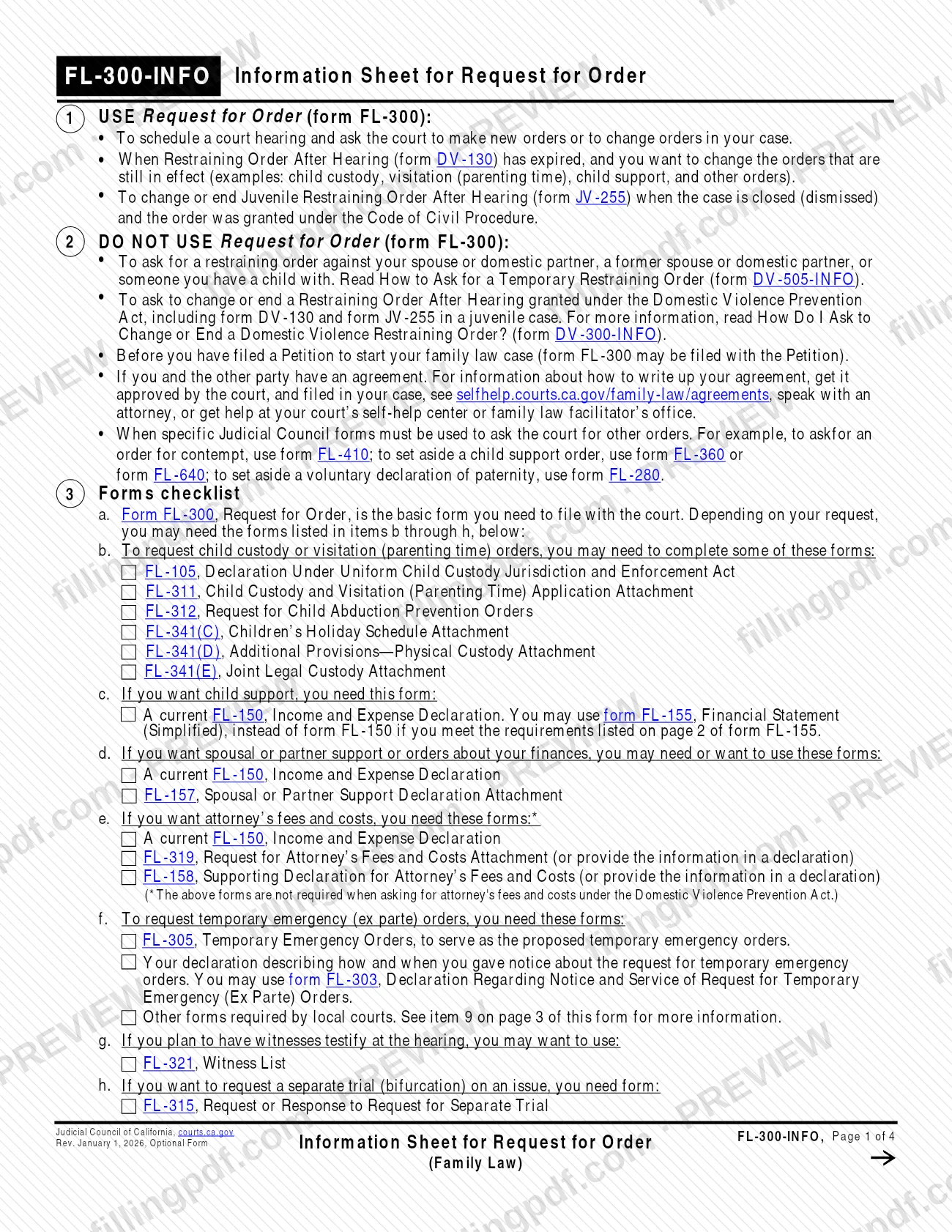
The four-page sheet is organized in numbered items. It says when to use and when not to use FL-300, lists the companion forms for each kind of request (child custody and visitation, child support, spousal or partner support, attorney's fees and costs, temporary emergency orders, witnesses and separate trial), and explains how to complete page 1 of FL-300. It then covers making copies, filing with the court clerk, paying filing fees or asking for a fee waiver, and the special rules for temporary emergency (ex parte) orders.
The second half of the sheet explains service: who may serve the papers, the difference between personal service and service by mail, the deadlines for each, and the proof of service forms. It closes with hearing preparation, the Findings and Order After Hearing (form FL-340) that follows the hearing, and where to get legal help.
The Judicial Council also publishes FL-300-INFO in Chinese Simplified, Korean, Spanish and Vietnamese. The sheet is not the request itself: the form that asks the court for orders is FL-300.
Who needs to file FL-300-INFO?
Anyone in a California family law case who plans to ask the court for new orders, or to change existing orders, with Request for Order (form FL-300) will find the steps in this sheet. A party's lawyer may also complete FL-300 for the party.
According to the sheet, you use FL-300 to:
- schedule a court hearing and ask the court to make new orders or change orders in your case;
- change orders that are still in effect after Restraining Order After Hearing (form DV-130) has expired, such as child custody, visitation (parenting time) and child support;
- change or end Juvenile Restraining Order After Hearing (form JV-255) when the case is closed (dismissed) and the order was granted under the Code of Civil Procedure.
Do not use FL-300 to:
- ask for a restraining order against a spouse or domestic partner, a former spouse or domestic partner, or someone you have a child with (read form DV-505-INFO);
- change or end a Restraining Order After Hearing granted under the Domestic Violence Prevention Act (read form DV-300-INFO);
- ask for orders before you have filed a Petition (FL-300 may be filed with the Petition);
- ask for orders you and the other party have already agreed on;
- request orders that have their own required Judicial Council form, such as contempt (FL-410), setting aside a child support order (FL-360 or FL-640) or setting aside a voluntary declaration of paternity (FL-280).
When to file FL-300-INFO
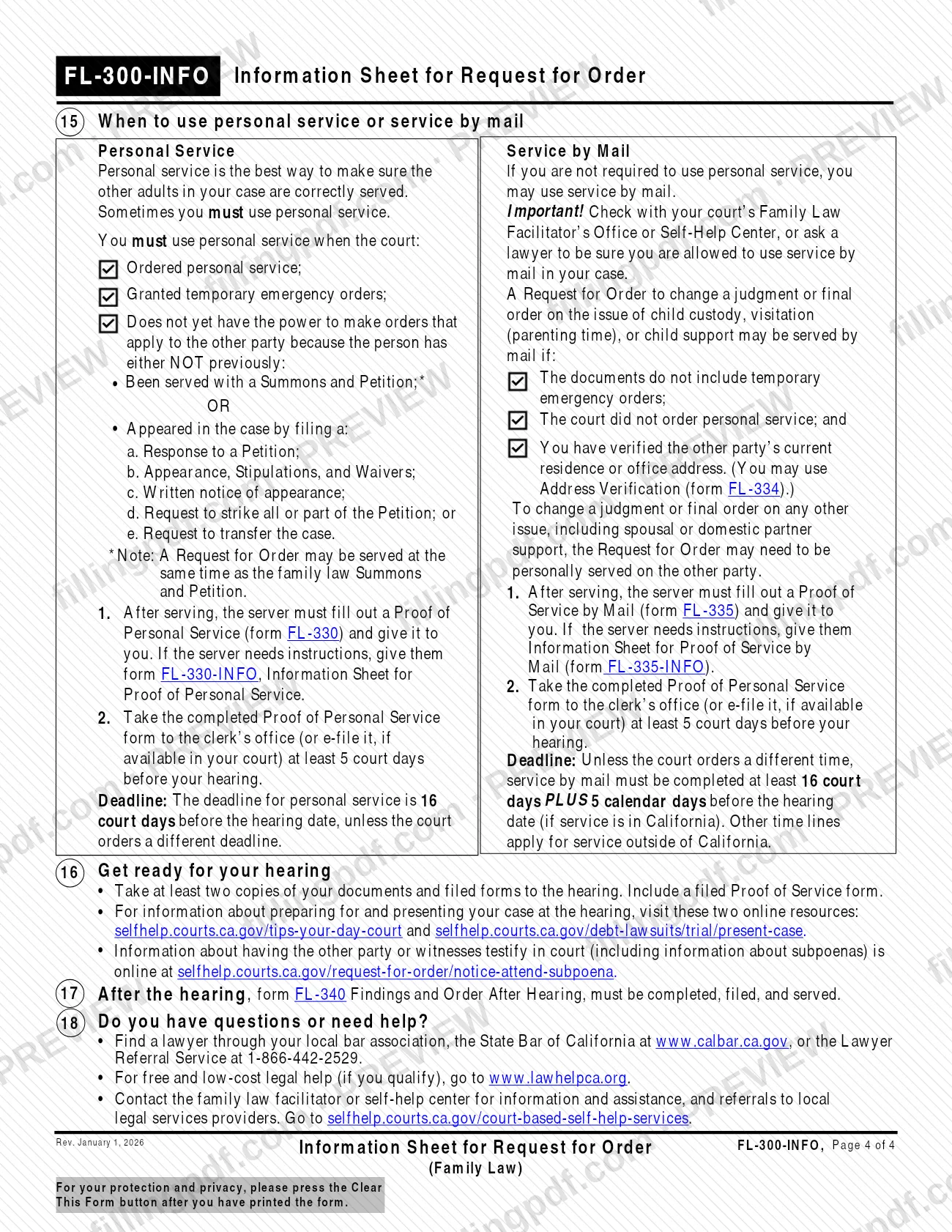
Use this sheet when you are ready to ask the court to make or change orders in your family law case, and you have already filed a Petition to start the case; FL-300 may also be filed together with the Petition. The sheet sets no filing date for FL-300 itself, but it sets service deadlines tied to the hearing date. Personal service is due 16 court days before the hearing, unless the court orders a different deadline. Service by mail must be completed at least 16 court days PLUS 5 calendar days before the hearing if service is in California; other time lines apply outside California. The completed proof of service goes to the clerk's office, or is e-filed where available, at least 5 court days before the hearing. Requests for temporary emergency orders follow the court's local procedures for reserving the hearing day. The revision printed on the sheet is Rev. January 1, 2026.
Documents you need
- Child custody or visitation (parenting time) requests: you may need FL-105, FL-311, FL-312, FL-341(C), FL-341(D) or FL-341(E), depending on what you ask for.
- Child support requests: a current FL-150, Income and Expense Declaration; you may use FL-155, Financial Statement (Simplified), instead if you meet the requirements on page 2 of FL-155.
- Spousal or partner support or financial orders: a current FL-150, and you may need or want FL-157, Spousal or Partner Support Declaration Attachment.
- Attorney's fees and costs: a current FL-150, FL-319 and FL-158, or the same information in a declaration; not required under the Domestic Violence Prevention Act.
- Temporary emergency (ex parte) orders: FL-305 as the proposed orders, plus a declaration on notice and service (you may use FL-303) and any forms required by local courts.
- If witnesses will testify at the hearing: you may want FL-321, Witness List.
- To request a separate trial (bifurcation) on an issue: FL-315, Request or Response to Request for Separate Trial.
- If you cannot afford the filing fee and have no valid fee waiver order in the case: FW-001, Request to Waive Court Fees, and FW-003, Order on Court Fee Waiver.
- With the papers you serve: a blank FL-320, Responsive Declaration to Request for Order, and a blank FL-150 if you served FL-150 or FL-155.
- With emergency orders you serve: a copy of the temporary emergency orders granted.
- Proof of service: FL-330 for personal service or FL-335 for service by mail, filled out by the server and filed with the clerk.
How to fill out FL-300-INFO
Confirm that FL-300 is the right form
Read items 1 and 2 of the sheet. Use FL-300 to schedule a hearing and ask for new or changed orders; do not use it for restraining orders, Domestic Violence Prevention Act orders, requests before a Petition is filed, agreed orders, or matters with their own form.
Use the forms checklist in item 3
Item 3 lists the forms to add for custody and visitation, child support, spousal or partner support, attorney's fees and costs, emergency orders, witnesses and separate trial. Mark the ones that match your request.
Complete the FL-300 caption
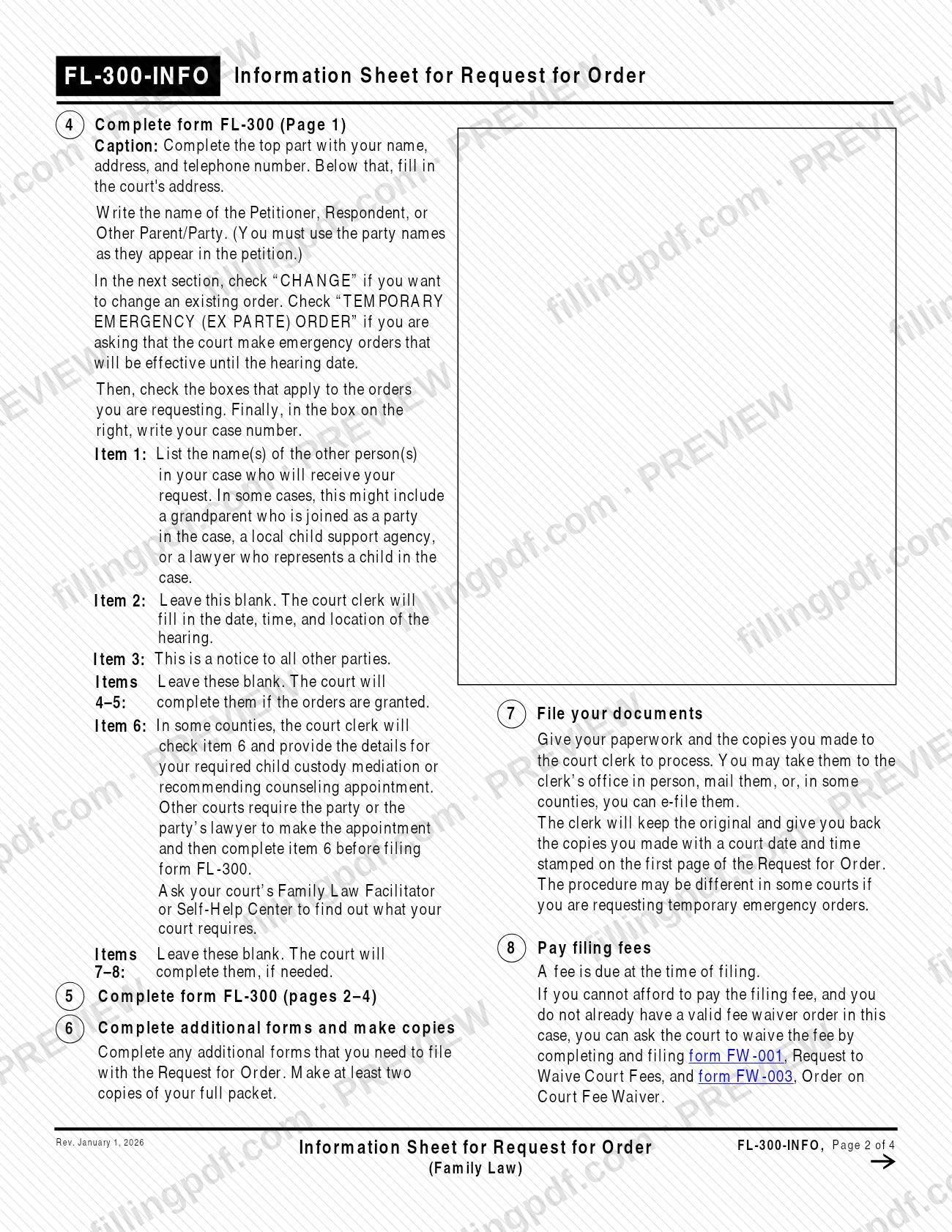
In item 4, enter your name, address and telephone number, the court's address, the party names as they appear in the petition and your case number. Check CHANGE or TEMPORARY EMERGENCY (EX PARTE) ORDER as it applies, and the boxes for the orders you request.
Complete items 1 to 3 of FL-300
Item 1: list the other person or persons who will receive your request, such as a joined grandparent, a local child support agency or a child's lawyer. Leave item 2 blank for the clerk; item 3 is a notice to all parties.
Leave the court's items blank
Leave items 4 and 5 blank, and items 7 and 8 for the court. Item 6 may be completed by the clerk, or you may need to schedule mediation or counseling yourself first; ask your Family Law Facilitator or Self-Help Center.
Add pages 2 to 4 and extra forms
Complete FL-300 pages 2 to 4 and any additional forms from the checklist. Make at least two copies of your full packet.
Prepare emergency order papers if needed
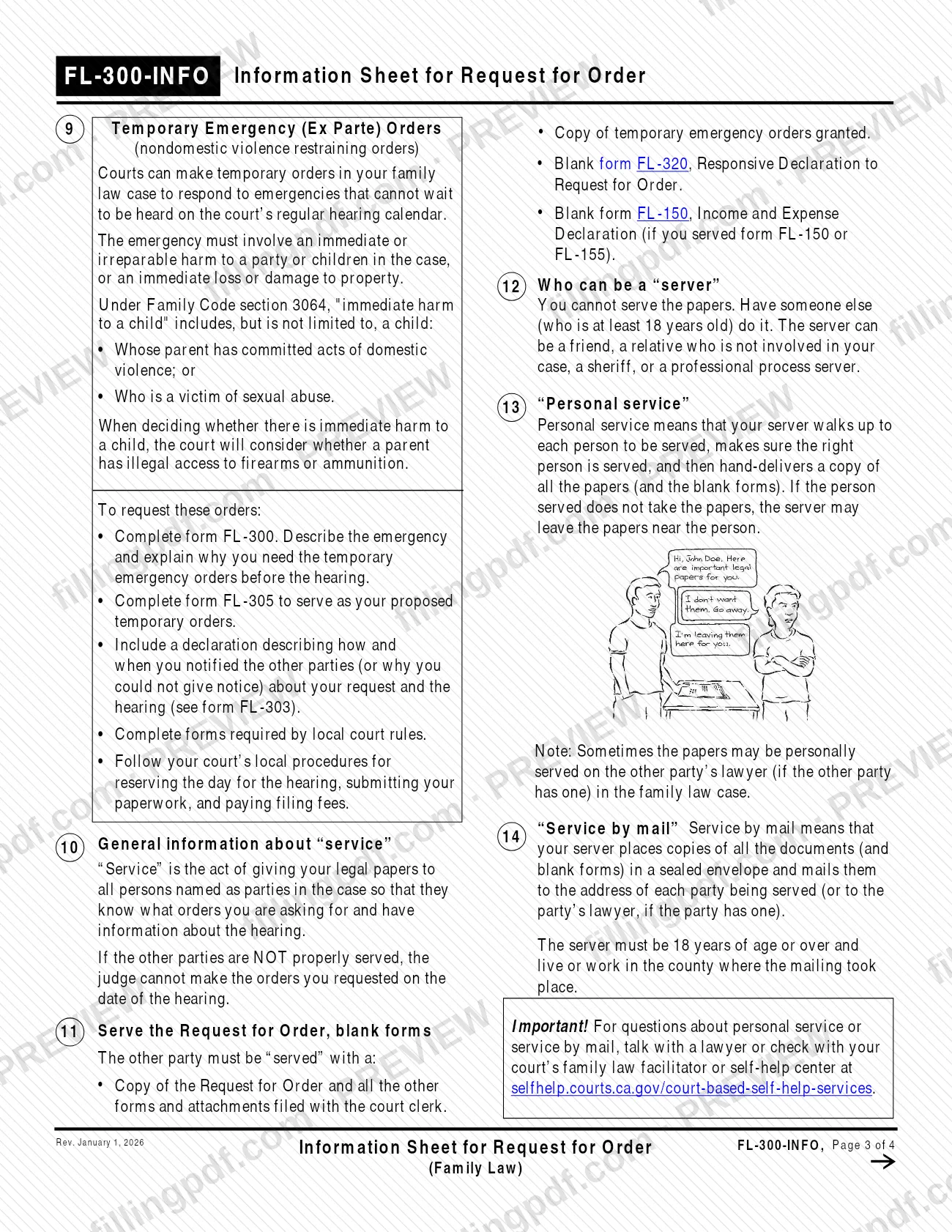
For temporary emergency orders, describe the emergency on FL-300, complete FL-305 as your proposed orders and add a declaration on notice, which may be FL-303. Add any local court forms.
File the packet and pay the fee
Give the originals and copies to the clerk in person, by mail or by e-filing where offered. A fee is due at filing; if you cannot pay it, ask for a waiver with FW-001 and FW-003.
Serve the other parties
Have someone at least 18 who is not you serve the filed papers and blank forms. Use personal service where the sheet requires it, such as after temporary emergency orders are granted; otherwise service by mail may be allowed.
Have the server complete proof of service
The server fills out FL-330 for personal service or FL-335 for service by mail. File it with the clerk at least 5 court days before the hearing.
Review and download the PDF
Check each entry against the checklist and the service deadlines, then download or print the completed PDF from FillingPDF. Bring at least two copies of your documents and a filed proof of service to the hearing.
How to submit FL-300-INFO
The sheet describes filing the Request for Order packet with the court clerk in person, by mail or, in some counties, by e-filing. FL-300-INFO itself is a guide to that packet.
- In person: take your paperwork and the copies you made (at least two copies of the full packet) to the clerk's office.
- By mail: mail the same packet to the clerk; the sheet gives no address, so ask your court.
- E-filing: available in some counties only.
The clerk keeps the original and gives back your copies with the court date and time stamped on the first page of the Request for Order. Procedures may differ in some courts if you request temporary emergency orders, so ask your court's Family Law Facilitator or Self-Help Center what it requires. A filing fee is due at the time of filing; the sheet gives no amount, so ask the court clerk. If you cannot afford it and have no valid fee waiver order in the case, you can ask the court to waive the fee with form FW-001, Request to Waive Court Fees, and form FW-003, Order on Court Fee Waiver. After filing, the other party must be served and a proof of service filed. FillingPDF lets you fill out and download the PDF; submission follows the court channels above.
Common mistakes to avoid
- Using Request for Order (FL-300) to ask for a restraining order; the sheet directs you to form DV-505-INFO instead.
- Using FL-300 to change or end a Restraining Order After Hearing granted under the Domestic Violence Prevention Act; read form DV-300-INFO.
- Filing FL-300 before a Petition has been filed, unless it is filed together with the Petition.
- Writing in item 2 on page 1 of FL-300; the court clerk fills in the date, time and location of the hearing.
- Using party names that differ from the petition; the sheet says you must use them as they appear there.
- Serving the papers yourself; the server must be someone else who is at least 18 years old.
- Serving the other party without the blank forms, such as FL-320, along with the filed papers.
- Using service by mail when temporary emergency orders were granted; the sheet requires personal service in that case.
- Serving a Request for Order late; if the other parties are not properly served, the judge cannot make the orders on the hearing date.
- Using FL-300 when a specific Judicial Council form is required, for example FL-410 for contempt.
Frequently asked questions
What is FL-300-INFO?
FL-300-INFO is the Information Sheet for Request for Order (Family Law) from the Judicial Council of California. It explains how to complete Request for Order (form FL-300), which companion forms to add, how to serve the other party, and what to do before and after the hearing.
Is FL-300-INFO the form I file to ask for court orders?
No. The form that asks the court to make or change orders is Request for Order (FL-300). FL-300-INFO is marked as an optional form and guides you through completing, copying, filing and serving FL-300 and its companion forms.
When should I not use form FL-300?
Do not use FL-300 to ask for a restraining order, to change or end a Domestic Violence Prevention Act order, before a Petition is filed, or when you and the other party have an agreement. It also does not replace forms required for specific requests, such as FL-410 for contempt.
What forms do I need with FL-300 for child custody?
For custody or visitation (parenting time) you may need some of FL-105, FL-311, FL-312, FL-341(C), FL-341(D) and FL-341(E). For child support you need a current FL-150, or FL-155 if you meet its requirements. Item 3 of the sheet lists the forms by type of request.
Who can serve my Request for Order?
Someone else who is at least 18 years old; you cannot serve the papers yourself. The sheet says the server can be a friend, a relative not involved in the case, a sheriff or a professional process server. For service by mail, the server must also live or work in the county where the mailing took place.
What is the deadline to serve a Request for Order?
Personal service must be done 16 court days before the hearing unless the court orders otherwise. Service by mail in California must be completed 16 court days plus 5 calendar days before the hearing, and the proof of service is filed at least 5 court days before the hearing.
How do I ask for temporary emergency (ex parte) orders?
Complete FL-300 describing the emergency, FL-305 as your proposed orders, and a declaration about notice (you may use FL-303). Add any forms your local court requires and follow its procedures for reserving the hearing day. Granted emergency orders must be served by personal service.
Is there a fee, and what if I cannot pay it?
A filing fee is due when you file, and the sheet does not state the amount; ask the court clerk. If you cannot afford it and have no valid fee waiver order in your case, file form FW-001, Request to Waive Court Fees, and form FW-003, Order on Court Fee Waiver.
Is FL-300-INFO available in Spanish?
Yes. The Judicial Council of California lists FL-300-INFO in Spanish, and also in Chinese Simplified, Korean and Vietnamese, on its self-help page for the form.
Can I fill out FL-300-INFO online?
You can fill out the PDF online on FillingPDF and download or print it. FillingPDF is an independent service and does not file anything with the court; you file Request for Order and its forms through the clerk's channels.
Ready to fill out FL-300-INFO?
Fill out FL-300-INFO now