
FL-300 is the Request for Order, a Judicial Council of California form that a party in a family law case uses to ask the Superior Court to make decisions (orders) on specific issues, such as child custody, child support or spousal support. The court also uses the form to set the date, time and location of the hearing. On this page you can fill out the form online on FillingPDF and download or print the completed PDF; the form and its instructions (form FL-300-INFO) are published by the California courts at courts.ca.gov.
Last updated
What is FL-300?
Form FL-300, Request for Order, is the Judicial Council of California form used to ask a Superior Court to make orders on specific issues in a family law case, or to change or end existing ones. It also serves as the court's notice of the hearing.
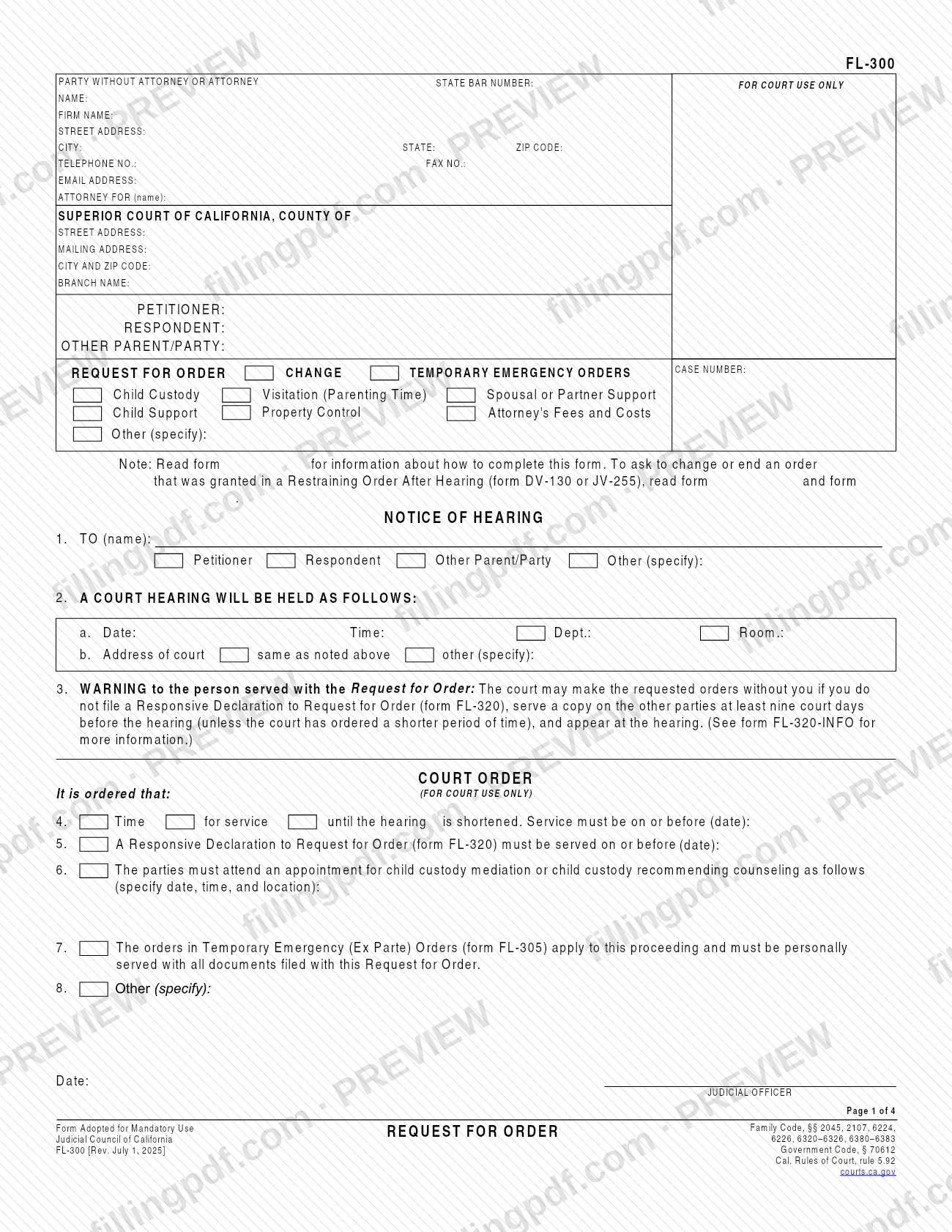
The form has two jobs. On page 1, the Notice of Hearing records who is being served, the date, time, department, room and address of the hearing, and a warning to the person served. The Court Order box on that page is for the court's use only and can shorten the time for service, set a deadline for a Responsive Declaration, or order a mediation or child custody recommending counseling appointment.
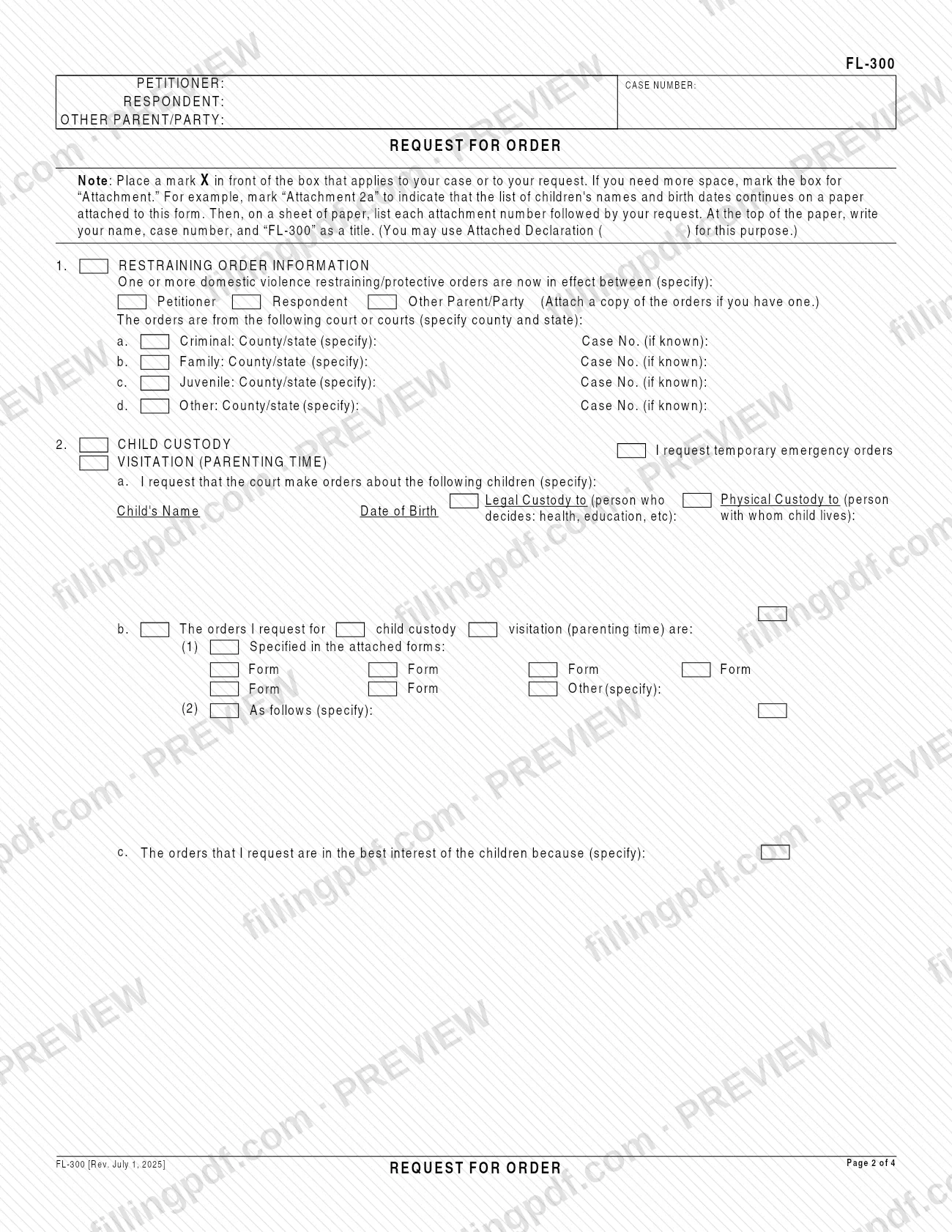
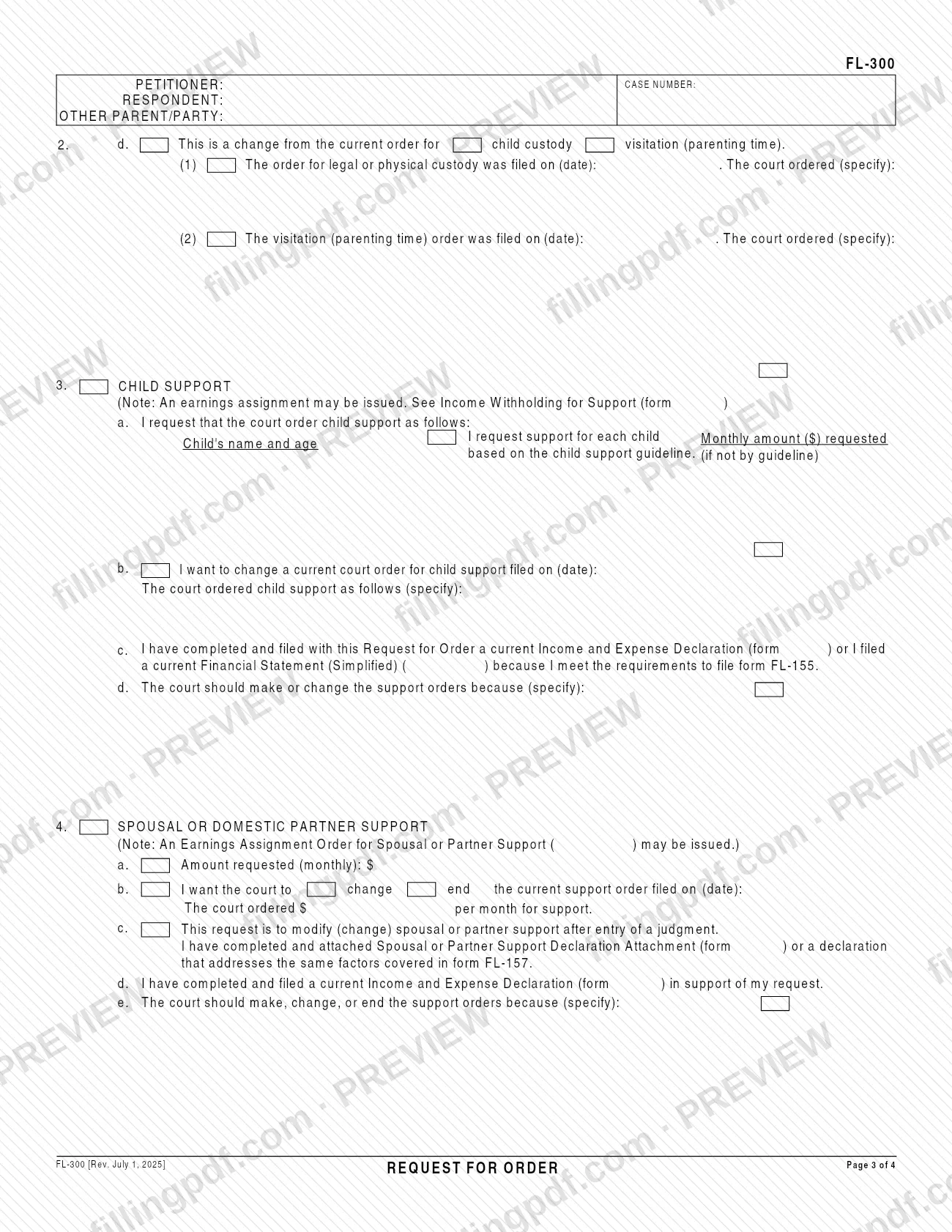
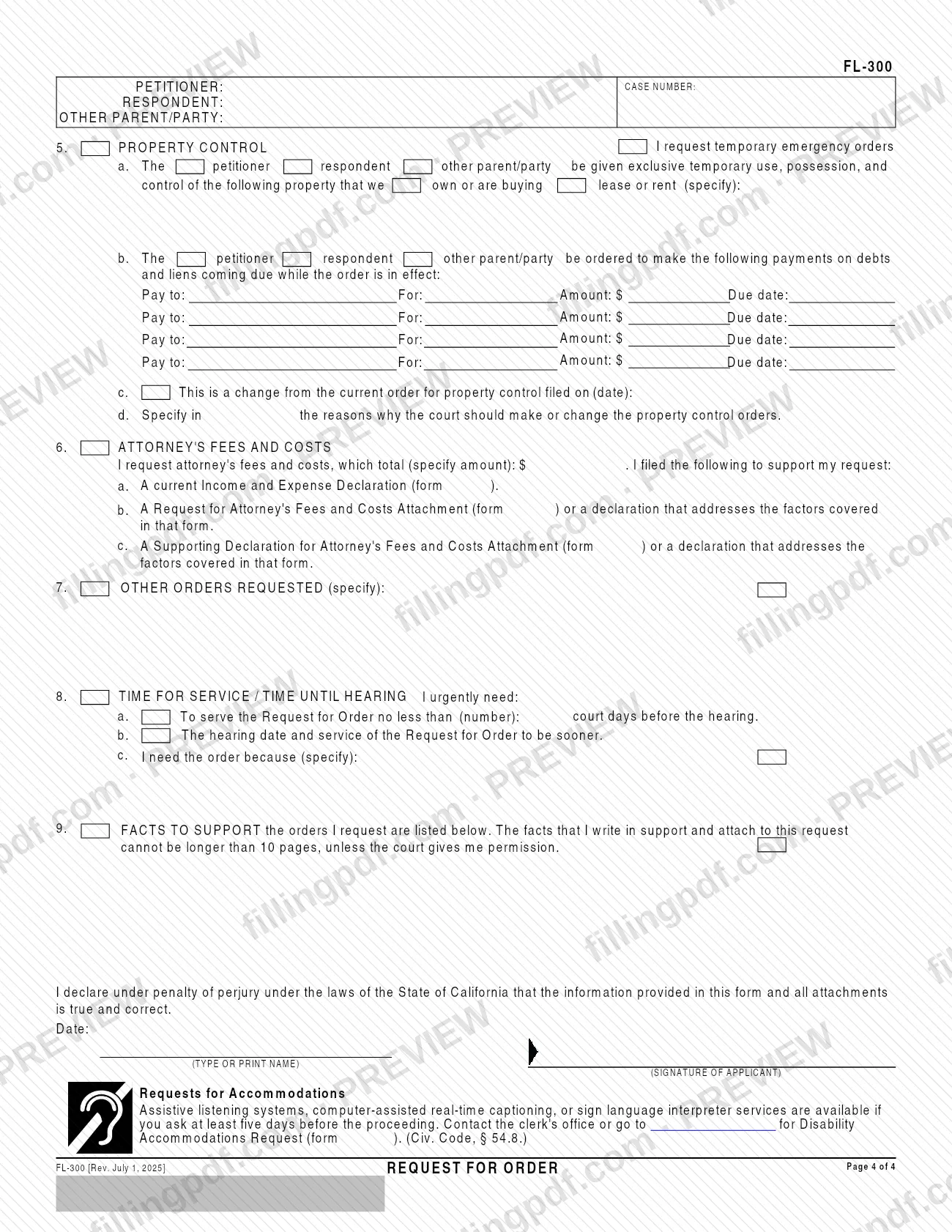
Pages 2 to 4 hold the request itself. You mark the boxes that apply: restraining order information (item 1), child custody and visitation (parenting time) (item 2), child support (item 3), spousal or domestic partner support (item 4), property control (item 5), attorney's fees and costs (item 6), other orders (item 7), time for service or time until hearing (item 8) and the facts that support your request (item 9). You can also mark Change or Temporary Emergency Orders at the top of page 1.
The person who receives the request answers with a Responsive Declaration to Request for Order (form FL-320). The form is adopted for mandatory use and was revised July 1, 2025. The California courts also publish it in Chinese Simplified, Korean, Spanish and Vietnamese.
Who needs to file FL-300?
A Petitioner, Respondent or Other Parent/Party in a California family law case who wants the court to make, change or end orders on child custody, visitation (parenting time), child support, spousal or partner support, property control or attorney's fees and costs uses FL-300. The caption also has a space for an attorney, so an attorney may complete it for a party.
- Changing a current order: mark the Change box and give the filing date and content of the current order where the form asks (items 2d, 3b, 4b and 5c).
- Urgent situations: the form has a Temporary Emergency Orders box and item 8 for asking that the hearing and service be sooner.
- Restraining orders: to change or end an order granted in a Restraining Order After Hearing (form DV-130 or JV-255), the form tells you to read FL-300-INFO and DV-300-INFO.
The person served with the request is not the one who completes it. That person responds with a Responsive Declaration to Request for Order (form FL-320); see form FL-320-INFO for details.
When to file FL-300
Use FL-300 when you need the court to decide a specific issue in your family law case or to change or end an existing order. The form prints no general filing deadline for the request.
Timing rules the form does state:
- The person served can lose the chance to respond: the court may make the requested orders without them if they do not file a Responsive Declaration (form FL-320), serve it on the other parties at least nine court days before the hearing (unless the court ordered a shorter time), and appear at the hearing.
- If you urgently need the hearing or service sooner, use item 8 to state the number of court days before the hearing by which you want to serve, and explain why in Attachment 8. The court decides in the Court Order box (items 4 and 5).
- Accommodation requests (assistive listening, real-time captioning or sign language interpreter) must be made at least five days before the proceeding.
Documents you need
- A copy of the domestic violence restraining or protective orders, if you have one, when item 1 says such orders are in effect between the parties.
- Forms that specify the custody or visitation orders you request, when you choose them in item 2b(1): FL-305, FL-311, FL-312, FL-341(C), FL-341(D), FL-341(E) or another listed form.
- Income and Expense Declaration (form FL-150), or Financial Statement (Simplified) (form FL-155) if you meet its requirements, filed with the request when you ask for or change child support (item 3c).
- Spousal or Partner Support Declaration Attachment (form FL-157), or a declaration covering the same factors, when you ask to modify spousal or partner support after entry of a judgment (item 4c).
- Income and Expense Declaration (form FL-150) in support of a request for spousal or partner support (item 4d).
- For attorney's fees and costs (item 6): a current FL-150, plus form FL-319 (or a declaration covering its factors) and form FL-158 (or a declaration covering its factors).
- Attachments for items where you need more space (such as 2a, 2b, 2c, 3a, 3d, 4e, 5d, 7, 8 and 9), headed with your name, case number and "FL-300"; Attached Declaration (form MC-031) may be used.
- The statement of supporting facts in Attachment 9, no longer than 10 pages unless the court gives you permission.
How to fill out FL-300
Complete the caption on page 1
Enter your name, State Bar number if you are an attorney, address, telephone, email and who you represent. Enter the county and court address, the names of the Petitioner, Respondent and Other Parent/Party, and your case number.
Mark the type of request
Check Request for Order and, if they apply, Change or Temporary Emergency Orders. Then check each issue you are raising: Child Custody, Visitation (Parenting Time), Spousal or Partner Support, Child Support, Property Control, Attorney's Fees and Costs, or Other (specify).
Fill in the Notice of Hearing
In item 1 enter the name of the person to be served and check their role. Items 2 and 3 give the hearing date, time, department, room and court address; the Court Order section (items 4 to 8) is for the judicial officer to complete.
Report restraining orders in item 1
On page 2, if domestic violence restraining or protective orders are in effect, check who they are between and list the criminal, family, juvenile or other court, county and state, and case number if known. Attach a copy if you have one.
Complete child custody and visitation, item 2
List each child's name and date of birth and the custody you request (legal and physical) in 2a. In 2b, name the attached forms or describe the orders; in 2c explain why they are in the children's best interest; use 2d for changes to an existing order.
Complete child support, item 3
In 3a list each child's name and age and check guideline support or give the monthly amount requested. In 3b enter the filing date of a current order you want changed, check 3c for your FL-150 or FL-155, and explain in 3d.
Complete spousal or partner support, item 4
Enter the monthly amount requested in 4a, or in 4b the date of the current order and amount you want changed or ended. Check 4c if this modifies support after judgment and 4d for your FL-150, then explain in 4e.
Complete property control, item 5
In 5a name who should have exclusive use, possession and control of which property, and in 5b list payments on debts and liens (pay to, for, amount, due date). Use 5c for changes and Attachment 5d for your reasons.
Complete fees, other orders and timing
In item 6 enter the total attorney's fees and costs requested and check the supporting forms you filed (a, b, c). Use item 7 for other orders. In item 8, enter the court days before the hearing by which you need to serve, and explain in Attachment 8.
Write the supporting facts, item 9
List the facts supporting your request in Attachment 9, no longer than 10 pages unless the court gives permission. Attach other attachments, and Attached Declaration (form MC-031) if you wish.
Sign, review and download the PDF
Date the form, type or print your name and sign above SIGNATURE OF APPLICANT, declaring under penalty of perjury that the information is true. Check each item against your attachments, then download or print the completed PDF from FillingPDF.
How to submit FL-300
The form does not print a filing address, portal or fee instructions; it is addressed to the Superior Court of California in the county named at the top, where your case is pending. Read form FL-300-INFO, the instructions the form points to, for how to complete and handle the request.
- Court: the caption asks for the county, street address, mailing address and branch of the Superior Court, and for your case number. Use the court handling your case.
- Service on the other parties: the Notice of Hearing names the person served (item 1), and the warning on page 1 refers to serving papers at least nine court days before the hearing unless the court orders a shorter time. If item 7 of the Court Order applies, the Temporary Emergency (Ex Parte) Orders (form FL-305) must be personally served with all documents filed with the request.
- Attachments: include every form or attachment your boxes call for (see the list of documents), and keep the supporting facts within 10 pages unless the court gives permission.
- Privacy: the PDF has Clear this Form button; the form advises pressing it after you print.
FillingPDF lets you fill out and download the PDF; submission follows the court channels described by the court and in FL-300-INFO.
Common mistakes to avoid
- Writing the supporting facts in Attachment 9 longer than 10 pages without the court's permission.
- Continuing a list on loose paper without marking the "Attachment" box and numbering the page (for example, Attachment 2a), or omitting your name, case number and "FL-300" at the top of the sheet.
- Asking for child support without filing a current Income and Expense Declaration (form FL-150) or, if you qualify, a Financial Statement (Simplified) (form FL-155).
- Asking to modify spousal or partner support after judgment without attaching form FL-157 or a declaration that covers the same factors.
- Requesting attorney's fees and costs without filing the supporting forms FL-150, FL-319 and FL-158, or declarations that address the same factors.
- Filling in the Court Order box on page 1; that section is for court use only.
- Using FL-300 alone to change or end an order from a Restraining Order After Hearing (DV-130 or JV-255) without reading FL-300-INFO and DV-300-INFO.
- Leaving out the filing date and terms of the current order when you mark that the request is a change (items 2d, 3b, 4b, 5c).
- Leaving the declaration under penalty of perjury unsigned and undated on page 4.
Frequently asked questions
What is the FL-300 form used for?
FL-300 is the Request for Order that a party in a California family law case uses to ask the court to make, change or end orders on issues such as child custody, visitation, child support, spousal support, property control or attorney's fees. The court also uses it to set the hearing date, time and location.
Can I fill out the FL-300 online?
Yes. You can complete the fillable PDF online on FillingPDF and download or print it. FillingPDF is an independent service and does not file the form with the court; you handle filing and service through the court's channels and the instructions in FL-300-INFO.
Where are the instructions for the FL-300?
The form itself points to form FL-300-INFO for information on how to complete it. To change or end an order granted in a Restraining Order After Hearing (DV-130 or JV-255), it says to read FL-300-INFO and DV-300-INFO as well.
What do I attach to the FL-300?
It depends on what you request. Child support needs a current FL-150 (or FL-155 if you qualify). Attorney's fees need FL-150, FL-319 and FL-158 or equivalent declarations. Spousal support changes after judgment need FL-157 or a declaration on the same factors. Custody orders may be specified on listed forms like FL-311 or FL-312.
How long can the facts in my FL-300 be?
The facts you write in support and attach to the request cannot be longer than 10 pages, unless the court gives you permission. Put them in Attachment 9, headed with your name, case number and "FL-300"; you may use Attached Declaration (form MC-031).
How much time does the other party have to respond to an FL-300?
The person served must file a Responsive Declaration to Request for Order (form FL-320) and serve it on the other parties at least nine court days before the hearing, unless the court ordered a shorter time. Otherwise the court may make the requested orders without them.
Can I ask for the hearing to happen sooner?
Yes. Item 8 lets you ask to serve the request fewer court days before the hearing, and for the hearing date and service to be sooner, with your reasons in Attachment 8. The court decides in the Court Order section, which can shorten time for service. You can also check Temporary Emergency Orders at the top.
Is the FL-300 available in Spanish?
Yes. The California courts self-help page offers FL-300 in Spanish, as well as Chinese Simplified, Korean and Vietnamese. This page covers the English-language form, revised July 1, 2025.
Ready to fill out FL-300?
Fill out FL-300 now