
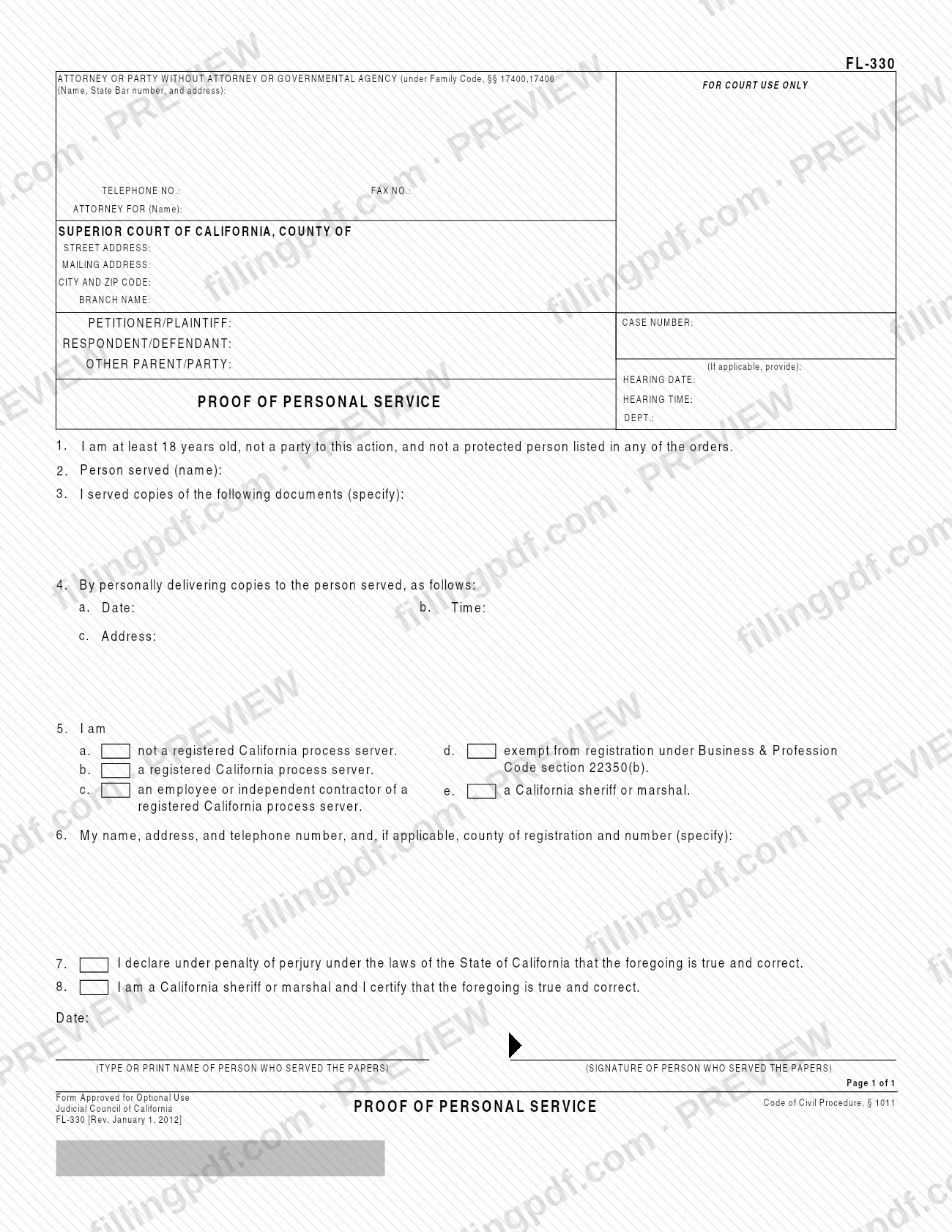
FL-330 is the Judicial Council of California form called Proof of Personal Service. The person who handed the legal papers to the other party completes it to tell the court which documents were served, on whom, and when and where the delivery took place. It carries the case caption and the hearing date, time and department at the top. On FillingPDF you can fill out the form online and download or print the completed PDF; the official PDF is published by the California courts at courts.ca.gov.
Last updated
What is FL-330?
Form FL-330, Proof of Personal Service, is the Judicial Council of California form that tells the court you had a person served in person with legal papers. It lists the papers served, when and where they were delivered, and who delivered them.
The page is a one-page declaration made by the person who did the serving, not by the party who asked for service. After the case caption (petitioner/plaintiff, respondent/defendant, an other parent or party if applicable, case number, and the hearing date, time and department), it runs through eight numbered items:
- Item 1: the server is at least 18 years old, is not a party to the action and is not a protected person listed in any of the orders.
- Item 2: the name of the person served.
- Item 3: the documents served.
- Item 4: that the copies were personally delivered, with the date, time and address.
- Item 5: the server's status, from not a registered California process server to a California sheriff or marshal.
- Item 6: the server's name, address and telephone number and, if applicable, county of registration and number.
- Items 7 and 8: the declaration under penalty of perjury, or the certification by a California sheriff or marshal.
The form is printed as Rev. January 1, 2012 and as Form Approved for Optional Use by the Judicial Council of California. It cites Code of Civil Procedure, § 1011.
Who needs to file FL-330?
The person who personally delivered the papers completes and signs FL-330. Item 1 sets the conditions for that person: at least 18 years old, not a party to the action, and not a protected person listed in any of the orders. A party to the case, or a protected person named in the orders, is not eligible to be the server on this form.
Item 5 asks the server to say which of these applies:
- not a registered California process server;
- a registered California process server;
- an employee or independent contractor of a registered California process server;
- exempt from registration under Business & Profession Code section 22350(b);
- a California sheriff or marshal.
A registered process server gives the county of registration and number in item 6. A California sheriff or marshal completes item 8 instead of the penalty-of-perjury statement in item 7.
The party or attorney who needs proof of service for the court file uses the completed form to show the court that the other party was served in person. The form itself records only in-person delivery.
When to file FL-330
Complete FL-330 after the papers have been personally delivered, because items 2 to 4 record the person served and the date, time and address of the delivery. The form prints no deadline of its own. It does carry the hearing date, time and department of the case at the top, so have the court paperwork at hand when you fill it out.
How to fill out FL-330
Enter the filer information
In the top-left box, enter the name, State Bar number and address of the attorney, party without attorney or governmental agency, with telephone and fax numbers and the name of the person you are the attorney for.
Complete the court information
Write the county of the Superior Court of California and its street address, mailing address, city and ZIP code, and branch name.
Fill in the case caption
Enter the PETITIONER/PLAINTIFF, the RESPONDENT/DEFENDANT and, if applicable, the OTHER PARENT/PARTY, then the CASE NUMBER.
Add the hearing details
Enter the HEARING DATE, HEARING TIME and DEPT. for the case.
Confirm the server qualifications
Item 1 states that the server is at least 18 years old, is not a party to the action and is not a protected person listed in any of the orders. The person who served the papers must be able to make that statement.
Name the person served and the papers
Item 2: the name of the person served. Item 3: specify the documents you served.
Record the personal delivery
Item 4: enter the date (a), the time (b) and the address (c) where you personally delivered the copies to the person served.
Select the server's status
Item 5: choose the box that fits, from a (not a registered California process server) through e (a California sheriff or marshal), including d if exempt under Business & Profession Code section 22350(b).
Give the server's contact details
Item 6: enter your name, address and telephone number and, if applicable, your county of registration and registration number.
Date and sign the declaration
Enter the date and the printed name of the person who served the papers, and have that person sign. Item 7 is the declaration under penalty of perjury; item 8 is the certification by a California sheriff or marshal.
Review and download the completed PDF
Check that every item matches the delivery that took place, then download or print the completed PDF from FillingPDF and provide it as the court's process requires.
Common mistakes to avoid
- Having a party to the action, a person under 18 or a protected person listed in the orders serve the papers and sign item 1.
- Leaving item 3 vague instead of specifying each document that was served.
- Leaving out the date, time or address in item 4 a, b or c.
- Skipping item 5, or ticking a status that does not match who served, such as marking registered process server without giving the county and number in item 6.
- Omitting the server's name, address and telephone number in item 6.
- Using the form for something other than in-person delivery; item 4 states the copies were personally delivered to the person served.
- Leaving the hearing date, time or department blank when the case has them.
- Submitting the form without the server's printed name, date and signature at the bottom.
Frequently asked questions
What is FL-330 used for?
FL-330 is the Judicial Council of California's Proof of Personal Service. It tells the court that the other party was served in person, lists the papers that were served, and says when and where the delivery was made and who made it.
Who can serve the papers and sign the FL-330 form?
The server must be at least 18 years old, not a party to the action and not a protected person listed in any of the orders (item 1). Item 5 then identifies the server, for example a registered California process server or a California sheriff or marshal.
Can I fill out FL-330 online?
Yes. You can fill out the PDF online on FillingPDF and download or print it. FillingPDF is an independent service, not connected to the Judicial Council of California, and it does not file or deliver the form to the court.
What goes in item 3 of FL-330?
Item 3 asks you to specify the documents you served. List each document that was delivered to the person served, so the court can see exactly which papers the proof of service covers.
What date and time do I enter on FL-330?
Enter the date and time of the in-person delivery in item 4a and 4b, and the address where the copies were handed over in item 4c. The hearing date and time at the top of the form are separate and belong to the case.
What is the difference between item 7 and item 8?
Item 7 is the declaration under penalty of perjury under California law that the statements are true and correct. Item 8 is for a California sheriff or marshal, who certifies that the statements are true and correct.
Do I need to be a registered process server to complete FL-330?
No. Item 5 lets you mark that you are not a registered California process server, or that you are exempt under Business & Profession Code section 22350(b). Registered servers and their employees or contractors give registration details in item 6.
Is FL-330 mandatory?
The form is printed as Form Approved for Optional Use by the Judicial Council of California. For questions about whether the court in your case requires it or accepts another proof of service, check with the court.
Ready to fill out FL-330?
Fill out FL-330 now