
FL-355 is the optional Judicial Council of California form on which parents and other parties in a California family court case state that they agree on custody and/or visitation (parenting time) and ask the judge to make that agreement a court order. The agreement itself is attached to the form, either as a separate document or as Form FL-341 and its attachments. On FillingPDF you can fill out the form online and download or print the completed PDF; the official PDF is published by the Judicial Council at courts.ca.gov.
Last updated
What is FL-355?
Form FL-355, Stipulation and Order for Custody and/or Visitation (Parenting Time), is a Judicial Council of California form on which the parties to a custody case state their agreement and the court adopts it as its order.
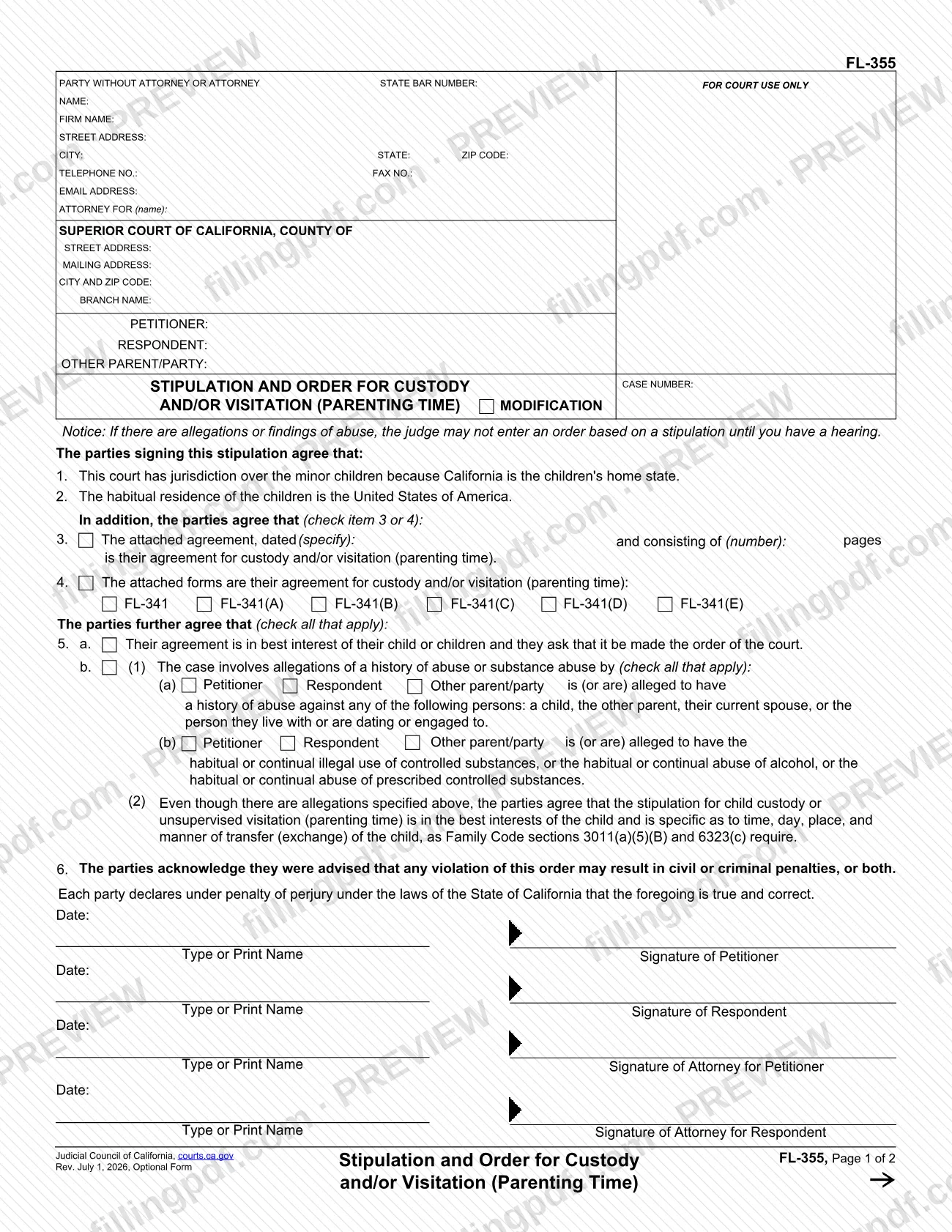
The form has two parts. Page 1 is the stipulation. The parties agree that California is the children's home state and that the children's habitual residence is the United States of America, then check item 3 (an attached agreement, with its date and number of pages) or item 4 (attached Forms FL-341, FL-341(A), FL-341(B), FL-341(C), FL-341(D) or FL-341(E)). Item 5 records that the agreement is in the child's best interest and, where the case involves allegations of abuse or substance abuse, the parties' statements required by Family Code sections 3011(a)(5)(B) and 6323(c). Item 6 acknowledges that violating the order may bring civil or criminal penalties, or both.
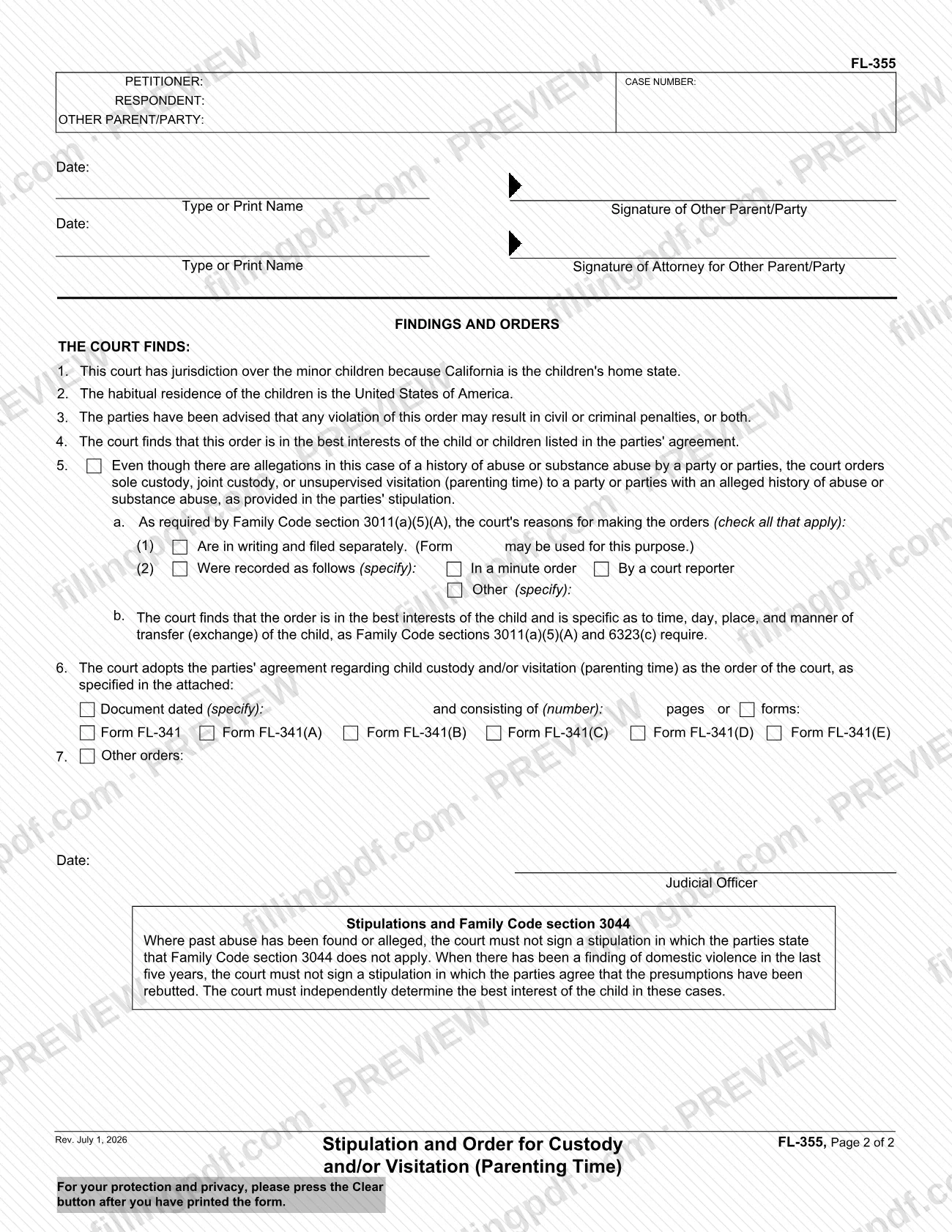
Page 2 holds the Findings and Orders for the judicial officer, including the court's adoption of the attached agreement as the order of the court. Form FL-351 may be used for the court's written reasons when abuse allegations are involved.
A notice at the top warns that where there are allegations or findings of abuse, the judge may not enter an order based on a stipulation until you have a hearing. A box on page 2 adds that, where past abuse has been found or alleged, the court must not sign a stipulation stating that Family Code section 3044 does not apply.
The Judicial Council's self-help site describes the form as the way parents tell the court they have an agreement and the court makes it an order. It lists Chinese Simplified, Korean, Spanish and Vietnamese versions of FL-355.
Who needs to file FL-355?
Parents and other parties in a California superior court case who have reached an agreement on child custody and/or visitation (parenting time) and want the court to adopt it as an order use FL-355. The form has signature lines for the Petitioner, the Respondent and an Other Parent/Party, and for the attorney of each when a party is represented.
Conditions printed on the form:
- The parties agree that California is the children's home state and that the children's habitual residence is the United States of America.
- If a party is alleged to have a history of abuse, or habitual or continual illegal use of controlled substances or abuse of alcohol or prescribed controlled substances, item 5b must be completed. The agreement must then be specific as to time, day, place and manner of transfer (exchange) of the child.
- Where past abuse has been found or alleged, the court must not sign a stipulation stating that Family Code section 3044 does not apply.
- After a finding of domestic violence in the last five years, the court must not sign a stipulation in which the parties agree the presumptions have been rebutted.
The form is labeled an optional form, so a written agreement presented in another way is not excluded by anything printed on it.
When to file FL-355
Use FL-355 when the parties have reached an agreement on custody and/or visitation (parenting time) and are ready to attach it and ask the court to make it an order. The form prints no due date of its own.
Timing of the order can depend on the facts of the case. The notice on page 1 says that if there are allegations or findings of abuse, the judge may not enter an order based on a stipulation until you have a hearing. Page 2 adds that where a finding of domestic violence was made in the last five years, the court must independently determine the child's best interest and will not sign a stipulation that the presumptions have been rebutted.
The revision on this page is dated July 1, 2026, which the Judicial Council gives as its effective date.
Documents you need
- The parties' written agreement, attached under item 3, with its date and number of pages entered on the form.
- Form FL-341 and any of FL-341(A), FL-341(B), FL-341(C), FL-341(D) or FL-341(E) that contain the parties' agreement, attached and checked under item 4 instead of a separate agreement.
- Form FL-351, only if the court uses it to put in writing its reasons for ordering custody or unsupervised visitation despite allegations of abuse or substance abuse; the court's reasons may instead be recorded in a minute order or by a court reporter.
How to fill out FL-355
Enter party or attorney information
In the top block, enter the name, State Bar number if an attorney, firm name, address, telephone and fax numbers, email address and the name of the party the attorney represents. Leave the box marked FOR COURT USE ONLY blank.
Identify the court and case
Enter the county of the Superior Court of California, its street and mailing address, city and ZIP code and branch name. Add the case number and the names of the Petitioner, Respondent and Other Parent/Party.
Read the jurisdiction statements
Items 1 and 2 state that California is the children's home state and that the children's habitual residence is the United States of America. By signing, the parties agree to both.
Choose item 3 or item 4
Check item 3 and enter the date and number of pages of the attached agreement, or check item 4 and mark each attached form: FL-341, FL-341(A), FL-341(B), FL-341(C), FL-341(D) or FL-341(E).
Complete item 5a
Check item 5a to state that the agreement is in the best interest of the child or children and that the parties ask that it be made the order of the court.
Complete item 5b if abuse is alleged
If the case involves allegations of abuse or substance abuse, check item 5b(1)(a) and/or (b) and mark Petitioner, Respondent or Other parent/party. Then confirm in item 5b(2) that the stipulation is in the child's best interests and is specific as to time, day, place and manner of transfer.
Review the penalties acknowledgment
Item 6 states that the parties were advised that any violation of the order may result in civil or criminal penalties, or both. Check that each party understands it before signing.
Type names, sign and date
On page 1, each party and each attorney enters the date, types or prints a name and signs. The Other Parent/Party and that party's attorney sign and date on page 2.
Leave the Findings and Orders to the court
The Findings and Orders on page 2, including items 5, 6 and 7 and the Judicial Officer's date and signature, are the court's part of the form.
Review and download the completed PDF
Check the case number, the attachment details in item 3 or 4 and every signature line. Download or print the completed PDF from FillingPDF and file it with the attached agreement through the court's channels described under How to submit.
How to submit FL-355
FL-355 is a court form, so it goes to the Superior Court of California in the county where the case is pending; the form names that court in its caption but prints no filing channel, address or portal.
- Complete and sign. Each party signs and dates the stipulation under penalty of perjury, and each attorney signs if a party is represented. Page 2 has the same signature lines for an Other Parent/Party and that party's attorney.
- Attach the agreement. Attach either the written agreement (item 3) or the FL-341 forms you check in item 4.
- Court action. The judicial officer reviews the stipulation, completes the Findings and Orders on page 2 and dates and signs it. Where abuse is alleged, a hearing may be required first.
- Where to file. Use the filing method of the court that has your case, such as its clerk's office or its published filing instructions; the form itself does not give one.
FillingPDF lets you fill out and download the PDF; submission follows the court's own channels.
Common mistakes to avoid
- Checking both item 3 and item 4, or neither, when the form says to check one: either a dated attached agreement or the attached FL-341 forms.
- Leaving the date or the number of pages blank in item 3 so the attached agreement cannot be identified.
- Omitting item 5b when the case involves allegations of abuse or substance abuse by a party, or attaching an agreement that is not specific as to time, day, place and manner of transfer (exchange) of the child.
- Submitting the form without every required signature: each party signs, and so does each attorney when a party is represented.
- Stating in the agreement that Family Code section 3044 does not apply where past abuse has been found or alleged; the court must not sign such a stipulation.
- Stating that the presumptions have been rebutted when there has been a finding of domestic violence in the last five years; the court must not sign it.
- Expecting an order on the stipulation alone when abuse is alleged or found; the judge may not enter the order until you have a hearing.
Frequently asked questions
What is Form FL-355 used for?
FL-355 is the Judicial Council of California form on which parents tell the court they agree on custody and/or visitation (parenting time) and ask that the agreement be made a court order. The agreement is attached, and the judicial officer signs the Findings and Orders on page 2.
Do I have to attach my parenting agreement to FL-355?
Yes. Item 3 or item 4 must point to the agreement: check item 3 for an attached agreement with its date and page count, or item 4 for attached Forms FL-341 and the FL-341(A) to (E) attachments that contain the agreement.
Can a judge sign FL-355 without a hearing?
Not always. The form warns that if there are allegations or findings of abuse, the judge may not enter an order based on a stipulation until you have a hearing. Without such allegations, the form does not require one.
Who signs Form FL-355?
Each party signs and dates under penalty of perjury: the Petitioner, the Respondent and any Other Parent/Party. An attorney for each party signs as well when the party is represented. The judicial officer signs the court's orders at the end of page 2.
What is the difference between FL-355 and FL-341?
FL-355 is the stipulation and order that carries the agreement to the court; FL-341 and its attachments (A) to (E) can be the agreement itself. Under item 4 of FL-355 you check the FL-341 forms you attach.
Is there a Spanish version of FL-355?
Yes. The Judicial Council's self-help site offers FL-355 in Chinese Simplified, Korean, Spanish and Vietnamese, in addition to the English form. This page covers the English form, revised July 1, 2026.
Can I fill out FL-355 online and file it?
You can fill out the FL-355 PDF online on FillingPDF and download or print it. FillingPDF is an independent service and does not file the form with the court; you file it through the channels of the Superior Court that has your case.
What if there are abuse allegations in my case?
Complete item 5b and make sure the agreement is specific as to time, day, place and manner of transfer of the child. The court must not sign a stipulation that says Family Code section 3044 does not apply where past abuse has been found or alleged.
Ready to fill out FL-355?
Fill out FL-355 now