
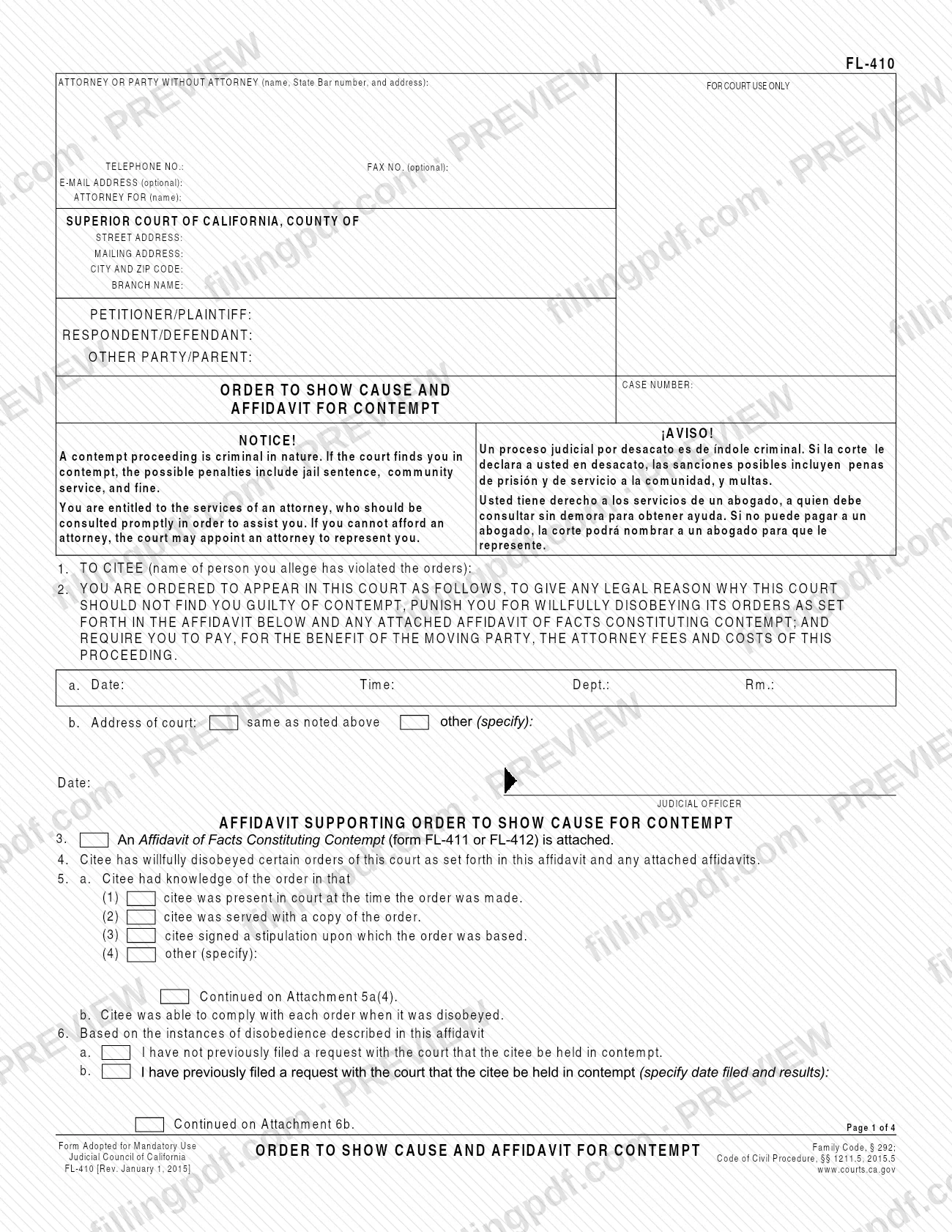
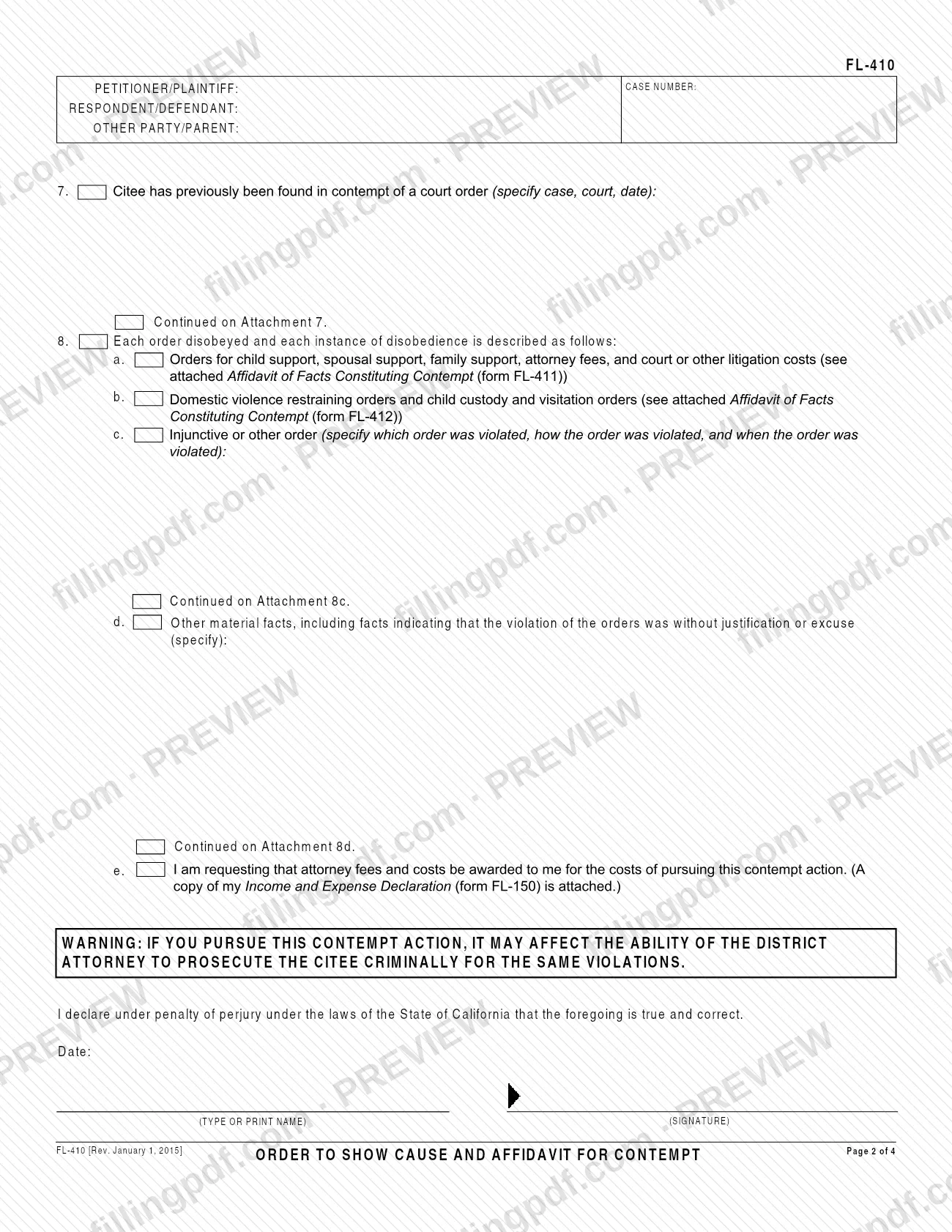
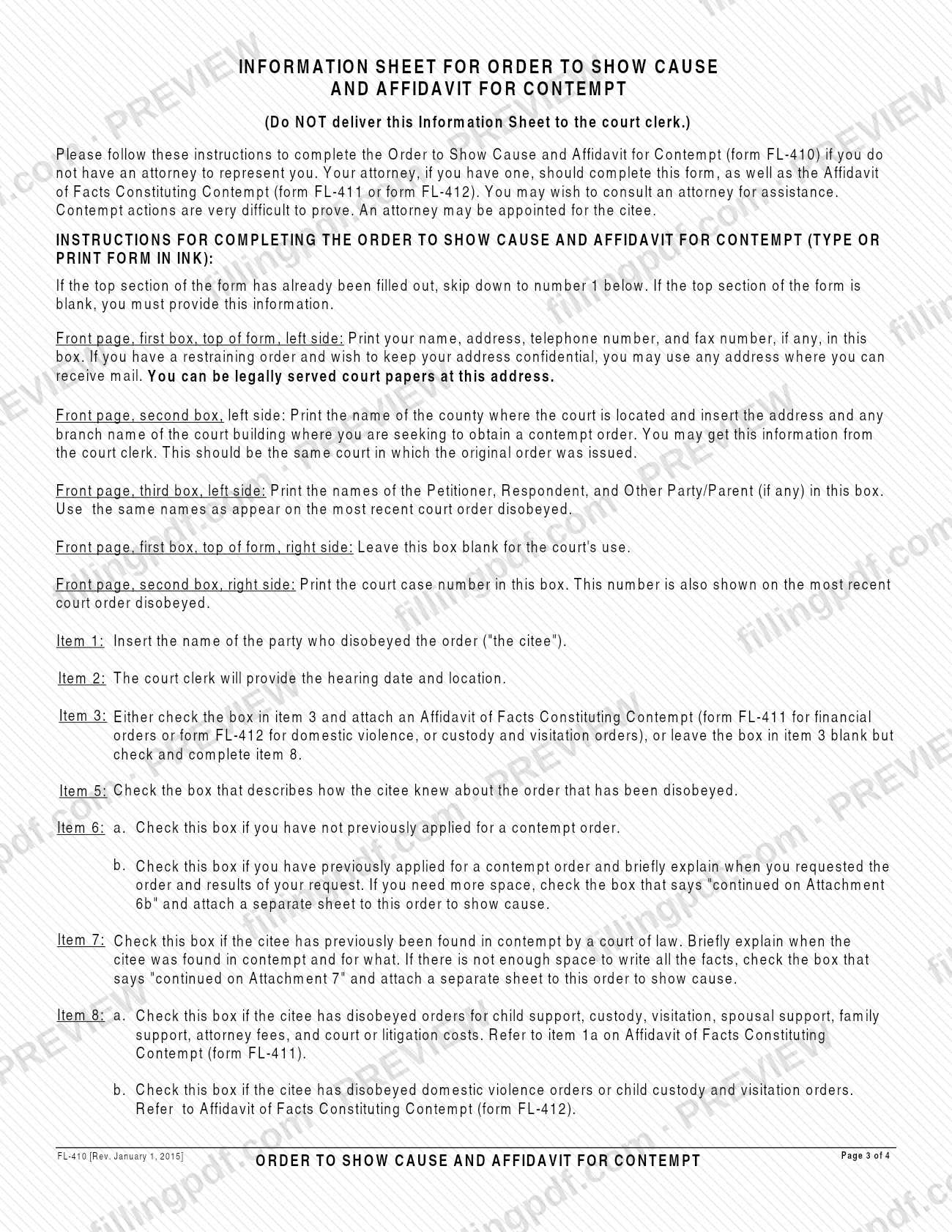
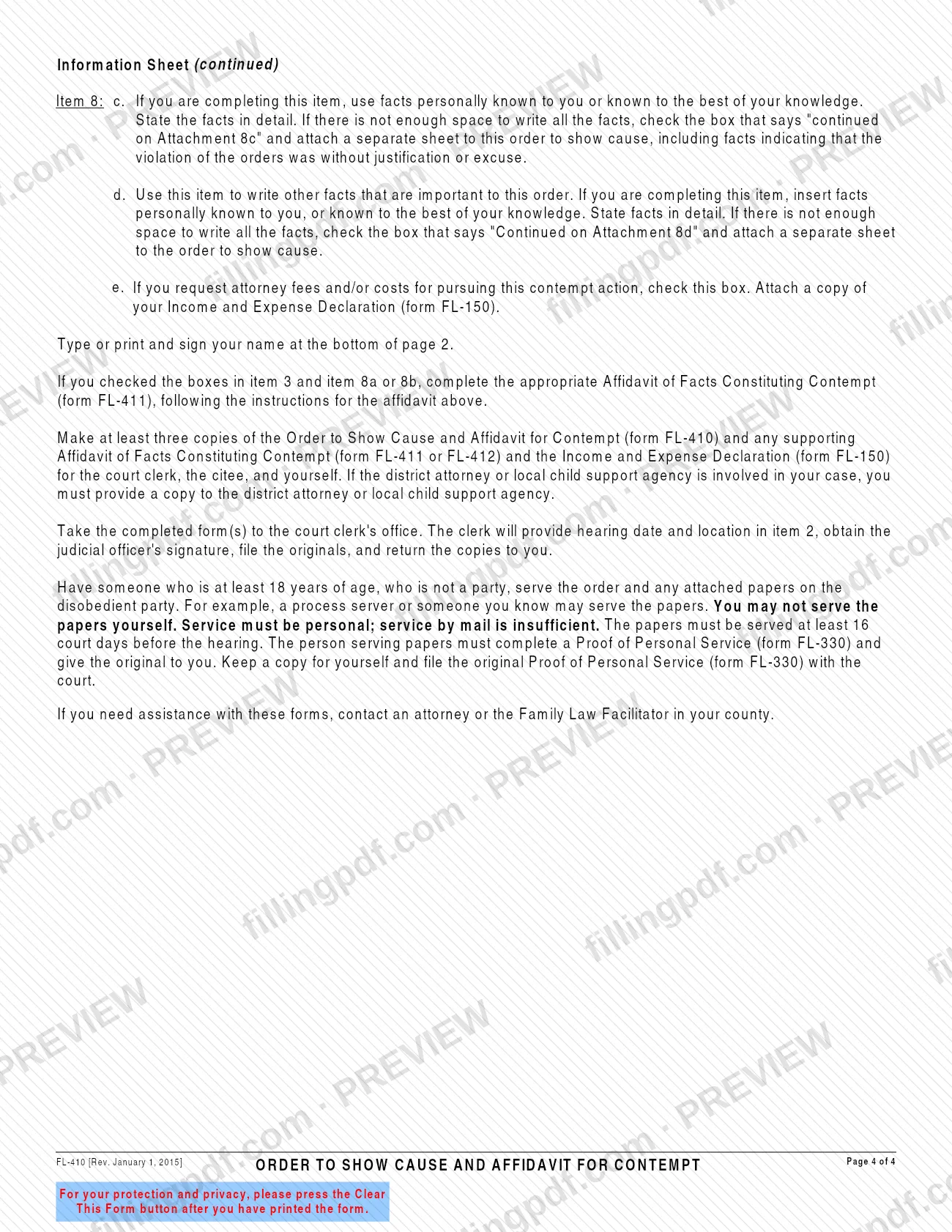
FL-410, Order to Show Cause and Affidavit for Contempt, is a Judicial Council of California form on which a party asks a superior court to find another person in contempt for willfully disobeying a court order. It is used in family law cases, together with a supporting affidavit of facts (form FL-411 or FL-412) when the orders involved are financial, domestic violence, custody or visitation orders. On this page you can fill out the form online on FillingPDF and download or print the completed PDF; the official PDF is published by the Judicial Council of California at courts.ca.gov.
Last updated
What is FL-410?
Form FL-410, Order to Show Cause and Affidavit for Contempt, is the Judicial Council of California form that orders a citee to appear in court and answer a contempt allegation, supported by the filer's sworn affidavit.
The "citee" is the person you allege has violated the court's orders. Page 1 is the order itself: it directs the citee to appear on a date the court clerk provides and to give any legal reason why the court should not find them guilty of contempt, punish them for willfully disobeying its orders, and require them to pay the moving party's attorney fees and costs of the proceeding. Page 2 is the affidavit: it states that the citee knew of the order and was able to comply, whether you have asked for contempt before, whether the citee has been found in contempt before, and which orders were disobeyed.
The form carries a notice, printed in English and Spanish, that a contempt proceeding is criminal in nature and that the possible penalties include a jail sentence, community service and a fine. It also warns that pursuing the action may affect the district attorney's ability to prosecute the citee criminally for the same violations.
FL-410 is the cover document. The detailed account of each violation goes in the Affidavit of Facts Constituting Contempt: FL-411 for orders for child support, spousal support, family support, attorney fees and court or litigation costs, and FL-412 for domestic violence restraining orders and child custody and visitation orders. The form is adopted for mandatory use under Family Code, § 292 and Code of Civil Procedure, §§ 1211.5 and 2015.5, and the Judicial Council's self-help site lists it in Chinese Simplified, Korean and Vietnamese as well.
Who needs to file FL-410?
A party in a California family law case who believes another person has willfully disobeyed a court order, and who wants the court to punish that disobedience, uses Form FL-410. The party completes it without an attorney or, if represented, the attorney completes it, along with the Affidavit of Facts Constituting Contempt (FL-411 or FL-412).
- Orders for child support, spousal support, family support, attorney fees, and court or litigation costs: attach FL-411.
- Domestic violence restraining orders and child custody and visitation orders: attach FL-412.
- Other injunctive orders: describe the order, how it was violated and when in item 8c instead.
The person who disobeyed the order is the citee. The citee does not complete this form; the filer must have the citee served with it. The instructions say contempt actions are very difficult to prove and that an attorney may be appointed for the citee. They suggest consulting an attorney, or the Family Law Facilitator in your county, if you need help. The Information Sheet printed on pages 3 and 4 is for the filer's use only and is not delivered to the court clerk.
When to file FL-410
You complete FL-410 when you decide to ask the court to hold someone in contempt for disobeying an order; the form prints no filing deadline of its own. Take it to the court clerk's office, where the clerk gives you the hearing date and location for item 2.
The timing that matters comes after filing: the citee must be personally served with the order and all attached papers at least 16 court days before the hearing. Service by mail is insufficient, and you may not serve the papers yourself. Allow for that period when you choose how soon to bring the form to the clerk.
Documents you need
- Affidavit of Facts Constituting Contempt (form FL-411): attach it if you check item 3 or item 8a, for orders for child support, spousal support, family support, attorney fees, and court or litigation costs.
- Affidavit of Facts Constituting Contempt (form FL-412): attach it if you check item 3 or item 8b, for domestic violence restraining orders and child custody and visitation orders.
- Income and Expense Declaration (form FL-150): attach a copy if you check item 8e to request attorney fees and costs for pursuing the contempt action.
- Separate attachment sheets: add Attachment 5a(4), 6b, 7, 8c or 8d only when the space on the form is not enough for that item.
- At least three copies of FL-410 and all supporting forms: one each for the court clerk, the citee and yourself, plus a copy for the district attorney or local child support agency if either is involved.
- Proof of Personal Service (form FL-330): completed by the person who served the papers; file the original with the court after service.
How to fill out FL-410
Enter your contact details
In the first box on the left of the front page, print your name, State Bar number if you have one, address, telephone number and fax number if any. If you have a restraining order and want your address kept confidential, you may use any address where you can receive mail.
Enter the court information
In the second box, print the county of the Superior Court, its street and mailing address, city and ZIP code, and branch name. Use the same court in which the original order was issued; the court clerk can give you this information.
Enter party names and case number
Print the Petitioner/Plaintiff, Respondent/Defendant and Other Party/Parent names exactly as they appear on the most recent court order disobeyed. Enter the case number shown on that order, and leave the box marked for court use blank.
Name the citee in item 1
In item 1, TO CITEE, insert the name of the person you allege has violated the orders.
Leave the hearing details to the clerk
Do not fill in item 2. The court clerk provides the date, time, department, room and court address, and the judicial officer signs the order.
Attach the affidavit of facts
Check item 3 and attach FL-411 (financial orders) or FL-412 (domestic violence, custody or visitation orders), or leave item 3 blank and complete item 8. Complete the attached form following its own instructions.
Show how the citee knew the order
In item 5a, check the box that describes how the citee learned of the order: present in court, served with a copy, signed a stipulation, or other (specify).
Report prior contempt requests
In item 6, check 6a if you have not asked the court before to hold the citee in contempt. Check 6b if you have, and give the date filed and the results; use Attachment 6b if you need more space.
Report prior contempt findings
Check item 7 only if the citee has previously been found in contempt of a court order. Specify the case, court and date, and use Attachment 7 if the space is not enough.
Describe each order disobeyed
In item 8, check 8a for financial orders (FL-411) or 8b for domestic violence, custody and visitation orders (FL-412). For other orders, use item 8c to state which order was violated, how and when, and item 8d for other material facts showing the violation had no justification or excuse.
Request fees if you want them
Check item 8e to request attorney fees and costs for pursuing the contempt action, and attach a copy of your Income and Expense Declaration (form FL-150).
Sign the declaration on page 2
Enter the date, type or print your name and sign above the statement made under penalty of perjury under the laws of the State of California. Use facts you know personally or know to the best of your knowledge.
Review, download and make copies
Check every item and attachment against the instructions, then download or print the completed PDF from FillingPDF. Make at least three copies and follow the steps under How to submit.
How to submit FL-410
You file FL-410 in person at the court clerk's office, and then arrange personal service on the citee.
- Court clerk's office: Take the completed FL-410 and any supporting FL-411, FL-412 and FL-150 to the clerk of the court where the original order was issued. Make at least three copies of everything, for the clerk, the citee and yourself. The clerk provides the hearing date and location in item 2, obtains the judicial officer's signature, files the originals and returns the copies to you.
- District attorney or local child support agency: If either is involved in your case, you must provide a copy to them.
- Service on the citee: Have someone at least 18 years old who is not a party serve the order and attached papers personally, at least 16 court days before the hearing. A process server or someone you know may do it; mail service is not enough.
- Proof of service: The person who served the papers completes a Proof of Personal Service (form FL-330) and gives you the original. File the original with the court and keep a copy.
Get the clerk's address and any branch information from the court clerk. The form lists no online filing channel. FillingPDF lets you fill out and download the PDF; submission follows the channels above.
Common mistakes to avoid
- Serving the papers yourself. The instructions say you may not; someone at least 18 years old who is not a party must serve them.
- Serving the citee by mail. Service must be personal, and mail service is insufficient.
- Serving less than 16 court days before the hearing; the papers must be served at least that long before the hearing date.
- Leaving item 3 blank without completing item 8, or checking item 3 without attaching FL-411 or FL-412.
- Writing a hearing date and location in item 2 yourself; the court clerk provides them.
- Delivering the Information Sheet (pages 3 and 4) to the court clerk; the sheet says not to.
- Checking item 8e without attaching a copy of your Income and Expense Declaration (form FL-150).
- Using names that differ from the most recent court order disobeyed, or a case number that does not match it.
- Forgetting to file the original Proof of Personal Service (form FL-330) with the court after service.
Frequently asked questions
What is Form FL-410 used for?
FL-410 is the California Judicial Council form used to ask a court to find a person in contempt for willfully disobeying its orders. It orders the citee to appear and show why they should not be punished, and it contains your affidavit supporting the request. Details of each violation go on FL-411 or FL-412.
What is the difference between FL-410, FL-411 and FL-412?
FL-410 is the order to show cause and affidavit that starts the contempt request. FL-411 is the Affidavit of Facts Constituting Contempt for support, attorney fee and cost orders. FL-412 is the affidavit for domestic violence restraining orders and child custody and visitation orders.
Can I serve the FL-410 papers myself?
No. The instructions say you may not serve the papers yourself. Someone at least 18 years old who is not a party must serve the citee personally; service by mail is insufficient. A process server or someone you know can do it.
How much time does the citee have before the hearing?
The papers must be served at least 16 court days before the hearing. The person who serves them completes a Proof of Personal Service (form FL-330) and gives you the original, which you file with the court.
What happens if the court finds someone in contempt?
The form's notice says a contempt proceeding is criminal in nature and the possible penalties include a jail sentence, community service and a fine. The order also lets the court require the citee to pay the moving party's attorney fees and costs of the proceeding.
Does the citee get a lawyer in a contempt case?
The notice on the form says the citee is entitled to an attorney and, if they cannot afford one, the court may appoint one. The instructions also note that contempt actions are very difficult to prove.
Where do I file Form FL-410?
Take the completed form and copies to the court clerk's office, to the court where the original order was issued. The clerk fills in the hearing date and location, obtains the judicial officer's signature, files the originals and returns your copies.
Can I fill out FL-410 online?
You can fill out the PDF online on FillingPDF and download or print it. FillingPDF does not file it with the court or serve it; you take it to the court clerk and arrange personal service as the instructions describe.
Ready to fill out FL-410?
Fill out FL-410 now