
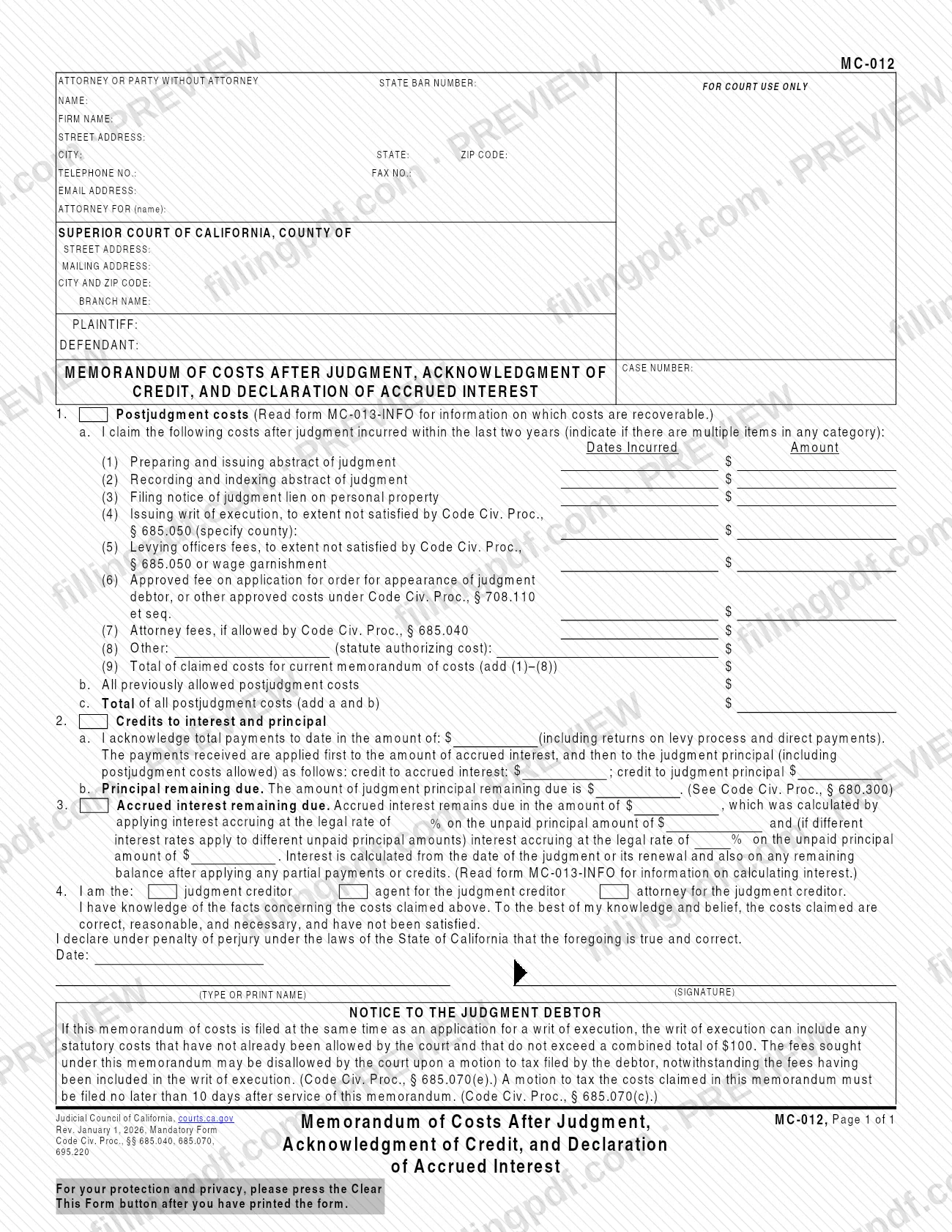
MC-012 is the Judicial Council of California form on which a judgment creditor lists the costs paid to enforce a civil judgment, credits the payments already received and declares the interest still owed. It is signed under penalty of perjury and is captioned for a California superior court case. On FillingPDF you can fill out the form online and download or print the completed PDF; the form and its companion information sheet, MC-013-INFO, are published by the California courts at courts.ca.gov.
Last updated
What is MC-012?
Memorandum of Costs After Judgment, Acknowledgement of Credit, and Declaration of Accrued Interest (MC-012) is a California Judicial Council form on which a judgment creditor claims postjudgment enforcement costs, acknowledges payments received and declares the interest that remains due on the judgment.
The California courts' self-help page describes the judgment creditor as a person the court has decided is owed money by another party in a civil case. With this form the creditor tells the court what it cost to enforce the judgment, what the other party has already paid, and what interest is still owed on the unpaid amount.
The form has four parts:
- Item 1, postjudgment costs incurred within the last two years, itemized in lines (1) to (9), plus previously allowed costs and a grand total.
- Item 2, credits to interest and principal, ending with the principal remaining due.
- Item 3, the accrued interest remaining due, with the legal rate or rates used.
- Item 4, the declaration, signed under penalty of perjury under California law.
MC-012 is a Mandatory Form (Rev. January 1, 2026) tied to Code of Civil Procedure sections 685.040, 685.070 and 695.220. It points to form MC-013-INFO for which costs are recoverable and for how interest is calculated. A printed notice to the judgment debtor on the form explains that the claimed costs can be challenged by a motion to tax.
Who needs to file MC-012?
The judgment creditor completes MC-012 when claiming costs after judgment. Item 4 lets the person signing check one of three roles: the judgment creditor, an agent for the judgment creditor, or an attorney for the judgment creditor. Whoever signs declares knowledge of the facts about the costs claimed and states that, to the best of their knowledge and belief, the costs are correct, reasonable and necessary, and have not been satisfied.
The page header is built for either an attorney or a party without an attorney: it asks for the State Bar number, the name, the firm name and contact details, and whom the attorney acts for.
The judgment debtor does not complete this form. The debtor is the person addressed by the printed Notice to the Judgment Debtor, which says the claimed fees may be disallowed on a motion to tax filed by the debtor. The form is not a statement of the debtor's own payments or defenses; it records the creditor's costs, credits and interest claim.
When to file MC-012
File MC-012 when you have postjudgment enforcement costs to claim: line 1a covers costs incurred within the last two years. The form sets no other filing date of its own.
It can be filed at the same time as an application for a writ of execution. In that case, the Notice to the Judgment Debtor on the form says the writ of execution can include statutory costs not already allowed by the court, up to a combined limit stated in that notice. The debtor's response time runs from service: a motion to tax the costs claimed in the memorandum must be filed no later than 10 days after service of the memorandum (Code Civ. Proc., § 685.070(c)). The fees may be disallowed on a motion to tax even if they were included in the writ of execution.
How to fill out MC-012
Enter attorney or party information
At the top, enter the State Bar number (if any), name, firm name, street address, city, state, ZIP code, telephone, fax, email and the party the attorney acts for. Leave the box marked For Court Use Only blank.
Complete the court and case caption
Enter the county of the Superior Court of California, its street and mailing address, city and ZIP code, and the branch name. Add the plaintiff, the defendant and the case number.
Itemize costs on line 1a
For each cost in lines (1) to (8), enter the dates incurred and the amount, indicating if there are multiple items in a category. For line (4), specify the county; for line (8), name the statute authorizing the cost.
Total the costs on lines 1a(9) to 1c
On line (9) add lines (1) to (8) for the current memorandum. Enter all previously allowed postjudgment costs on line 1b, then add 1a and 1b for line 1c.
Acknowledge payments on line 2a
Enter total payments to date, including returns on levy process and direct payments. Then show the credit to accrued interest and the credit to judgment principal, applying payments to interest first.
State principal remaining on line 2b
Enter the amount of judgment principal remaining due, including postjudgment costs allowed (see Code Civ. Proc., § 680.300).
Declare accrued interest in item 3
Enter the accrued interest remaining due, the legal rate in percent and the unpaid principal it applied to. If different rates apply to different principal amounts, complete the second rate and amount.
Check your role in item 4
Check judgment creditor, agent for the judgment creditor or attorney for the judgment creditor. Do so only if you know the facts about the costs claimed.
Date, print your name and sign
Enter the date, type or print your name and sign above it. The declaration is made under penalty of perjury under California law.
Review and download the completed PDF
Check that the totals add up and the interest matches item 3. Download or print the completed PDF from FillingPDF, then file it as described under How to submit.
How to submit MC-012
MC-012 is a court paper. The form prints no mailing address, online portal or appointment rule of its own; it is captioned for the Superior Court of California, County of the county where your case is pending, with the case number. Ask that court's clerk how it accepts filings.
- Court named in the caption: complete the court name, branch, street and mailing address, parties and case number at the top, and file the signed form in that case.
- With a writ of execution: the form's notice says it may be filed at the same time as an application for a writ of execution.
- Service on the debtor: the debtor's deadline for a motion to tax is 10 days after service of the memorandum, so keep a record of when and how it is served.
Before you print, note the form's privacy reminder: press the Clear This Form button after printing. FillingPDF lets you fill out and download the PDF; submission follows the court's channels above.
Common mistakes to avoid
- Claiming in line 1a costs incurred more than two years ago; the form covers costs incurred within the last two years.
- Leaving out line 1b, previously allowed postjudgment costs, so the total of all postjudgment costs on line 1c is understated.
- Claiming writ of execution or levying officer fees that are already satisfied under Code Civ. Proc., § 685.050; lines (4) and (5) cover only the extent not satisfied.
- Applying payments to principal first. The form says payments are applied first to accrued interest and then to the judgment principal.
- Calculating interest from a date other than the date of the judgment or its renewal, or ignoring the balance left after partial payments or credits.
- Omitting the second legal rate and principal amount in item 3 when different interest rates apply to different unpaid principal amounts.
- Signing without checking one of the item 4 boxes: judgment creditor, agent for the judgment creditor or attorney for the judgment creditor.
- Leaving the form's data in the PDF after printing; the form asks you to press the Clear This Form button once printed.
Frequently asked questions
What is form MC-012 used for?
MC-012 is the California Judicial Council form a judgment creditor uses after judgment to claim enforcement costs, acknowledge payments received and declare the accrued interest still owed. It is signed under penalty of perjury and filed in the superior court case.
Who signs form MC-012?
The judgment creditor, an agent for the judgment creditor or an attorney for the judgment creditor signs, checking the matching box in item 4. The signer declares knowledge of the facts and that the costs claimed are correct, reasonable and necessary, and not yet satisfied.
Which costs can I claim on MC-012?
Line 1a lists costs incurred within the last two years, such as abstract of judgment, judgment lien filing, writ issuance, levying officer fees, attorney fees if allowed by Code Civ. Proc., § 685.040, and other costs with a statute cited. Form MC-013-INFO explains which are recoverable.
How is interest calculated on MC-012?
Item 3 says interest is calculated from the date of the judgment or its renewal, and also on any balance left after partial payments or credits, at the legal rate. Form MC-013-INFO gives more information on calculating interest.
Can the debtor challenge the costs on MC-012?
Yes. The form's notice says the debtor can file a motion to tax, and the fees may be disallowed even if included in a writ of execution. The motion must be filed no later than 10 days after service of the memorandum.
Can I file MC-012 with an application for a writ of execution?
Yes. The Notice to the Judgment Debtor on the form says it may be filed at the same time as an application for a writ of execution, and the writ can then include statutory costs not already allowed, up to the combined limit stated in that notice.
Can I fill out MC-012 online?
You can fill out the MC-012 PDF online on FillingPDF and download or print it. FillingPDF is an independent service and does not file the form with the court; you file and serve it through the court's channels.
Ready to fill out MC-012?
Fill out MC-012 now