
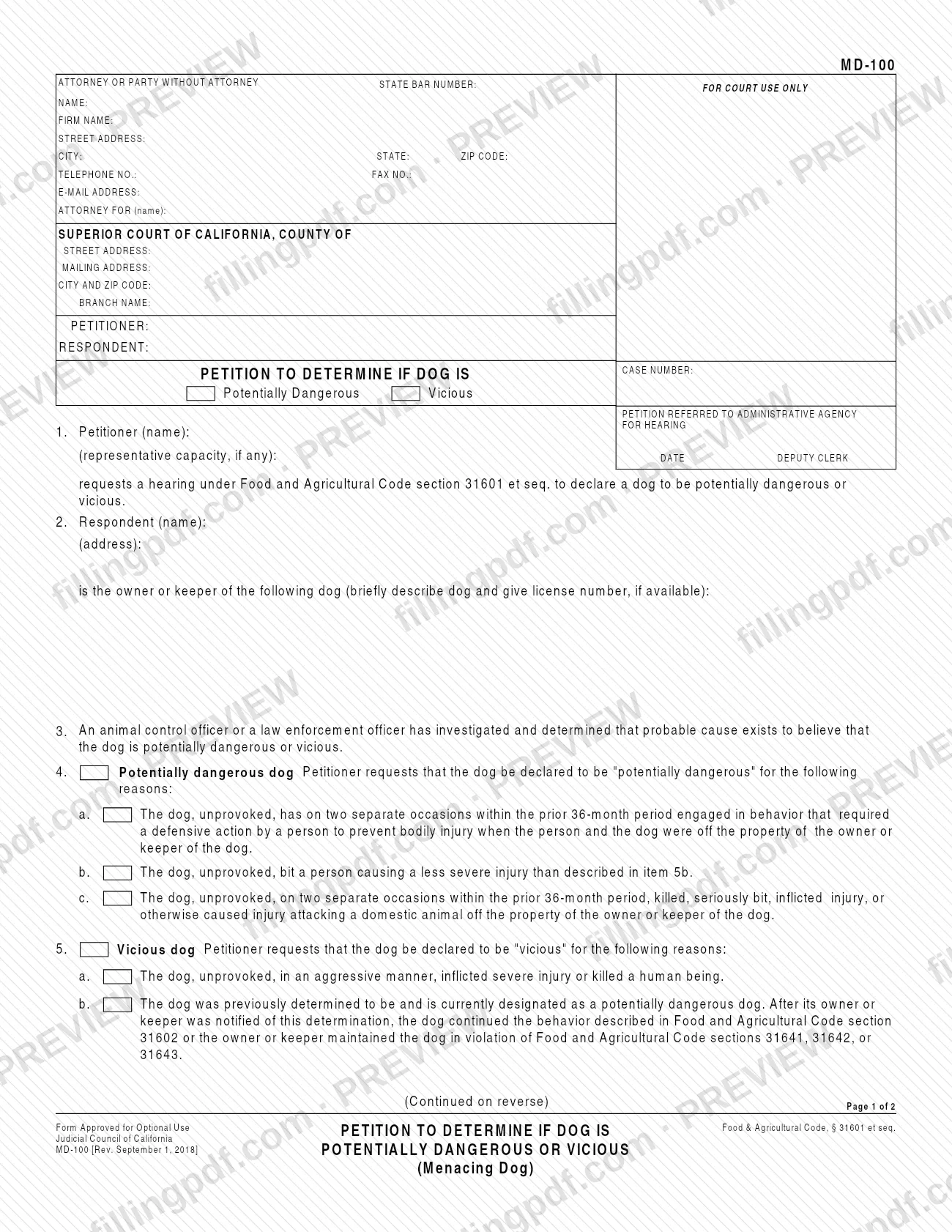
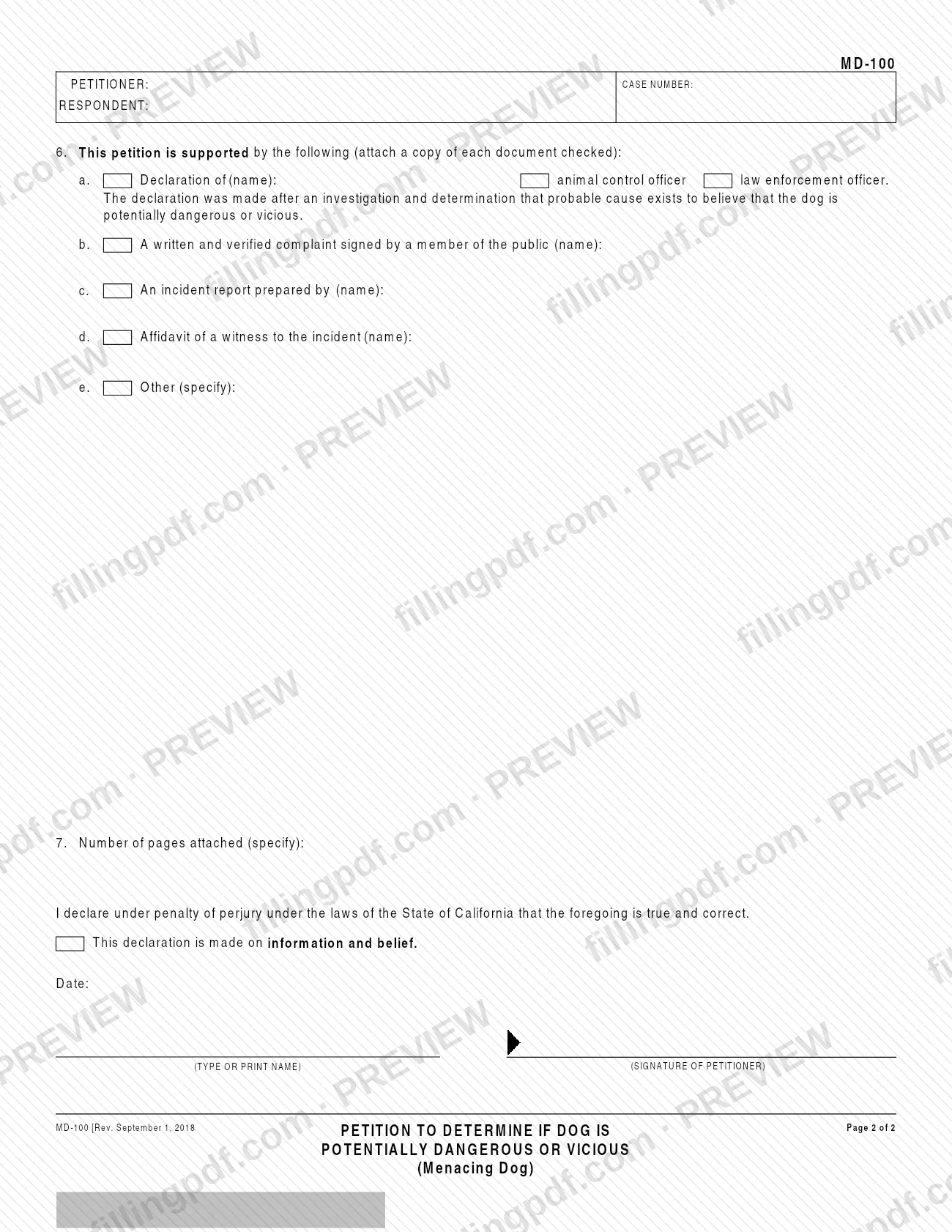
MD-100 is the Petition to Determine If Dog Is Potentially Dangerous or Vicious (Menacing Dog), a Judicial Council of California form that asks for a hearing under Food and Agricultural Code section 31601 et seq. According to the Judicial Council's self-help page, an animal control department, public animal shelter or law enforcement agency uses it to ask the court, or another public entity chosen by the city or county, to decide whether a dog is dangerous or vicious. On this page you can fill out the form online on FillingPDF and download or print the completed PDF. The official PDF is published by the Judicial Council at courts.ca.gov.
Last updated
What is MD-100?
Form MD-100, Petition to Determine If Dog Is Potentially Dangerous or Vicious (Menacing Dog), is the Judicial Council of California form on which a petitioner asks for a hearing under Food and Agricultural Code section 31601 et seq. to declare a dog "potentially dangerous" or "vicious."
The form is approved for optional use and carries the revision date Rev. September 1, 2018. It is captioned for the Superior Court of California, with the county, petitioner, respondent and case number at the top. The respondent is the owner or keeper of the dog, and item 2 asks you to briefly describe the dog and give its license number, if available.
Two classifications are offered, and each has its own item:
- Item 4, potentially dangerous dog. Reasons include two separate unprovoked occasions within the prior 36-month period requiring a person's defensive action off the owner's property, an unprovoked bite causing a less severe injury, or two separate unprovoked attacks on a domestic animal within 36 months.
- Item 5, vicious dog. Reasons include an unprovoked, aggressive infliction of severe injury on, or killing of, a human being, or continued behavior or violations after the dog was already designated potentially dangerous.
Item 3 states that an animal control officer or a law enforcement officer has investigated and found probable cause. Item 6 lists the supporting documents attached. A box at the top lets the court mark that the petition is referred to an administrative agency for hearing.
Who needs to file MD-100?
The petitioner who is asking for a dog to be declared potentially dangerous or vicious completes Form MD-100. The Judicial Council's self-help page says an animal control department, public animal shelter or law enforcement agency uses it to ask the court, or another public entity picked by the city or county, to make the determination.
The form allows for several people to be involved:
- Attorney or party without attorney: the top left block takes the name, State Bar number, firm, address, telephone, fax and e-mail, and the party the attorney acts for.
- Petitioner acting in a representative capacity: item 1 has a line for the representative capacity, if any.
- Respondent: the owner or keeper of the dog, named with an address in item 2. The respondent does not complete the form.
Item 3 states that an animal control officer or a law enforcement officer has investigated and found probable cause to believe the dog is potentially dangerous or vicious, and item 6 asks you to attach the documents that support the petition. The form prints no list of people who are barred from using it.
When to file MD-100
File Form MD-100 when you are ready to ask for a hearing on a dog and an animal control officer or a law enforcement officer has investigated and determined that probable cause exists to believe the dog is potentially dangerous or vicious, as item 3 states. The form prints no filing deadline of its own.
Items 4a and 4c refer to a 36-month period: they describe two separate unprovoked occasions within the prior 36-month period. That window describes the dog's behavior, not a deadline for filing the petition. Check the supporting declaration, complaint, report or affidavit you plan to attach under item 6 before you complete the form, because those documents back up the reasons you check.
Documents you need
- Declaration of an animal control officer or a law enforcement officer, if you check item 6a; it must have been made after an investigation and determination that probable cause exists that the dog is potentially dangerous or vicious.
- A written and verified complaint signed by a member of the public, if you check item 6b; name the person in item 6b.
- An incident report, if you check item 6c; name the person who prepared it.
- Affidavit of a witness to the incident, if you check item 6d; name the witness.
- Any other supporting document, if you check item 6e; specify what it is on the line provided.
- A copy of each document you check in item 6; the form says to attach a copy of each one, and item 7 asks for the number of pages attached.
How to fill out MD-100
Enter attorney or party information
In the top left block, enter your name, State Bar number if you are an attorney, firm name, street address, city, state, ZIP code, telephone, fax and e-mail, and for whom you act ("Attorney for (name)").
Complete the court caption
Write the county after "Superior Court of California, County of," then the court's street address, mailing address, city and ZIP code and branch name. Enter the petitioner and respondent names; leave the case number to the court.
Choose the dog classification
In the title, check Potentially Dangerous or Vicious to match the determination you are requesting. Do not mark the box for referral to an administrative agency or the Deputy Clerk line; those are for the court.
Identify the petitioner in item 1
Enter the petitioner's name and, if any, the representative capacity. Item 1 states the request for a hearing under Food and Agricultural Code section 31601 et seq.
Describe the respondent and the dog
In item 2, enter the respondent's name and address as owner or keeper, then briefly describe the dog and give its license number, if available.
Review the probable cause statement
Item 3 states that an animal control officer or a law enforcement officer has investigated and determined that probable cause exists. Complete the form only if that is true for this dog.
Check potentially dangerous reasons
If you request a potentially dangerous declaration, check each reason that applies in item 4: 4a, 4b or 4c. Items 4a and 4c refer to two separate occasions within the prior 36-month period.
Check vicious reasons
If you request a vicious declaration, check each reason that applies in item 5: 5a for unprovoked severe injury to or killing of a human being, or 5b for a dog already designated potentially dangerous that continued the behavior or was maintained in violation of the listed code sections.
List supporting documents
In item 6, check each supporting document you will attach and enter the name where requested: 6a officer declaration, 6b verified complaint, 6c incident report, 6d witness affidavit, 6e other. Enter the number of pages attached in item 7.
Review, sign and download
Type or print your name, enter the date and sign as petitioner under the penalty of perjury statement, checking "made on information and belief" if it applies. Download or print the completed PDF from FillingPDF and assemble the attachments.
How to submit MD-100
Form MD-100 is a court petition, so it goes to the Superior Court of California in the county named in the caption at the top of page 1. The form prints no filing address, portal or fee information, and it names no other channel.
- Court caption: write the county on the line after SUPERIOR COURT OF CALIFORNIA, COUNTY OF, and the court's street address, mailing address, city and ZIP code and branch name in the boxes provided.
- Attachments: attach a copy of each document you check in item 6, and enter the number of pages attached in item 7.
- Referral: the box at the top, "Petition referred to administrative agency for hearing," is for the court's use, with a date and deputy clerk line. The Judicial Council's self-help page says the determination may be made by the court or by another public entity picked by the city or county.
- Privacy: the PDF reminds you to press the Clear This Form button after you print it.
Ask the clerk of that superior court how it accepts petitions and about any fees. FillingPDF lets you fill out and download the PDF; submission follows the court's channels.
Common mistakes to avoid
- Checking a supporting document in item 6 without attaching a copy of it; the form says to attach a copy of each document checked.
- Leaving item 7 blank instead of entering the number of pages attached.
- Using item 6a for a declaration that was not made after an investigation and a probable cause determination; the form describes it as made after both.
- Mixing the two classifications: reasons for "potentially dangerous" belong in item 4, and reasons for "vicious" belong in item 5.
- Omitting the dog's description or license number in item 2 when it is available.
- Signing without checking the "made on information and belief" box when the declaration rests on information and belief rather than personal knowledge.
- Writing in the "For Court Use Only" area or the referral box and date/deputy clerk line, which the court completes.
- Leaving the form filled in on a shared computer; the PDF asks you to press Clear This Form after printing, for your protection and privacy.
Frequently asked questions
What is the MD-100 form?
MD-100 is the Judicial Council of California's Petition to Determine If Dog Is Potentially Dangerous or Vicious (Menacing Dog). A petitioner uses it to request a hearing under Food and Agricultural Code section 31601 et seq. to declare a dog potentially dangerous or vicious.
Who files Form MD-100?
The Judicial Council's self-help page says an animal control department, public animal shelter or law enforcement agency uses it to ask the court, or another public entity picked by the city or county, to decide whether a dog is dangerous or vicious. The respondent is the dog's owner or keeper.
What is the difference between potentially dangerous and vicious on the MD-100?
Item 4 lists reasons for a "potentially dangerous" declaration, such as repeated unprovoked behavior within 36 months. Item 5 lists reasons for a "vicious" declaration, such as unprovoked severe injury to or killing of a human being, or continued behavior after a prior potentially dangerous designation.
What do I have to attach to Form MD-100?
Attach a copy of each document you check in item 6: an officer's declaration, a verified complaint from a member of the public, an incident report, a witness affidavit, or another document you specify. Then enter the number of pages attached in item 7.
Can I fill out Form MD-100 online?
Yes. You can fill out the PDF online on FillingPDF and download or print it. FillingPDF is an independent service and does not file the petition; the petition reaches the court only through the court's own filing channels.
Where do I file the MD-100 petition?
With the Superior Court of California in the county named in the form's caption. The form prints no filing address, so ask that court's clerk how it accepts petitions. The court may refer the petition to an administrative agency for hearing, as the box at the top of the form shows.
What does the 36-month period in item 4 mean?
Items 4a and 4c ask whether the dog, unprovoked, engaged in the described behavior on two separate occasions within the prior 36-month period. It describes the dog's conduct, and the form prints no filing deadline.
Is there a deadline to file Form MD-100?
The form prints no filing deadline. It states in item 3 that an animal control officer or law enforcement officer has already investigated and found probable cause, so the petition follows that investigation.
Ready to fill out MD-100?
Fill out MD-100 now