
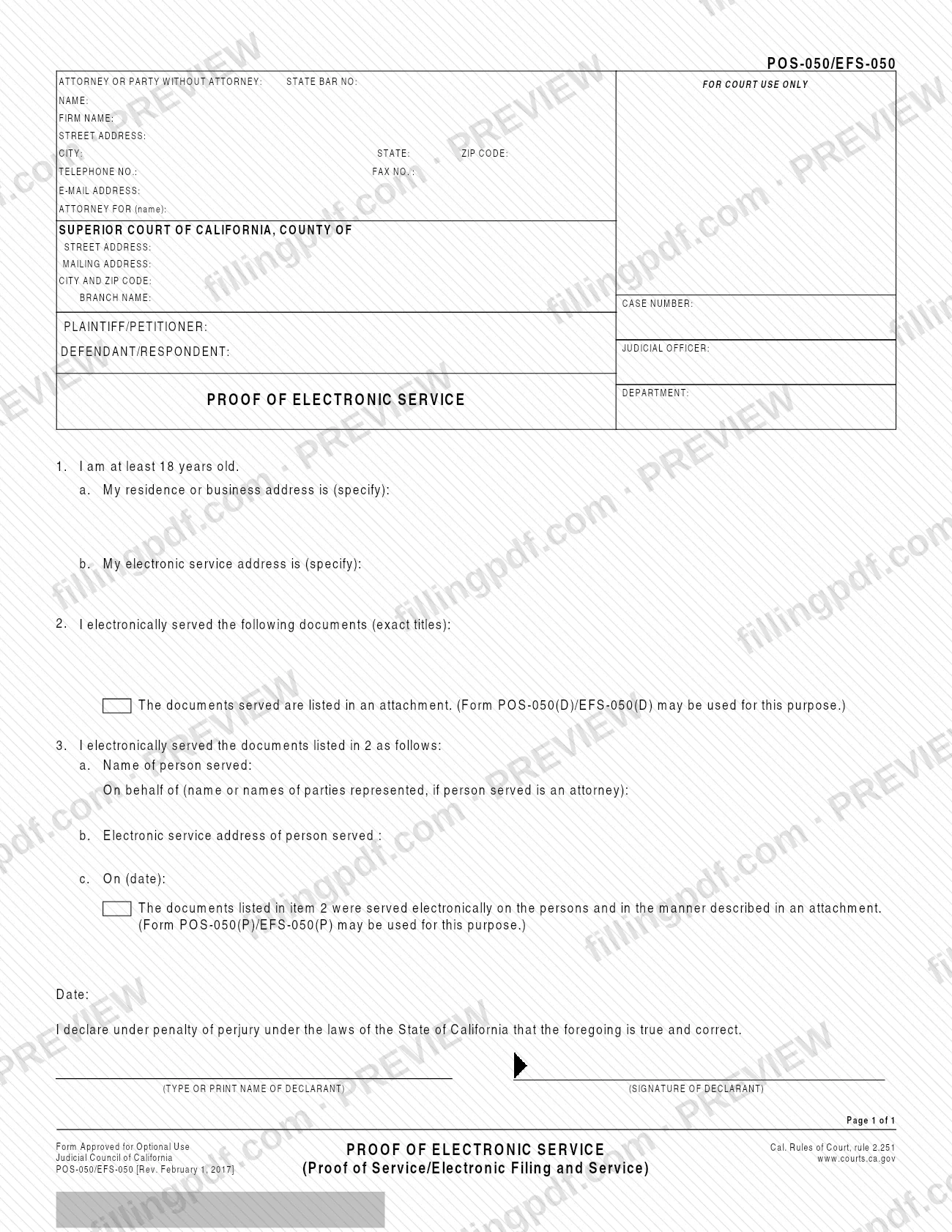
Form POS-050 is the Proof of Electronic Service published by the Judicial Council of California. It tells the court that legal papers were delivered electronically to another party, lists the papers served and records who served them, on whom, at what electronic address and on what date. Anyone who served court documents electronically in a California case can use it to prepare that proof. On this page you can fill out the form online on FillingPDF and download or print the completed PDF; the official PDF is published by the California courts.
Last updated
What is POS-050/EFS-050?
Form POS-050/EFS-050, Proof of Electronic Service, is the Judicial Council of California form on which a person declares, under penalty of perjury, which documents they served electronically, on whom, at what electronic address and on what date.
The Judicial Council describes the form as telling the court that legal papers were electronically delivered to (served on) the other party. It lists the papers that were served and shows who they were served on, where and when, and who served them. The form cites California Rules of Court, rule 2.251, and carries the double code POS-050/EFS-050 (Proof of Service/Electronic Filing and Service). It is marked "Form Approved for Optional Use," and the revision printed on it is Rev. February 1, 2017.
The form is one page. It has a caption block for the attorney or party and the court, a case number, and three numbered items: the declarant's age and addresses (item 1), the exact titles of the documents served (item 2) and the person served with the electronic service address and date (item 3). It ends with the date, the declaration under penalty of perjury and the declarant's printed name and signature.
Two companion attachments exist for long lists. Form POS-050(D)/EFS-050(D) may be used to list the documents served, and Form POS-050(P)/EFS-050(P) may be used to list the persons served and how.
Who needs to file POS-050/EFS-050?
The person who electronically served documents in a California court case completes Form POS-050 as the declarant. The declarant must state on the form that they are at least 18 years old (item 1) and sign under penalty of perjury.
Typical users, from what the form's caption and items show:
- An attorney or a party without an attorney who served the papers. The top block asks for the State Bar number, firm name, contact details and, for an attorney, the party represented.
- Another adult who carried out the electronic service. The declarant is the person who served, and is not required to be the attorney or party named in the caption.
The form is approved for optional use, so it is one way of documenting electronic service rather than the only one. If you served several people or many documents, the form allows attachments: POS-050(D)/EFS-050(D) for the documents and POS-050(P)/EFS-050(P) for the persons served. If you served by another method, such as mail or personal delivery, this form does not describe it; it covers electronic service only.
When to file POS-050/EFS-050
Complete Form POS-050 after you have electronically served the documents, because the declaration states that you already served them and records the date of service in item 3c. No separate deadline is printed on the form itself. The form cites California Rules of Court, rule 2.251, so check that rule and any court order or local rule in your case for timing questions. The form is used for each service event: if you serve different documents on a different date, the item 2 list and the item 3 date must match that service.
Documents you need
- Form POS-050(D)/EFS-050(D), an attachment listing the documents served, when the exact titles do not fit in item 2; check the box saying the documents are listed in an attachment.
- Form POS-050(P)/EFS-050(P), an attachment listing the persons served and the manner of service, when you served more than the one person described in item 3.
- Another attachment in place of either of those forms, if you list the documents or persons served in a different attachment; the form only says the listed forms "may be used."
How to fill out POS-050/EFS-050
Enter your information at the top
In the attorney or party block, fill in name, State Bar number, firm name, street address, city, state, ZIP code, telephone, fax, e-mail address and, for an attorney, the name of the client you represent. Leave the "For Court Use Only" space blank.
Identify the court
Write the county in the line reading "Superior Court of California, County of," then the street address, mailing address, city and ZIP code, and the branch name.
Complete the case caption
Enter the case number, the plaintiff/petitioner, the defendant/respondent, and the judicial officer and department if they apply to your case.
Confirm your age and addresses
Item 1 states that you are at least 18 years old. In 1a enter your residence or business address, and in 1b the electronic service address you used.
List the documents served
In item 2, write the exact titles of each document you electronically served. If the list is long, check the box for an attachment and use Form POS-050(D)/EFS-050(D).
Identify the person served
In item 3a, enter the name of the person served and, if that person is an attorney, the party or parties represented. In 3b, enter that person's electronic service address.
Enter the date of service
In item 3c, enter the date on which the documents were served electronically.
Use an attachment for several people
If you served more than one person, check the box that says the documents were served on the persons and in the manner described in an attachment, and attach Form POS-050(P)/EFS-050(P).
Date, print your name and sign
Enter the date, then your printed name and signature as declarant under the statement made under penalty of perjury under the laws of the State of California.
Review and download the completed PDF
Check the exact document titles, the electronic service addresses and the dates, then download or print the completed PDF from FillingPDF and keep a copy with your case papers.
How to submit POS-050/EFS-050
The form itself names no filing channel, address or portal: it is a declaration that is prepared by the person who served the documents and presented to the court in the case named in its caption.
- Court caption: the top of the form identifies the Superior Court of California, County of, with its street address, mailing address, branch name, case number, parties, judicial officer and department, so the proof is tied to one case.
- Attachments: if you use POS-050(D)/EFS-050(D) or POS-050(P)/EFS-050(P), attach them to the signed form.
- Court rules: the form cites California Rules of Court, rule 2.251, and the Judicial Council publishes it at www.courts.ca.gov. Check your court's instructions for how it accepts proofs of service.
FillingPDF lets you fill out and download the PDF; submission follows the court's channels, not this site.
Common mistakes to avoid
- Leaving the declaration unsigned or without the printed name of the declarant; the declaration under penalty of perjury needs both.
- Describing the documents served in general terms instead of their exact titles, which item 2 asks for.
- Omitting your electronic service address in item 1b, or the electronic service address of the person served in item 3b.
- Leaving out the date of service in item 3c, or dating the declaration but not the service itself.
- Naming an attorney as the person served in item 3a without entering the party or parties that attorney represents on the "On behalf of" line.
- Referring to a list in an attachment without checking the box, or checking the box without attaching the list.
- Signing as declarant when you are under 18; item 1 states that the declarant is at least 18 years old.
- Leaving the case caption incomplete, so the proof cannot be tied to the court, case number and parties.
Frequently asked questions
What is POS-050 used for?
POS-050 is the Judicial Council of California's Proof of Electronic Service. It tells the court that legal papers were electronically delivered to another party, listing the documents served, who was served, at what electronic address, on what date and by whom.
Who signs the POS-050 form?
The declarant signs, which is the person who actually served the documents electronically. The declarant states they are at least 18 years old and declares under penalty of perjury under California law that the statements are true and correct.
Do I have to use form POS-050?
The form is marked "Form Approved for Optional Use" by the Judicial Council, so using it is optional. It documents electronic service under California Rules of Court, rule 2.251, and covers only electronic service, not service by other methods.
What if I served more than one person or many documents?
Use the attachments. Form POS-050(D)/EFS-050(D) may be used to list the documents served, and Form POS-050(P)/EFS-050(P) may be used to list the persons served and how. Check the matching box on the form so it refers to the attachment.
What goes in item 3 of POS-050?
Item 3 records the service itself: 3a the name of the person served and, for an attorney, the parties represented; 3b that person's electronic service address; and 3c the date of service. Item 1b asks for your own electronic service address.
Can I fill out POS-050 online?
Yes. You can fill out the PDF online on FillingPDF and download or print it. FillingPDF is an independent service and does not serve or file anything; you present the signed proof to the court under its rules.
What does EFS-050 mean on the form?
POS-050/EFS-050 is one form with two codes: POS for Proof of Service and EFS for Electronic Filing and Service. The printed line reads "Proof of Service/Electronic Filing and Service." Both codes refer to the same Proof of Electronic Service.
Ready to fill out POS-050/EFS-050?
Fill out POS-050/EFS-050 now