
Form REG 138 is the Notice of Transfer and Release of Liability issued by the California Department of Motor Vehicles (DMV). Sellers and lessees use it to tell the DMV that a vehicle or vessel was sold, transferred or returned at the end of a lease, so liability for later violations moves to the new owner. On this page you can fill out the form online on FillingPDF and download or print the completed PDF; the DMV publishes the original at its website and also accepts the report online at dmv.ca.gov/nrl.
Last updated
What is REG 138?
Form REG 138, Notice of Transfer and Release of Liability, is the California Department of Motor Vehicles (DMV) form on which a seller or lessee reports that a vehicle or vessel was sold, transferred or returned at lease end, so the DMV can update its record and release the previous owner's liability.
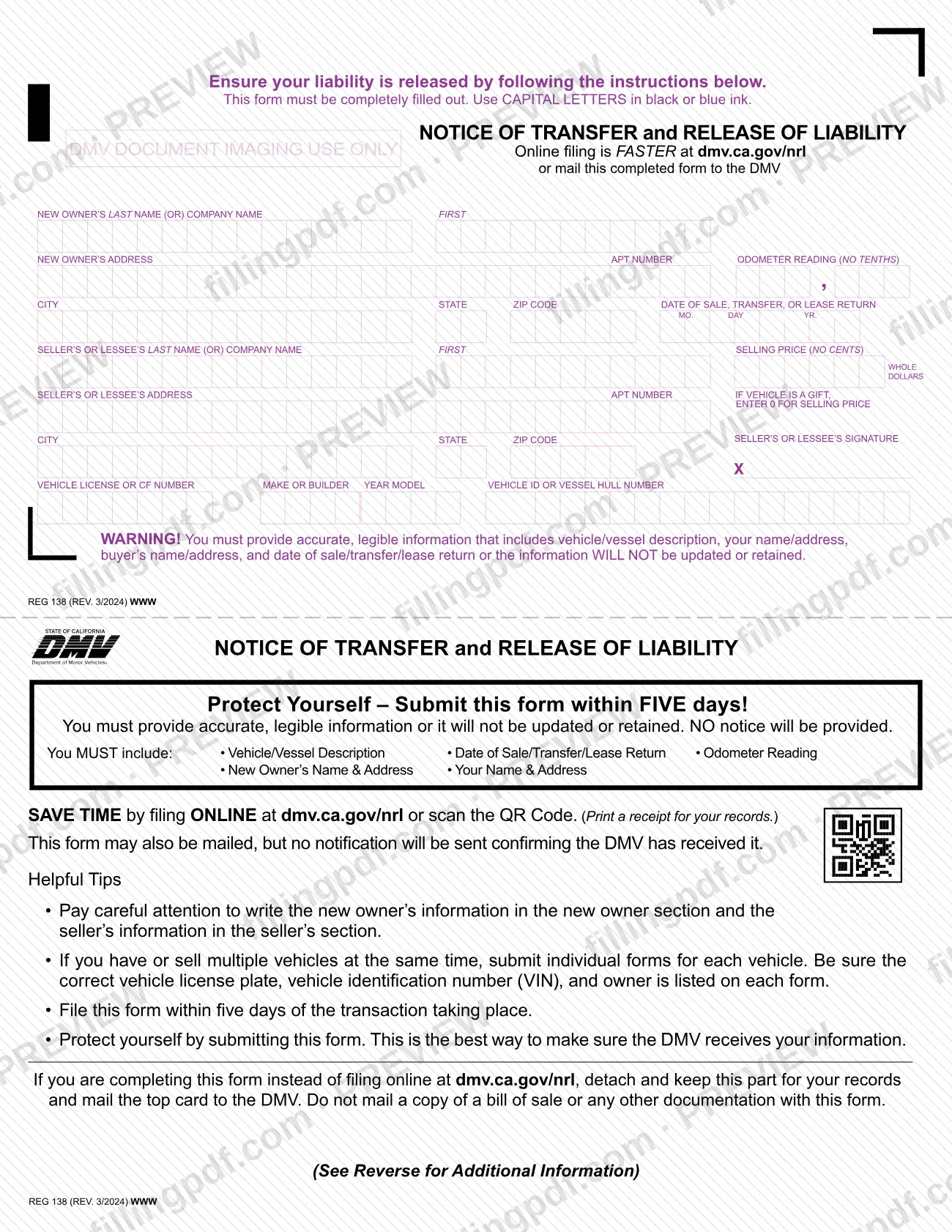
The form records the new owner's name and address, the seller's or lessee's name and address, the vehicle license or CF number, make or builder, year model, vehicle ID or vessel hull number, the odometer reading, the date of sale, transfer or lease return, and the selling price. The form tells you to enter 0 as the selling price when the vehicle is a gift.
When the form is properly completed and the DMV records the information, liability for parking and traffic violations and for civil litigation resulting from operating the vehicle or vessel after the date of sale, transfer or lease return becomes the responsibility of the subsequent new owner or owners. The instructions refer readers to California Vehicle Code §5602 for the requirements on releasing liability and for liability disputes.
The form does not transfer ownership. The filing of this form is not an application for transfer of ownership (title). Before your name is removed from DMV records for the vehicle or vessel, the new owner must apply for transfer using the endorsed Certificate of Ownership (Title) received from you.
Who needs to file REG 138?
Anyone who sells or otherwise disposes of a vehicle or vessel in California files this notice with the DMV. The form says you are required by law to notify the DMV within five days from the date you sell or dispose of the vehicle or vessel. The same form serves a lessee who returns a leased vehicle: it has a "Seller's or Lessee's" section and a date of "sale, transfer, or lease return".
Other situations the form covers:
- Gifts: if the vehicle is a gift, you still report the transfer and enter 0 as the selling price.
- Several vehicles: if you sell or have multiple vehicles at the same time, submit a separate form for each one, with the correct license plate, vehicle identification number (VIN) and owner on each form.
- Vessels: the form includes a CF number and a vessel hull number, so it also reports vessel transfers.
The new owner does not use this form to take title. The new owner must complete all transfer requirements with the endorsed Certificate of Ownership (Title). The DMV suggests that you verify the new owner's identification so the name you enter is accurate.
When to file REG 138
Submit Form REG 138 within five days of the sale, transfer or lease return. The form says you are required by law to notify the DMV within five days from the date you sell or dispose of a vehicle or vessel, and its header reads "Protect Yourself – Submit this form within FIVE days!"
The five days run from the date of the transaction, which is the date you write in the Date of Sale, Transfer, or Lease Return box. The DMV states that filing online at dmv.ca.gov/nrl is faster than mailing. If you mail the form, the DMV sends no notification confirming it received it, so keep the detached stub as your record. The form gives no separate processing time.
How to fill out REG 138
Use capital letters and ink
The form must be completely filled out. If you complete it by hand, use CAPITAL LETTERS in black or blue ink and write legibly.
Enter the new owner's name
In the new owner section, write the New Owner's Last Name (or) Company Name and the First name.
Enter the new owner's address
Write the new owner's address, apartment number if any, city, state and ZIP code.
Enter odometer reading and date
Write the Odometer Reading (No Tenths), then the Date of Sale, Transfer, or Lease Return as MO. DAY YR.
Enter the seller's or lessee's details
In the seller's section, write the Seller's or Lessee's last name or company name, first name, address, apartment number, city, state and ZIP code.
Enter the selling price
Write the Selling Price (No Cents) in whole dollars. If the vehicle is a gift, enter 0.
Describe the vehicle or vessel
Enter the Vehicle License or CF Number, Make or Builder, Year Model and Vehicle ID or Vessel Hull Number. Check the VIN against your records.
Sign as seller or lessee
Sign on the line marked Seller's or Lessee's Signature.
Fill the stub and mail address card
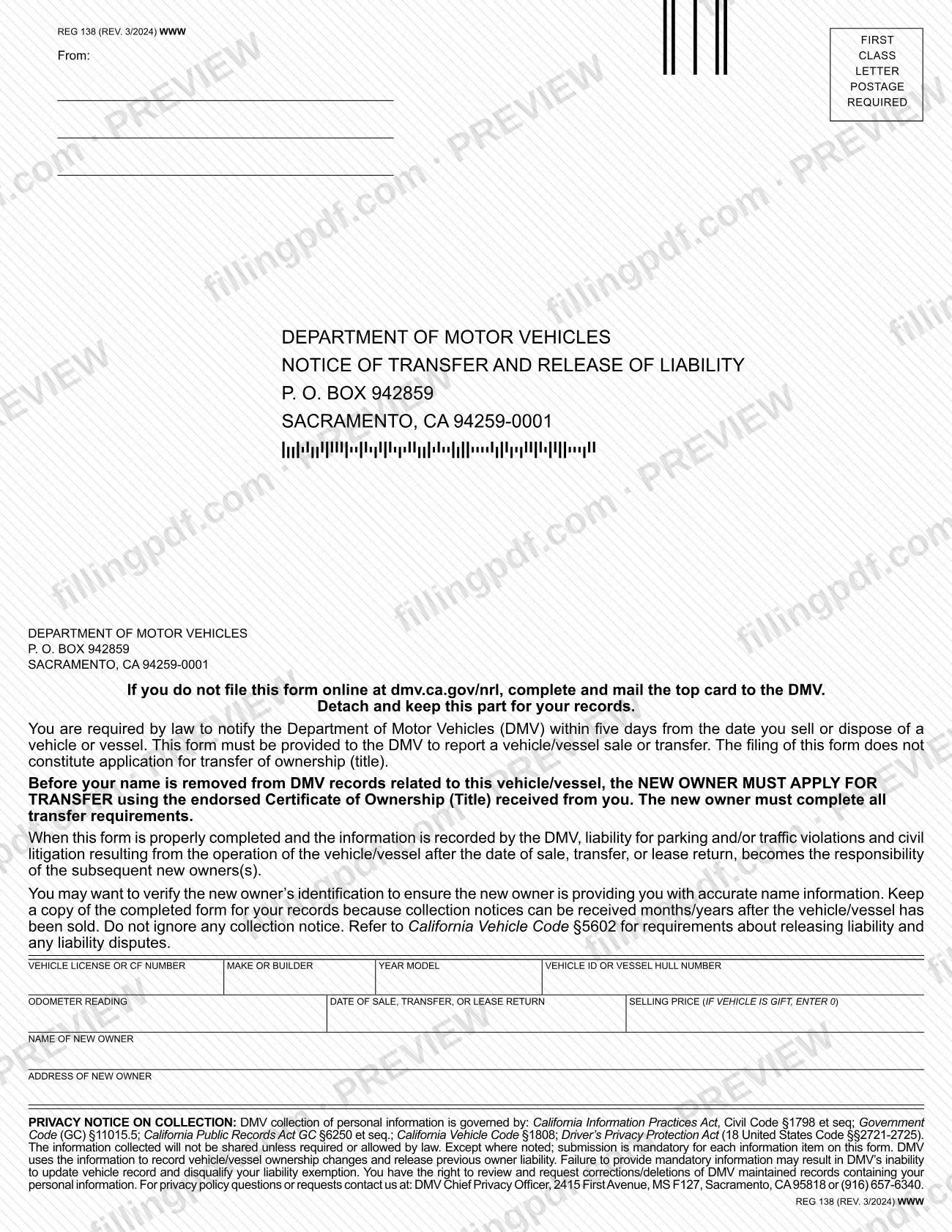
If you mail the form, the detachable card also asks for the vehicle details, odometer reading, date, selling price and the new owner's name and address; the top card carries a 'From' return address.
Review, download and keep a copy
Check that the vehicle description, dates, names and addresses are accurate and legible. Download or print the completed PDF from FillingPDF, keep the detached part for your records, and submit the top card as described under How to submit.
How to submit REG 138
You can report the transfer online at the DMV or mail the completed form.
- Online: go to dmv.ca.gov/nrl, or scan the QR code on the form. The DMV says online filing is faster and tells you to print a receipt for your records.
- By mail: complete the form, detach and keep the bottom part for your records, and mail the top card, with first-class postage, to: Department of Motor Vehicles, Notice of Transfer and Release of Liability, P. O. Box 942859, Sacramento, CA 94259-0001.
Do not mail a copy of a bill of sale or any other documentation with this form. The DMV sends no notification confirming it received a mailed form, so keep a copy of the completed form: collection notices can arrive months or years after the sale, and the form says not to ignore them. FillingPDF lets you fill out and download the PDF; submission follows the DMV channels above.
Common mistakes to avoid
- Submitting the form after the five-day period; the form says the DMV must be notified within five days from the date you sell or dispose of the vehicle or vessel.
- Writing the new owner's details in the seller's section, or the seller's in the new owner's section; the form warns to keep the two sections straight.
- Leaving out required information such as the vehicle description, date of sale, odometer reading or either party's name and address; incomplete or illegible forms will not be updated or retained.
- Using one form for several vehicles; each vehicle needs its own form with its own license plate, VIN and owner.
- Mailing a bill of sale or other documents with the form; the instructions say not to.
- Entering cents or tenths: the selling price is whole dollars and the odometer reading has no tenths.
- Leaving the selling price blank on a gift; the form says to enter 0 for a gift.
- Assuming the form transfers title; it does not, and the new owner must still apply for transfer with the endorsed Certificate of Ownership (Title).
- Discarding your copy; collection notices can arrive months or years after the sale and the DMV sends no confirmation of a mailed form.
Frequently asked questions
What is the REG 138 form?
REG 138 is the California DMV's Notice of Transfer and Release of Liability. A seller or lessee uses it to report the sale, transfer or lease return of a vehicle or vessel so that liability for later violations and civil litigation passes to the new owner once the DMV records it.
How long do I have to submit the REG 138?
Five days from the date you sell or dispose of the vehicle or vessel. The form says this is required by law. File online at dmv.ca.gov/nrl or mail the top card to the DMV; the DMV says online filing is faster.
Where do I mail the REG 138 form?
Mail the top card to the Department of Motor Vehicles, Notice of Transfer and Release of Liability, P. O. Box 942859, Sacramento, CA 94259-0001. Do not include a bill of sale or other documents, and keep the detached stub for your records.
Can I submit the REG 138 online?
Yes. The DMV accepts the notice at dmv.ca.gov/nrl, and the form invites you to scan its QR code. Print the receipt for your records. A mailed form gets no confirmation notice from the DMV, so the online receipt is your proof.
Does the REG 138 transfer the title to the buyer?
No. Filing it is not an application for transfer of ownership. The new owner must apply for transfer with the endorsed Certificate of Ownership (Title) you gave them and complete all transfer requirements before your name is removed from DMV records.
What do I enter as the selling price if the car was a gift?
Enter 0. The form says that if the vehicle is a gift, you enter 0 for the selling price. Otherwise write the price in whole dollars with no cents.
Do I need a separate REG 138 for each vehicle?
Yes. If you sell or have multiple vehicles at the same time, submit an individual form for each one, with the correct license plate, VIN and owner listed on each form.
Can I fill out the REG 138 online on FillingPDF?
Yes. You can fill out the PDF online on FillingPDF and download or print it. FillingPDF is independent, is not connected to the DMV and does not submit anything to it; you report the transfer through the DMV's online service or by mail.
Ready to fill out REG 138?
Fill out REG 138 now