
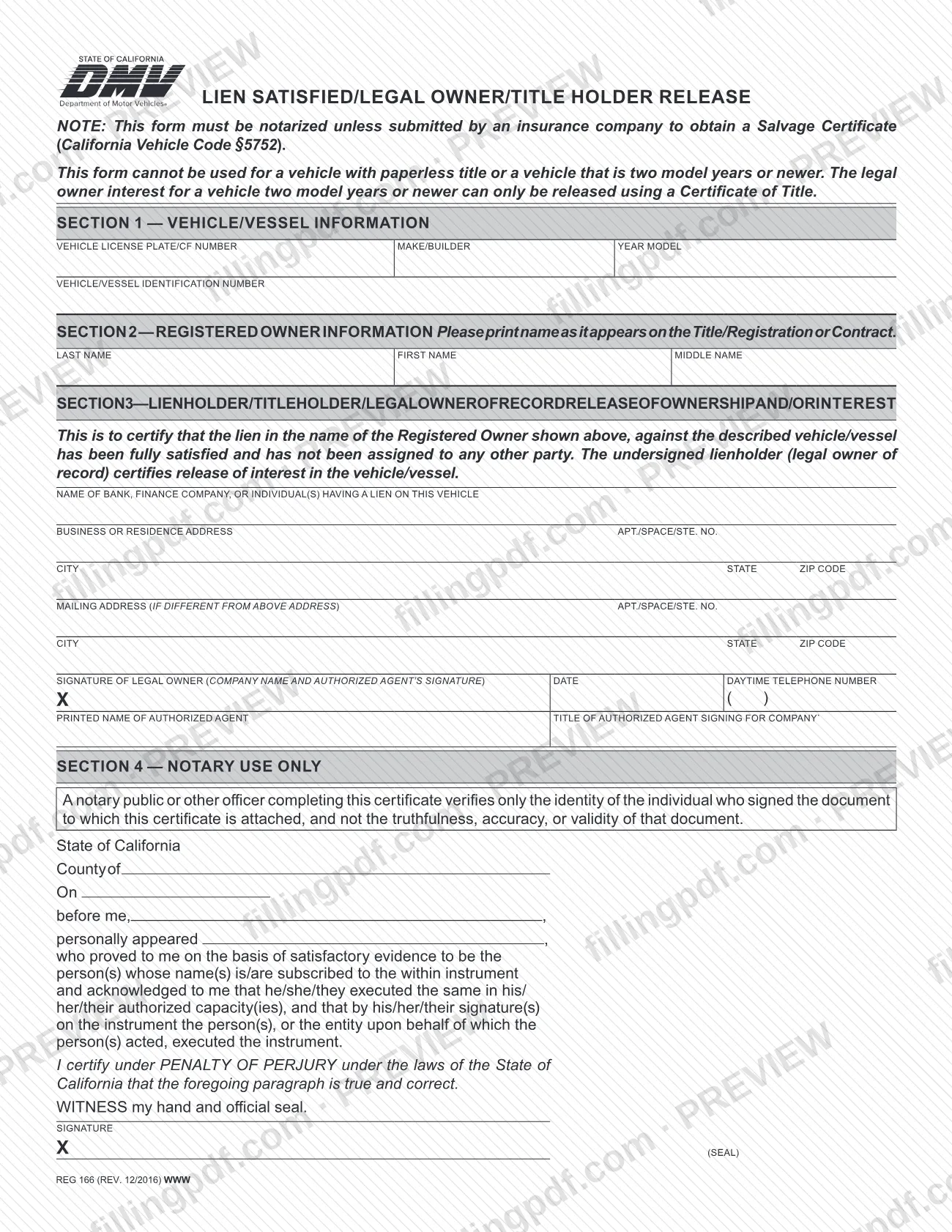
REG 166 is the Lien Satisfied/Title Holder Release, a California Department of Motor Vehicles (DMV) form on which a bank, finance company or individual holding a lien certifies that the lien has been fully satisfied and releases its interest in the vehicle or vessel. The printed form says it must be notarized unless an insurance company submits it to obtain a Salvage Certificate, and it cannot be used for a vehicle with a paperless title or one that is two model years or newer. On this page you can fill out the form online on FillingPDF and download or print the completed PDF; the form itself is published by the DMV on its forms page.
Last updated
What is REG 166?
Form REG 166, Lien Satisfied/Title Holder Release, is the California Department of Motor Vehicles (DMV) form in which a lienholder, also called the legal owner of record, certifies that a lien on a vehicle or vessel has been fully satisfied and releases its interest in it.
The title printed at the top of the PDF reads "Lien Satisfied/Legal Owner/Title Holder Release". In Section 3 the lienholder certifies two things: that the lien in the name of the registered owner against the described vehicle or vessel has been fully satisfied, and that it has not been assigned to any other party. The same section states that the undersigned lienholder certifies release of interest in the vehicle or vessel.
The form has four sections:
- Section 1: vehicle or vessel information.
- Section 2: registered owner information.
- Section 3: the lienholder, title holder or legal owner of record's release of ownership and/or interest, with the signature.
- Section 4: notary use only.
The form carries a notarization requirement under California Vehicle Code §5752. It has two stated limits: it cannot be used for a vehicle with a paperless title, and it cannot be used for a vehicle that is two model years or newer. For a vehicle two model years or newer, the form says the legal owner interest can only be released using a Certificate of Title.
Who needs to file REG 166?
The lienholder (legal owner of record) completes and signs Form REG 166: the bank, finance company or individual(s) having a lien on the vehicle or vessel. A company signs through an authorized agent, whose printed name and title go on the form. The registered owner is named in Section 2, but the release itself is certified and signed by the lienholder.
Insurance companies that submit the form to obtain a Salvage Certificate are the one group the form excuses from notarization.
Do not use this form in these cases:
- The vehicle has a paperless title.
- The vehicle is two model years or newer. The legal owner interest for such a vehicle can only be released using a Certificate of Title.
- The lien has not been fully satisfied, or it has been assigned to another party, because the lienholder certifies the opposite on the form.
When to file REG 166
Form REG 166 is completed once the lien on the vehicle or vessel has been fully satisfied, because the lienholder certifies in Section 3 that the lien is satisfied and has not been assigned to any other party. No separate due date is printed on the form.
The form must be notarized before it is used, unless an insurance company submits it to obtain a Salvage Certificate. The notary certificate in Section 4 states that the signer personally appeared before the notary, so plan the signing around a notary's availability.
If the vehicle is two model years or newer or has a paperless title, this form is not the right document at all; the release of a legal owner interest in a vehicle two model years or newer is made on a Certificate of Title.
How to fill out REG 166
Confirm the form fits the vehicle
Check that the vehicle does not have a paperless title and is not two model years or newer. If either applies, the form says the legal owner interest is released using a Certificate of Title instead.
Enter the vehicle or vessel details
In Section 1, enter the vehicle license plate/CF number, make/builder, year model and the vehicle/vessel identification number.
Enter the registered owner's name
In Section 2, print the last name, first name and middle name as they appear on the Title/Registration or Contract.
Name the lienholder
In Section 3, enter the name of the bank, finance company or individual(s) having a lien on the vehicle.
Enter the lienholder's addresses
Give the business or residence address with apt./space/ste. no., city, state and ZIP code. Add the mailing address only if it differs from the first address.
Sign for the legal owner
Under the certification, add the signature of the legal owner (for a company, the company name and the authorized agent's signature), the date and a daytime telephone number.
Print the authorized agent's details
If a company is signing, enter the printed name of the authorized agent and the agent's title.
Have Section 4 notarized
Section 4 is for the notary only: it records the county, the date, the name of the person who appeared, the notary's signature and the seal. An insurance company submitting the form to obtain a Salvage Certificate is exempt from notarization.
Review and download the completed PDF
Check the plate, VIN, owner name and lienholder details for errors, then download or print the completed PDF from FillingPDF and take it to the notary and on to the DMV as described under How to submit.
How to submit REG 166
The form prints no mailing address, portal or appointment rule, so the channel is not stated on the document itself. What it does state is how the package must be prepared.
- Signature: the lienholder signs in Section 3; a company gives its name and the signature of its authorized agent, with the agent's printed name and title.
- Notarization: Section 4 is completed by a notary public or other officer, unless an insurance company submits the form to obtain a Salvage Certificate.
- Where to get the form: the DMV publishes it on its forms page at https://www.dmv.ca.gov/portal/form/lien-satisfied-title-holder-release-reg-166/.
Contact the California DMV to confirm where the signed, notarized form should go for your transaction. FillingPDF lets you fill out and download the PDF; submission follows the DMV's channels.
Common mistakes to avoid
- Using Form REG 166 for a vehicle with a paperless title; the form says it cannot be used for one.
- Using the form to release the legal owner interest in a vehicle that is two model years or newer, which can only be released using a Certificate of Title.
- Leaving Section 4 blank when no insurance company is submitting the form for a Salvage Certificate; the form must be notarized.
- Writing the registered owner's name differently from how it appears on the Title/Registration or Contract in Section 2.
- Signing for a company without giving the company name, the authorized agent's printed name and the agent's title.
- Signing the release before the lien has been fully satisfied or when it has been assigned to another party; Section 3 certifies it is satisfied and not assigned.
- Omitting the vehicle or vessel identification number in Section 1.
Frequently asked questions
What is the REG 166 form?
REG 166 is the California DMV's Lien Satisfied/Title Holder Release. A lienholder (legal owner of record) uses it to certify that the lien on a vehicle or vessel has been fully satisfied and not assigned to anyone else, and to release its interest in the vehicle.
Does the REG 166 have to be notarized?
Yes, with one exception. The form says it must be notarized unless an insurance company submits it to obtain a Salvage Certificate (California Vehicle Code §5752). Section 4 is reserved for the notary public or other officer.
Can I use REG 166 for a new car?
Not if the vehicle is two model years or newer. The form says the legal owner interest for such a vehicle can only be released using a Certificate of Title. It also cannot be used for a vehicle with a paperless title.
Who signs the REG 166, the owner or the lienholder?
The lienholder signs. Section 3 is signed by the legal owner of record; for a company, that means the company name and an authorized agent's signature, plus the agent's printed name and title. The registered owner is only named in Section 2.
Can I fill out the REG 166 online?
You can complete the PDF online on FillingPDF and download or print it. FillingPDF does not file the form or deliver it to the DMV; the signed and notarized form follows the DMV's own channels.
What does the notary verify on the REG 166?
Only the identity of the person who signed. Section 4 states that the notary or other officer does not verify the truthfulness, accuracy or validity of the document, and the signer must have personally appeared before the notary.
Where do I get the REG 166 form?
The California DMV publishes it on its forms page at https://www.dmv.ca.gov/portal/form/lien-satisfied-title-holder-release-reg-166/. The version on this page is the one printed REV. 12/2016.
Ready to fill out REG 166?
Fill out REG 166 now