
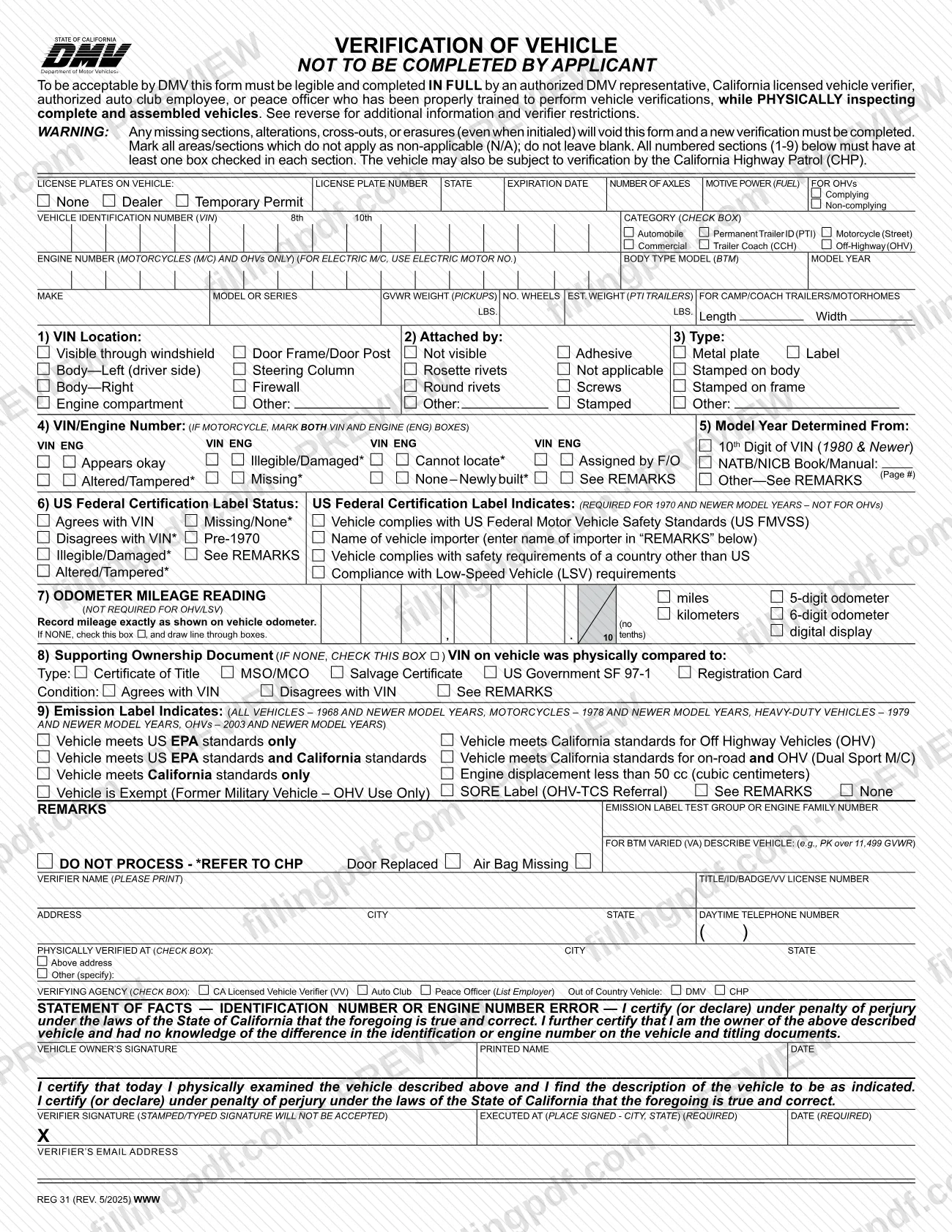
REG 31 is the California Department of Motor Vehicles (DMV) form on which an authorized person records a physical inspection of a vehicle: its Vehicle Identification Number (VIN), ownership document, odometer reading, federal certification label and emission label. The applicant does not complete it. It must be filled in full by an authorized DMV representative, a California licensed vehicle verifier, an authorized auto club employee, or a trained peace officer. On this page you can fill out the form online on FillingPDF and download or print the completed PDF; the form is published by the DMV at dmv.ca.gov.
Last updated
What is REG 31?
Form REG 31, Verification of Vehicle (Not to be completed by applicant), is the California DMV form on which an authorized verifier certifies, after physically inspecting a complete and assembled vehicle, that the vehicle matches the description entered on the form.
The form is issued by the California Department of Motor Vehicles (DMV). The revision printed on it is REV. 5/2025, and the DMV says the most current version must be used. The front page records the license plates on the vehicle, the VIN, the vehicle category (automobile, motorcycle, trailer, commercial trailer coach, off-highway vehicle and others), engine number for motorcycles and off-highway vehicles (OHVs), body type model (BTM), model year, make, weights and dimensions. It then runs through nine numbered sections: VIN location, how the VIN is attached, VIN type, VIN or engine number condition, how the model year was determined, the US Federal Certification Label status, the odometer reading, the supporting ownership document, and the emission label.
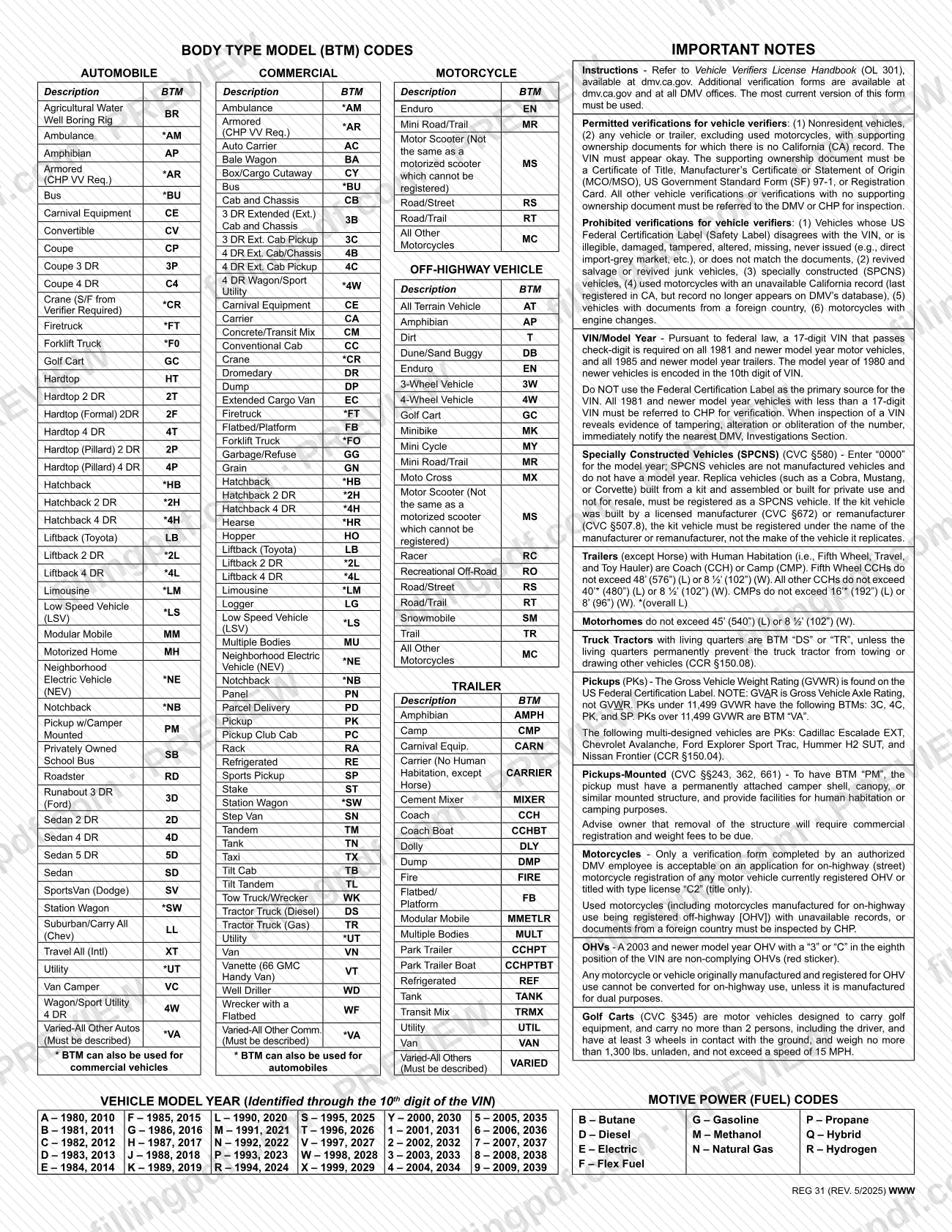
The reverse side holds the BTM code tables, the model-year and motive-power code charts, and notes that spell out which verifications a vehicle verifier may and may not perform. A Statement of Facts section for an identification or engine number error is signed by the vehicle owner only when that situation applies.
The DMV forms page lists other vehicle forms, such as REG 343, Application for Title or Registration/Verification of Vehicle, and REG 256, Statement of Facts. Those are separate documents; REG 31 is the verifier's inspection record.
Who needs to file REG 31?
REG 31 is completed by the person who inspects the vehicle, not by the person applying. The form says it must be legible and completed in full by one of these:
- an authorized DMV representative;
- a California licensed vehicle verifier;
- an authorized auto club employee;
- a peace officer who has been properly trained to perform vehicle verifications.
The verifier must physically inspect the complete and assembled vehicle. The vehicle owner signs only the Statement of Facts block, and only when there is an identification number or engine number error, certifying that the owner had no knowledge of the difference between the vehicle and the titling documents.
The notes on the form limit what a vehicle verifier may do. Verifiers may handle nonresident vehicles (CHP vehicle verifier required for some body types) and any vehicle or trailer, excluding used motorcycles, that has a supporting ownership document for which there is no California record. Other cases go to the DMV or the California Highway Patrol (CHP), including vehicles whose US Federal Certification Label disagrees with the VIN or is missing or damaged, revived salvage or junk vehicles, specially constructed vehicles, vehicles with foreign documents, and motorcycles with engine changes. Only a DMV employee's form is acceptable for on-highway motorcycle registration of a vehicle currently registered OHV.
When to file REG 31
REG 31 is completed when a vehicle has to be verified, at the moment the verifier physically inspects it. The notes on the form name the situations a licensed vehicle verifier may handle: a nonresident vehicle, or a vehicle or trailer (not a used motorcycle) that has a supporting ownership document with no California record. Cases outside those limits must be referred to the DMV or the CHP for inspection, and the form allows a box to mark that the vehicle is subject to CHP referral. The form prints no due date of its own. Use the current revision, REV. 5/2025. If a section is missing or the form has alterations, cross-outs or erasures, even initialed, the form is void and a new verification must be completed.
Documents you need
- Supporting ownership document that the verifier compares to the VIN on the vehicle: a Certificate of Title, MSO/MCO, Salvage Certificate, US Government SF 97-1 or Registration Card. If there is none, the verifier checks the "none" box in section 8.
- For a vehicle or trailer verified by a licensed vehicle verifier, a supporting ownership document for which there is no California record; it must be a Certificate of Title, MCO/MSO, SF 97-1 or Registration Card.
- Vehicle owner's signature, printed name and date in the Statement of Facts block, only when there is an identification number or engine number error.
How to fill out REG 31
Enter plates and vehicle category
The verifier enters the license plate number, state, expiration date, number of axles and motive power (fuel) code for OHVs under LICENSE PLATES ON VEHICLE, checking Complying, Non-complying, None, Dealer or Temporary Permit as it applies. Then check one CATEGORY box, such as Automobile, Motorcycle (Street), Commercial Trailer Coach (CCH) or Off-Highway (OHV).
Record the VIN and engine number
Enter the VIN, marking the 8th and 10th digits where the form shows them. Enter the engine number for motorcycles and OHVs only; for an electric motorcycle use the electric motor number.
Enter body type, year, make and model
Fill in the BTM code from the reverse-side tables, the model year, the make and the model or series. For BTM Varied (VA), describe the vehicle in the space provided.
Enter weights and dimensions
Enter GVWR, pickup weight, number of wheels, estimated weight for permanent trailer ID trailers, and length and width for camp or coach trailers and motorhomes. Mark anything that does not apply as N/A.
Complete VIN sections 1, 2 and 3
In section 1, check where the VIN is located; in section 2, how it is attached; in section 3, its type. Each numbered section needs at least one box checked.
Check VIN condition and model year source
In section 4, mark VIN and ENG for motorcycles and note whether the number appears okay, is illegible or damaged, altered, missing, cannot be located or is newly built. In section 5, check how the model year was determined, such as the 10th digit of the VIN or the NATB/NICB book or manual with the page number.
Record the federal certification label
In section 6, check the label status and what it indicates. It is required for 1970 and newer model years and not for OHVs; a disagreeing, altered or missing label means the vehicle must be referred.
Enter the odometer reading
In section 7, record the mileage exactly as shown on the odometer, checking miles or kilometers and the odometer type. If there is no reading, check the NONE box and draw a line through the boxes. It is not required for OHV or LSV.
Identify the ownership document
In section 8, check the type of supporting ownership document the VIN was compared to and whether it agrees with the VIN, disagrees or needs a REMARKS note. If there is none, check the NONE box.
Check the emission label and remarks
In section 9, check what the emission label indicates, using the model-year ranges printed on the form. Use REMARKS for the emission test group or engine family number and any explanation, and mark the CHP referral or Door Replaced or Air Bag Missing boxes if they apply.
Enter verifier details and agency
Print the verifier name, title/ID/badge/VV license number, address and daytime telephone. Check where the vehicle was physically verified and the verifying agency: CA Licensed Vehicle Verifier, Auto Club, Peace Officer, or out of country vehicle verified by DMV or CHP.
Complete the Statement of Facts if needed
If there is an identification or engine number error, the vehicle owner signs, prints a name and dates the Statement of Facts. Otherwise mark this block N/A.
Sign, review and download the PDF
The verifier signs by hand, since a stamped or typed signature is not accepted, and enters the place executed and the date, both required, plus an email address. Check that no section is blank, then download or print the completed PDF from FillingPDF.
How to submit REG 31
REG 31 does not print its own mailing address, portal or appointment rules. The form states that it must be acceptable to the DMV, so it is presented to the DMV with the vehicle transaction it supports; ask the DMV which office or channel applies to your transaction.
- Get the form: the DMV says additional verification forms are available at dmv.ca.gov and at all DMV offices.
- Instructions: the form refers verifiers to the Vehicle Verifiers License Handbook (OL 301), available at dmv.ca.gov.
- Before you hand it in: check that every numbered section (1-9) has at least one box checked, that non-applicable areas are marked N/A, that the verifier signed by hand (a stamped or typed signature is not accepted), and that the place signed and the date are filled in.
- CHP referral: the vehicle may also be subject to verification by the CHP, and a box on the form marks a vehicle as "DO NOT PROCESS - REFER TO CHP".
FillingPDF lets you fill out and download the PDF; submission follows the DMV's channels.
Common mistakes to avoid
- Leaving a section blank instead of marking it N/A; every non-applicable area must be marked N/A and each numbered section (1-9) needs at least one box checked.
- Correcting an entry with a cross-out, alteration or erasure, even if initialed; the form says this voids it and a new verification must be completed.
- Having the applicant fill out the form; REG 31 is marked as not to be completed by the applicant.
- Signing for the verifier with a stamped or typed signature; the form states it will not be accepted.
- Omitting the verifier's place signed (city, state) or date; both are marked REQUIRED.
- Using the Federal Certification Label as the primary source for the VIN; the notes say not to.
- Using an older revision of the form; the DMV says the most current version must be used.
- Completing a verification the form lists as prohibited for verifiers, such as a vehicle with a missing or disagreeing federal label or a specially constructed vehicle, instead of referring it to the DMV or CHP.
- Entering a model year for a specially constructed vehicle; the notes say to enter "0000".
Frequently asked questions
What is the REG 31 form?
REG 31 is the California DMV's Verification of Vehicle form. An authorized verifier uses it to record a physical inspection of a vehicle, including the VIN, ownership document, odometer reading and federal and emission labels. The applicant does not complete it.
Who can complete the REG 31 form?
An authorized DMV representative, a California licensed vehicle verifier, an authorized auto club employee, or a peace officer trained in vehicle verifications. They must physically inspect the complete and assembled vehicle. A vehicle owner cannot complete the verification, and signs only the Statement of Facts block when an identification or engine number error applies.
Can I fill out REG 31 myself as the vehicle owner?
No. The form is titled Not to be completed by applicant. The only part an owner signs is the Statement of Facts for an identification or engine number error, certifying the owner did not know of the difference between the vehicle and the titling documents.
What makes a REG 31 void?
Any missing section, alteration, cross-out or erasure, even if initialed, voids the form and a new verification must be completed. Blank areas must be marked N/A, and each numbered section (1-9) needs at least one box checked.
Can a vehicle verifier verify any vehicle?
No. Verifiers may handle nonresident vehicles and any vehicle or trailer, except used motorcycles, with a supporting ownership document that has no California record, and the VIN must appear okay. Other verifications go to the DMV or CHP, such as revived salvage vehicles and specially constructed vehicles.
Which ownership documents does REG 31 accept?
Section 8 lists Certificate of Title, MSO/MCO, Salvage Certificate, US Government SF 97-1 and Registration Card. The verifier physically compares the VIN on the vehicle to the document and records whether it agrees. If there is no document, the verifier checks the NONE box.
Where do I get a REG 31 form?
The California DMV publishes it at dmv.ca.gov, and the form says additional verification forms are available at all DMV offices. Use the most current version, which is the one the DMV says must be used; the revision printed on this one is REV. 5/2025.
Can I fill out REG 31 online on FillingPDF?
You can fill out the PDF online on FillingPDF and download or print it. FillingPDF is independent of the DMV and does not file, submit or certify the form, and the verifier must still inspect the vehicle and sign it by hand.
Ready to fill out REG 31?
Fill out REG 31 now