
SC-200 is the Notice of Entry of Judgment (Small Claims), the Judicial Council of California form that records the court's decision in a small claims case. The date the small claims clerk handed or mailed the notice sets the deadline for the parties to appeal, ask the court to cancel or correct the judgment, pay, or enforce it. On this page you can fill out the form online on FillingPDF and download or print the completed PDF; the form and its self-help pages are published by the California courts at courts.ca.gov.
Last updated
What is SC-200?
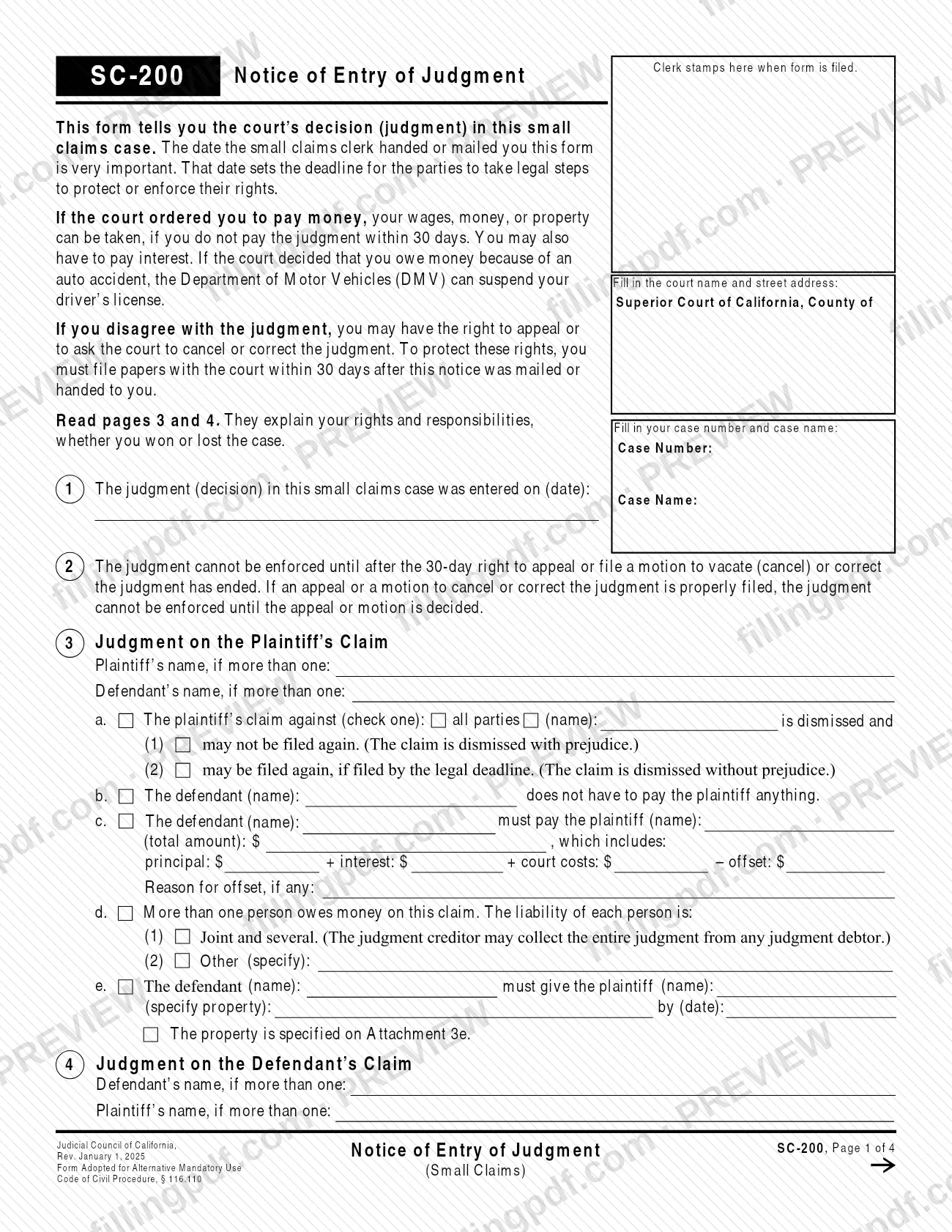
Form SC-200, Notice of Entry of Judgment (Small Claims), is the Judicial Council of California form that tells the parties in a small claims case the court's decision (judgment) and sets the deadline for the parties' next legal steps.
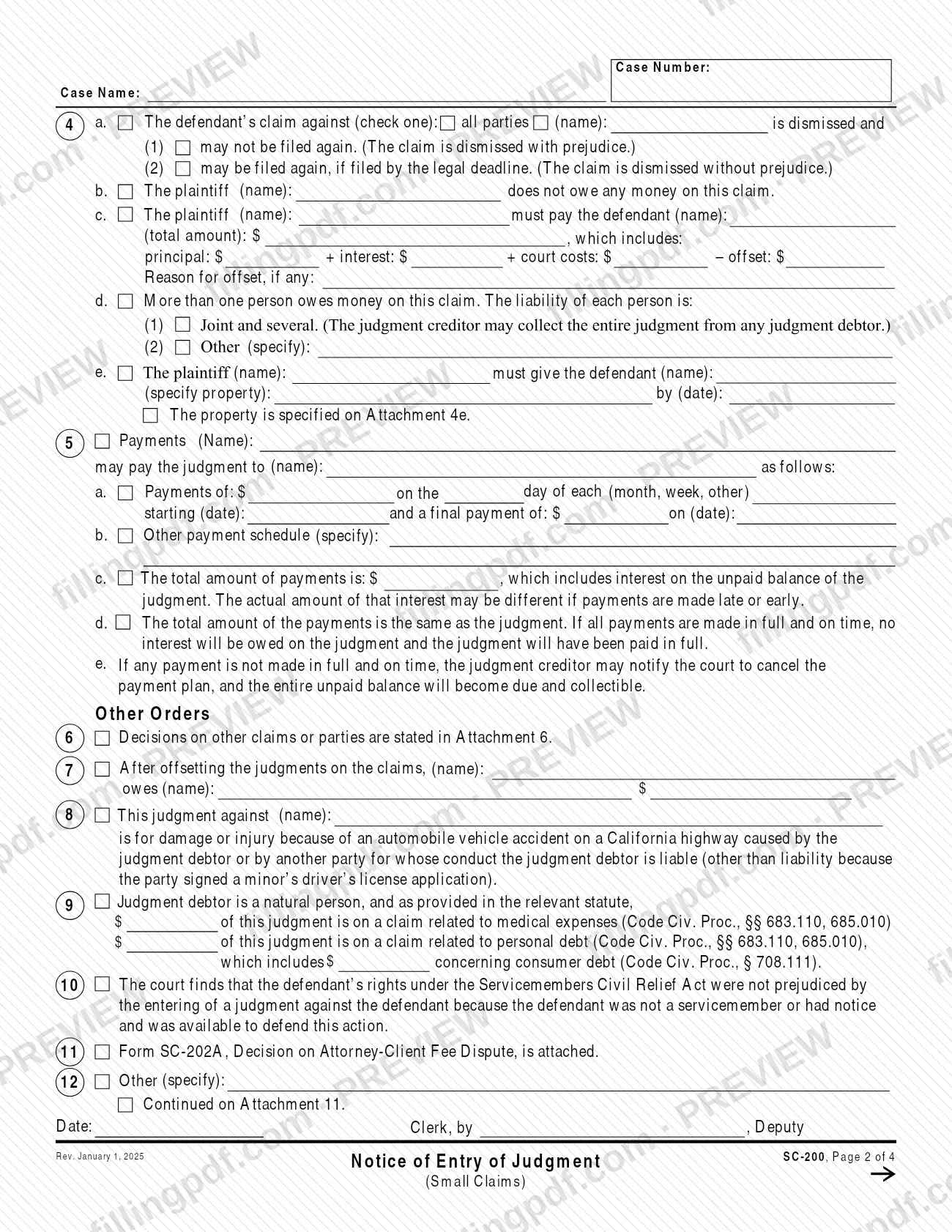
Pages 1 and 2 state the judgment: the date it was entered (item 1), the ruling on the plaintiff's claim (item 3), the ruling on the defendant's claim (item 4), any payment plan (item 5) and other orders (items 6 to 12). A claim can be dismissed with or without prejudice, the court can order one side to pay principal, interest and court costs less any offset, and it can order property to be handed over. The form ends with the clerk's date and signature line.
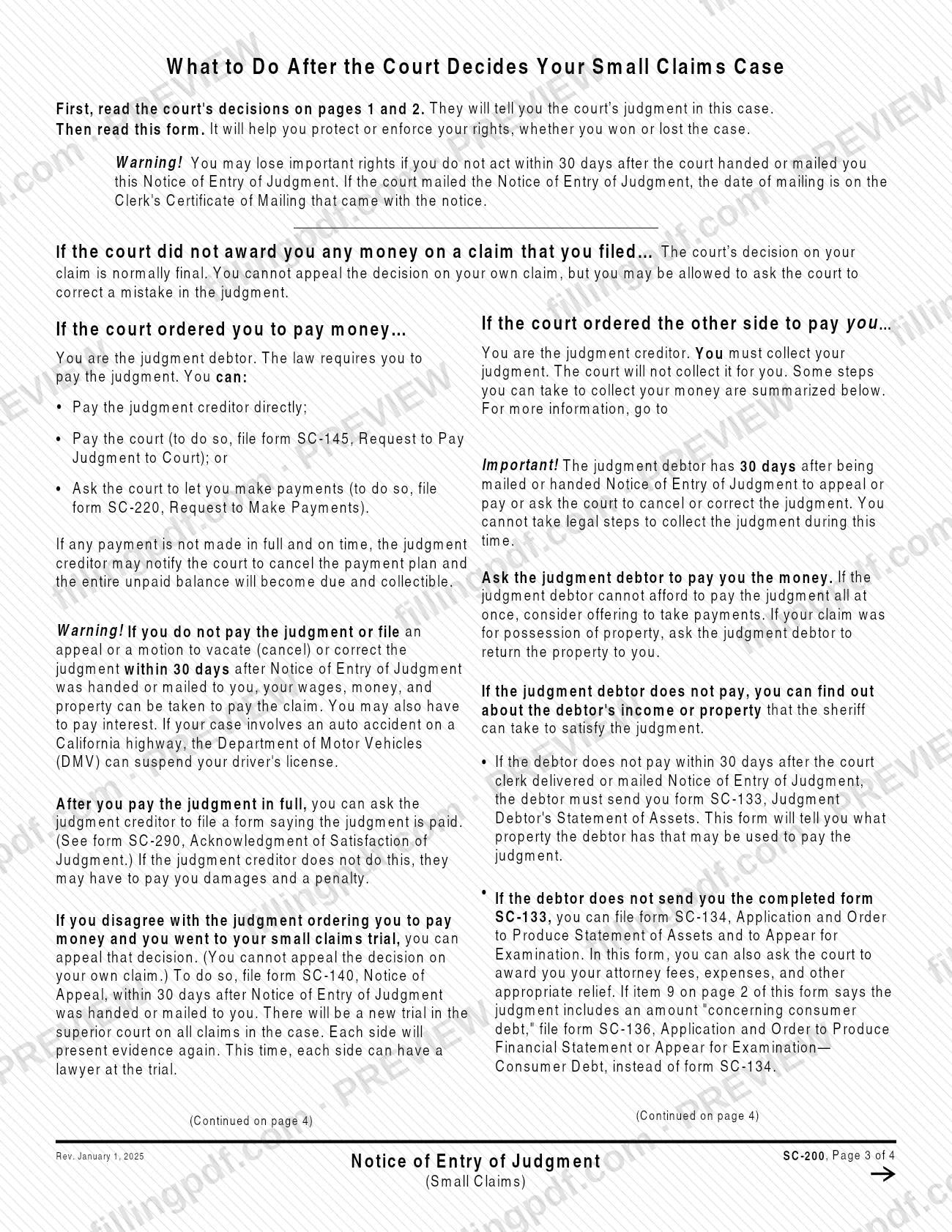
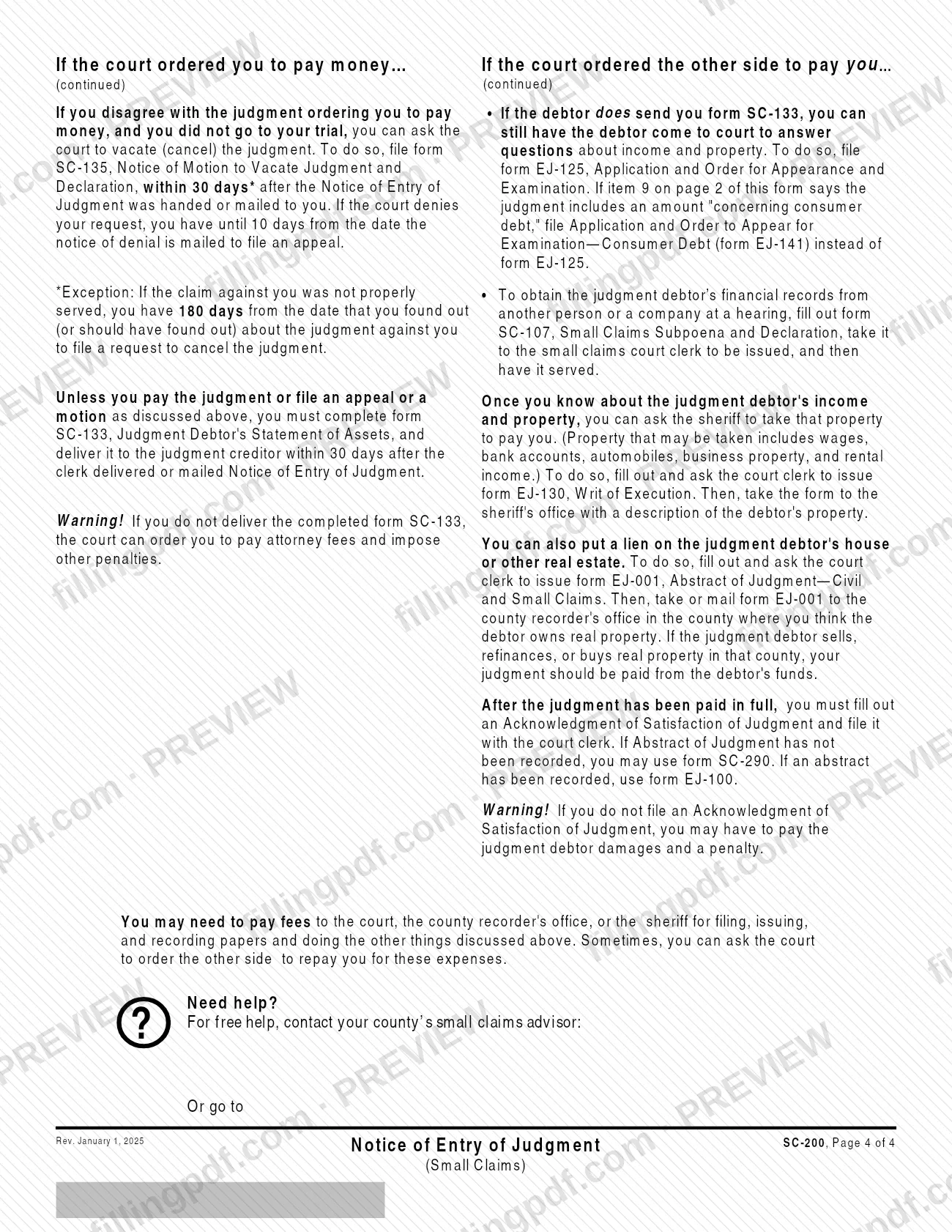
Pages 3 and 4, titled "What to Do After the Court Decides Your Small Claims Case," explain the rights and responsibilities of the judgment debtor and the judgment creditor, whether you won or lost. They name the follow-up forms: SC-145, SC-220, SC-140, SC-135, SC-133, SC-134, SC-136, SC-290, EJ-125, EJ-130 and EJ-001, among others.
The form is adopted for alternative mandatory use under Code of Civil Procedure, § 116.110. It reports a decision; it does not start a case or ask the court for anything.
Who needs to file SC-200?
The parties to a small claims case receive this notice: the plaintiff and the defendant, including any who are named in the judgment as a judgment creditor or a judgment debtor. The small claims clerk completes and signs it (the form ends with "Clerk, by ____, Deputy") and hands or mails it to the parties.
How it applies to you depends on the result:
- You were ordered to pay money (judgment debtor): the law requires you to pay. You can pay the creditor directly, pay the court with form SC-145, or ask to make payments with form SC-220.
- The other side was ordered to pay you (judgment creditor): you must collect the judgment yourself; the court will not collect it for you.
- The court did not award you money on a claim you filed: that decision is normally final and you cannot appeal your own claim, though you may be allowed to ask the court to correct a mistake in the judgment.
If a claim was dismissed, item 3a or 4a says whether it may be filed again. If the judgment includes a payment plan, item 5 names who may pay and to whom.
When to file SC-200
The notice is issued after the court enters judgment in the small claims case; item 1 states the date of entry. The date the clerk handed or mailed the notice to you is the date that matters. If the notice was mailed, that date is on the Clerk's Certificate of Mailing that came with it.
Most rights end 30 days after that date. The form warns you may lose important rights if you do not act within 30 days:
- A judgment debtor who went to trial can appeal with form SC-140 within 30 days.
- A judgment debtor who did not go to trial can ask the court to vacate the judgment with form SC-135 within 30 days. If the claim was not properly served, there are 180 days from when you found out, or should have found out, about the judgment. If the court denies the request, there are 10 days from the date the notice of denial is mailed to appeal.
- Unless you pay or appeal, a judgment debtor must deliver form SC-133 to the creditor within 30 days.
The judgment cannot be enforced until the 30-day period ends, or until a timely appeal or motion is decided.
Documents you need
- Attachment 3e: needed only if the plaintiff's claim ends with an order to give property and the property is specified on that attachment.
- Attachment 4e: needed only if the defendant's claim ends with an order to give property and the property is specified on that attachment.
- Attachment 6: needed only if decisions on other claims or parties are stated in an attachment (item 6).
- Form SC-202A, Decision on Attorney-Client Fee Dispute: attached only if item 11 is checked.
- Continuation attachment for item 12 (Other): needed only if the specification does not fit; the form prints "Continued on Attachment 11."
How to fill out SC-200
Enter the court and case details
In the boxes at the top of page 1, fill in the court name and street address (Superior Court of California, County of ____), the Case Number and the Case Name. Repeat the case number and name at the top of page 2.
Enter the date of judgment
In item 1, enter the date the judgment was entered. Item 2 is printed text about the 30-day period before enforcement.
Complete the plaintiff's claim ruling
In item 3, name the plaintiff and defendant if there are several. In 3a check dismissal with or without prejudice if the claim is dismissed; use 3b for no payment, 3c for the total amount with principal, interest, court costs and offset, 3d for joint and several liability, and 3e for property to be given.
Complete the defendant's claim ruling
In item 4, repeat the same structure for the defendant's claim: 4a dismissal, 4b no money owed, 4c the amount the plaintiff must pay, 4d liability of each person and 4e property to be given.
Enter any payment plan
In item 5, name who may pay and to whom. Use 5a for a payment amount, day, start date and final payment, 5b for another schedule, and check 5c, 5d or 5e as the plan requires.
Complete the other orders
Check item 6 if decisions on other claims or parties are in Attachment 6. In item 7, enter who owes whom what amount after offsetting the judgments.
Complete the automobile accident item
Check and complete item 8 only if the judgment against the named party is for damage or injury from an automobile vehicle accident on a California highway.
Enter medical and personal debt amounts
In item 9, enter the dollar amounts of the judgment on a claim related to medical expenses and to personal debt, including any amount concerning consumer debt, if the judgment debtor is a natural person.
Complete items 10 to 12
Check item 10 for the Servicemembers Civil Relief Act finding and item 11 if form SC-202A is attached. In item 12, specify any other order.
Add the clerk's date and signature
At the end of page 2, enter the Date and the Clerk's signature line (Clerk, by ____, Deputy). The clerk stamps the form in the space marked at the top of page 1.
Review, download and print the PDF
Check that dates, names and amounts match the court's decision and that needed attachments are included, then download or print the completed PDF from FillingPDF. The form asks you to press Clear This Form after printing.
How to submit SC-200
SC-200 is not something a party files to start a process: the small claims clerk completes it, stamps it and hands or mails it to the parties. The form prints no mailing address, portal or appointment rule of its own; the court name and street address go in the box at the top of page 1.
- From the court: the clerk hands or mails the notice. A mailed notice comes with a Clerk's Certificate of Mailing showing the mailing date.
- Follow-up filings: responses to the judgment are filed with the court on separate forms named on pages 3 and 4, such as SC-140 (appeal), SC-135 (motion to vacate), SC-145 (pay the court) and SC-220 (request to make payments).
- Fees: you may need to pay fees to the court, the county recorder's office or the sheriff for filing, issuing and recording papers; ask the court for the current amounts.
- Help: your county's small claims advisor gives free help, listed at https://selfhelp.courts.ca.gov/small-claims-advisor.
FillingPDF lets you fill out and download the PDF; delivery and any later filings follow the court's channels above.
Common mistakes to avoid
- Treating the entry date as the deadline date: the 30 days run from when the clerk handed or mailed the notice, shown on the Clerk's Certificate of Mailing for mailed notices.
- Trying to enforce the judgment before the 30-day period ends; it cannot be enforced until then, or until a timely appeal or motion is decided.
- Appealing your own claim: the form says you cannot appeal the decision on a claim you filed and lost.
- Appealing with form SC-140 after skipping your trial, when the form says to file SC-135, Notice of Motion to Vacate Judgment and Declaration.
- Ignoring form SC-133 as a judgment debtor: unless you pay or appeal, deliver it within 30 days, or the court can order attorney fees and other penalties.
- Checking both item 3a(1) and 3a(2), or checking neither, when a claim is dismissed; the form says to check one dismissal option.
- Using form SC-134 when item 9 shows an amount concerning consumer debt; the form says to use SC-136 instead.
- Not filing an Acknowledgment of Satisfaction of Judgment after being paid in full, which can mean paying the debtor damages and a penalty.
Frequently asked questions
What is form SC-200?
SC-200 is the Notice of Entry of Judgment (Small Claims) from the Judicial Council of California. It states the court's judgment in a small claims case, and the date the clerk handed or mailed it to you sets the deadline for appealing, asking to cancel or correct the judgment, paying or enforcing it.
How long do I have to appeal after receiving the SC-200?
You have 30 days after the notice was handed or mailed to you. A judgment debtor who went to trial appeals with form SC-140. You cannot appeal the decision on your own claim, but you may be able to ask the court to correct a mistake in the judgment.
What can I do if I did not go to my small claims trial?
You can ask the court to vacate (cancel) the judgment with form SC-135 within 30 days after the notice was handed or mailed. If the claim was not properly served, you have 180 days from when you found out about the judgment. If the court denies the request, you have 10 days from the mailing of the denial to appeal.
What happens if I do not pay the judgment within 30 days?
Your wages, money or property can be taken, and you may have to pay interest. If the case involves an auto accident on a California highway, the DMV can suspend your driver's license. You can instead pay the creditor or the court, or ask for a payment plan with form SC-220.
Does the court collect the judgment for me if I won?
No. The judgment creditor must collect the judgment. The form lists steps such as asking the debtor to pay, using form SC-133 or SC-134 to learn about assets, a writ of execution (EJ-130) and an abstract of judgment (EJ-001). You cannot take collection steps during the 30-day period.
Can I fill out SC-200 online?
You can fill out the SC-200 PDF online on FillingPDF and download or print it. FillingPDF is independent, is not the court and does not file or deliver the form; the clerk completes, stamps and hands or mails the notice to the parties.
What do I do after I pay the judgment in full?
A judgment debtor can ask the creditor to file a form saying the judgment is paid (SC-290). A judgment creditor must file an Acknowledgment of Satisfaction of Judgment with the clerk: SC-290 if no abstract was recorded, or EJ-100 if one was. Failing to do so can mean paying damages and a penalty.
Where can I get help with the SC-200?
Your county's small claims advisor gives free help; the form points to https://selfhelp.courts.ca.gov/small-claims-advisor. The California courts self-help page for SC-200 also describes the form as stating the small claims judge's decision in your case.
Ready to fill out SC-200?
Fill out SC-200 now