
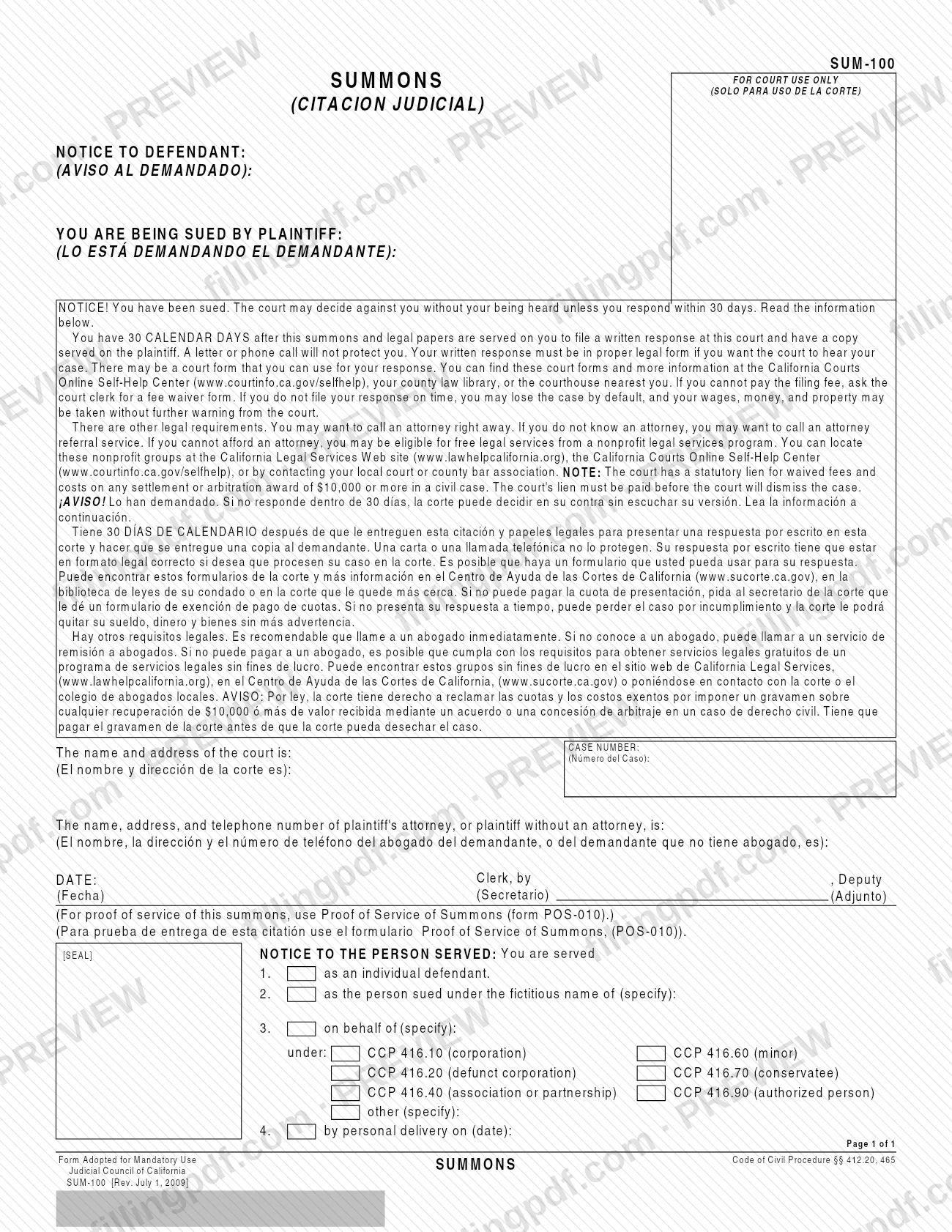
SUM-100 is the Summons form that the Judicial Council of California adopted for mandatory use under Code of Civil Procedure (CCP) §§ 412.20 and 465. It tells a defendant that a court case has started and that a written response is due within 30 days. On this page you can fill out the form online on FillingPDF and download or print the completed PDF. The official PDF and the Judicial Council's self-help page for the form are published by the California courts.
Last updated
What is SUM-100?
Form SUM-100, Summons, is the Judicial Council of California form that notifies a defendant that a court case has started and that the court may decide against the defendant unless a written response is filed within 30 days of service.
The form is printed in English and Spanish side by side. Its warning block tells the defendant that there are 30 calendar days after the summons and legal papers are served to file a written response at the court and have a copy served on the plaintiff. It also says that a letter or phone call will not protect the defendant, that a late response can mean losing the case by default, and that wages, money and property may then be taken without further warning.
The body of the form identifies the case: the case number, the name and address of the court, and the name, address and telephone number of the plaintiff's attorney or of a plaintiff without an attorney. It carries a date line with the Clerk and Deputy, a space for the court seal, and a NOTICE TO THE PERSON SERVED block that records the capacity in which the defendant is served and the date of personal delivery.
SUM-100 does not prove that service took place. The form itself points to Proof of Service of Summons (form POS-010) for that purpose. The Judicial Council's self-help page lists translations of SUM-100 in Chinese Simplified, Korean, Spanish and Vietnamese, and gives July 1, 2009 as the effective date.
Who needs to file SUM-100?
The main audience is the defendant in a California civil case: the person who is served with a SUM-100 and must decide whether to file a written response. The form states that anyone who has been sued has 30 calendar days after service to respond, and it urges the defendant to consider calling an attorney right away.
The NOTICE TO THE PERSON SERVED block shows the ways a person can be served:
- as an individual defendant;
- as the person sued under a fictitious name;
- on behalf of another party, under CCP 416.10 (corporation), 416.20 (defunct corporation), 416.40 (association or partnership), 416.60 (minor), 416.70 (conservatee), 416.90 (authorized person), or another provision that is written in.
The plaintiff side appears on the form too. It asks for the name, address and telephone number of the plaintiff's attorney, or of the plaintiff if there is no attorney.
Defendants who cannot afford a lawyer are told they may qualify for free legal services from a nonprofit program. They can look for one at www.lawhelpcalifornia.org, at the California Courts Online Self-Help Center (www.courtinfo.ca.gov/selfhelp), or through the local court or county bar association.
When to file SUM-100
The clock on a SUM-100 starts when the summons and legal papers are served on the defendant. From that day the defendant has 30 calendar days to file a written response at the court named on the form and to have a copy served on the plaintiff.
A letter or phone call does not count as a response, and the response must be in proper legal form for the court to hear the case. If the response is not filed on time, the defendant may lose the case by default. The form says a court form for the response may exist and points to the California Courts Online Self-Help Center, the county law library and the nearest courthouse. The summons itself has no separate due date printed on it, and the form is dated by the Clerk.
How to fill out SUM-100
Enter the defendant's name
Under NOTICE TO DEFENDANT (Aviso al demandado), enter the name of the party being sued.
Enter the plaintiff's name
Under YOU ARE BEING SUED BY PLAINTIFF (Lo está demandando el demandante), enter the name of the party who filed the case.
Enter the case number
In the CASE NUMBER box (Número del Caso), enter the number the court assigned to the case.
Give the court's name and address
On the line The name and address of the court is (El nombre y dirección de la corte es), write the court's name and its full address.
Add the plaintiff's contact details
Enter the name, address and telephone number of the plaintiff's attorney, or of the plaintiff if there is no attorney.
Complete the date and clerk lines
The DATE line sits beside Clerk, by and Deputy, next to the [SEAL] area. Enter the date and the clerk and deputy as the court issues the summons.
Mark how the person was served
In NOTICE TO THE PERSON SERVED, check item 1 for an individual defendant, or item 2 and write the fictitious name. Check item 3 if the person is served on behalf of another, write who, and check the CCP box that applies or other (specify).
Enter the date of personal delivery
On item 4, by personal delivery on (date), enter the date the summons was delivered in person.
Review and download the completed PDF
Check the names, case number, court address and the boxes you marked. Then download or print the completed PDF from FillingPDF.
How to submit SUM-100
The SUM-100 reaches the defendant by service, and the form names no other channel for the summons itself. It records how the person was served in the NOTICE TO THE PERSON SERVED block, including the date of personal delivery on item 4. For proof of service, the form says to use Proof of Service of Summons (form POS-010).
- Defendant's response: file a written response at the court whose name and address are printed on the summons, and have a copy served on the plaintiff, within 30 calendar days after service.
- Filing fee: the form says that if you cannot pay the filing fee, you should ask the court clerk for a fee waiver form. Ask the clerk for any amount that applies.
- Questions about the case: the court's name and address and the plaintiff's attorney's contact details appear on the form itself.
FillingPDF lets you fill out and download the PDF; submission follows the channels above.
Common mistakes to avoid
- Treating a letter or phone call to the court or the plaintiff as a response; the form says neither will protect you.
- Missing the 30-calendar-day response period after service, which can lead to a loss by default.
- Filing a response that is not in proper legal form; the form says the written response must be in proper legal form for the court to hear the case.
- Filing the response with the court but not having a copy served on the plaintiff.
- Using SUM-100 to prove that the defendant was served instead of Proof of Service of Summons (form POS-010).
- Checking item 2 or item 3 in the notice block without writing the fictitious name or the person or entity served in the "specify" line.
- Leaving out the plaintiff's attorney's address or telephone number, or the plaintiff's own details when there is no attorney.
- Assuming a defendant who cannot pay the filing fee must skip the response; the form tells you to ask the court clerk for a fee waiver form.
Frequently asked questions
What is the SUM-100 form used for?
SUM-100 is the Judicial Council of California's Summons. It tells a defendant that a court case has started and that the court may decide against them unless they file a written response within 30 days of being served.
How long do I have to respond after being served with a SUM-100?
You have 30 calendar days after the summons and legal papers are served on you. Within that time you must file a written response at the court named on the form and have a copy served on the plaintiff.
Can I respond to a summons with a letter or phone call?
No. The SUM-100 says a letter or phone call will not protect you. The written response must be in proper legal form if you want the court to hear your case, and a court form for the response may be available.
What happens if I do not respond to a SUM-100 in time?
You may lose the case by default. The form warns that your wages, money and property may then be taken without further warning from the court, so respond within the 30 calendar days.
What if I cannot pay the court's filing fee?
Ask the court clerk for a fee waiver form. The SUM-100 also notes that the court has a statutory lien for waived fees and costs on certain settlements or arbitration awards in civil cases, and the lien must be paid before the case is dismissed.
Which form proves that a summons was served?
Use Proof of Service of Summons, form POS-010. The SUM-100 itself says to use that form for proof of service; the summons only records how the person was served in its notice block.
Is SUM-100 available in languages other than English?
Yes. The Judicial Council's self-help page lists SUM-100 in Chinese Simplified, Korean, Spanish and Vietnamese. The English form also prints its warnings in Spanish beside the English text.
Can I fill out the SUM-100 form online on FillingPDF?
Yes. You can fill out the fillable PDF online on FillingPDF and download or print it. FillingPDF is an independent service and does not serve or file the summons; service and filing follow the court's rules.
Ready to fill out SUM-100?
Fill out SUM-100 now