
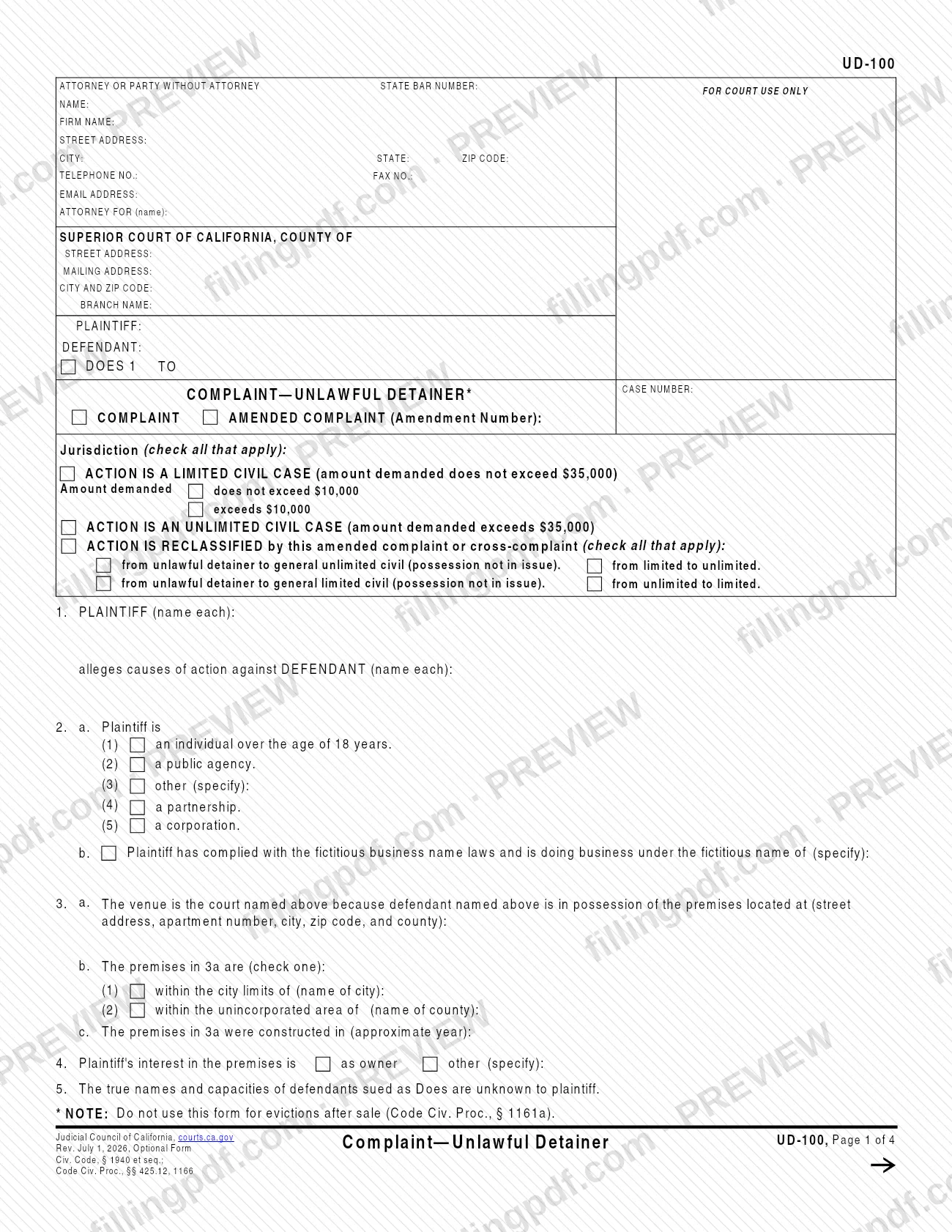
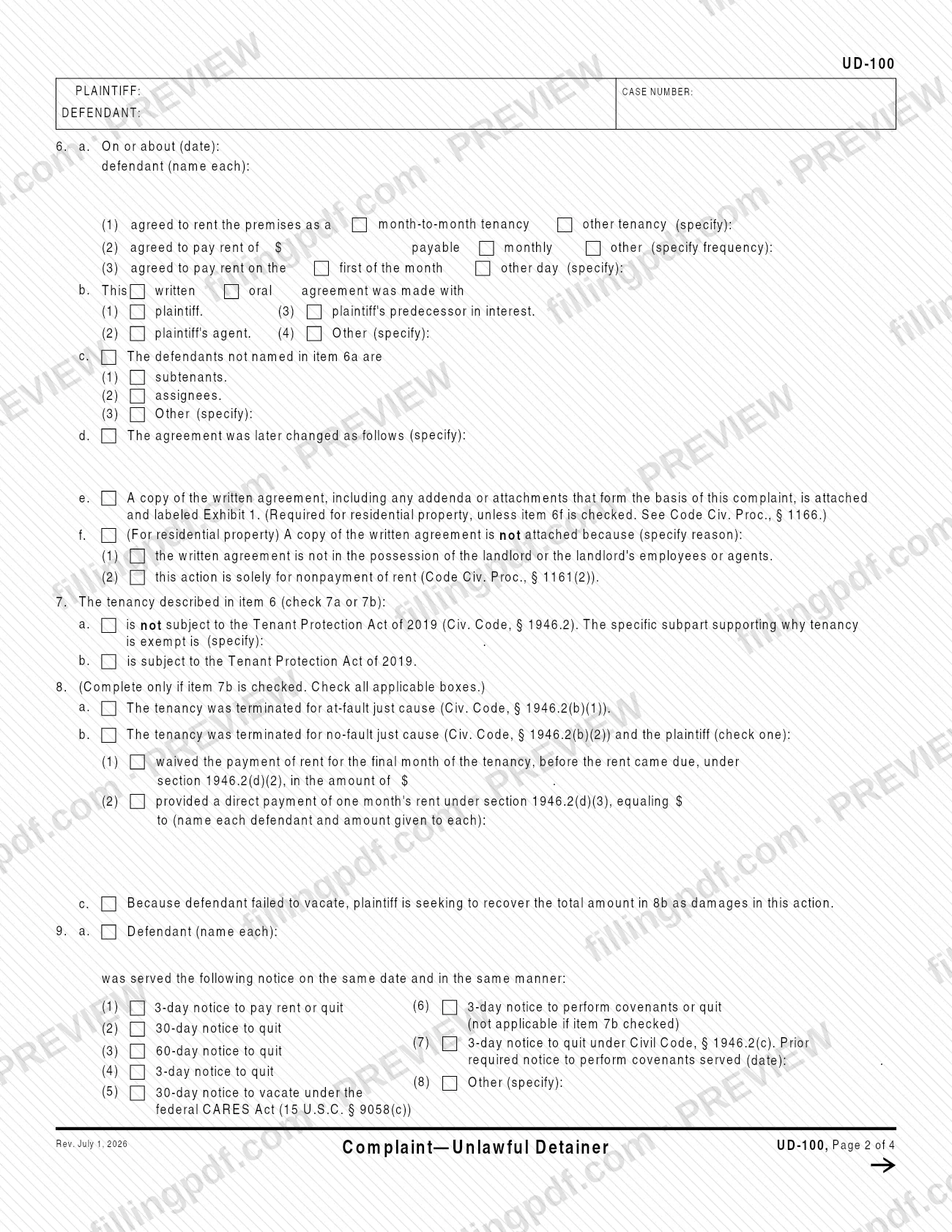
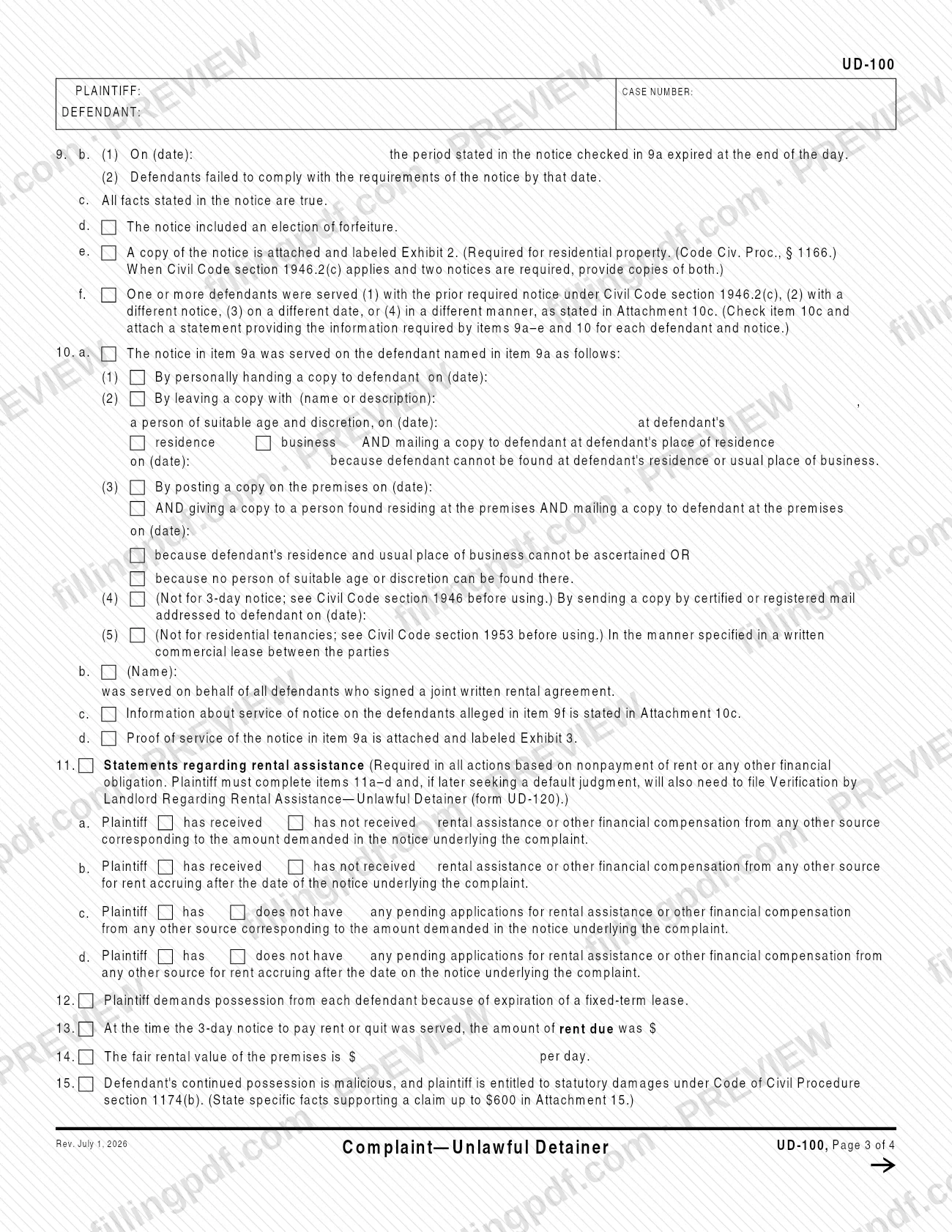
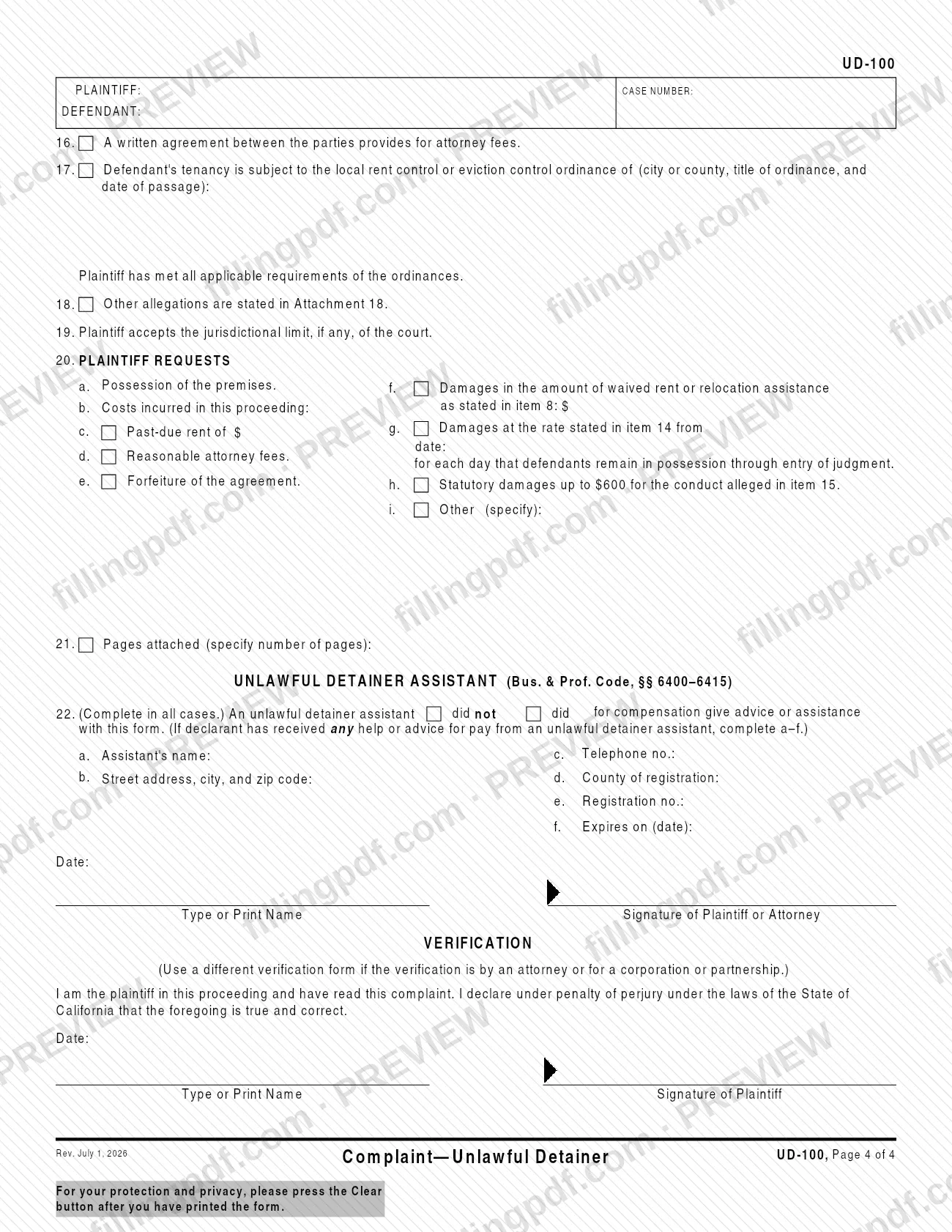
UD-100 is the Complaint—Unlawful Detainer, an optional Judicial Council of California form that a landlord uses to start an eviction case in a California superior court. The plaintiff states the tenancy, the notice that was served and what the court is asked to award. On this page you can fill out the form online on FillingPDF and download or print the completed PDF; the official PDF and the court's filing rules remain with the Judicial Council and the superior court.
Last updated
What is UD-100?
Form UD-100, Complaint—Unlawful Detainer, is the Judicial Council of California form a landlord (the plaintiff) files in superior court to start an eviction case, setting out the rental agreement, the notice served on the tenant and what the plaintiff asks the court to award.
The Judicial Council's self-help page describes it as the form that starts an eviction case and tells the tenant all the issues the landlord wants to include in a judgment against them. The form is printed as an "Optional Form" and cites Civ. Code, § 1940 et seq. and Code Civ. Proc., §§ 425.12 and 1166. The revision given here is effective July 1, 2026.
The four pages follow the story of the case:
- The caption, the case type (limited or unlimited civil case, or reclassification by an amended complaint) and the parties.
- The premises, the plaintiff's interest and the rental agreement (items 1 to 6).
- Whether the Tenant Protection Act of 2019 applies, and the notice that was served and how (items 7 to 10).
- Rental assistance statements, the amounts demanded, other allegations and what the plaintiff requests (items 11 to 21).
- The unlawful detainer assistant disclosure, the plaintiff's signature and the verification (item 22 and the end of page 4).
The form is not for evictions after sale: its own note says to use another form for those (Code Civ. Proc., § 1161a). The Judicial Council also publishes form UD-100 in Spanish, Chinese Simplified and Korean. If the landlord later seeks a default judgment in an action based on nonpayment of rent or another financial obligation, a separate form, UD-120, Verification by Landlord Regarding Rental Assistance—Unlawful Detainer, is also needed.
Who needs to file UD-100?
The plaintiff, normally the landlord or the landlord's attorney, completes the UD-100 when starting an unlawful detainer case against one or more defendants. Item 2 asks whether the plaintiff is an individual over the age of 18 years, a public agency, a partnership, a corporation or another type of plaintiff, and item 4 asks whether the plaintiff's interest in the premises is as owner or in another capacity.
Who signs: the plaintiff or attorney signs at the end of item 22. The verification at the bottom of page 4 is for a plaintiff who has read the complaint and declares under penalty of perjury that it is true; the form says to use a different verification form when the verification is by an attorney or for a corporation or partnership.
Do not use this form for evictions after sale (Code Civ. Proc., § 1161a). The form also marks several choices as unavailable in some situations: the 30-day notice to quit in item 9a(2) is not applicable if item 7b (tenancy subject to the Tenant Protection Act of 2019) is checked, and certified or registered mail service in item 10a(4) is not for a 3-day notice.
Item 22 must be completed in all cases, whether or not an unlawful detainer assistant helped with the form.
When to file UD-100
The form has no due date of its own. It is filed when the plaintiff is ready to begin the eviction case in court, after the notice described in item 9 has been served. Item 9b asks for the date on which the period stated in that notice expired at the end of the day, and states that the defendants failed to comply with the notice by that date.
The notice types listed in item 9a are a 3-day notice to pay rent or quit, a 30-day notice to quit, a 60-day notice to quit, a 3-day notice to quit, a 30-day notice to vacate under the federal CARES Act (15 U.S.C. § 9058(c)), a 3-day notice to perform covenants or quit, a 3-day notice to quit under Civil Code, § 1946.2(c) and other notices.
Item 12 applies where possession is demanded because a fixed-term lease expired. Revision effective July 1, 2026 is the one printed on this form; deadlines for serving the notice or filing in court are not stated on it, so confirm them with the court or the Judicial Council's self-help resources.
Documents you need
- Exhibit 1: a copy of the written rental agreement, including addenda or attachments that form the basis of the complaint. Required for residential property unless item 6f is checked (agreement not in the landlord's possession, or action solely for nonpayment of rent).
- Exhibit 2: a copy of the notice served on the defendant (item 9a). Required for residential property; provide copies of both notices when Civil Code section 1946.2(c) applies and two notices are required.
- Exhibit 3: proof of service of the notice in item 9a, when item 10d is checked.
- Attachment 10c: a statement giving the information required by items 9a–e and 10 for each defendant and notice, when item 9f applies because defendants were served differently.
- Attachment 15: specific facts supporting a claim of malicious continued possession and statutory damages under Code of Civil Procedure section 1174(b), when item 15 is checked.
- Attachment 18: other allegations, when item 18 is checked.
- Form UD-120, Verification by Landlord Regarding Rental Assistance—Unlawful Detainer: needed if the plaintiff later seeks a default judgment in an action based on nonpayment of rent or any other financial obligation.
How to fill out UD-100
Complete the caption and court information
Enter the attorney or party without attorney details, then the Superior Court of California, county, court address, branch name, plaintiff, defendant and Does 1 to the number you need. Leave the case number and the For Court Use Only area to the court.
Choose complaint type and jurisdiction
Check COMPLAINT or AMENDED COMPLAINT (with the amendment number). Check all jurisdiction boxes that apply: limited civil case, unlimited civil case, or reclassification by an amended complaint.
Name the plaintiff and defendants
Item 1: name each plaintiff and each defendant. Item 2a: check what the plaintiff is; in item 2b, give the fictitious business name if one is used.
Describe the premises and venue
Item 3a: the full address of the premises, with apartment number, city, ZIP code and county. In 3b check city limits or unincorporated area and name it; in 3c enter the approximate year of construction.
State your interest and unknown Does
Item 4: check owner or other (specify). Item 5 states that the true names of defendants sued as Does are unknown to the plaintiff.
Describe the rental agreement
Item 6a to 6d: the date, tenancy type, rent and due day, who made the agreement, any other defendants (subtenants or assignees) and later changes. In 6e check the Exhibit 1 box, or in 6f give the reason it is not attached.
Answer the Tenant Protection Act items
Item 7: check 7a (with the exemption subpart) or 7b. Complete item 8 only if 7b is checked, choosing at-fault or no-fault just cause and, for no-fault, the waived rent or direct payment and the amount.
Identify the notice and how it expired
Item 9a: name each defendant and check the notice served. Item 9b to 9f: the expiration date, whether the defendants failed to comply, the election of forfeiture if any, and Exhibit 2.
Describe how the notice was served
Item 10a: check the method and enter the dates, names and mailing details it asks for. Use 10b for a joint written rental agreement, 10c for Attachment 10c and 10d for Exhibit 3.
Make the rental assistance statements
Item 11a to 11d: check whether the plaintiff has received rental assistance or other compensation and has pending applications, for amounts corresponding to the notice and for rent accruing afterward. Required in actions based on nonpayment of rent or any other financial obligation.
Complete items 12 through 19
Check and fill only what applies: fixed-term lease expiration (12), rent due when the 3-day notice was served (13), fair rental value per day (14), malicious possession (15), attorney fees agreement (16), local rent control ordinance (17), other allegations (18) and the jurisdictional limit (19).
Enter what plaintiff requests
Item 20: check each request, such as possession, costs, past-due rent, attorney fees, forfeiture, damages tied to item 8 or item 14, statutory damages for item 15 and other relief. Item 21: enter the number of pages attached.
Complete the unlawful detainer assistant item
Item 22: check whether an unlawful detainer assistant did or did not give paid advice or help. If it did, complete the assistant's name, address, telephone number, county of registration, registration number and expiration date.
Review, sign and download the PDF
Enter the date and printed name and sign as plaintiff or attorney, then sign and date the verification as the plaintiff. Check every item against your exhibits, then download or print the completed PDF from FillingPDF.
How to submit UD-100
The UD-100 is a court pleading: it is filed in the Superior Court of California for the county named in the caption, at the branch named there. The form prints no mailing address, portal or other filing channel of its own.
- Court of filing: item 3a states that the venue is the court named above because the defendant is in possession of the premises, so the court is the one covering the premises' address and county.
- Exhibits: for residential property, attach the written agreement as Exhibit 1 (unless item 6f is checked) and a copy of the notice as Exhibit 2; when two notices are required under Civil Code section 1946.2(c), provide copies of both. If item 10d is checked, attach proof of service of the notice as Exhibit 3.
- Attachments: attach statements called for by items 9f/10c (Attachment 10c), 15 (Attachment 15) and 18 (Attachment 18), and enter the number of pages attached in item 21.
- Signature: the plaintiff or attorney signs item 22, and the plaintiff signs the verification on page 4.
- Rental assistance: if the plaintiff later seeks a default judgment in a case based on nonpayment of rent or another financial obligation, form UD-120 must also be filed.
Ask the clerk of the superior court how it accepts filings and whether a filing fee applies; the form does not say. The form also prompts you to press its Clear button after printing. FillingPDF lets you fill out and download the PDF; submission follows the court's channels, not this site.
Common mistakes to avoid
- Using the UD-100 for an eviction after sale; the form's note says not to use it for those (Code Civ. Proc., § 1161a).
- Leaving out Exhibit 1 or Exhibit 2 on a residential property case when no exception applies; both are marked as required for residential property.
- Checking neither item 7a nor item 7b, or completing item 8 when item 7b is not checked; item 8 is for tenancies subject to the Tenant Protection Act of 2019 only.
- Choosing the 30-day notice to quit in item 9a(2) when item 7b is checked; the form says it is not applicable in that case.
- Describing service by certified or registered mail (item 10a(4)) for a 3-day notice, which the form says is not for 3-day notices.
- Skipping the rental assistance statements in item 11 in an action based on nonpayment of rent or another financial obligation; they are required there.
- Leaving item 22 blank; it must be completed in all cases, stating whether an unlawful detainer assistant gave paid help.
- Using this plaintiff's verification when an attorney verifies the complaint or the plaintiff is a corporation or partnership; the form says to use a different verification form.
- Attaching Attachment 15 or 18 without checking the item that refers to it, or not entering the number of pages in item 21.
Frequently asked questions
What is the UD-100 form?
UD-100 is the Judicial Council of California's Complaint—Unlawful Detainer. A landlord files it in superior court to start an eviction case. It states the rental agreement, the notice served on the tenant and what the plaintiff asks the court to award, such as possession of the premises.
Who files the UD-100?
The plaintiff, usually the landlord or the landlord's attorney, files it. The plaintiff may be an individual over 18, a public agency, a partnership, a corporation or another type of plaintiff, as item 2 lists. The tenant does not file this complaint.
Can I use the UD-100 for an eviction after a sale?
No. The form's own note says not to use it for evictions after sale (Code Civ. Proc., § 1161a). Use it for the situations covered by its items: expired notices, fixed-term lease expiration and similar grounds against a defendant in possession.
What do I have to attach to the UD-100?
For residential property, attach the written agreement as Exhibit 1 (unless item 6f applies) and a copy of the notice as Exhibit 2. Check item 10d and attach Exhibit 3 if you include proof of service of the notice. Attachments 10c, 15 and 18 are used only for the items that call for them.
Does the UD-100 require a verification?
Yes, the form ends with a verification in which the plaintiff declares under penalty of perjury that the complaint is true. It says to use a different verification form if an attorney verifies it or the plaintiff is a corporation or partnership.
What is form UD-120, and when is it needed with the UD-100?
UD-120 is Verification by Landlord Regarding Rental Assistance—Unlawful Detainer. In actions based on nonpayment of rent or another financial obligation, the plaintiff completes UD-100 item 11 and, if later seeking a default judgment, also files UD-120.
Is the UD-100 available in Spanish?
Yes. The Judicial Council's self-help page lists form UD-100 in Spanish, Chinese Simplified and Korean. The English form is the one used on this page.
Can I fill out the UD-100 online and file it with FillingPDF?
You can fill out the UD-100 online on FillingPDF and download or print the completed PDF. FillingPDF is an independent service and does not file the complaint; the plaintiff files it with the superior court named in the caption.
Ready to fill out UD-100?
Fill out UD-100 now