
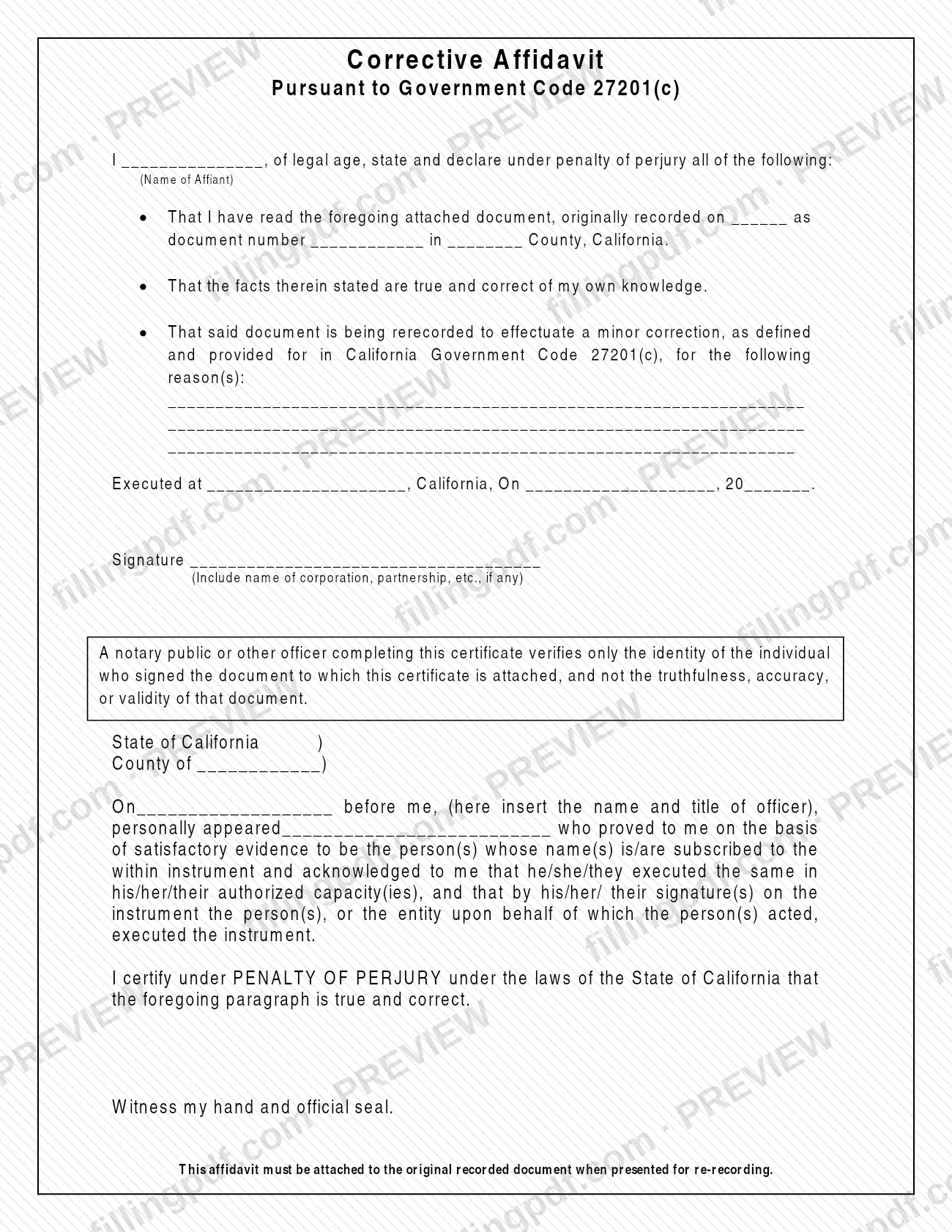
The Corrective Affidavit is the sworn statement used with the Los Angeles County Registrar-Recorder/County Clerk (RR/CC) when a recorded document is re-recorded to make a minor correction under California Government Code 27201(c). The affiant states that they read the attached document, that its facts are true of their own knowledge, and why the correction is needed. On this page you can fill out the Corrective Affidavit online on FillingPDF and download or print the completed PDF; the official PDF is published by the RR/CC at lavote.gov. The RR/CC's own page lists the same form as the Re-Recording Affidavit (AKA Corrective Affidavit).
Last updated
What is Corrective Affidavit – Los Angeles County, CA?
The Corrective Affidavit is a sworn statement, made under penalty of perjury pursuant to California Government Code 27201(c), in which the affiant declares that a previously recorded document is being rerecorded to effectuate a minor correction and gives the reason for it.
The affiant makes three declarations on the form. First, that they have read the attached document, which was originally recorded on a stated date as a stated document number in a named California county. Second, that the facts in that document are true and correct of their own knowledge. Third, that the document is being rerecorded to effectuate a minor correction, as defined and provided for in Government Code 27201(c), for the reasons written on the lines provided.
The affidavit is then executed: the affiant enters the place in California and the date, and signs. The form includes a California notary acknowledgment block, and its printed note says the notary public or other officer completing that certificate verifies only the identity of the person who signed, not the truthfulness, accuracy or validity of the document.
The Los Angeles County Registrar-Recorder/County Clerk publishes the form, and its page names it the Re-Recording Affidavit (AKA Corrective Affidavit). That page also points to a public notice on the re-recording process and Assembly Bill 1974. The affidavit is not filed alone: the form says it must be attached to the original recorded document when presented for re-recording.
Who needs to file Corrective Affidavit – Los Angeles County, CA?
The main user is an affiant of legal age who wants to re-record a document that has already been recorded, in order to make a minor correction as defined in California Government Code 27201(c). The affiant must have read the recorded document and be able to state under penalty of perjury that its facts are true and correct of their own knowledge.
Details that depend on your situation:
- The form has a blank for the county where the document was originally recorded, so it is not limited to documents recorded in one county.
- If you sign for a corporation, a partnership or another entity, the signature line asks you to include the name of that entity.
- The notary public or other officer completes the acknowledgment certificate; that person is not the affiant.
Do not use this form for a change that is not a minor correction under Government Code 27201(c). The form does not list which corrections qualify, so read that section of the Government Code and the Registrar-Recorder/County Clerk's re-recording page before you sign.
When to file Corrective Affidavit – Los Angeles County, CA
Complete the Corrective Affidavit when you are about to present a recorded document for re-recording to make a minor correction under Government Code 27201(c). The form prints no deadline of its own; it travels with the original recorded document, because it must be attached to that document when presented for re-recording.
The affidavit carries two dates you need to have ready: the date the document was originally recorded and the date you execute the affidavit, written as the day, then the year in the form "20__". The notary's acknowledgment carries its own date. For the steps and timing of the re-recording itself, the Registrar-Recorder/County Clerk refers to a public notice on its Re-Recording Affidavit page.
Documents you need
- The original recorded document being corrected: the form says the affidavit must be attached to it when presented for re-recording.
How to fill out Corrective Affidavit – Los Angeles County, CA
Enter the affiant's name
On the opening line, "I ____, of legal age", write the full name of the person making the declaration.
Identify the recorded document
Enter the date the document was originally recorded, its document number and the California county where it was recorded, as the first declaration requests.
State the reason for correction
On the lines after "for the following reason(s)", describe the minor correction under Government Code 27201(c) that the re-recording will make.
Enter the place and date executed
In "Executed at ____, California, On __, 20", write the city where you sign and the date.
Sign the affidavit
Sign on the signature line. If you sign for a corporation, partnership or similar entity, include its name as the line instructs.
Have the notary complete the certificate
The notary public or other officer fills in the county, the date, the officer's name and title and the name of the person who appeared, then completes the certificate.
Attach it to the recorded document
The form says the affidavit must be attached to the original recorded document when presented for re-recording.
Review and download the completed PDF
Check the recording details, the reason lines and the dates, then download or print the completed PDF from FillingPDF for signing and notarization.
How to submit Corrective Affidavit – Los Angeles County, CA
The Corrective Affidavit is presented for re-recording together with the original recorded document: the form states that it must be attached to that document. It prints no address, portal or fee of its own.
- Prepare the package: the signed, notarized affidavit attached to the original recorded document.
- Find the process: the Los Angeles County Registrar-Recorder/County Clerk's Re-Recording Affidavit (AKA Corrective Affidavit) page, at https://www.lavote.gov/home/recorder/property-document-recording/forms/re-recording-affidavit, links to the public notice on re-recording and Assembly Bill 1974. Check it for how and where the package is presented.
FillingPDF lets you fill out and download the PDF; submission follows the agency's channels above.
Common mistakes to avoid
- Presenting the affidavit without attaching it to the original recorded document, which the form requires for re-recording.
- Using the affidavit for a change that is not a minor correction as defined in Government Code 27201(c).
- Leaving blank the recording date, the document number or the county where the document was originally recorded.
- Writing no reason on the lines for the minor correction, although the affiant declares the document is rerecorded for those reasons.
- Signing for a corporation or partnership without including the entity's name under the signature line.
- Filling in the notary acknowledgment yourself; the notary public or other officer completes it, and verifies only your identity.
- Signing the affidavit without having read the attached document, since you declare under penalty of perjury that you did.
Frequently asked questions
What is a corrective affidavit in Los Angeles County?
It is a sworn statement, made pursuant to California Government Code 27201(c), saying a recorded document is being rerecorded to make a minor correction. The Los Angeles County Registrar-Recorder/County Clerk also calls it the Re-Recording Affidavit (AKA Corrective Affidavit).
Is a corrective affidavit the same as a re-recording affidavit?
Yes. The Registrar-Recorder/County Clerk's page is titled Re-Recording Affidavit (AKA Corrective Affidavit) and links to this same form, Corrective Affidavit, which cites Government Code 27201(c).
What do I attach to the Corrective Affidavit?
Attach the affidavit to the original recorded document. The form states that the affidavit must be attached to the original recorded document when it is presented for re-recording, so the two go together.
Does the Corrective Affidavit need to be notarized?
The form includes a California acknowledgment certificate for a notary public or other officer to complete. The officer verifies only the identity of the person who signed, not whether the document is truthful, accurate or valid.
What information do I need before filling it out?
You need the affiant's name, the date the document was originally recorded, its document number, the California county of recording, the reason for the minor correction and the place and date you will sign.
What corrections can I make with a Corrective Affidavit?
Only a minor correction as defined and provided for in Government Code 27201(c). The form does not list qualifying corrections, so check that section and the Registrar-Recorder/County Clerk's re-recording page before you use it.
Where can I find the re-recording process and Assembly Bill 1974 notice?
On the Los Angeles County Registrar-Recorder/County Clerk's Re-Recording Affidavit (AKA Corrective Affidavit) page at lavote.gov, which links to a public notice about the re-recording process and Assembly Bill 1974.
Can I fill out the Corrective Affidavit online on FillingPDF?
Yes. You can fill out the PDF online on FillingPDF and download or print it. FillingPDF is independent of the Registrar-Recorder/County Clerk and does not file or record anything; the signed, notarized affidavit follows the agency's channels.
Ready to fill out Corrective Affidavit – Los Angeles County, CA?
Fill out Corrective Affidavit – Los Angeles County, CA now