
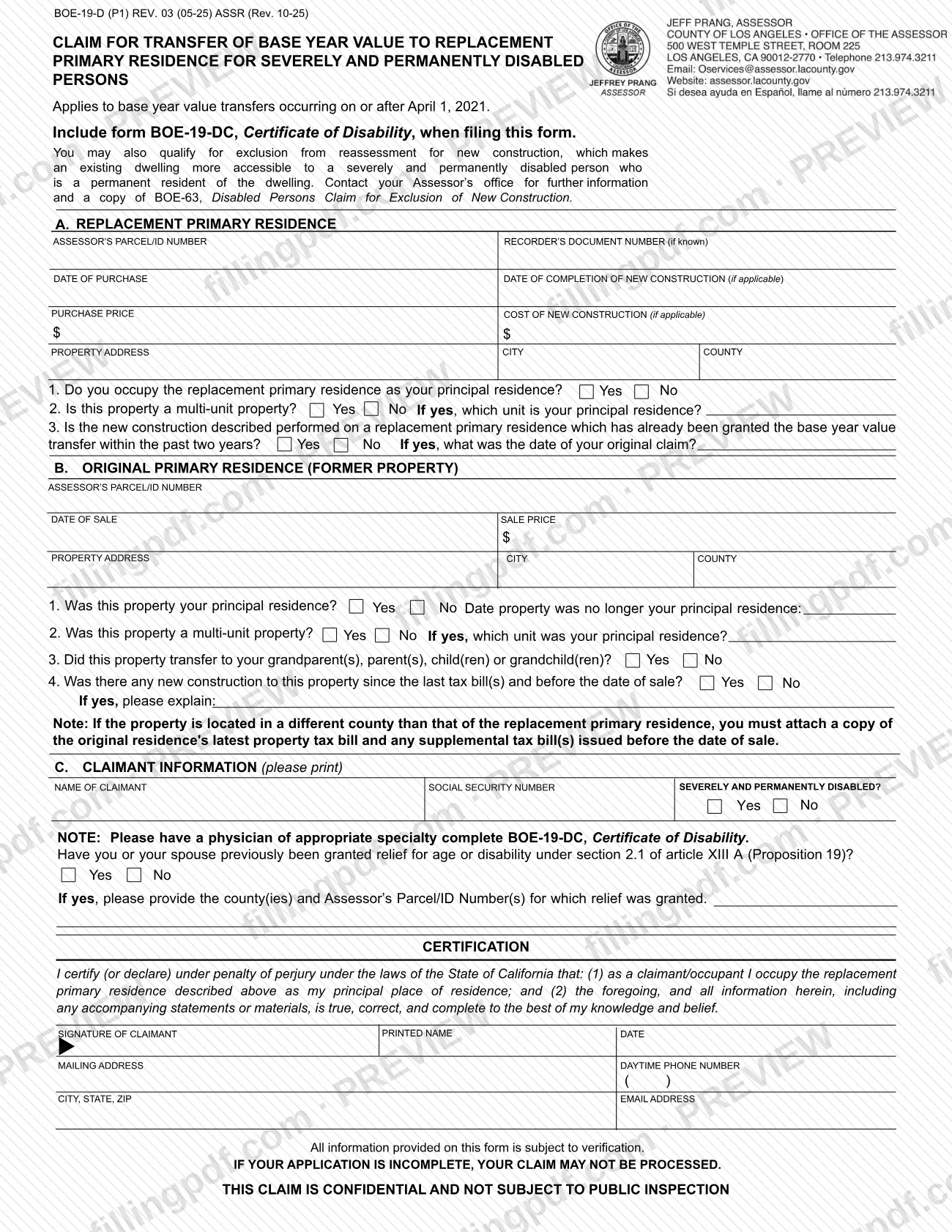
Form BOE-19-D is the claim that a severely and permanently disabled homeowner files with the county Assessor to carry the factored base year value of a sold primary residence over to a replacement primary residence in California. It is one of the Los Angeles County property tax forms listed on the Los Angeles County Office of the Assessor's forms page, and it must be filed with form BOE-19-DC, Certificate of Disability. On this page you can fill out the form online on FillingPDF and download or print the completed PDF; the form itself is published at the agency's official source.
Last updated
What is BOE-19-D?
Claim for Transfer of Base Year Value to Replacement Primary Residence for Severely Disabled Persons (Form BOE-19-D) is the claim a severely and permanently disabled owner files with the county Assessor to transfer the factored base year value of an original primary residence to a replacement primary residence located anywhere in California.
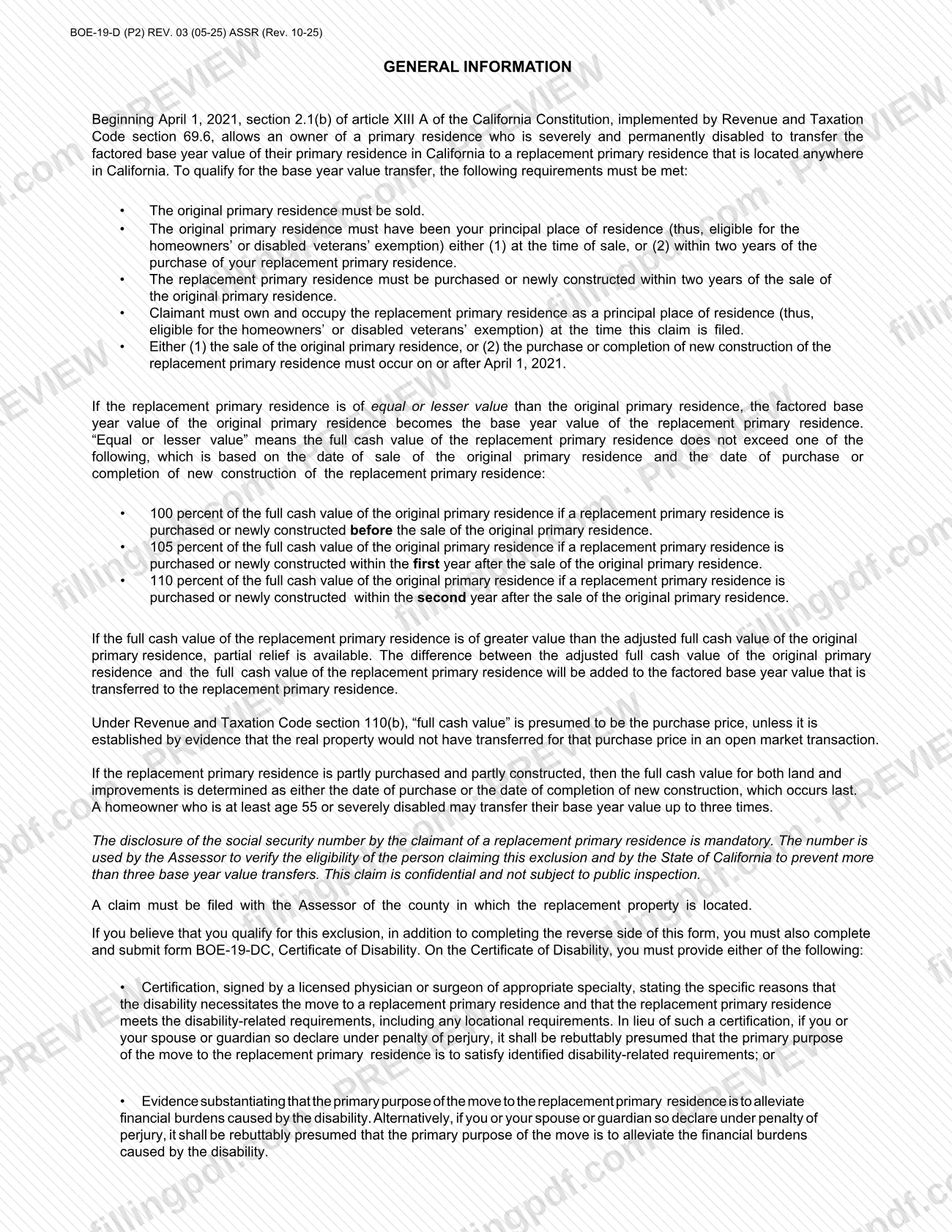
The form applies to base year value transfers occurring on or after April 1, 2021. Its general information explains that section 2.1(b) of article XIII A of the California Constitution, implemented by Revenue and Taxation Code section 69.6, allows the transfer.
How the new value is set depends on the replacement home's full cash value compared with the original home's:
- 100 percent, if the replacement is purchased or newly constructed before the original is sold.
- 105 percent, if it is purchased or constructed within the first year after the sale.
- 110 percent, if it is purchased or constructed within the second year after the sale.
If the replacement is of equal or lesser value, the original factored base year value becomes its base year value. If it costs more, partial relief is available: the difference is added to the transferred value. A homeowner who is at least age 55 or severely disabled may transfer a base year value up to three times.
The form has two other jobs. It also serves as the claim for additional treatment when new construction is performed on a replacement home that already received the benefit. It is not the claim for persons at least 55 years old: that is BOE-19-B, listed by the Los Angeles County Assessor.
Who needs to file BOE-19-D?
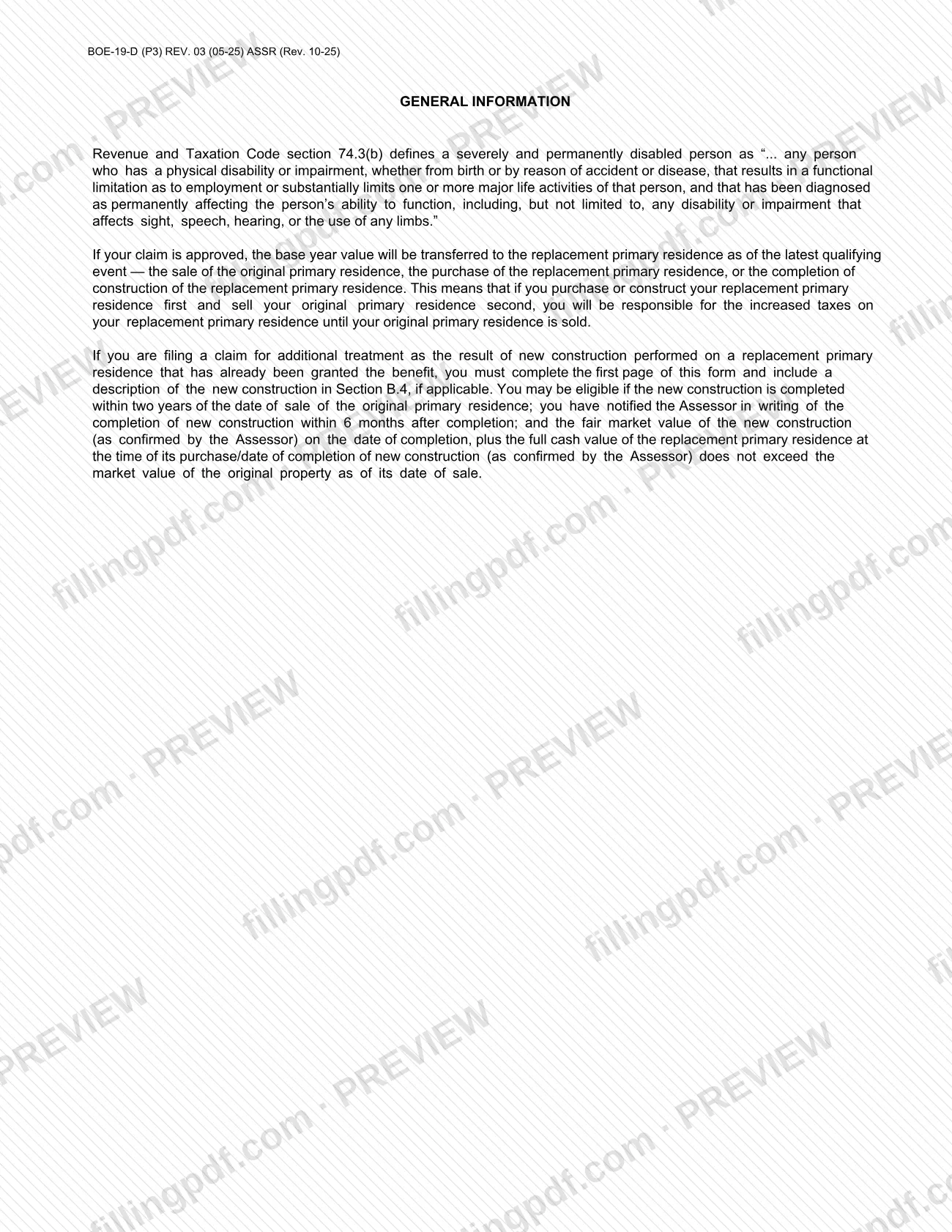
The main group is owners of a primary residence who are severely and permanently disabled and have sold, or are selling, that home and bought or built a replacement primary residence in California. Revenue and Taxation Code section 74.3(b), quoted on the form, defines such a person as someone with a physical disability or impairment that results in a functional limitation as to employment or substantially limits one or more major life activities, and that has been diagnosed as permanently affecting the person's ability to function.
To qualify, the form's general information requires that:
- the original primary residence is sold;
- it was your principal place of residence at the time of sale, or within two years of buying the replacement;
- the replacement is purchased or newly constructed within two years of the sale;
- you own and occupy the replacement as your principal residence when the claim is filed;
- either the sale, or the purchase or completion of construction, occurs on or after April 1, 2021.
Owners who already received the benefit and then completed new construction on the replacement home also use the form. The claimant must provide a Social Security number; disclosure is mandatory. The certification on the form is signed by the claimant. Separately, the form points to BOE-63 for an exclusion for new construction that makes an existing dwelling more accessible.
When to file BOE-19-D
The form prints no filing deadline, but timing rules shape when you can qualify. The replacement primary residence must be purchased or newly constructed within two years of the sale of the original primary residence, and you must own and occupy the replacement as your principal residence when you file the claim.
If the replacement is bought or built first and the original is sold second, the instructions warn that you pay the increased taxes on the replacement until the original is sold, because the value transfers as of the latest qualifying event: the sale, the purchase or the completion of construction.
For new construction on a replacement home that already received the benefit, you may be eligible if the construction is completed within two years of the sale of the original home and you notify the Assessor in writing of its completion within 6 months after completion.
Documents you need
- Form BOE-19-DC, Certificate of Disability: include it when filing BOE-19-D. A physician of appropriate specialty is to complete it.
- A copy of the original residence's latest property tax bill and any supplemental tax bill(s) issued before the date of sale: required only if the original property is in a different county than the replacement primary residence.
- A written description of the new construction in Section B.4: needed only when you are claiming additional treatment for new construction on a replacement home that already received the benefit.
- Written notice to the Assessor of completion of new construction within 6 months after completion: needed only for that additional-treatment claim.
How to fill out BOE-19-D
Identify the replacement residence
In Section A, enter the Assessor's Parcel/ID number, the recorder's document number (if known), the date of purchase, the purchase price, and the property address, city and county. If it was newly constructed, also enter the completion date and cost of new construction.
Answer the Section A questions
Question 1 asks whether you occupy the replacement as your principal residence. Question 2 asks if it is a multi-unit property and, if yes, which unit is yours. Question 3 asks whether the new construction is on a home already granted the transfer within two years, and the date of your original claim.
Identify the original residence
In Section B, enter the Assessor's Parcel/ID number, date of sale, sale price, and the property address, city and county of the former property.
Answer the Section B questions
Answer whether it was your principal residence (with the date it stopped being so), whether it was multi-unit and which unit, and whether it transferred to a grandparent, parent, child or grandchild. For question 4, state if there was new construction since the last tax bill and explain it.
Attach tax bills if needed
If the original home is in a different county than the replacement, attach a copy of its latest property tax bill and any supplemental tax bill(s) issued before the date of sale.
Complete the claimant information
In Section C, print the claimant's name, enter the Social Security number, and check Yes or No for severely and permanently disabled. Have a physician of appropriate specialty complete BOE-19-DC.
Report prior Proposition 19 relief
Answer whether you or your spouse previously received relief for age or disability under section 2.1 of article XIII A (Proposition 19). If yes, give the county(ies) and Assessor's Parcel/ID number(s) for which relief was granted.
Sign and date the certification
Sign, print your name and enter the date under the certification, made under penalty of perjury. Add your mailing address, daytime phone number, city, state, ZIP and email address.
Review, download and assemble
Check every entry, then download or print the completed PDF from FillingPDF. Assemble it with BOE-19-DC and any tax bills, and submit as described under How to submit.
How to submit BOE-19-D
Per the form, the claim is filed with the Assessor of the county in which the replacement property is located. It prints no mailing address, portal or appointment rule, so use the Assessor's contact details for that county. The Los Angeles County Office of the Assessor lists BOE-19-D on its forms page at https://assessor.lacounty.gov/forms.
What to send:
- The signed claim. Complete both sides as needed and sign the certification.
- Form BOE-19-DC, Certificate of Disability. The form says to include it when filing.
- Tax bills, if the original home is in another county. Attach a copy of the original residence's latest property tax bill and any supplemental tax bill(s) issued before the date of sale.
The form states that all information is subject to verification, that an incomplete application may not be processed, and that the claim is confidential and not subject to public inspection. FillingPDF lets you fill out and download the PDF; submission follows the channels above.
Common mistakes to avoid
- Filing BOE-19-D without form BOE-19-DC, Certificate of Disability, which the form says to include.
- Filing the claim with the wrong county; it goes to the Assessor of the county where the replacement property is located.
- Leaving out the latest tax bill and supplemental tax bill(s) of the original home when it is in a different county than the replacement.
- Omitting the Social Security number: disclosure by the claimant is mandatory, and an incomplete application may not be processed.
- Signing the certification when you do not occupy the replacement home as your principal residence, since the claim requires that you own and occupy it when filing.
- Buying or building the replacement more than two years after selling the original, which falls outside the stated requirement.
- Expecting relief if the replacement costs more than the allowed percentage of the original's full cash value; only partial relief is available then.
- Not describing the new construction in Section B.4 when filing for new construction on a replacement home already granted the transfer.
Frequently asked questions
What is Form BOE-19-D used for?
Form BOE-19-D is the claim a severely and permanently disabled homeowner files to transfer the factored base year value of an original primary residence to a replacement primary residence anywhere in California. It applies to transfers occurring on or after April 1, 2021.
Do I need BOE-19-DC with BOE-19-D?
Yes. The form says to include form BOE-19-DC, Certificate of Disability, when filing. It has a physician of appropriate specialty certify the disability, or, in lieu of certification, you, your spouse or guardian may declare under penalty of perjury, creating a rebuttable presumption.
Where do I file Form BOE-19-D?
With the Assessor of the county in which the replacement property is located. The form prints no address or portal, so contact that county's Assessor. The Los Angeles County Office of the Assessor lists the form at https://assessor.lacounty.gov/forms.
How much can the replacement home cost?
For full relief, its full cash value may not exceed 100 percent of the original's if bought or built before the sale, 105 percent within the first year after the sale, or 110 percent within the second year. If it costs more, partial relief applies.
How many times can I transfer my base year value?
A homeowner who is at least age 55 or severely disabled may transfer a base year value up to three times. The Social Security number you disclose is used by the State of California to prevent more than three transfers.
Is the claim confidential?
Yes. The form states that the claim is confidential and not subject to public inspection, and that all information on it is subject to verification. An incomplete application may not be processed.
What if I buy the new home before selling the old one?
You can still qualify if the sale is within two years, but the value transfers as of the latest qualifying event. You are responsible for the increased taxes on the replacement home until the original is sold.
Can I fill out Form BOE-19-D online?
You can fill out the PDF online on FillingPDF and download or print it. FillingPDF is independent, is not the Assessor and does not file the claim; you submit it to the county Assessor yourself.
Ready to fill out BOE-19-D?
Fill out BOE-19-D now