
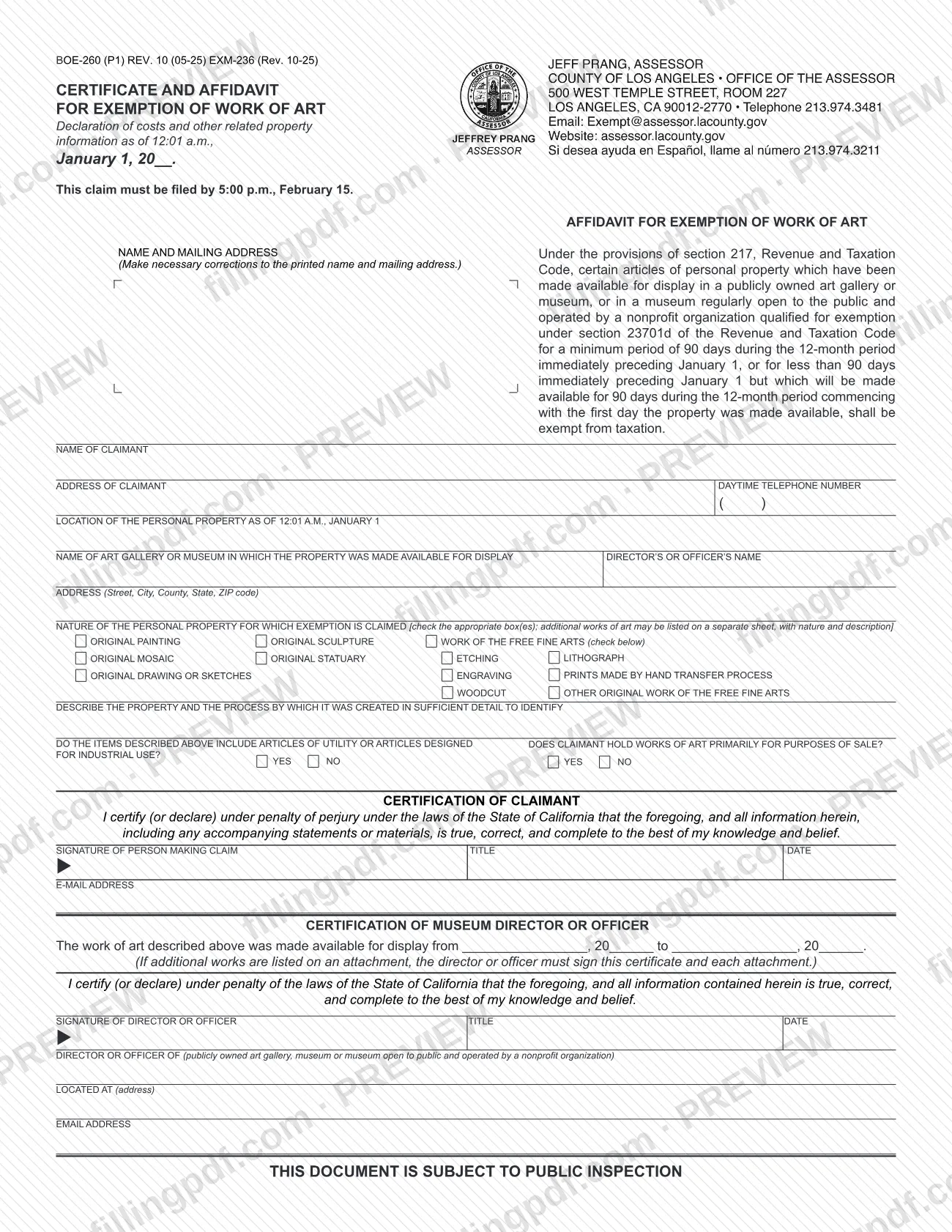
Form BOE-260, Certificate and Affidavit for Exemption of Work of Art, is the claim a person files with the assessor to exempt works of art from property tax under section 217 of the California Revenue and Taxation Code. It is one of the Los Angeles County property tax forms listed by the Los Angeles County Office of the Assessor, and it must be accompanied by a certificate from the director or an officer of the gallery or museum that displayed the art. On FillingPDF you can fill out the form online and download or print the completed PDF; the official PDF is published by the Assessor.
Last updated
What is BOE-260?
Form BOE-260, Certificate and Affidavit for Exemption of Work of Art, is the claim by which an owner asks the assessor to exempt works of art from taxation because they were made available for display in a publicly owned art gallery or museum, or in a qualifying nonprofit museum open to the public.
The form is a declaration of costs and other related property information as of 12:01 a.m. on January 1 of the year of the claim. It has two signed parts. In the first, the claimant identifies the property, its location on January 1, the gallery or museum, the nature of the work and a description detailed enough to identify it, and signs under penalty of perjury under California law. In the second, the museum director or officer certifies the dates on which the work was available for display.
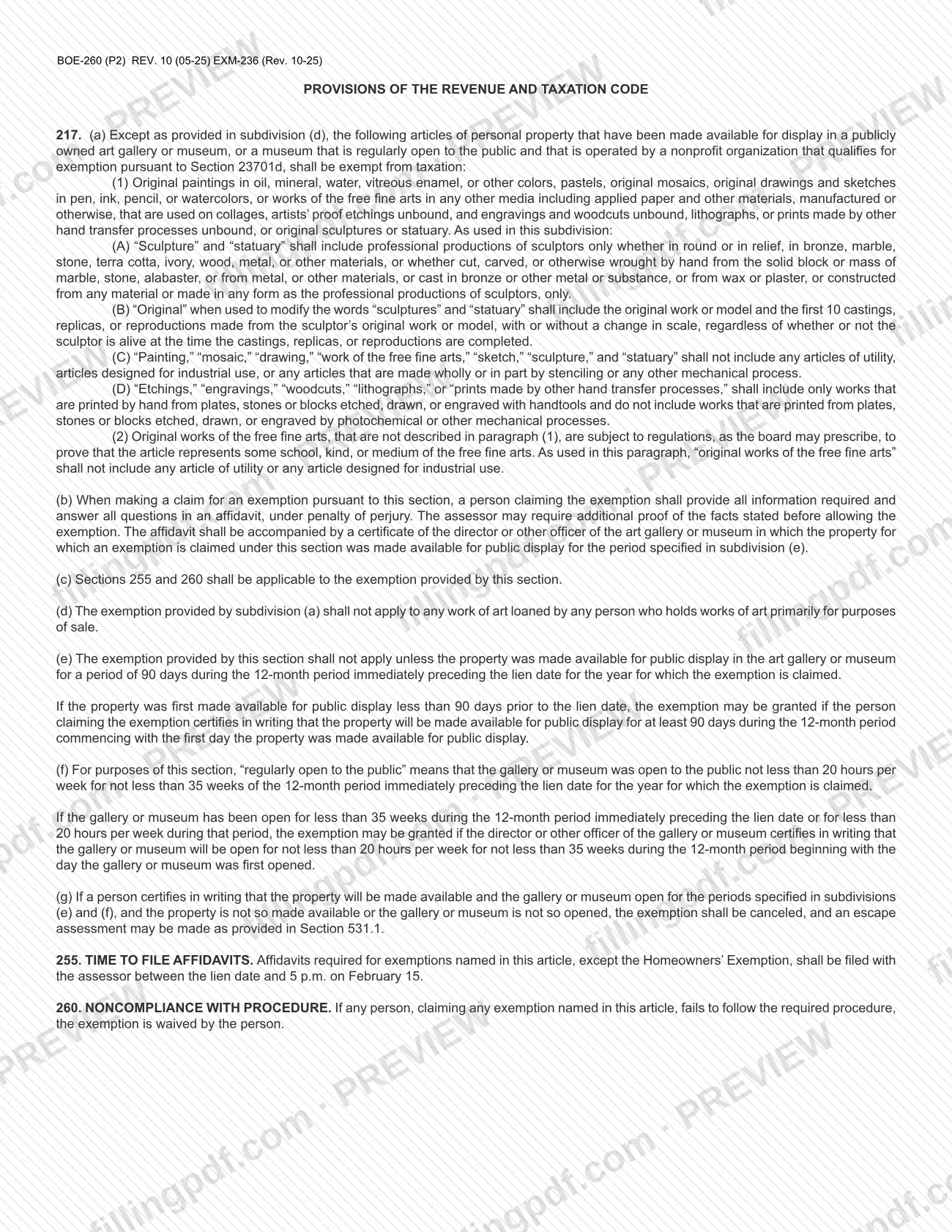
Page 2 reproduces the provisions of the Revenue and Taxation Code that govern the claim: section 217 (the exemption itself), section 255 (time to file affidavits) and section 260 (noncompliance with procedure). The Los Angeles County Office of the Assessor lists the form as BOE-260 / EXM-236. A printed revision mark, REV. 10 (05-25), appears on both pages. The form states that it is subject to public inspection.
It is a claim for works of art only. The same assessor's forms list shows separate claims for other exemptions, such as BOE-260-A for certain aircraft.
Who needs to file BOE-260?
The main group is a person who owns, or claims the exemption for, original works of art that have been made available for display in a publicly owned art gallery or museum, or in a museum regularly open to the public and operated by a nonprofit organization qualified under section 23701d of the Revenue and Taxation Code. The form names this person the claimant.
Conditions that apply to the claim:
- The property must have been on display for at least 90 days in the 12-month period before January 1. If it was first displayed less than 90 days before January 1, the claimant may certify in writing that it will be displayed for 90 days during the 12 months starting with the first day of display.
- Qualifying works include original paintings, mosaics, drawings and sketches, original sculpture and statuary, and hand-printed etchings, engravings, woodcuts and lithographs, as section 217 defines them. Articles of utility, articles designed for industrial use and works made wholly or partly by stenciling or another mechanical process are not included.
- The exemption does not apply to a work loaned by a person who holds works of art primarily for purposes of sale.
The museum director or another officer of the institution must also sign the certificate on the form.
When to file BOE-260
The claim must be filed by 5:00 p.m. on February 15; the form prints this deadline on its first page. Section 255, reproduced on page 2, says affidavits for exemptions of this kind, other than the Homeowners' Exemption, are filed with the assessor between the lien date and 5 p.m. on February 15. The form reports information as of 12:01 a.m. on January 1, so the year you write at the top is the year of the claim.
Timing also matters for the display period. The property must have been displayed for 90 days during the 12 months before January 1, or the claimant must certify that it will be displayed for 90 days in the 12 months starting with the first day of display. If the property is not displayed as certified, or the museum is not open as certified, section 217(g) says the exemption is canceled and an escape assessment may be made. Under section 260, failing to follow the required procedure means the exemption is waived.
Documents you need
- Certificate of the museum director or other officer, completed on the second part of Form BOE-260, giving the display dates and signed under penalty of the laws of California; section 217(b) requires it to accompany the affidavit.
- Separate sheet listing additional works of art with their nature and description, only if the claim covers more works than fit on the form.
- Signature of the director or officer on each attachment, when additional works are listed on an attachment.
- Additional proof of the facts stated, only if the assessor requires it before allowing the exemption (section 217(b)).
How to fill out BOE-260
Enter the claim year
Write the year in the blank "January 1, 20__" in the heading; the form declares costs and property information as of 12:01 a.m. on that January 1.
Check your name and mailing address
In the Name and Mailing Address block, correct the printed name and mailing address if they are wrong, as the form directs.
Enter the claimant details
Fill in Name of Claimant, Address of Claimant and Daytime Telephone Number.
Give the property's January 1 location
In Location of the Personal Property as of 12:01 a.m., January 1, state where the art was on that date.
Identify the gallery or museum
Enter the name of the art gallery or museum where the property was made available for display, the director's or officer's name, and the address (street, city, county, state, ZIP code).
Check the nature of the property
Check each box that applies, such as original painting, original sculpture, original mosaic, original statuary, etching, lithograph, original drawing or sketches, engraving, woodcut or other original work of the free fine arts. List additional works on a separate sheet with nature and description.
Describe the property and its process
In the description box, describe the property and the process by which it was created in enough detail to identify it.
Answer the two yes/no questions
Mark Yes or No for whether the items include articles of utility or articles designed for industrial use, and for whether the claimant holds works of art primarily for purposes of sale.
Sign the certification of claimant
Sign and date the certification under penalty of perjury, enter your title, and add your e-mail address.
Complete the museum director's certificate
The director or officer enters the display dates (from and to), then signs, dates, adds title, e-mail address, the institution's name and its address. On any attachment listing more works, the director or officer signs as well.
Review and download the completed PDF
Check every entry and both signature blocks, then download or print the completed PDF from FillingPDF and file it with the assessor by 5:00 p.m. on February 15.
How to submit BOE-260
File the completed, signed form with the assessor; section 255 on page 2 of the form names the assessor as the office that receives the affidavit. The form itself prints no mailing address, portal or appointment rule, so confirm the delivery options with the Los Angeles County Office of the Assessor, which lists the form as BOE-260 / EXM-236 on its forms page at https://assessor.lacounty.gov/forms.
Before you file, make sure the package is complete:
- The claimant's affidavit is signed and dated.
- The certification of the museum director or officer is signed and dated. If you list additional works on an attachment, the director or officer must also sign each attachment.
- The package reaches the assessor by 5:00 p.m. on February 15.
Section 217(b) allows the assessor to require additional proof of the facts stated before allowing the exemption, and the form is subject to public inspection. FillingPDF lets you fill out and download the PDF; submission follows the channels above.
Common mistakes to avoid
- Filing after 5:00 p.m. on February 15; the form prints this deadline, and section 260 says failing to follow the required procedure waives the exemption.
- Submitting the affidavit without the certificate of the museum director or officer, which section 217(b) requires to accompany it.
- Listing extra works on a separate sheet but not having the director or officer sign each attachment.
- Claiming the exemption for a work loaned by someone who holds works of art primarily for purposes of sale; section 217(d) excludes it.
- Claiming articles of utility, articles designed for industrial use or works made by stenciling or another mechanical process as works of art.
- Claiming works displayed for fewer than 90 days without the written certification that they will be displayed for 90 days; the exemption is canceled if that does not happen.
- Leaving the yes/no questions about utility or industrial articles and about holding art for sale unanswered; section 217(b) requires all questions to be answered.
- Not correcting the printed name and mailing address at the top when they are wrong.
Frequently asked questions
What is Form BOE-260 used for?
Form BOE-260 is the claim for exemption of works of art from property taxation under section 217 of the California Revenue and Taxation Code. It covers art made available for display in a publicly owned gallery or museum, or a qualifying nonprofit museum open to the public.
Is Form BOE-260 a Los Angeles County property tax form?
Yes. The Los Angeles County Office of the Assessor lists it as BOE-260 / EXM-236 on its forms page. It is a claim for an exemption from taxation of works of art, filed with the assessor, not a tax return or a payment form.
What is the deadline for filing Form BOE-260?
The claim must be filed by 5:00 p.m. on February 15, as printed on the form. Section 255 says affidavits for these exemptions are filed with the assessor between the lien date and 5 p.m. on February 15.
How long must the artwork be on display to qualify?
At least 90 days during the 12 months before January 1. If it was first displayed less than 90 days before January 1, you may certify in writing that it will be displayed for 90 days during the 12 months starting on the first day of display.
Does the museum have to sign Form BOE-260?
Yes. The museum director or another officer must complete and sign the certificate on the form, giving the display dates. If additional works are listed on an attachment, the director or officer must sign each attachment too.
Can I claim the exemption for art I hold for sale?
No. The exemption does not apply to a work loaned by a person who holds works of art primarily for purposes of sale, and the form asks you to answer that question. Articles of utility and industrial-use articles are also not eligible.
What happens if the art is not displayed as certified?
If you certified that the property would be displayed and the museum open for the required periods, and that does not happen, section 217(g) says the exemption is canceled and an escape assessment may be made.
Can I fill out Form BOE-260 online?
You can fill out the PDF online on FillingPDF and download or print it. FillingPDF does not file the claim with the assessor; you submit the signed form, with the museum certificate, through the assessor's channels.
Ready to fill out BOE-260?
Fill out BOE-260 now