
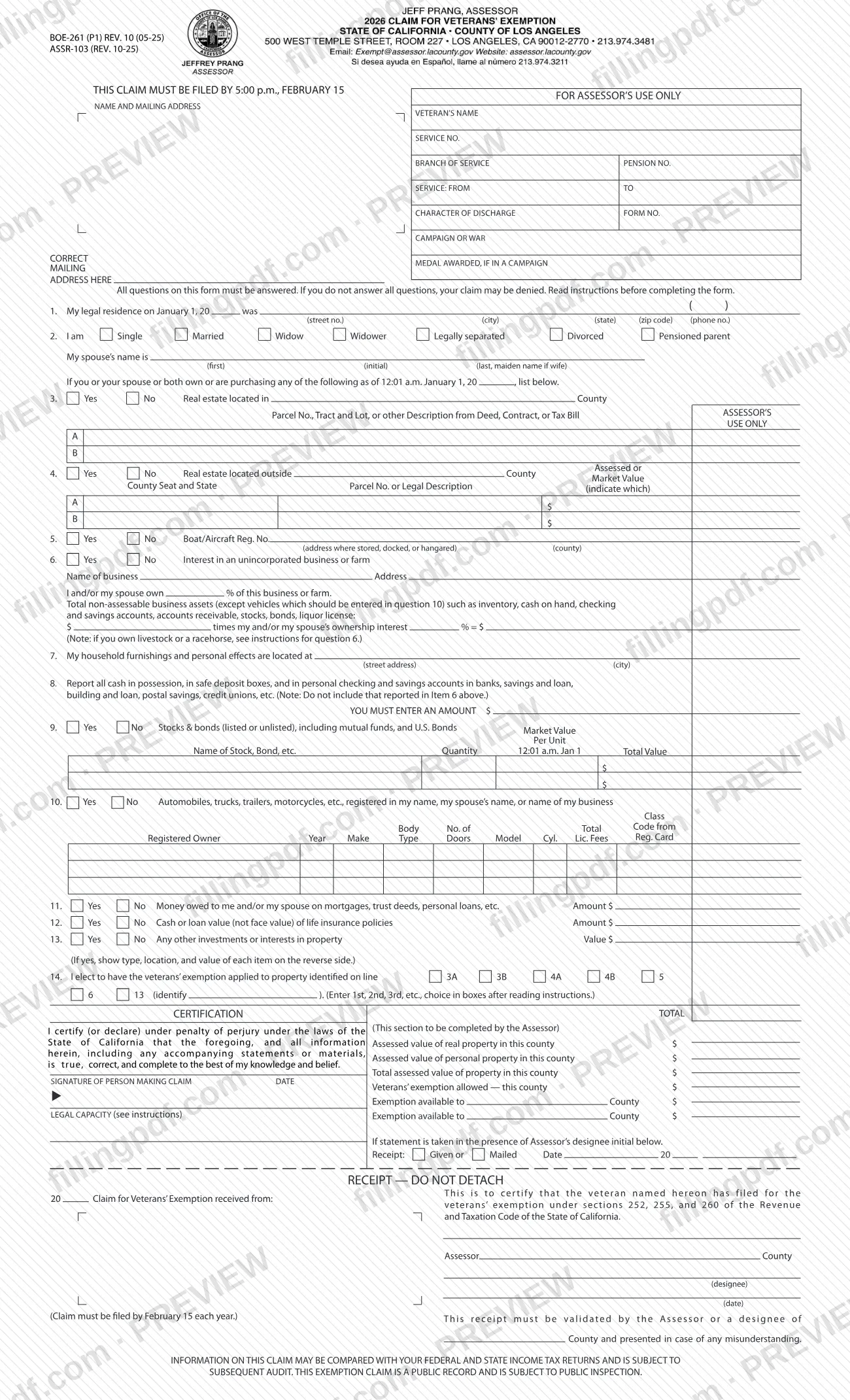
Form BOE-261, Claim for Veterans' Exemption, is the claim that qualifying veterans, unmarried widows or widowers of veterans, and pensioned parents of deceased veterans file with the county assessor to receive the California veterans' exemption; in Los Angeles County the form is published by the Los Angeles County Office of the Assessor. It is one of the Los Angeles County property tax forms, and the claim must be filed by 5:00 p.m. on February 15. On FillingPDF you can fill out the form online and download or print the completed PDF; the official PDF is published by the Assessor.
Last updated
What is BOE-261?
Form BOE-261, Claim for Veterans' Exemption, is the affidavit a claimant files with the county assessor to request the veterans' exemption from property tax under sections 252, 255 and 260 of the California Revenue and Taxation Code. It is also printed as ASSR-103 (REV. 10-25).
The claim has two jobs. It identifies the claimant, the claimant's legal residence on January 1 and marital status. It then lists what the claimant and spouse own as of 12:01 a.m. on January 1: real estate in and outside the county, a boat or aircraft, an interest in an unincorporated business or farm, household furnishings, cash, stocks and bonds, vehicles, money owed to them, life insurance cash value and other investments. The assessor uses these answers to test the property-ownership limits and to apply the exemption.
On question 14 you choose, in order, the property to which the exemption should be applied. The instructions explain that the veterans' exemption and the homeowners' exemption cannot both be allowed on the same property, so the choice matters if you own more than one taxable property. The form carries a receipt that the assessor validates; the receipt proves you filed, not that the exemption was granted.
The form does not cover veterans who are blind in both eyes, have lost the use of two or more limbs, or are totally disabled because of service-connected injury or disease. They, and the unmarried widow or widower of such a veteran, should file BOE-261-G, Disabled Veterans' Property Tax Exemption. A service member not claiming California residence completes BOE-261-D instead.
Who needs to file BOE-261?
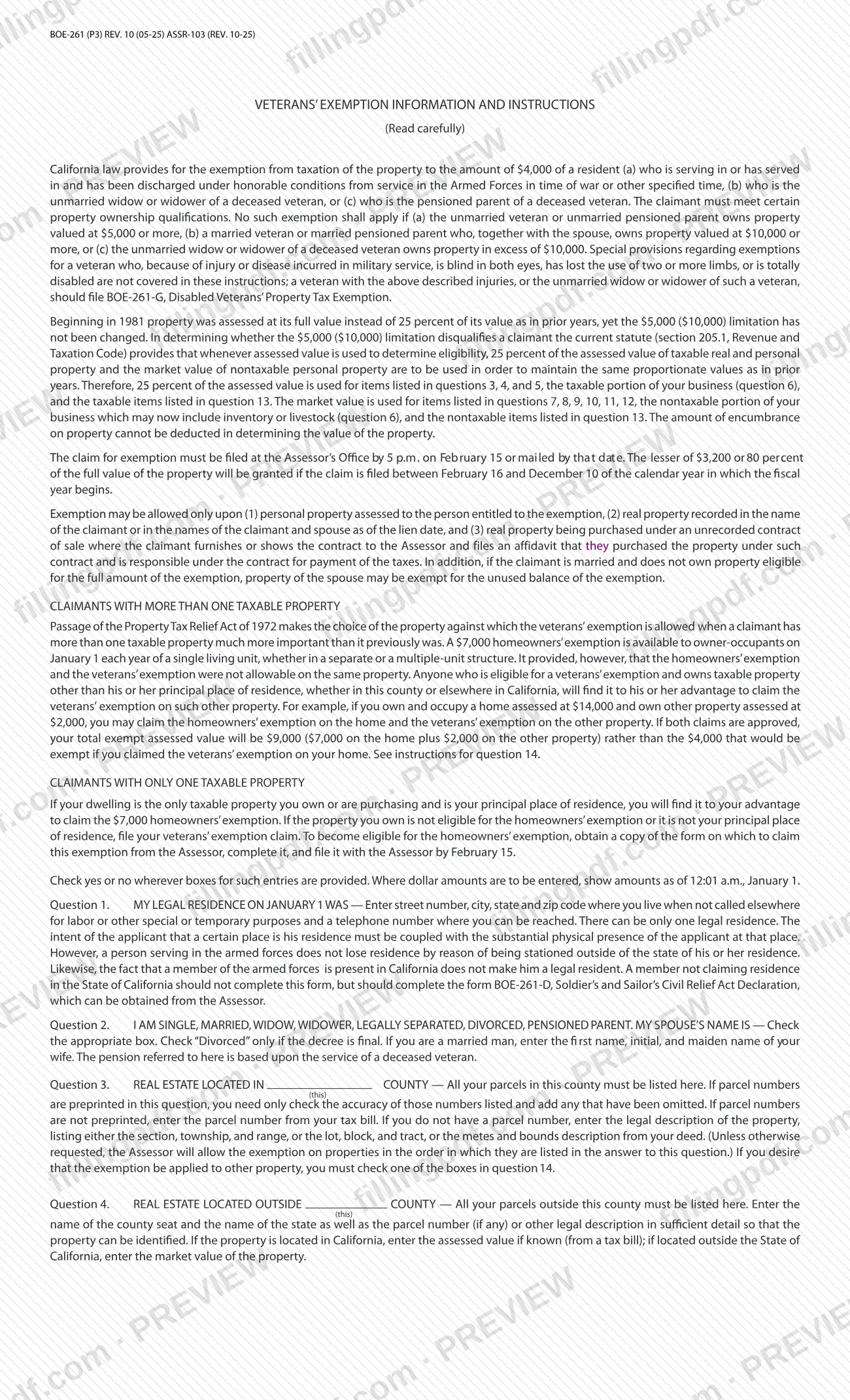
The main group is California residents who are serving in, or have served in and been discharged under honorable conditions from, the Armed Forces in time of war or another specified time. Two other groups may claim: the unmarried widow or widower of a deceased veteran, and the pensioned parent of a deceased veteran.
The claimant must also meet the property-ownership qualifications in the instructions. The exemption does not apply when the property you own, or you and your spouse together, reaches the limit stated there; the limits differ for an unmarried veteran or pensioned parent, a married veteran or pensioned parent, and an unmarried widow or widower.
Do not use this form if:
- you are blind in both eyes, have lost the use of two or more limbs, or are totally disabled from injury or disease incurred in service, or you are the unmarried widow or widower of such a veteran: file BOE-261-G;
- you are a service member who does not claim California residence: complete BOE-261-D, Soldier's and Sailor's Civil Relief Act Declaration.
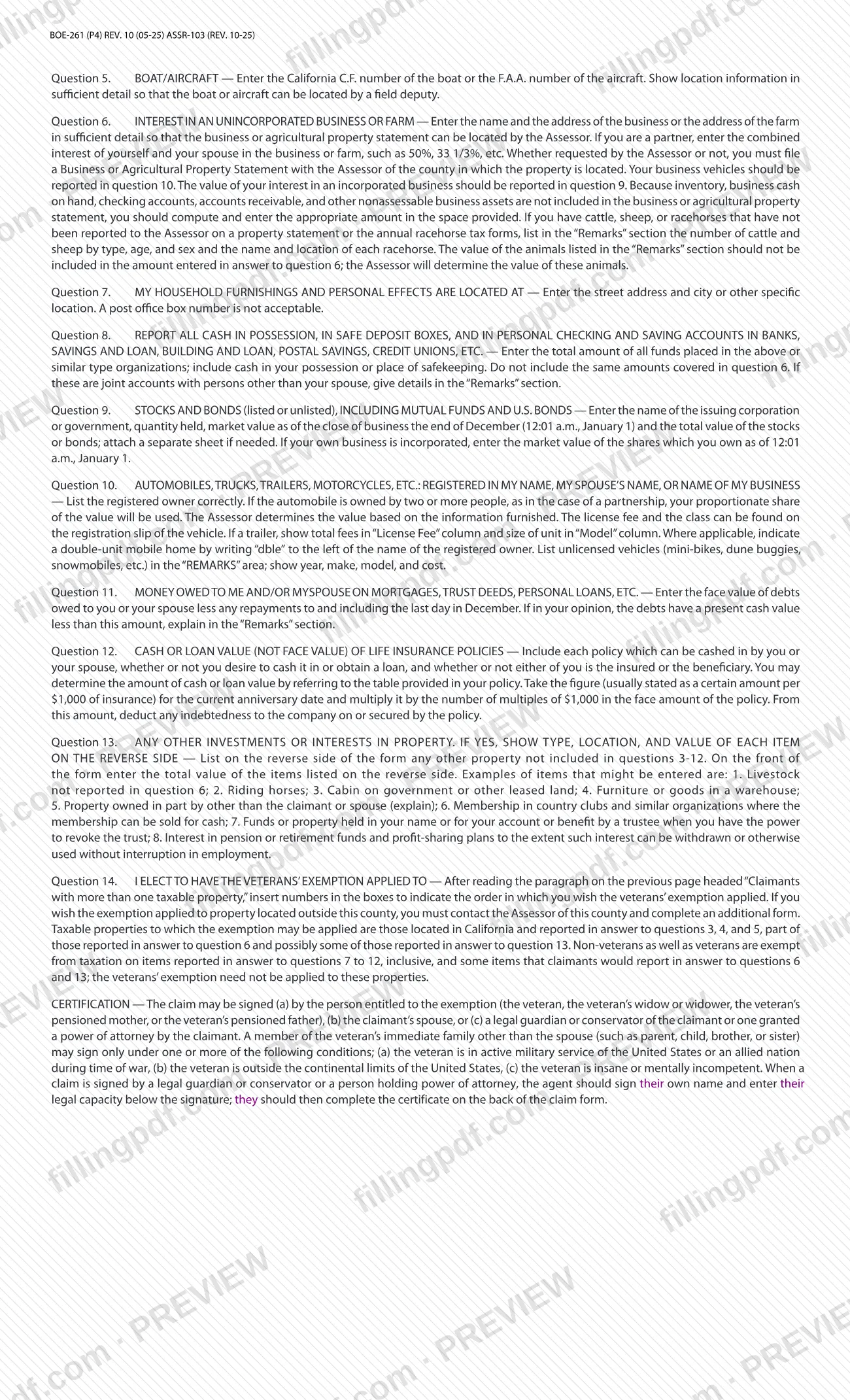
Who may sign: the claimant, the claimant's spouse, a legal guardian or conservator, or someone holding a power of attorney. Other immediate family (parent, child, brother or sister) may sign only if the veteran is in active military service during time of war, is outside the continental United States, or is insane or mentally incompetent.
When to file BOE-261
The claim must be filed with the assessor by 5:00 p.m. on February 15; the form says it must be filed or mailed by that date. Under section 255, affidavits are filed between the lien date and 5 p.m. on February 15, and the claim is renewed by filing each year.
A late claim is not lost automatically. If you file between February 16 and December 10 of the calendar year in which the fiscal year begins, the assessor grants a reduced exemption: the lesser of a limited dollar amount stated in the instructions or 80 percent of the full value of the property.
Section 260 provides that a person who fails to follow the required procedure waives the exemption. Report amounts as of 12:01 a.m. on January 1.
Documents you need
- Unrecorded contract of sale, only if you are buying real property under one: furnish or show the contract to the assessor and file an affidavit that you purchased under it and are responsible for paying the taxes.
- Separate sheet listing stocks and bonds (name, quantity, per-unit market value at 12:01 a.m. January 1, total value), only if question 9 does not have enough room.
- Reverse side of the form listing the type, location and value of each item, if you answer Yes to question 13.
- Business or Agricultural Property Statement filed with the assessor of the county where the property is located, if you answer Yes to question 6.
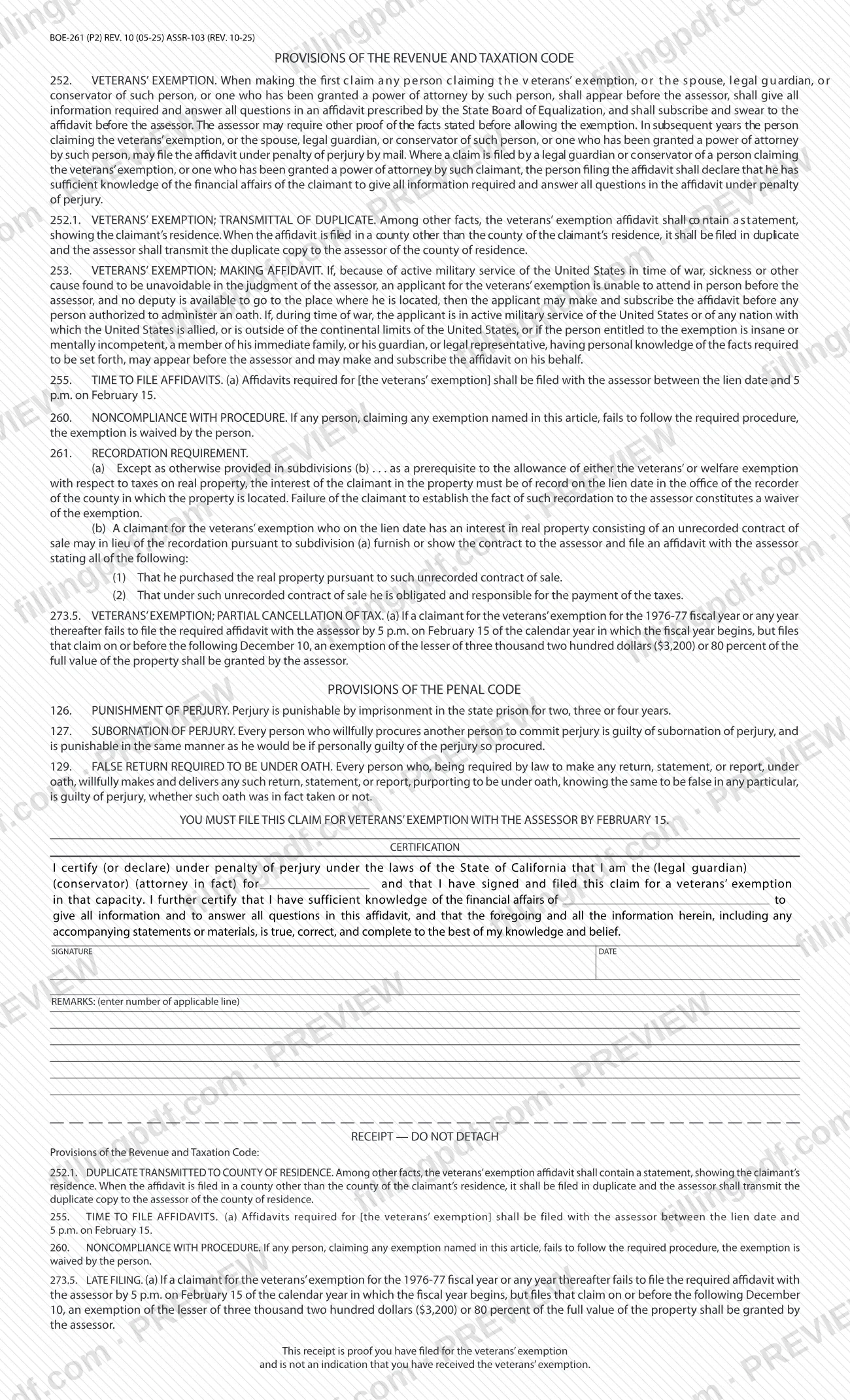
- Certification on the back of the form, completed by the agent, if a legal guardian, conservator or person holding a power of attorney signs the claim.
- Other proof of the facts stated in the claim, only if the assessor requires it before allowing the exemption.
How to fill out BOE-261
Enter name, mailing address and service data
At the top, complete the name and mailing address, veteran's name, service number, branch of service, pension number if any, service dates, character of discharge, campaign or war and medal awarded. Leave the assessor's-use boxes blank.
State your legal residence (question 1)
Enter the street number, city, state, ZIP code and phone number where you lived on January 1 of the claim year. There can be only one legal residence.
Mark your status (question 2)
Check one: Single, Married, Widow, Widower, Legally separated, Divorced or Pensioned parent. Check Divorced only if the decree is final, and enter your spouse's name if applicable.
List real estate (questions 3 and 4)
Answer Yes or No for each. In question 3 list every parcel in this county by parcel number or legal description; in question 4 give the county seat, state, parcel number or legal description and the assessed or market value.
Report boat, aircraft and business (questions 5 and 6)
Enter the boat or aircraft registration number and where it is kept. For a business or farm, give its name, address, your ownership percentage and the non-assessable business assets multiplied by that percentage.
Give furnishings and cash (questions 7 and 8)
Enter the street address and city where your furnishings are located, with no P.O. box. Enter the total cash on hand and in bank and similar accounts; an amount is required.
List stocks and bonds (question 9)
Answer Yes or No. Enter the name of each stock, bond or fund, the quantity, the per-unit market value at 12:01 a.m. January 1 and the total value.
List vehicles (question 10)
Answer Yes or No, then enter the registered owner, year, make, body type, doors, model, cylinders, license fees and class code from the registration card for each vehicle.
Report debts owed, insurance and other property (questions 11-13)
Enter money owed to you or your spouse, the cash or loan value of life insurance policies, and other investments or interests. For question 13, list each item on the reverse side and enter the total on the front.
Choose where the exemption applies (question 14)
Number the boxes for lines 3A, 3B, 4A, 4B, 5, 6 and 13 in your order of choice (1st, 2nd, 3rd) after reading the instructions on claimants with more than one taxable property.
Sign, date and state your capacity
Sign and date the certification under penalty of perjury. If you sign as a legal guardian, conservator or attorney in fact, enter your legal capacity and complete the certificate on the back.
Review and download the completed PDF
Check that every question is answered and amounts are as of 12:01 a.m. January 1, then download or print the completed PDF from FillingPDF and file it with the Assessor as described under How to submit.
How to submit BOE-261
You can file the claim in person at the Assessor's Office or mail it, and it must be filed or postmarked by February 15 (see When to file for the 5:00 p.m. rule).
- First claim: section 252 requires a person making a first claim to appear before the assessor, give all required information and swear to the affidavit. The assessor may ask for other proof of the facts stated.
- Later years: the claimant, or the spouse, legal guardian, conservator or attorney in fact, may file the affidavit under penalty of perjury by mail.
- Claim filed in another county: if the claimant lives in a different county, section 252.1 requires it to be filed in duplicate so the assessor can send a copy to the county of residence.
- Unable to appear: section 253 allows the affidavit to be sworn before another authorized person when active wartime service, illness or another unavoidable cause prevents appearing, subject to the assessor's judgment.
The form prints no mailing address, so confirm the current office and address with the Los Angeles County Office of the Assessor through its forms page at https://assessor.lacounty.gov/forms. Keep the validated receipt. FillingPDF lets you fill out and download the PDF; submission follows the channels above.
Common mistakes to avoid
- Leaving questions unanswered; the form says all questions must be answered and an incomplete claim may be denied.
- Leaving question 8 blank; the form states you must enter an amount for cash.
- Filing after 5:00 p.m. on February 15 and expecting the full exemption; late claims through December 10 receive only the reduced exemption.
- Giving a post office box in question 7; the instructions say a P.O. box is not acceptable for the location of furnishings.
- Checking Divorced before the decree is final; the instructions say to check it only if the decree is final.
- Subtracting mortgages or other encumbrances from property values; the instructions say encumbrances cannot be deducted.
- Naming only the veteran's own residence for the exemption when you own other taxable property, without reading the question 14 guidance on the homeowners' exemption.
- Signing for the claimant as an agent without entering your legal capacity below the signature and completing the certificate on the back.
- Using this form when you are blind, have lost the use of two or more limbs or are totally disabled from service; those claims use BOE-261-G.
Frequently asked questions
What is Form BOE-261 used for?
Form BOE-261, Claim for Veterans' Exemption, is the affidavit used to request the California veterans' exemption from property tax. It lists your residence, marital status and property as of January 1 so the assessor can test eligibility and apply the exemption.
When is the deadline to file the veterans' exemption claim?
The claim must be filed with the assessor by 5:00 p.m. on February 15, or mailed by that date. A claim filed from February 16 through December 10 receives a reduced exemption: the lesser of a stated dollar limit or 80 percent of the property's full value.
Who qualifies for the veterans' exemption?
California residents who served in the Armed Forces in time of war or another specified time and were discharged under honorable conditions, unmarried widows or widowers of deceased veterans, and pensioned parents of deceased veterans. Property-ownership limits also apply.
Do I have to appear in person to file BOE-261?
For your first claim, yes: section 252 requires you to appear before the assessor and swear to the affidavit. In later years you, or your spouse, guardian, conservator or attorney in fact, may file the affidavit under penalty of perjury by mail.
Can someone else sign the claim for me?
Yes, in set cases. Your spouse, a legal guardian or conservator, or someone with your power of attorney may sign. Other immediate family may sign only if you are in wartime active service, outside the continental United States, or mentally incompetent.
Can I claim the veterans' exemption and the homeowners' exemption on the same home?
No. The instructions say the two exemptions are not allowable on the same property. If you own other taxable property, they suggest claiming the veterans' exemption on that property and using question 14 to choose it.
Which form do disabled veterans use instead?
A veteran blind in both eyes, who has lost the use of two or more limbs or is totally disabled from service-related injury or disease, should file BOE-261-G, Disabled Veterans' Property Tax Exemption. The unmarried widow or widower of such a veteran files it too.
Can I fill out BOE-261 online on FillingPDF?
You can fill out the PDF online on FillingPDF and download or print it. FillingPDF is independent, is not affiliated with the Assessor and does not file the claim; you submit it to the Assessor yourself.
Ready to fill out BOE-261?
Fill out BOE-261 now