
Form BOE-263, the Lessors' Exemption Claim, is the form a property owner (the lessor) files with the Los Angeles County Office of the Assessor to claim an exemption on property leased to a qualifying institution. It is one of the Los Angeles County property tax exemption forms, and it must be filed by 5:00 p.m. on February 15. On this page you can fill out the form online on FillingPDF and download or print the completed PDF; the Assessor publishes the original form and its instructions.
Last updated
What is BOE-263?
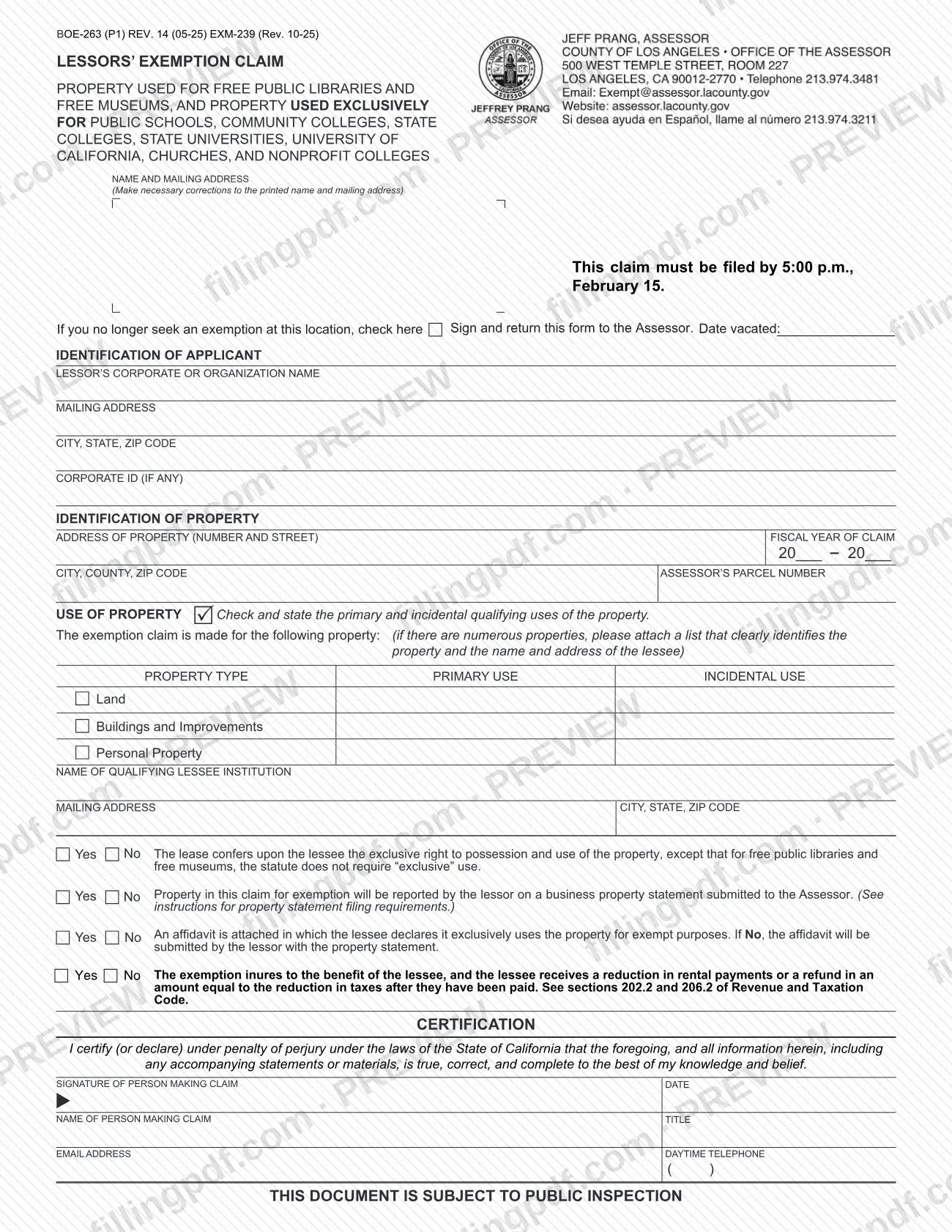
Form BOE-263, Lessors' Exemption Claim, is the Los Angeles County Office of the Assessor claim form that a lessor files to seek a property tax exemption on property leased to a qualifying institution such as a free public library, free museum, public school or church.
The printed form covers property used for free public libraries and free museums, and property used exclusively for public schools, community colleges, state colleges, state universities, the University of California, churches and nonprofit colleges. The claim identifies the lessor, the property (address, fiscal year of the claim and Assessor's Parcel Number), the type of property claimed (land, buildings and improvements, personal property), its primary and incidental qualifying uses and the lessee institution. It ends with a certification signed under penalty of perjury. The form is marked as subject to public inspection.
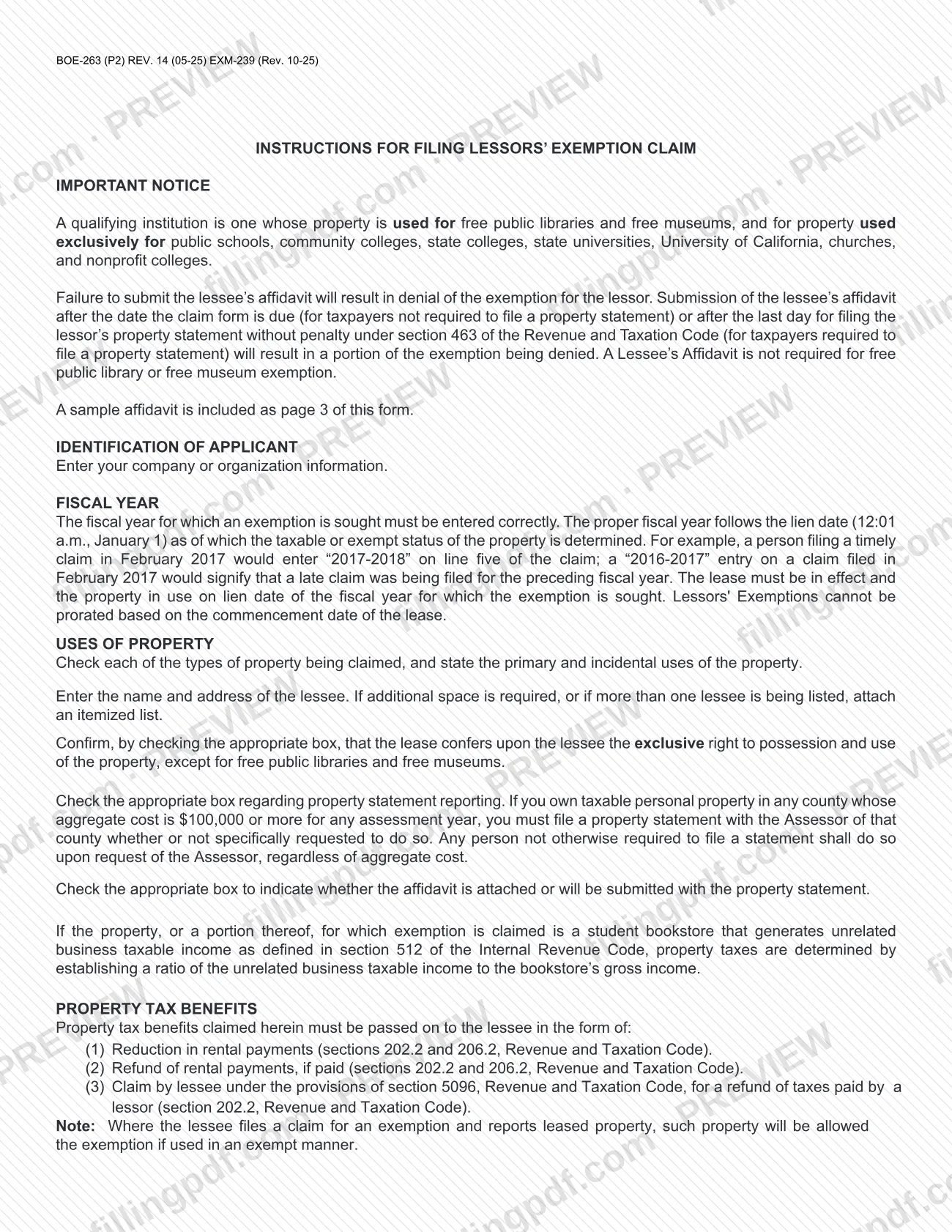
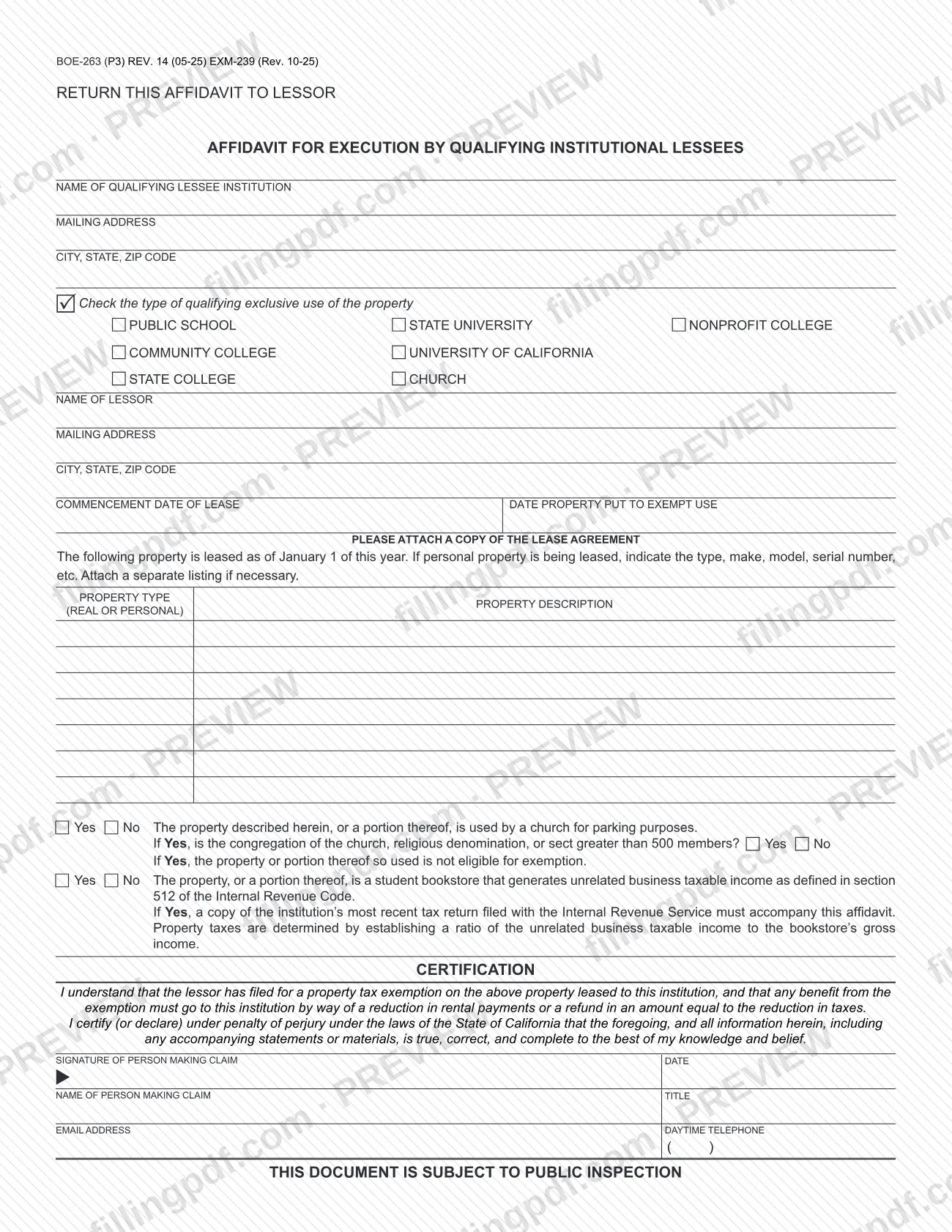
The form has three pages. Page 1 is the claim, page 2 holds the instructions, and page 3 is a sample Affidavit for Execution by Qualifying Institutional Lessees, which the lessee completes and returns to the lessor.
The exemption must benefit the lessee. The instructions say the tax benefit has to be passed on as a reduction in rental payments, a refund of rental payments if paid, or a lessee's claim under section 5096 of the Revenue and Taxation Code.
The Assessor's forms list names related forms: BOE-263-B (Lessees Exemption Claim Property Used Exclusively For Public Schools Community and State Colleges and Universities), BOE-263-C (Church-Lessors-Exemption Claim Property Leased by a Church to a Public School College etc used Jointly with a Church), BOE-268-A (Public School Exemption) and BOE-268-B (Free Public Library or Free Museum Claim).
Who needs to file BOE-263?
Lessors, meaning owners who lease property to a qualifying institution, file Form BOE-263 to claim the exemption. A qualifying institution, per the instructions, is one whose property is used for free public libraries and free museums, or used exclusively for public schools, community colleges, state colleges, state universities, the University of California, churches and nonprofit colleges.
Conditions the form attaches:
- The lease must confer on the lessee the exclusive right to possession and use of the property. For free public libraries and free museums the statute does not require "exclusive" use.
- The lease must be in effect and the property in use on the lien date (12:01 a.m., January 1) of the fiscal year claimed.
- The exemption must benefit the lessee through reduced or refunded rent.
- Lessors who own taxable personal property in any county with a specified aggregate cost, and anyone the Assessor asks, must file a business property statement; the instructions explain the requirement.
- If you no longer seek an exemption at the location, check the box at the top, enter the date vacated, then sign and return the form.
Where the lessee files its own exemption claim and reports the leased property, the property is allowed the exemption if it is used in an exempt manner. A church that uses leased property jointly with a public school or college may need a different form, BOE-263-C.
When to file BOE-263
The claim must be filed by 5:00 p.m., February 15. The fiscal year you enter follows the lien date (12:01 a.m., January 1) that fixes the property's taxable or exempt status. The instructions give an example: a timely claim filed in February 2017 enters "2017-2018", while "2016-2017" on a February 2017 claim signals a late claim for the preceding fiscal year.
The lease must be in effect and the property in use on the lien date of that fiscal year. Lessors' exemptions cannot be prorated based on the lease commencement date.
The lessee's affidavit has its own timing. Submitted after the claim due date (for taxpayers not required to file a property statement), or after the last day to file the lessor's property statement without penalty under section 463 of the Revenue and Taxation Code (for taxpayers required to file one), it results in a portion of the exemption being denied. If the affidavit is never submitted, the lessor's exemption is denied. No affidavit is required for the free public library or free museum exemption.
Documents you need
- Lessee's affidavit (page 3 of the form), signed by the qualifying institution, attached to the claim if the affidavit box says Yes; if No, the lessor submits it with the property statement. Not required for free public library or free museum exemption.
- A copy of the lease agreement, which the affidavit asks to be attached.
- An itemized list identifying each property and the name and address of each lessee, when there are numerous properties or more than one lessee.
- A separate listing of leased personal property (type, make, model, serial number, etc.) when it does not fit on the affidavit.
- A copy of the institution's most recent tax return filed with the Internal Revenue Service, only if a leased property is a student bookstore that generates unrelated business taxable income under section 512 of the Internal Revenue Code.
- A business property statement for the Assessor, only if the lessor reports the property on one or the Assessor requires it; see the instructions.
How to fill out BOE-263
Correct the name and mailing address
Review the printed name and mailing address at the top and make any necessary corrections. If you no longer seek an exemption at this location, check the box, enter the date vacated, then sign and return the form.
Complete the applicant identification
Enter the lessor's corporate or organization name, mailing address, city, state, ZIP code and corporate ID, if any.
Identify the property and fiscal year
Enter the property address (number and street), city, county, ZIP code and Assessor's Parcel Number. Enter the fiscal year of the claim as 20___ – 20___, following the lien-date rule in the instructions.
State the use of the property
For each type of property claimed (Land, Buildings and Improvements, Personal Property), check it and state the primary and incidental qualifying uses. Attach a list if there are numerous properties.
Enter the qualifying lessee
Write the name of the qualifying lessee institution, its mailing address, city, state and ZIP code. Attach an itemized list if more than one lessee.
Answer the four Yes/No questions
Check Yes or No for exclusive possession and use under the lease, reporting on a business property statement, whether the lessee's affidavit is attached, and whether the exemption benefits the lessee through rent reduction or refund.
Sign the certification
The person making the claim signs and dates it under penalty of perjury, then enters name, title, email address and daytime telephone.
Prepare the lessee's affidavit
Give page 3 to the lessee, who completes the institution and lessor details, checks the exclusive-use type, enters the lease commencement date and date put to exempt use, describes the property and signs. Attach a copy of the lease.
Review and download the completed PDF
Check the fiscal year, parcel number and answers, then download or print the completed PDF from FillingPDF and send it as described under How to submit.
How to submit BOE-263
Form BOE-263 is signed and returned to the Assessor, and the supporting papers go with it or with the lessor's property statement.
- Claim (page 1): the form says to sign and return it to the Assessor. It prints no mailing address, portal or fax number. The Los Angeles County Assessor's forms page is at https://assessor.lacounty.gov/forms.
- Lessee's affidavit (page 3): the lessee completes it and returns it to the lessor. The lessor attaches it to the claim if the Yes box is checked on the affidavit question, or submits it with the business property statement if the answer is No.
- Property statement: if the lessor reports the property on a business property statement, that statement goes to the Assessor under its own filing rules, which are explained in the instructions.
- Attachments: a list of properties and lessees when there are several, and a copy of the lease with the affidavit.
The claim must reach the Assessor by 5:00 p.m., February 15. FillingPDF lets you fill out and download the PDF; submission follows the channels above.
Common mistakes to avoid
- Filing after 5:00 p.m. on February 15; the form states that deadline.
- Entering the wrong fiscal year; a 2016-2017 entry on a claim filed in February 2017 signals a late claim for the preceding year.
- Not submitting the lessee's affidavit, which results in denial of the exemption (except for free public library or free museum exemptions); a late affidavit denies a portion.
- Claiming the exemption when the lease was not in effect and the property not in use on the January 1 lien date; exemptions cannot be prorated from the lease start date.
- Listing several properties or lessees without attaching an itemized list with each lessee's name and address.
- Not checking the box to say the exemption benefits the lessee, when rent has not been reduced or refunded as sections 202.2 and 206.2 require.
- Overlooking the church parking question on the affidavit: parking use by a congregation of more than 500 members is not eligible.
- Omitting the institution's IRS return when the property is a student bookstore with unrelated business taxable income.
Frequently asked questions
What is Form BOE-263 used for?
Form BOE-263 is the lessor's exemption claim filed with the Los Angeles County Office of the Assessor for property leased to a qualifying institution, such as a free public library, free museum, public school, college or church. The exemption must benefit the lessee through reduced or refunded rent.
When is the BOE-263 lessors' exemption claim due?
The claim must be filed by 5:00 p.m., February 15. The fiscal year you enter follows the January 1 lien date, and the lease must be in effect and the property in use on that date. Exemptions are not prorated from the lease start date.
Do I need the lessee's affidavit with Form BOE-263?
Yes, except for free public library or free museum exemptions. Without the affidavit the lessor's exemption is denied, and a late affidavit means a portion of the exemption is denied. The sample affidavit is page 3 of the form.
Who is a qualifying institution under BOE-263?
One whose property is used for free public libraries and free museums, or used exclusively for public schools, community colleges, state colleges, state universities, the University of California, churches or nonprofit colleges.
Where do I send Form BOE-263?
The form says to sign and return it to the Assessor and prints no address. The Los Angeles County Assessor's forms page is https://assessor.lacounty.gov/forms. The lessee returns its affidavit to the lessor, who attaches it or submits it with the property statement.
What is the difference between BOE-263 and BOE-263-B?
BOE-263 is filed by the lessor. The Assessor's forms list also names BOE-263-B, the Lessees Exemption Claim for property used exclusively for public schools, community and state colleges and universities. Where the lessee claims and reports the property, it is exempt if used in an exempt manner.
Who benefits from the tax exemption on leased property?
The lessee. The instructions say the lessor must pass the benefit on as a reduction in rental payments, a refund of rental payments if paid, or the lessee's refund claim under section 5096 of the Revenue and Taxation Code.
Can I fill out Form BOE-263 online?
You can fill out the PDF online on FillingPDF and download or print it. FillingPDF is an independent service: it does not file the claim with the Assessor, which you submit through the Assessor's channels.
Ready to fill out BOE-263?
Fill out BOE-263 now