
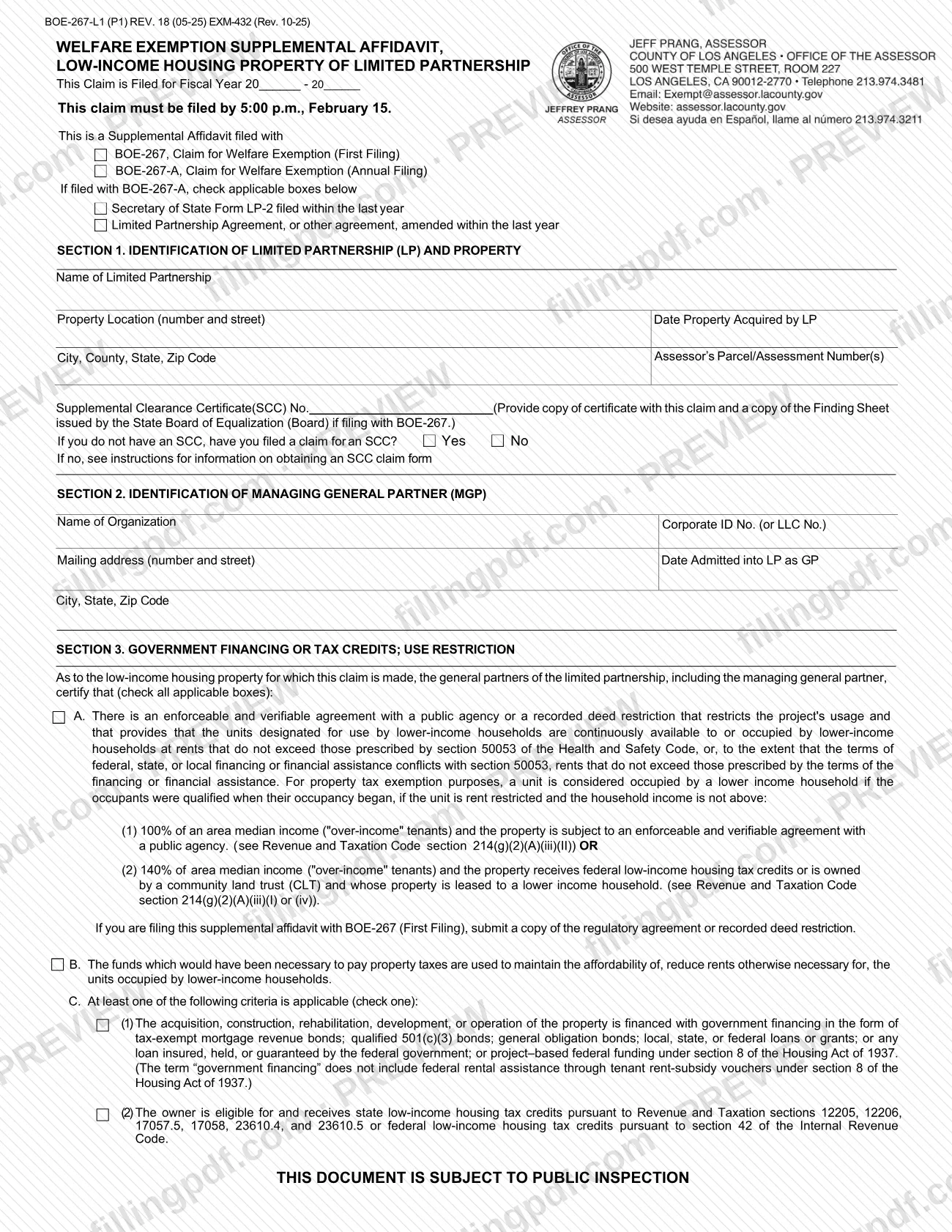
Form BOE-267-L1 is the supplemental affidavit a limited partnership (LP) files with the county assessor to support a Welfare Exemption claim on low-income housing it owns and operates. It is one of the Los Angeles County property tax forms listed by the Los Angeles County Office of the Assessor, and it is never filed alone: it goes with Form BOE-267 (first filing) or BOE-267-A (annual filing). On FillingPDF you can fill out the form online and download or print the completed PDF; the agency publishes the original PDF at the official URL shown on this page.
Last updated
What is BOE-267-L1?
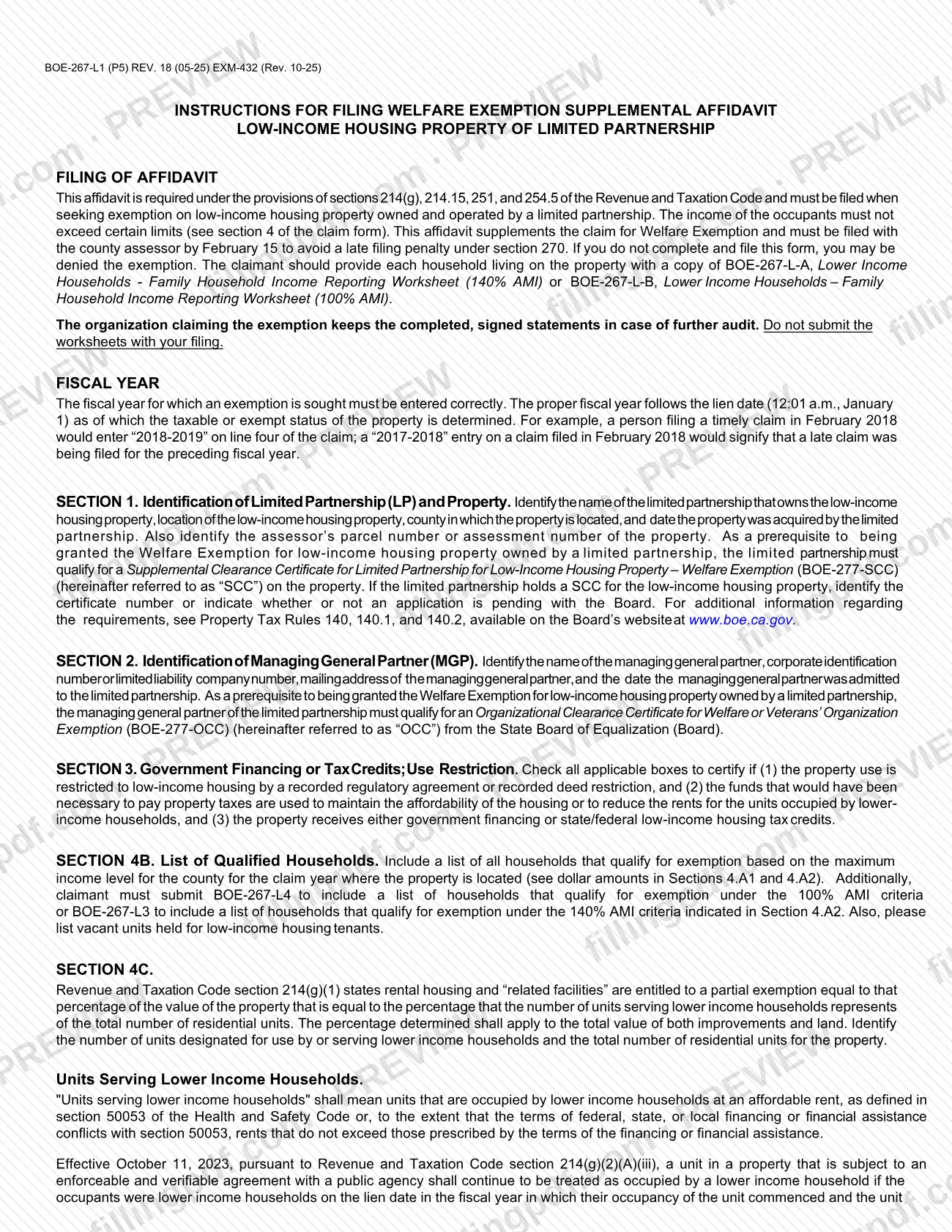
Form BOE-267-L1, Welfare Exemption Supplemental Affidavit Low Income Housing Property of Limited Partnership, is the affidavit in which a limited partnership certifies the facts that qualify its low-income housing property for the Welfare Exemption from property taxes. It supplements Form BOE-267 or BOE-267-A.
The instructions say the affidavit is required under sections 214(g), 214.15, 251 and 254.5 of the Revenue and Taxation Code whenever an exemption is sought on low-income housing property owned and operated by a limited partnership. Without it, the exemption may be denied.
The form has eight sections:
- Section 1 identifies the LP and the property, including its Supplemental Clearance Certificate (SCC) number.
- Section 2 identifies the managing general partner (MGP).
- Section 3 certifies the use restriction and the government financing or tax credits.
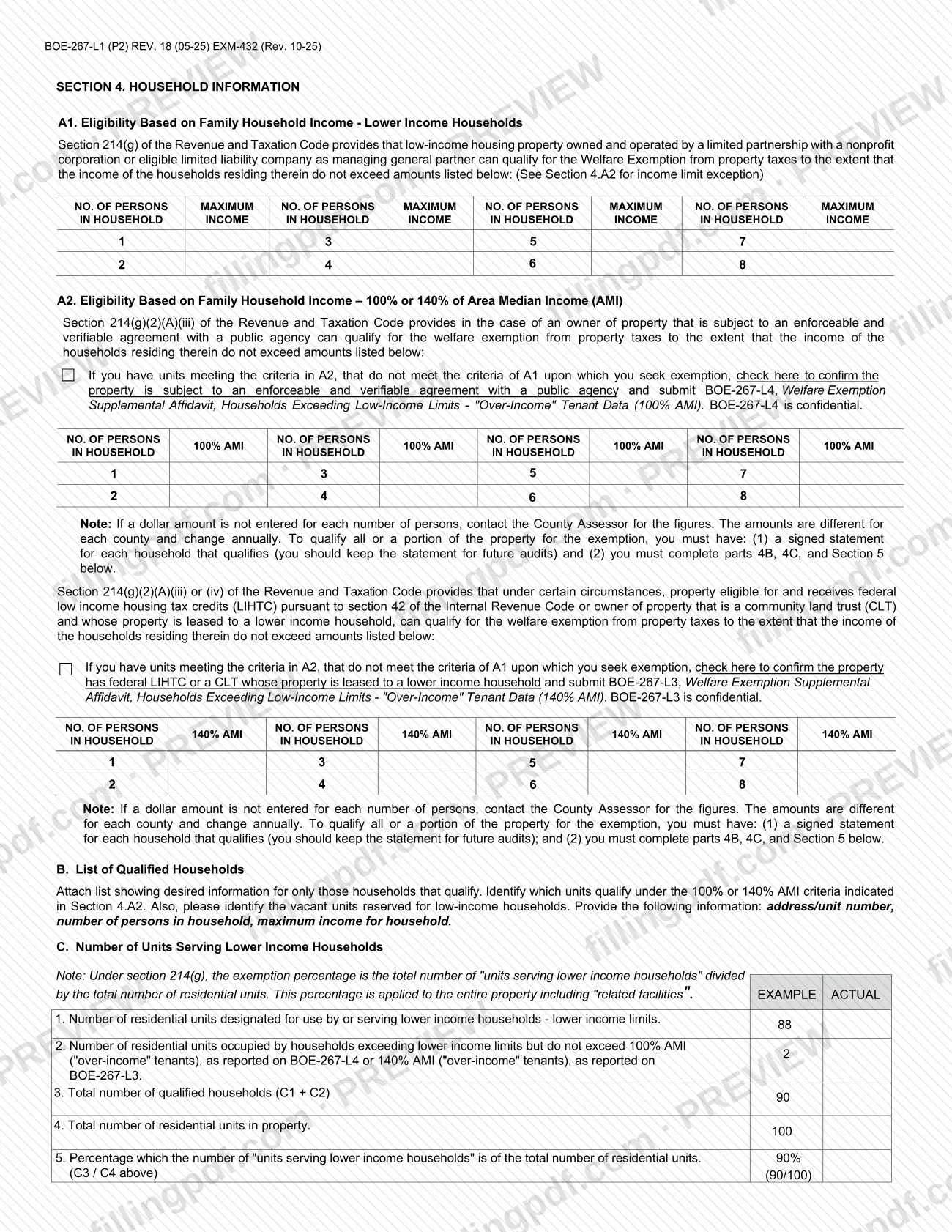
- Section 4 reports household income eligibility and the number of units serving lower income households.
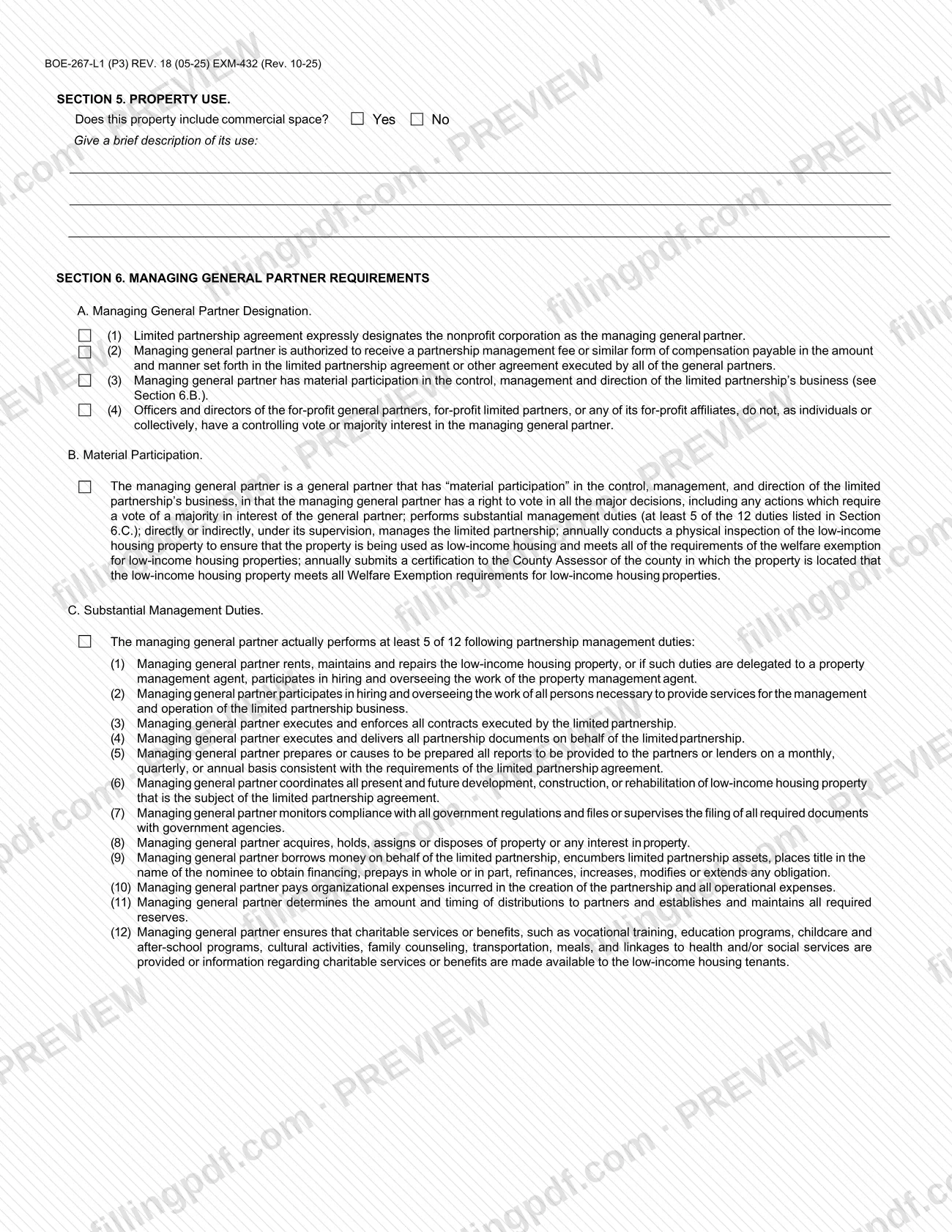
- Section 5 describes property use and any commercial space.
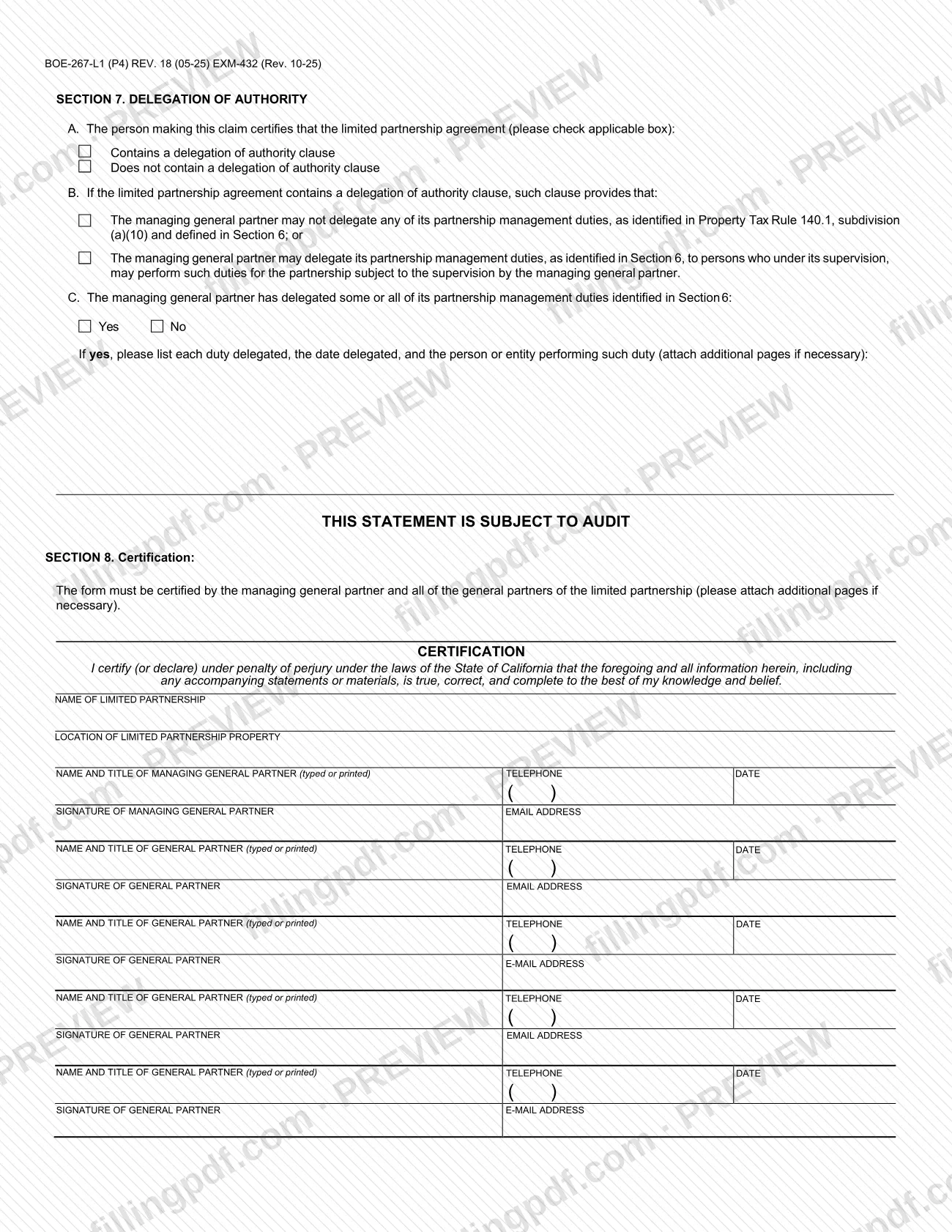
- Sections 6 and 7 cover the MGP's designation, material participation, management duties and delegation of authority.
- Section 8 is the certification signed under penalty of perjury.
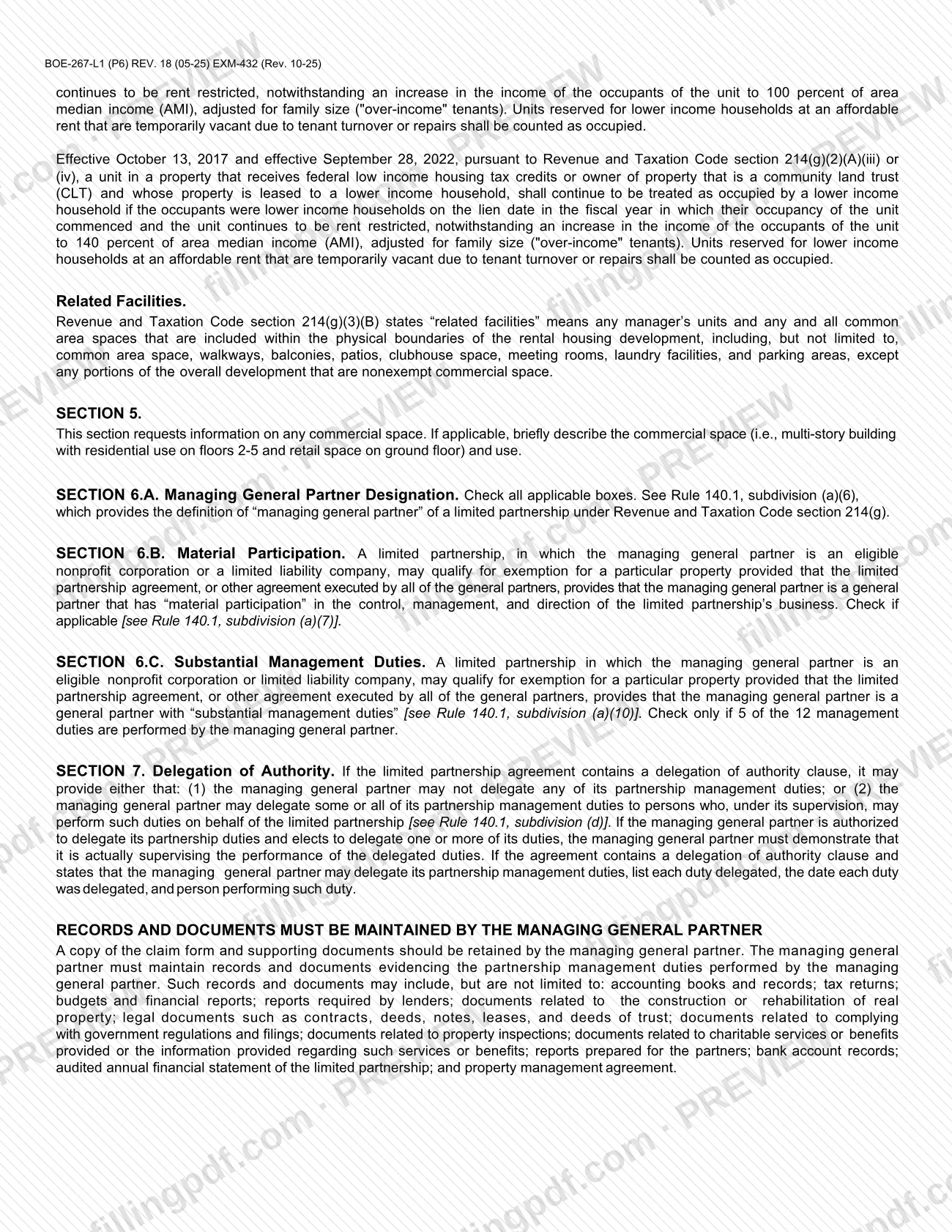
The exemption percentage is the number of units serving lower income households divided by the total number of residential units, applied to the whole property, including related facilities such as common areas. Over-income tenant data is reported on the companion forms BOE-267-L4 (100% AMI) or BOE-267-L3 (140% AMI), which are confidential.
Who needs to file BOE-267-L1?
A limited partnership that owns and operates low-income housing property and is seeking the Welfare Exemption files this affidavit, certified by its managing general partner and all of its general partners.
The form sets conditions that bear on who can use it:
- The LP must hold, or have applied for, a Supplemental Clearance Certificate (SCC) from the State Board of Equalization for the property. The form asks whether a claim for an SCC has been filed if you have no SCC number.
- The managing general partner must qualify for an Organizational Clearance Certificate (OCC) from the Board. The managing general partner must be a nonprofit corporation or an eligible limited liability company.
- The property must be subject to an enforceable and verifiable agreement with a public agency or a recorded deed restriction limiting its use to lower-income households, and must receive government financing or low-income housing tax credits.
- Households must meet the income limits in Section 4. Owners with over-income tenants also file BOE-267-L4 or BOE-267-L3.
The claimant also gives each household a copy of Form BOE-267-L-A (140% AMI) or BOE-267-L-B (100% AMI), the family household income reporting worksheets. The form names no representative who may sign for the partnership; the managing general partner and all general partners sign.
When to file BOE-267-L1
File the affidavit by 5:00 p.m. on February 15 with the county assessor, at the same time as the Welfare Exemption claim it supplements. The instructions state that filing by February 15 avoids the late filing penalty under section 270 of the Revenue and Taxation Code.
The fiscal year you enter must follow the lien date, 12:01 a.m. on January 1. The instructions give this example: a timely claim filed in February 2018 shows 2018-2019, while 2017-2018 on that claim would signal a late claim for the preceding year.
The same affidavit accompanies both first filings (Form BOE-267) and annual filings (Form BOE-267-A). On an annual filing, the form asks you to check a box if Secretary of State Form LP-2 was filed within the last year or the limited partnership agreement was amended within the last year.
Documents you need
- Copy of the Supplemental Clearance Certificate (SCC) and a copy of the Finding Sheet issued by the State Board of Equalization, when filing with BOE-267 (first filing).
- Copy of the regulatory agreement or recorded deed restriction, when filing with BOE-267 (first filing).
- List of qualified households (Section 4B): address or unit number, number of persons in the household and maximum income, for qualifying households only, with units marked 100% or 140% AMI and vacant low-income units identified.
- Form BOE-267-L4 (100% AMI), when you check the Section 4.A2 box for an enforceable and verifiable agreement with a public agency; the form is confidential.
- Form BOE-267-L3 (140% AMI), when you check the Section 4.A2 box for federal low-income housing tax credits or a community land trust; the form is confidential.
- Additional pages for Section 7 delegated duties (duty, date delegated, person or entity), if the space is not enough.
- Additional pages for signatures if the limited partnership has more general partners than the form has signature blocks.
How to fill out BOE-267-L1
Enter the fiscal year and filing type
At the top, enter the fiscal year (20__ - 20__) following the January 1 lien date and check whether you are filing with BOE-267 (first filing) or BOE-267-A (annual filing). With BOE-267-A, also check the boxes for Form LP-2 filed or the partnership agreement amended within the last year, if they apply.
Identify the limited partnership and property
In Section 1, enter the LP name, property location, date the LP acquired the property, city, county, state, ZIP code and the assessor's parcel or assessment number(s). Enter the SCC number, or answer Yes or No on whether you have filed a claim for an SCC.
Identify the managing general partner
In Section 2, enter the organization name, corporate ID or LLC number, mailing address and the date it was admitted into the LP as general partner.
Certify financing and use restriction
In Section 3, check all boxes that apply: A (enforceable agreement or recorded deed restriction and the 100% or 140% AMI choices), B (property tax savings maintain affordability) and one criterion under C (government financing or low-income housing tax credits).
Review the household income limits
In Section 4.A1 and A2, check the income limits that apply. If you rely on 100% or 140% AMI units, check the matching box and prepare BOE-267-L4 or BOE-267-L3. If a dollar amount is missing, contact the County Assessor for the figures.
Attach the list of qualified households
For Section 4B, attach a list of qualifying households with address or unit number, number of persons and maximum income. Mark units qualifying under 100% or 140% AMI and identify vacant units reserved for low-income households.
Count units serving lower income households
In Section 4C, enter lines C1 and C2, add them for C3, enter total residential units on C4, and divide C3 by C4 for the percentage on C5.
Describe property use
In Section 5, answer Yes or No for commercial space and briefly describe the use, for example residential floors above ground-floor retail.
Complete managing general partner requirements
In Section 6.A, check each designation that applies. Check Section 6.B if the managing general partner has material participation, and check Section 6.C only if it actually performs at least 5 of the 12 listed duties.
Answer the delegation of authority questions
In Section 7, check whether the partnership agreement contains a delegation clause and what it provides. If duties are delegated, answer Yes in 7.C and list each duty, the date delegated and the person or entity performing it.
Certify, sign and download the PDF
In Section 8, enter the LP name and property location, then names, titles, telephone numbers, dates, signatures and emails for the managing general partner and every general partner. Review all sections, then download or print the completed PDF from FillingPDF.
How to submit BOE-267-L1
Form BOE-267-L1 is filed with the county assessor, together with the Welfare Exemption claim it supplements, Form BOE-267 (first filing) or Form BOE-267-A (annual filing). The form prints no mailing address, portal or appointment rule of its own.
- With the county assessor: deliver the signed affidavit and its attachments to the assessor of the county where the property is located by 5:00 p.m. on February 15. In Los Angeles County, the Office of the Assessor lists this form on its forms page at https://assessor.lacounty.gov/forms. Contact that office for how it accepts filings.
- With BOE-267 (first filing): include a copy of the SCC, a copy of the Finding Sheet issued by the State Board of Equalization, and a copy of the regulatory agreement or recorded deed restriction.
- Do not submit the household worksheets. Keep the signed household statements and the worksheets for future audits.
The form states that it is subject to public inspection and that the statement is subject to audit. Keep a copy of the claim form and supporting records. FillingPDF lets you fill out and download the PDF; submission follows the channels above.
Common mistakes to avoid
- Filing after 5:00 p.m. on February 15, which exposes the claim to the late filing penalty under section 270 of the Revenue and Taxation Code.
- Entering the wrong fiscal year; a timely claim filed in February uses the fiscal year that starts that year, and the preceding year signals a late claim.
- Filing the affidavit alone instead of with Form BOE-267 or BOE-267-A, since it is a supplemental affidavit.
- Leaving out the SCC number or the answer on whether a claim for an SCC has been filed in Section 1.
- Omitting the copy of the regulatory agreement or recorded deed restriction when filing with BOE-267.
- Listing households that do not qualify in Section 4B; the list must show only qualifying households.
- Attaching the household income worksheets (BOE-267-L-A or BOE-267-L-B) instead of keeping them for audit.
- Checking Section 6.C without the managing general partner actually performing at least 5 of the 12 duties.
- Signing with only the managing general partner when the form requires all general partners to certify.
Frequently asked questions
What is Form BOE-267-L1 used for?
Form BOE-267-L1 is the supplemental affidavit a limited partnership files to support a Welfare Exemption claim on low-income housing it owns and operates. It certifies the use restriction, financing, household income eligibility, unit counts and managing general partner requirements.
What is the deadline to file Form BOE-267-L1?
The claim must be filed with the county assessor by 5:00 p.m. on February 15. The instructions say filing by that date avoids the late filing penalty under section 270 of the Revenue and Taxation Code, and that failing to file the form may lead to denial of the exemption.
Do I file BOE-267-L1 by itself?
No. It is a supplemental affidavit filed with Form BOE-267 (first filing) or Form BOE-267-A (annual filing). The first-filing package also needs the SCC and Finding Sheet copies and the regulatory agreement or recorded deed restriction.
What do I attach to Form BOE-267-L1?
Attach a list of qualified households (Section 4B). With BOE-267, add copies of the SCC, the Finding Sheet and the regulatory agreement or deed restriction. Add BOE-267-L4 for 100% AMI or BOE-267-L3 for 140% AMI over-income tenants, when you rely on them.
Do I send the household income worksheets with the affidavit?
No. The instructions say the organization keeps the completed, signed household statements for audits and that the worksheets, BOE-267-L-A (140% AMI) and BOE-267-L-B (100% AMI), are not submitted with the filing.
Who has to sign Form BOE-267-L1?
The managing general partner and all the general partners of the limited partnership must certify the form under penalty of perjury under California law. If the form's signature blocks are not enough, attach additional pages.
How is the exemption percentage calculated?
Divide the number of units serving lower income households by the total number of residential units (Section 4C, C3 divided by C4). The percentage applies to the whole property, including related facilities such as common areas and manager's units.
Can I fill out Form BOE-267-L1 online?
Yes. You can fill out the PDF online on FillingPDF and download or print it. FillingPDF is independent of the assessor and does not file the form; you submit it to the county assessor with your BOE-267 or BOE-267-A claim.
Ready to fill out BOE-267-L1?
Fill out BOE-267-L1 now