
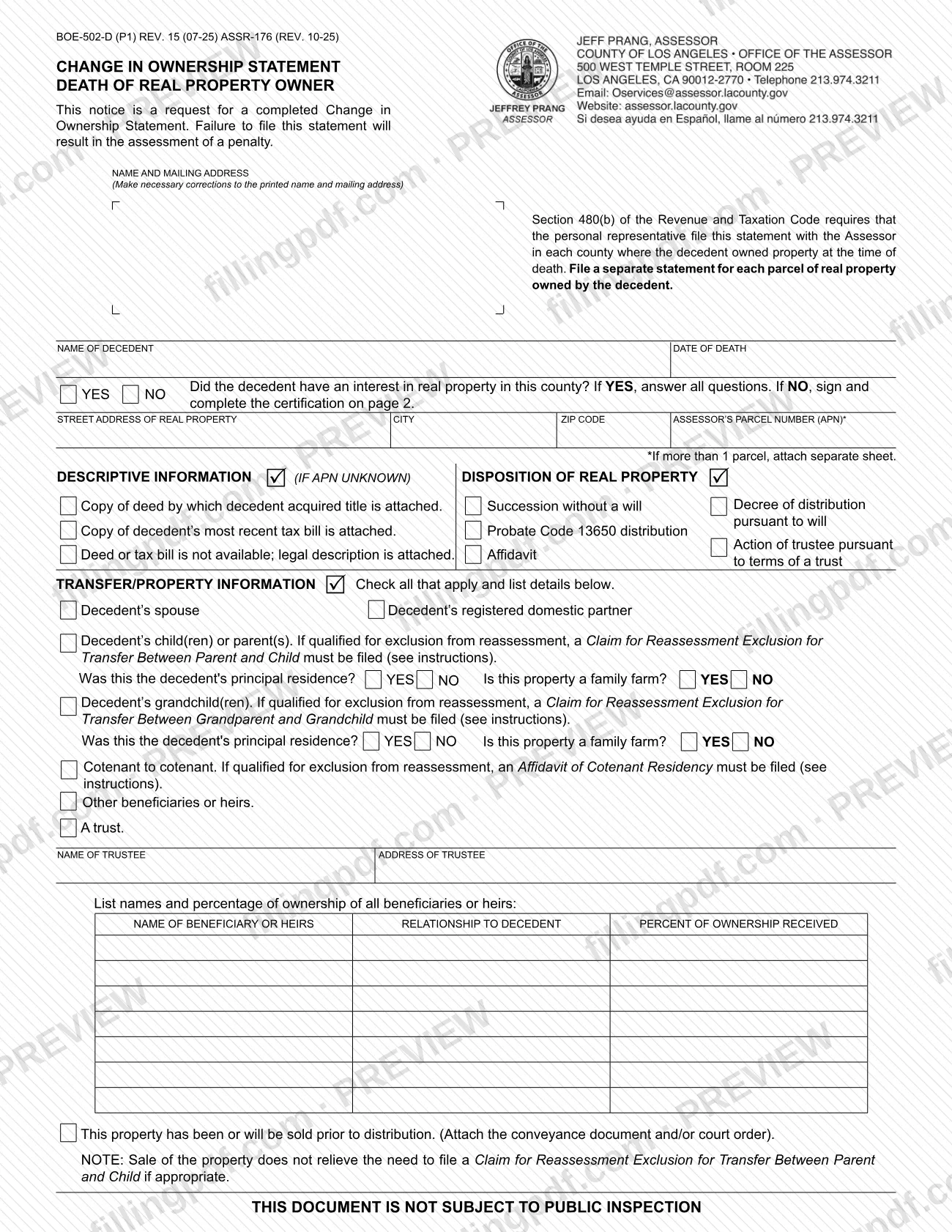
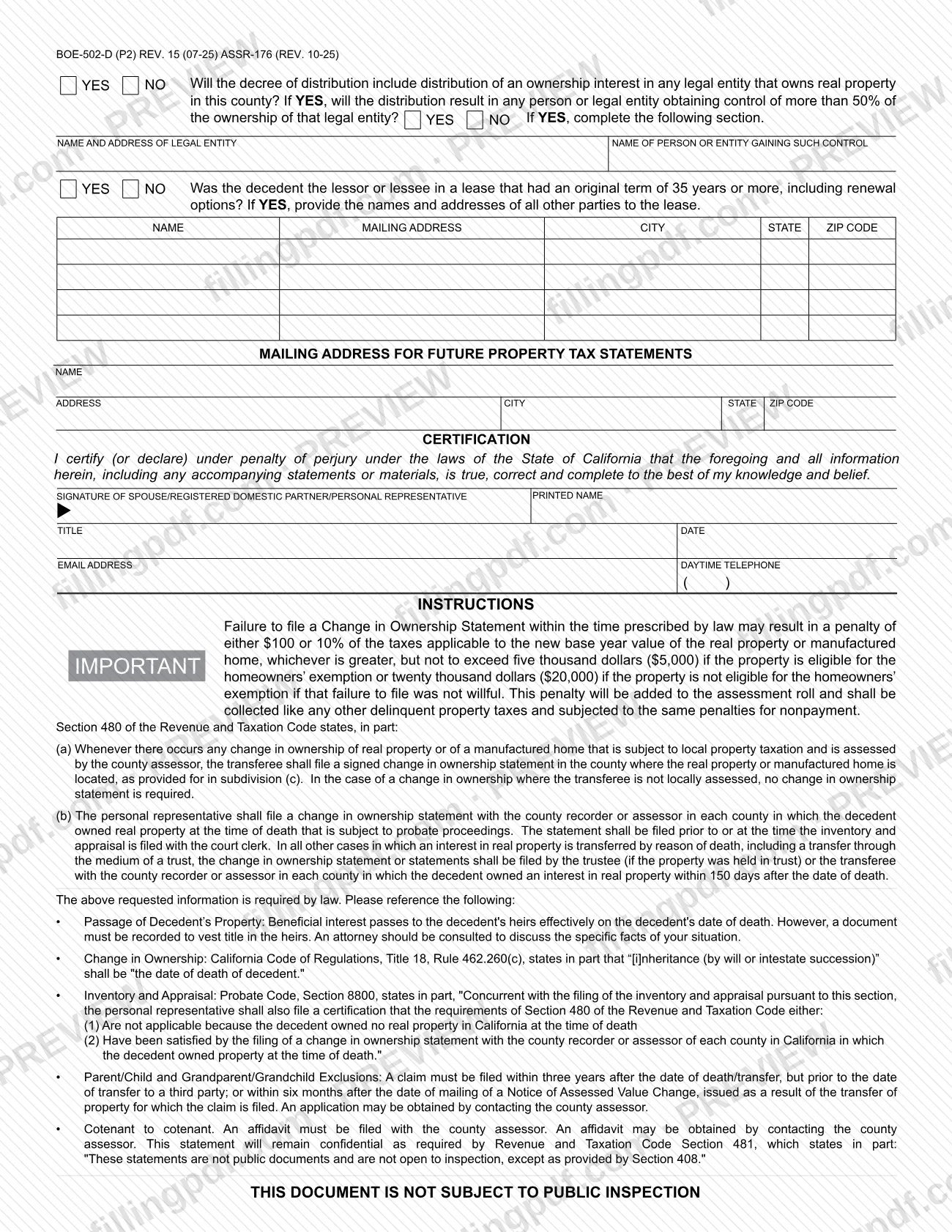
Form BOE-502-D, Change in Ownership Statement Death of Real Property Owner (also numbered ASSR-176), is the statement filed with the county assessor to report a change in ownership of real property caused by an owner's death. It is one of the Los Angeles County property tax forms published by the Los Angeles County Office of the Assessor, and a separate statement is filed for each parcel the decedent owned. On this page you can fill out the form online on FillingPDF and download or print the completed PDF; the official PDF is published by the Assessor.
Last updated
What is BOE-502-D?
Form BOE-502-D, Change in Ownership Statement Death of Real Property Owner, is the two-page statement that reports to the county assessor that real property has passed because its owner died, and tells the Assessor who received it and how.
The form is printed as a notice and request for a completed Change in Ownership Statement, and it states that failure to file will result in the assessment of a penalty. It rests on Section 480 of the California Revenue and Taxation Code, and Section 480(b) requires the personal representative to file it with the Assessor in each county where the decedent owned property at the time of death. The form's instructions add that beneficial interest in a decedent's property passes to the heirs effectively on the date of death, that California Code of Regulations, Title 18, Rule 462.260(c) treats inheritance as a change in ownership on the date of death, and that a document must still be recorded to vest title in the heirs. For the facts of your situation, the form recommends consulting an attorney.
The statement collects the decedent's name and date of death, the property address and Assessor's Parcel Number (APN), how the property was or will be distributed, who receives it and in what percentages, any legal entity or long-term lease involved, and a mailing address for future property tax statements.
The Assessor's forms page lists other ownership statements with different purposes, such as the Change of Ownership Statement (BOE-502-AH / ASSR-73) and the Change in Ownership Statement Oil and Gas Property (BOE-502-G). Form BOE-502-D is the one for a transfer caused by death. The document is not subject to public inspection.
Who needs to file BOE-502-D?
The personal representative of a decedent who owned real property in the county files Form BOE-502-D. Under Section 480(b), printed on the form, the personal representative files with the Assessor in each county where the decedent owned property at the time of death.
Where an interest in real property is transferred by reason of death and the property is not handled through probate, the instructions say the statement is filed by the trustee, if the property was held in trust, or by the transferee. This includes transfers made through a trust.
- File a separate statement for each parcel of real property the decedent owned.
- The certification may be signed by the spouse, the registered domestic partner or the personal representative.
- If the decedent had no interest in real property in this county, mark NO on page 1, then sign and complete the certification on page 2.
Beneficiaries who may qualify for an exclusion from reassessment, such as a child or parent, a grandchild or a cotenant, must file the separate claim or affidavit named on the form in addition to this statement. A sale of the property before distribution does not remove the need to file the Claim for Reassessment Exclusion for Transfer Between Parent and Child, if it is appropriate.
When to file BOE-502-D
Timing depends on how the property passes. For property subject to probate proceedings, Section 480(b) requires the personal representative to file the statement prior to or at the time the inventory and appraisal is filed with the court clerk. Probate Code Section 8800 also has the personal representative file, with the inventory and appraisal, a certification that the Section 480 requirements were satisfied by this filing or do not apply because the decedent owned no California real property.
In all other cases where an interest in real property transfers by reason of death, including through a trust, the trustee or transferee files within 150 days after the date of death.
Exclusion claims have their own windows. A parent/child or grandparent/grandchild claim must be filed within three years after the date of death or transfer, but before the property is transferred to a third party, or within six months after the date of mailing of a Notice of Assessed Value Change issued because of the transfer. Missing the statement deadline may bring a penalty that is added to the assessment roll and collected like delinquent property taxes.
Documents you need
- Copy of the deed by which the decedent acquired title, attached when you mark that box under Descriptive Information.
- Copy of the decedent's most recent tax bill, attached when you mark that box instead of the deed.
- Legal description of the property, attached when neither the deed nor the tax bill is available.
- Separate sheet listing the parcels, when there is more than one parcel (the form notes this under the APN field).
- Conveyance document and/or court order, attached when the property has been or will be sold prior to distribution.
- Claim for Reassessment Exclusion for Transfer Between Parent and Child, filed when a child or parent qualifies for exclusion from reassessment.
- Claim for Reassessment Exclusion for Transfer Between Grandparent and Grandchild, filed when a grandchild qualifies for exclusion from reassessment.
- Affidavit of Cotenant Residency, filed with the county assessor when a cotenant-to-cotenant transfer qualifies for exclusion from reassessment.
How to fill out BOE-502-D
Correct the name and mailing address
In the NAME AND MAILING ADDRESS box, make any necessary corrections to the printed name and mailing address.
Enter the decedent and date of death
Write the NAME OF DECEDENT and the DATE OF DEATH.
Answer the real property interest question
Mark YES or NO for whether the decedent had an interest in real property in this county. If YES, answer all questions; if NO, sign and complete the certification on page 2.
Identify the property
Enter the street address, city, ZIP code and ASSESSOR'S PARCEL NUMBER (APN). File a separate statement for each parcel.
Mark the descriptive information
Check whether a copy of the deed, a copy of the most recent tax bill, or a legal description (when neither is available) is attached. Use the descriptive information line if the APN is unknown.
Select the disposition of the property
Check the disposition that applies: succession without a will, decree of distribution pursuant to will, Probate Code 13650 distribution, action of trustee pursuant to terms of a trust, or affidavit.
Check the transfer and property information
Check all boxes that apply (spouse, registered domestic partner, child or parent, grandchild, cotenant, other beneficiaries or a trust). For children, parents and grandchildren, answer the principal residence and family farm questions.
Enter trustee and beneficiary details
For a trust, give the name and address of the trustee. List each beneficiary or heir with relationship to the decedent and percent of ownership received, and check the sale box if the property was or will be sold before distribution.
Answer the legal entity question
On page 2, mark YES or NO for a distribution of an ownership interest in a legal entity that owns real property in this county. If YES and one person or entity gains control of more than 50%, enter the entity name and address and the name of the person or entity gaining control.
Answer the long-term lease question
Mark YES or NO for whether the decedent was lessor or lessee in a lease with an original term of 35 years or more, including renewal options. If YES, give each other party's name, mailing address, city, state and ZIP code.
Give the tax statement mailing address
Under MAILING ADDRESS FOR FUTURE PROPERTY TAX STATEMENTS, enter the name, address, city, state and ZIP code.
Complete the certification
The spouse, registered domestic partner or personal representative signs, then enters the printed name, title, date, email address and daytime telephone. The certification is made under penalty of perjury.
Review and download the completed PDF
Check that every answer matches your records and that attachments are ready. Download or print the completed PDF from FillingPDF and file it as described under How to submit.
How to submit BOE-502-D
File the completed statement with the county assessor where the property is located. Section 480(b), printed on the form, also refers to the county recorder as a place of filing, and the form directs you to file in each county where the decedent owned real property.
- With the county assessor: for Los Angeles County property, this is the Los Angeles County Office of the Assessor. The form itself prints no mailing address, portal or office hours, so confirm the current filing details on the Assessor's forms page at https://assessor.lacounty.gov/forms.
- One statement per parcel: file a separate statement for each parcel of real property owned by the decedent.
- Attachments: include the deed or tax bill copy (or legal description), and the conveyance document or court order if the property was or will be sold before distribution.
- Exclusion claims: the Claim for Reassessment Exclusion for Transfer Between Parent and Child, the claim for transfer between grandparent and grandchild, and the Affidavit of Cotenant Residency are separate filings with the county assessor, which you can obtain by contacting the assessor.
The information is kept confidential under Revenue and Taxation Code Section 481. FillingPDF lets you fill out and download the PDF; submission follows the Assessor's channels above.
Common mistakes to avoid
- Listing several parcels on one statement, when the form says to file a separate statement for each parcel of real property owned by the decedent.
- Missing the filing time: before or at the inventory and appraisal filing for probate property, or within 150 days after the date of death in other cases.
- Answering YES to the real property interest question and then leaving later questions blank; the form says to answer all questions.
- Not correcting the printed name and mailing address at the top when they are wrong.
- Marking the deed or tax bill box without attaching a copy, or omitting the legal description when neither document is available.
- Selling the property before distribution without attaching the conveyance document and/or court order.
- Assuming the statement replaces the parent/child or grandparent/grandchild claim, or the Affidavit of Cotenant Residency; each is filed separately.
- Leaving out the names and addresses of all other parties to a lease with an original term of 35 years or more.
- Submitting the certification unsigned; it is made under penalty of perjury and needs a signature, printed name, title and date.
Frequently asked questions
What is Form BOE-502-D used for?
Form BOE-502-D is the Change in Ownership Statement Death of Real Property Owner. It reports to the county assessor that real property passed because the owner died, and lists the property, the distribution and who received it. A separate statement is filed for each parcel.
Is BOE-502-D one of the Los Angeles County property tax forms?
Yes. The Los Angeles County Office of the Assessor lists it on its forms page as BOE-502-D / ASSR-176. It is the Assessor's version of the statement used when an owner's death changes who owns the property.
Who has to file the Change in Ownership Statement after a death?
The personal representative files it with the Assessor in each county where the decedent owned property. In other cases, including property held in a trust, the trustee or transferee files it with the county recorder or assessor.
What is the deadline for Form BOE-502-D?
For probate property, file it prior to or at the time the inventory and appraisal is filed with the court clerk. In all other cases, file within 150 days after the date of death. Late filing may bring a penalty added to the assessment roll.
Do I file one BOE-502-D for each parcel?
Yes. The form says to file a separate statement for each parcel of real property owned by the decedent. If you list more than one parcel in the APN field, the form tells you to attach a separate sheet.
Is the death statement open to public inspection?
No. The form states that it is not subject to public inspection. Revenue and Taxation Code Section 481, quoted on the form, says these statements are not public documents and are not open to inspection except as provided by Section 408.
Does BOE-502-D also claim the parent-child reassessment exclusion?
No. If a child, parent or grandchild qualifies for exclusion from reassessment, a separate claim must be filed. The claim must be filed within three years after the date of death or transfer, before any transfer to a third party, or within six months after a Notice of Assessed Value Change is mailed.
Can I fill out Form BOE-502-D online?
You can fill out the PDF online on FillingPDF and download or print it. FillingPDF is an independent service and does not file the statement; you submit it to the county assessor or recorder through their channels.
Ready to fill out BOE-502-D?
Fill out BOE-502-D now