

Form BOE-566-K, Oil and Gas Operating Expense Data, is a declaration of costs and related property information that operators of oil and gas properties file with the Los Angeles County Office of the Assessor. It is one of the Los Angeles County property tax forms the Assessor lists on its forms page, and a separate report is filed for each property. On this page you can fill out the form online on FillingPDF and download or print the completed PDF; the form itself and its instructions are published by the Assessor.
Last updated
What is BOE-566-K?
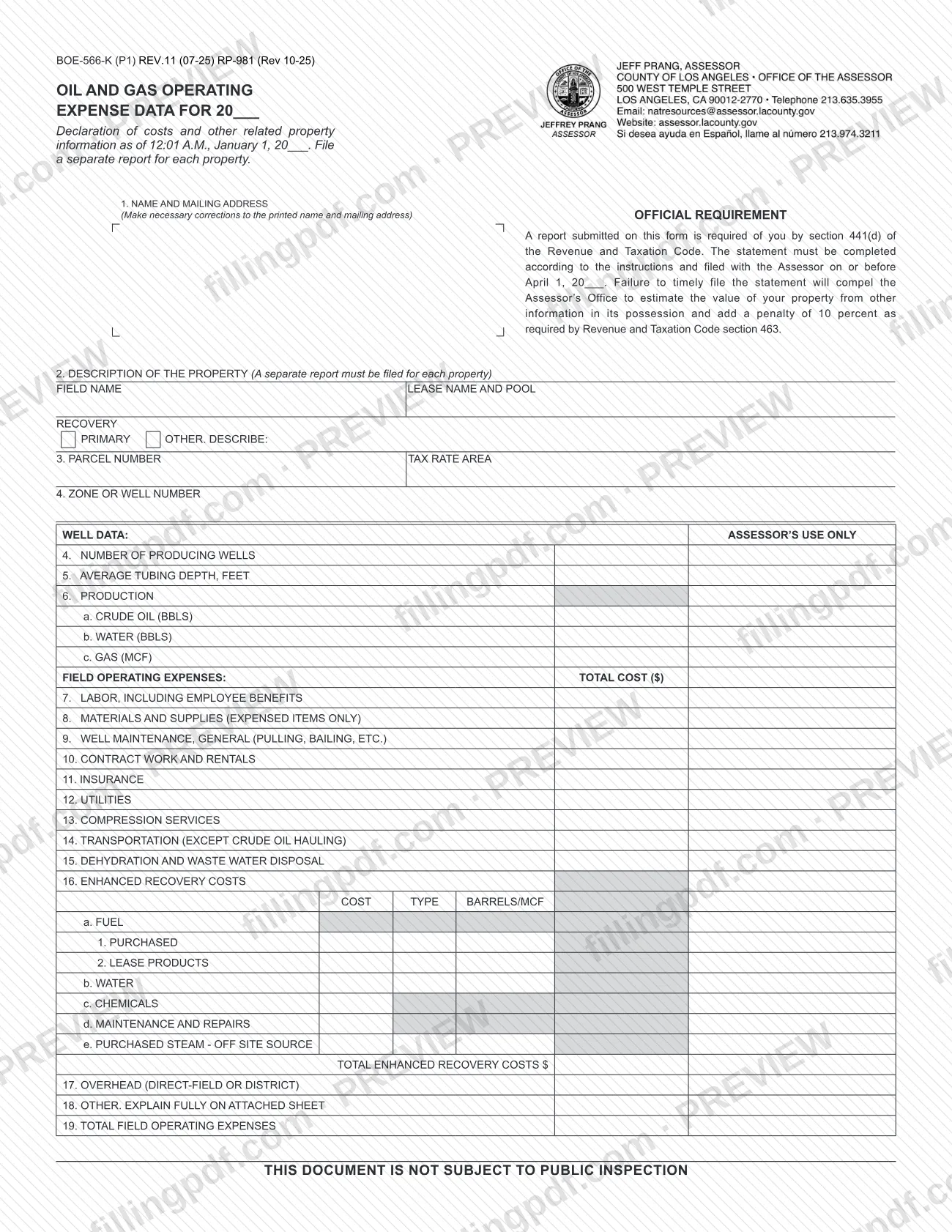
Form BOE-566-K, Oil and Gas Operating Expense Data, is the declaration of costs and other related property information, as of 12:01 A.M. on January 1, that an operator reports to the Los Angeles County Assessor for an oil and gas property.
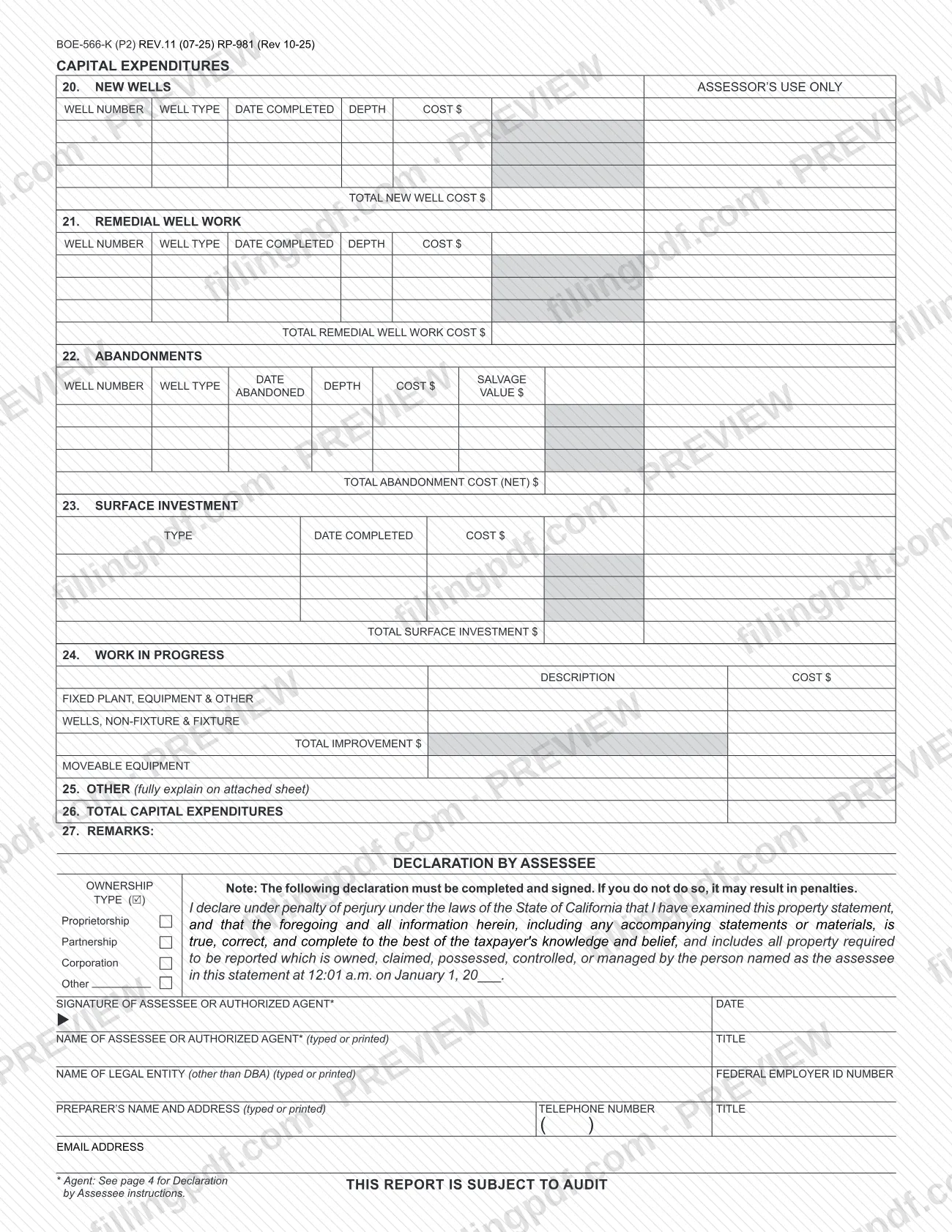
The form says the report is required by section 441(d) of the Revenue and Taxation Code. It has two parts of data. Lines 1 to 6 identify the operator, the property, the parcel, the wells and production. Lines 7 to 19 report field operating expenses, including a block of enhanced recovery costs on line 16. Page 2 reports capital expenditures: new wells (line 20), remedial well work (line 21), abandonments (line 22), surface investment (line 23), work in progress (line 24), other investment (line 25) and the total on line 26. Line 27 is for remarks, and a signed declaration under penalty of perjury closes the form.
The form states that it is not subject to public inspection and that the report is subject to audit. The Assessor's forms page lists it next to other oil and gas forms such as BOE-566-D, Oil and Dissolved Gas Production Report, and BOE-566-J, Oil, Gas and Geothermal Personal Property Statement. Form BOE-566-K reports expense data only; it is not a change-of-ownership statement.
Who needs to file BOE-566-K?
The operator (a person or a corporation) of an oil and gas property in Los Angeles County files this report with the Assessor; the form states that section 441(d) of the Revenue and Taxation Code requires it. A separate report must be filed for each property or parcel.
Who may sign the declaration, according to the instructions:
- The assessee, a duly appointed fiduciary, or a person authorized to sign for the assessee.
- For a corporation: an officer, or an employee or agent designated in writing by the board of directors, by name or title.
- For a partnership: a partner or an authorized employee or agent.
- For a limited liability company (LLC): an LLC manager, or a member where there is no manager, or an employee or agent designated by the manager or members.
An employee or agent who is not a member of the bar, a certified public accountant, a public accountant, an enrolled agent or a duly appointed fiduciary needs the assessee's written authorization, which must be filed with the Assessor. The Assessor may ask for proof of that authorization at any time.
When to file BOE-566-K
File Form BOE-566-K with the Assessor on or before April 1 of the year printed on the form. The report covers the property as of 12:01 A.M. on January 1 of that year, and the year of the lien date is entered at the top of the form.
The form states the consequence of filing late: the Assessor's Office will estimate the value of the property from other information in its possession and add a 10 percent penalty under Revenue and Taxation Code section 463. The instructions add that an expense data statement that is not signed and executed as required is not validly filed, and that the section 463 penalty applies to unsigned statements. Production reported on line 6 must cover the same period as the expense data.
Documents you need
- Attached sheet fully explaining the costs entered on line 18, Other, including crude hauling expenses when oil must be hauled.
- Attached sheet fully explaining the amounts entered on line 25, Other, for investment expenditures not listed on lines 20 through 24.
- The assessee's written authorization filed with the Assessor, only when the declaration is signed by an employee or agent who is not a member of the bar, a CPA, a public accountant, an enrolled agent or a duly appointed fiduciary.
- For a corporation, the written designation by the board of directors (by name or title) of the employee or agent who signs on its behalf.
How to fill out BOE-566-K
Enter the year and confirm line 1
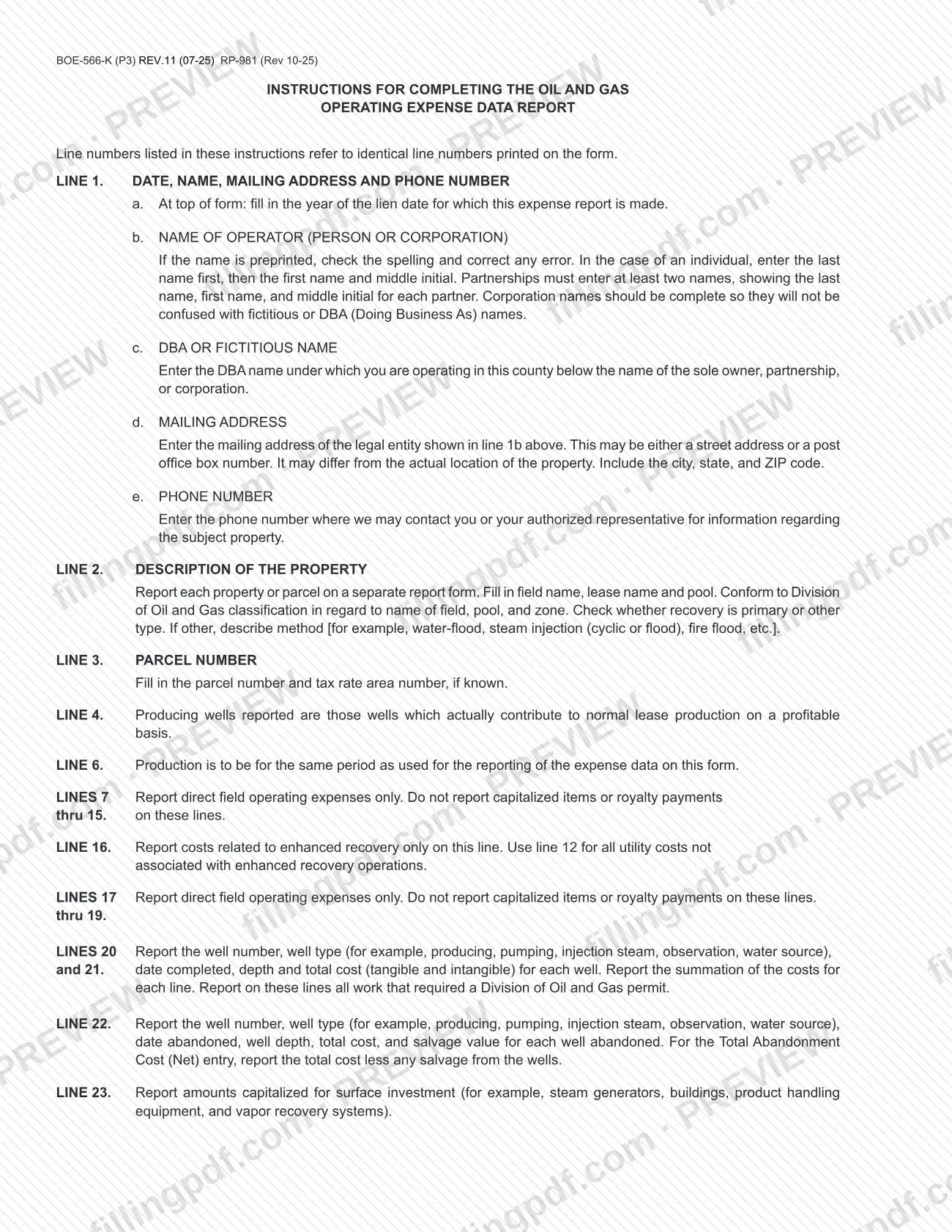
At the top, enter the year of the lien date for the report. On line 1, check the preprinted name and mailing address and correct any error; individuals enter last name first, partnerships list at least two partners, and corporation names must be complete. Add any DBA name below the owner's name.
Describe the property on line 2
Enter the field name, lease name and pool, following the Division of Oil and Gas classification. Check Primary recovery or Other; if Other, describe the method, such as water-flood or steam injection.
Enter parcel, tax rate area and zone
On line 3, enter the parcel number and the tax rate area number, if known. Enter the zone or well number in the next field.
Complete the well data and production
Enter the number of producing wells (only wells that actually contribute to normal lease production on a profitable basis) and the average tubing depth in feet. On line 6, report crude oil (BBLS), water (BBLS) and gas (MCF) for the same period as the expense data.
Report field operating expenses, lines 7–15
Enter total cost for labor, materials and supplies, well maintenance, contract work and rentals, insurance, utilities, compression, transportation, and dehydration and waste water disposal. Report direct field operating expenses only, with no capitalized items or royalty payments.
Report enhanced recovery costs on line 16
List costs by type (fuel, water, chemicals, maintenance and repairs, purchased steam) with barrels or MCF where asked, then the total enhanced recovery costs. Use line 12 for utilities not tied to enhanced recovery.
Complete lines 17 to 19
Enter overhead (direct-field or district) on line 17 and other costs on line 18, explained fully on an attached sheet; include crude hauling there if oil must be hauled. Enter the total of field operating expenses on line 19.
Report wells on lines 20 to 22
For new wells (line 20) and remedial well work (line 21), enter well number, well type, date completed, depth and cost. For abandonments (line 22), enter date abandoned, depth, cost and salvage value, and the net total cost less salvage.
Complete lines 23 to 26
On line 23, enter surface investment by type, date completed and cost. On line 24, describe work in progress by category and say whether it is new or maintenance. Enter other investment on line 25, explained on an attached sheet, and total capital expenditures on line 26.
Add remarks and the declaration
Use line 27 for remarks. Check the ownership type, then enter the legal entity name, federal employer ID number, preparer details, telephone number and email address, and sign and date the declaration.
Review and download the completed PDF
Check that each line matches your records and that attachments are ready. Download or print the completed PDF from FillingPDF and file it with the Assessor as described under How to submit.
How to submit BOE-566-K
The form says the completed report is filed with the Assessor; it prints no mailing address, portal or appointment rule, and it names no other channel. The Los Angeles County Office of the Assessor publishes its forms at https://assessor.lacounty.gov/forms, where you can look for current filing details.
- Sign it: the declaration on page 2 must be signed and dated by the assessee or an authorized agent. Unsigned statements are not validly filed.
- Attach what applies: any sheet that explains line 18 or line 25, and the assessee's written authorization when an employee or agent without a listed professional status signs.
- One report per property: do not combine properties on one form.
Check the printed name and mailing address on line 1 and correct them before filing. FillingPDF lets you fill out and download the PDF; submission follows the Assessor's channels.
Common mistakes to avoid
- Filing after April 1, which leads the Assessor to estimate the property's value from other information and add a 10 percent penalty under section 463.
- Leaving the declaration unsigned; the instructions say an unsigned statement is not validly filed and the section 463 penalty applies.
- Combining several properties on one form instead of filing a separate report for each property.
- Reporting capitalized items or royalty payments on lines 7 through 15 or lines 17 through 19, which are for direct field operating expenses only.
- Putting utility costs of enhanced recovery operations on line 12, or non-enhanced-recovery utilities on line 16.
- Including depreciation, depletion, amortization, interest, federal and state income taxes, property taxes, royalty payments or general office overhead in the expenses.
- Reporting production on line 6 for a different period than the expense data.
- Having an agent sign without the assessee's written authorization on file with the Assessor, when the agent is not in one of the listed professional categories.
Frequently asked questions
What is Form BOE-566-K used for?
Form BOE-566-K, Oil and Gas Operating Expense Data, is the report an operator files with the Los Angeles County Assessor to declare field operating expenses, production and capital expenditures for an oil and gas property as of January 1.
When is the BOE-566-K due?
On or before April 1 of the year printed on the form. If it is filed late, the Assessor will estimate the property's value from other information it has and add a 10 percent penalty under Revenue and Taxation Code section 463.
Do I need a separate BOE-566-K for each property?
Yes. The form says a separate report must be filed for each property, and the instructions say to report each property or parcel on its own form.
Who can sign the BOE-566-K declaration?
The assessee, a duly appointed fiduciary, or an authorized person. Corporations, partnerships and LLCs each have specific signers. An agent outside the listed professions needs the assessee's written authorization filed with the Assessor.
What expenses should not be reported on BOE-566-K?
Do not include depreciation, depletion, amortization, interest, federal and state income taxes, property taxes, royalty payments or general office overhead. Lines 7 through 15 and 17 through 19 also exclude capitalized items.
Where do I report crude oil hauling costs?
On line 18, Other, if oil must be hauled, with a full explanation on an attached sheet. Transportation on line 14 excludes crude oil hauling.
Is the information on Form BOE-566-K public?
The form states that it is not subject to public inspection. It also states that the report is subject to audit.
Can I fill out Form BOE-566-K online?
You can fill out the PDF online on FillingPDF and download or print it. FillingPDF is an independent service and does not file the form; you file it with the Los Angeles County Assessor through its channels.
Ready to fill out BOE-566-K?
Fill out BOE-566-K now