
Form BOE-571-F2, Registered and Showhorses Other Than Racehorses, is the Supplementary Schedule to the Agricultural Property Statement used by the Los Angeles County Office of the Assessor to list registered and show horses. It is one of the Los Angeles County property tax forms for agricultural property, and it is returned together with the Agricultural Property Statement. Racehorses, pets and horses that qualify for the business inventory exemption are not listed on it. On FillingPDF you can fill out the form online and download or print the completed PDF; the Assessor publishes the original form.
Last updated
What is BOE-571-F2?
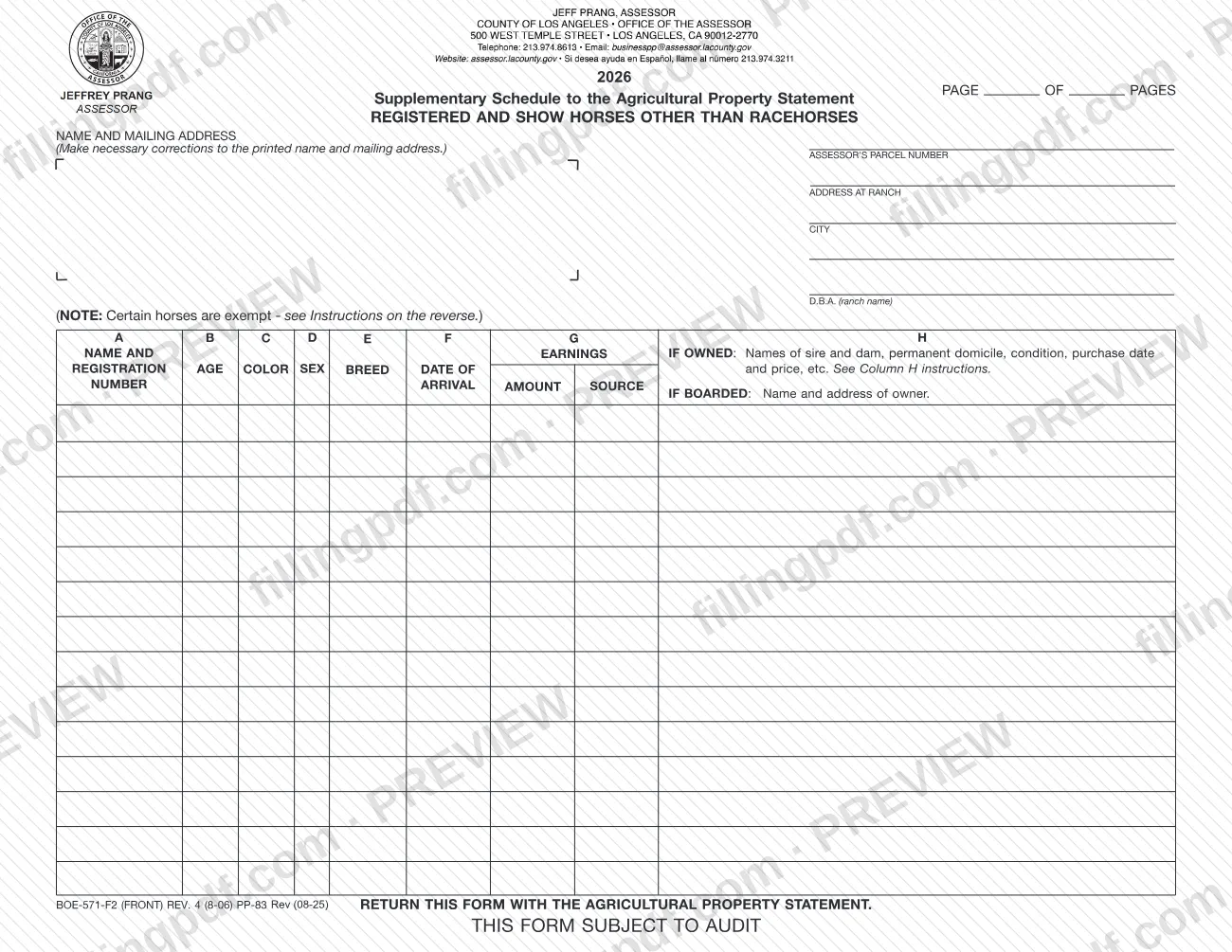
Form BOE-571-F2, Registered and Showhorses Other Than Racehorses, is a supplementary schedule to the Agricultural Property Statement on which the owner or keeper of registered and show horses lists each animal held on January 1, with its age, color, sex, breed and ownership details.
The Los Angeles County Office of the Assessor lists it as BOE-571-F2 / PP-83. The printed copy carries the year 2026 and a "PAGE OF PAGES" box, so a long list can run over several pages. The form says it is subject to audit.
The form has columns A through H:
- A: name and registration number of each horse.
- B to E: age, color, sex and breed, using the abbreviations the instructions give.
- F: date of arrival, for boarded horses.
- G: earnings and their source, for horses you own.
- H: owner details for boarded horses, or sire, dam, domicile, condition and purchase information for owned horses.
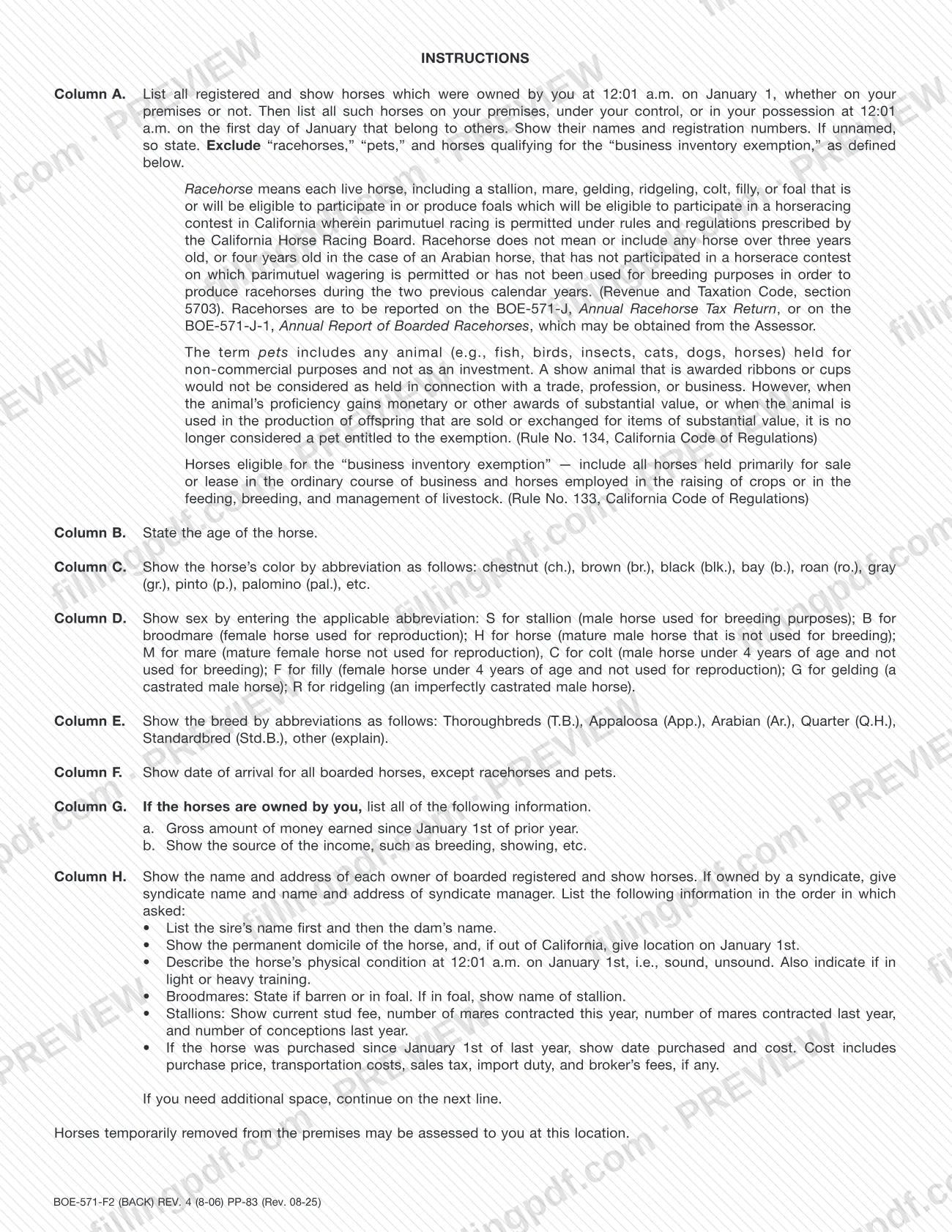
It is not the form for racehorses. The instructions say racehorses are reported on the BOE-571-J, Annual Racehorse Tax Return, or on the BOE-571-J-1, Annual Report of Boarded Racehorses, both available from the Assessor. The Agricultural Property Statement itself is a separate form, listed by the Assessor as BOE-571-F / ASSR-485.
Who needs to file BOE-571-F2?
List horses on this schedule if you own registered or show horses, or if you keep such horses that belong to others, and you are returning the Agricultural Property Statement. The instructions ask for two groups:
- Registered and show horses you owned at 12:01 a.m. on January 1, whether on your premises or not.
- Registered and show horses on your premises, under your control or in your possession at 12:01 a.m. on the first day of January that belong to others.
Do not list these horses:
- Racehorses, as defined in Revenue and Taxation Code section 5703. They go on Form BOE-571-J or BOE-571-J-1.
- Pets: animals held for non-commercial purposes and not as an investment. A show animal that only wins ribbons or cups is not treated as held for business. It stops being a pet when its proficiency gains monetary or other awards of substantial value, or when its offspring are sold or exchanged for items of substantial value (Rule No. 134, California Code of Regulations).
- Horses eligible for the business inventory exemption: horses held primarily for sale or lease in the ordinary course of business, and horses employed in raising crops or in feeding, breeding and management of livestock (Rule No. 133, California Code of Regulations).
The form adds that horses temporarily removed from the premises may be assessed to you at this location.
When to file BOE-571-F2
The reporting date is 12:01 a.m. on January 1: list the horses you owned, and the horses of others in your possession or under your control, at that moment. The form says to return it with the Agricultural Property Statement, so it is submitted whenever that statement is filed. It prints no separate due date.
Some entries look back further. Column G asks for the gross amount earned since January 1st of the prior year, and column H asks for the date and cost of any horse purchased since January 1st of last year. For the deadline that applies to the Agricultural Property Statement, check with the Los Angeles County Office of the Assessor.
How to fill out BOE-571-F2
Check name, address and parcel details
Correct the printed name and mailing address if needed. Enter the Assessor's Parcel Number, the address at the ranch, the city and the D.B.A. (ranch name). Fill in the page number and total pages if you use more than one.
Decide which horses to list
List registered and show horses you owned at 12:01 a.m. on January 1, plus those of others in your possession or control on that date. Leave out racehorses, pets and horses qualifying for the business inventory exemption.
Enter name and registration number
In column A, write each horse's name and registration number. If the horse has no name, state that it is unnamed.
Enter age and color
In column B, state the horse's age. In column C, use the color abbreviations, such as ch., br., blk., b., ro., gr., p. or pal.
Enter sex by abbreviation
In column D, enter S, B, H, M, C, F, G or R, as defined in the instructions for stallion, broodmare, horse, mare, colt, filly, gelding and ridgeling.
Enter the breed
In column E, use T.B., App., Ar., Q.H. or Std.B. For any other breed, write "other" and explain.
Enter date of arrival for boarded horses
In column F, show the date each boarded horse arrived. Racehorses and pets are the exceptions the instructions name.
Report earnings for horses you own
In column G, enter the gross amount earned since January 1st of the prior year and its source, such as breeding or showing.
Give owner details for boarded horses
In column H, enter the name and address of each owner. For a syndicate, give the syndicate name and the name and address of its manager.
Complete the column H horse details
In the order the instructions ask: sire, then dam; permanent domicile (and location on January 1st if outside California); physical condition and training level; for broodmares, barren or in foal and the stallion's name; for stallions, stud fee and mare and conception counts.
Add purchase date and cost
For a horse bought since January 1st of last year, show the purchase date and the cost, including transportation, sales tax, import duty and broker's fees. Continue on the next line if you need more space.
Review and download the completed PDF
Check the January 1 date, the abbreviations and each column against the instructions. Download or print the completed PDF from FillingPDF and return it with the Agricultural Property Statement as described under How to submit.
How to submit BOE-571-F2
This schedule has one submission route: it is returned together with the Agricultural Property Statement. The form prints the instruction "RETURN THIS FORM WITH THE AGRICULTURAL PROPERTY STATEMENT" and gives no separate mailing address, portal or appointment rule.
- With the Agricultural Property Statement: attach the completed schedule to that statement. The Los Angeles County Office of the Assessor lists the statement as BOE-571-F / ASSR-485 on its forms page, https://assessor.lacounty.gov/forms.
- Corrections to your details: the form asks you to make any necessary corrections to the printed name and mailing address.
- Racehorses: do not include them here. The BOE-571-J and BOE-571-J-1 may be obtained from the Assessor.
Contact the Assessor for the filing channels of the Agricultural Property Statement. The form is subject to audit, so keep records that support the entries. FillingPDF lets you fill out and download the PDF; submission follows the Assessor's channels described above.
Common mistakes to avoid
- Listing racehorses on this schedule; the instructions send them to Form BOE-571-J or BOE-571-J-1.
- Listing pets or horses that qualify for the business inventory exemption, which the instructions tell you to exclude.
- Reporting horses as of another date instead of 12:01 a.m. on January 1.
- Leaving out horses of others that were on your premises, under your control or in your possession on January 1.
- Forgetting to state "unnamed" for a horse without a name; the instructions say to show names and registration numbers and, if unnamed, so state.
- Omitting the date of arrival in column F for a boarded horse (racehorses and pets are the exceptions).
- Writing the full word for sex, color or breed instead of the abbreviations the instructions list, or using "other" for a breed without an explanation.
- Understating the purchase cost in column H: cost includes purchase price, transportation, sales tax, import duty and broker's fees.
- Returning the schedule separately instead of with the Agricultural Property Statement.
Frequently asked questions
What is Form BOE-571-F2 used for?
It is the Supplementary Schedule to the Agricultural Property Statement on which you list registered and show horses other than racehorses. The Los Angeles County Office of the Assessor uses it to collect each horse's identity, ownership, earnings and related details as of January 1.
Is Form BOE-571-F2 a Los Angeles County property tax form?
Yes. It is issued by the Los Angeles County Office of the Assessor and returned with the Agricultural Property Statement. The form states that horses temporarily removed from the premises may be assessed to you at this location, and that the form is subject to audit.
Which horses do I leave off Form BOE-571-F2?
Leave off racehorses, pets and horses qualifying for the business inventory exemption. Racehorses go on Form BOE-571-J or BOE-571-J-1, which you can get from the Assessor. The instructions define each excluded group, citing Revenue and Taxation Code section 5703 and Rules 133 and 134.
What date do I use to list my horses?
Use 12:01 a.m. on January 1. List registered and show horses you owned at that time, wherever they were, and horses of others that were on your premises, under your control or in your possession at that time.
Where do I send Form BOE-571-F2?
Return it with the Agricultural Property Statement. The form says exactly that and prints no separate address or portal. Ask the Los Angeles County Office of the Assessor for the filing channels that apply to the Agricultural Property Statement.
What do I enter in column H of Form BOE-571-F2?
For boarded horses, the owner's name and address (or the syndicate and its manager). Then list in order: sire and dam, permanent domicile, condition and training level, broodmare or stallion details, and purchase date and cost if bought since January 1st of last year.
Can I fill out Form BOE-571-F2 online?
You can fill out the PDF online on FillingPDF and download or print it. FillingPDF is an independent service: it does not file the form with the Assessor, so you return the completed schedule with the Agricultural Property Statement.
What is the difference between BOE-571-F2 and BOE-571-J?
Form BOE-571-F2 covers registered and show horses other than racehorses. Form BOE-571-J, the Annual Racehorse Tax Return, covers racehorses, and BOE-571-J-1 covers boarded racehorses. The Assessor can supply both racehorse forms.
Ready to fill out BOE-571-F2?
Fill out BOE-571-F2 now