
Form BOE-571-J, the Annual Racehorse Tax Return, is the return that owners of racehorses domiciled in Los Angeles County file with the County Tax Collector; the Los Angeles County Office of the Assessor publishes it. It is one of the Los Angeles County property tax forms, and it lists each racehorse you owned at 12:01 a.m. on January 1, with its classification and the annual tax due. On FillingPDF you can fill out the form online and download or print the completed PDF; filing follows the county's channels, and the original form and instructions are published by the Assessor.
Last updated
What is BOE-571-J?
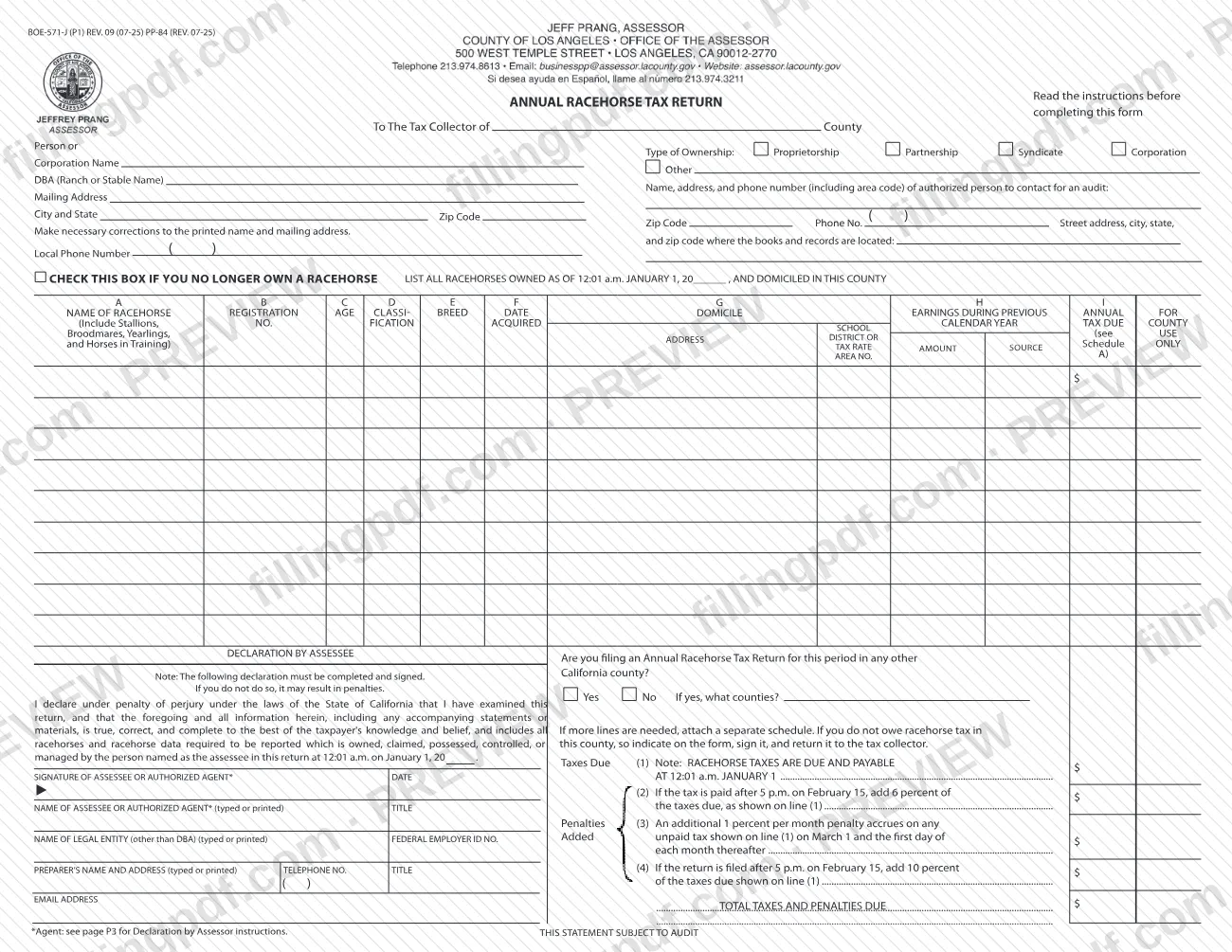
Form BOE-571-J, Annual Racehorse Tax Return, is the return on which an owner reports every racehorse domiciled in Los Angeles County and owned at 12:01 a.m. on January 1, and computes the annual racehorse tax due on each horse. It is addressed to the Tax Collector of Los Angeles County.
The form also appears on the Assessor's forms list as PP-84. The printed revision is REV. 09 (07-25), and the version supplied is dated for January 1, 2026.
Each horse gets one line with these columns:
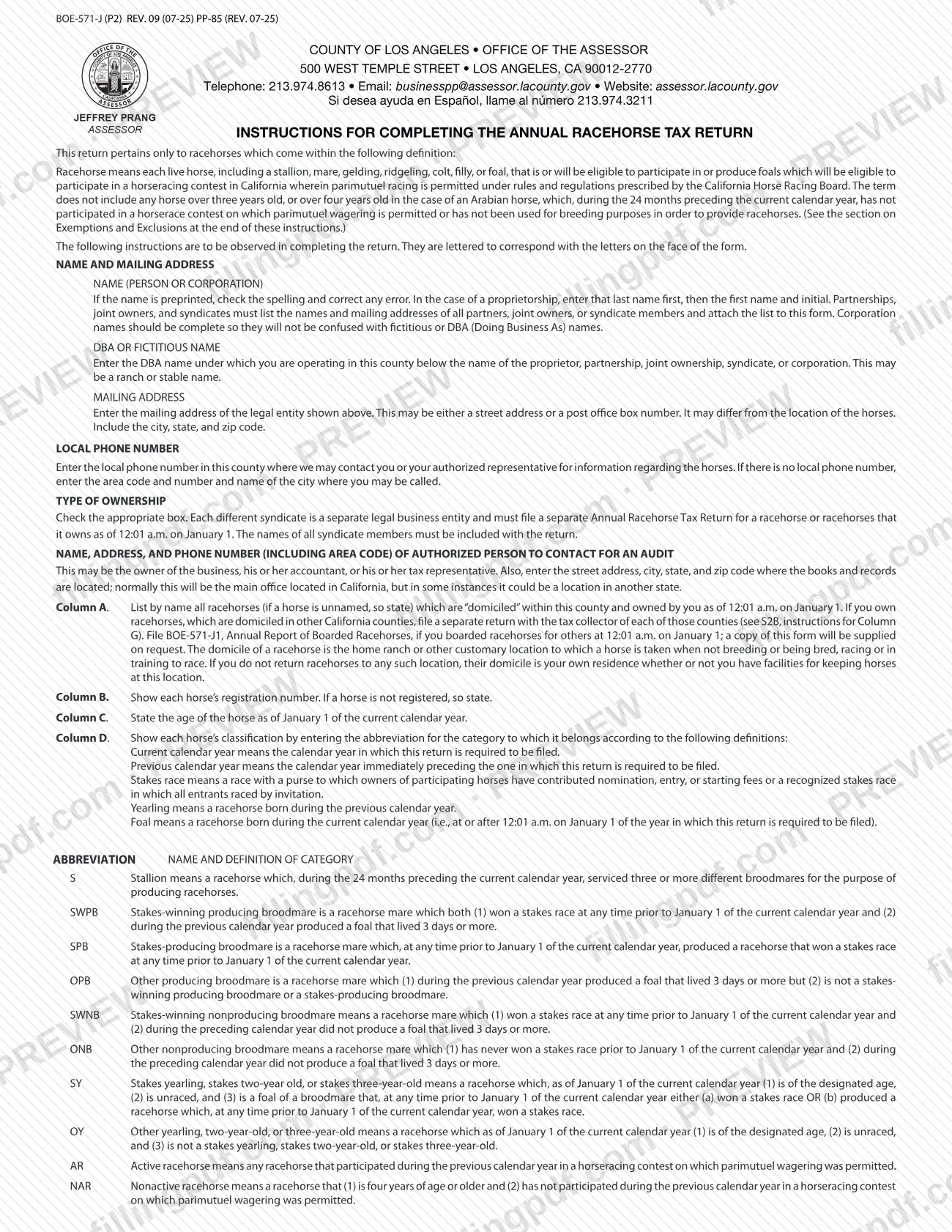
- A: name; B: registration number; C: age on January 1; D: classification, using abbreviations such as S, SWPB, SPB, OPB, SWNB, ONB, SY, OY, AR and NAR;
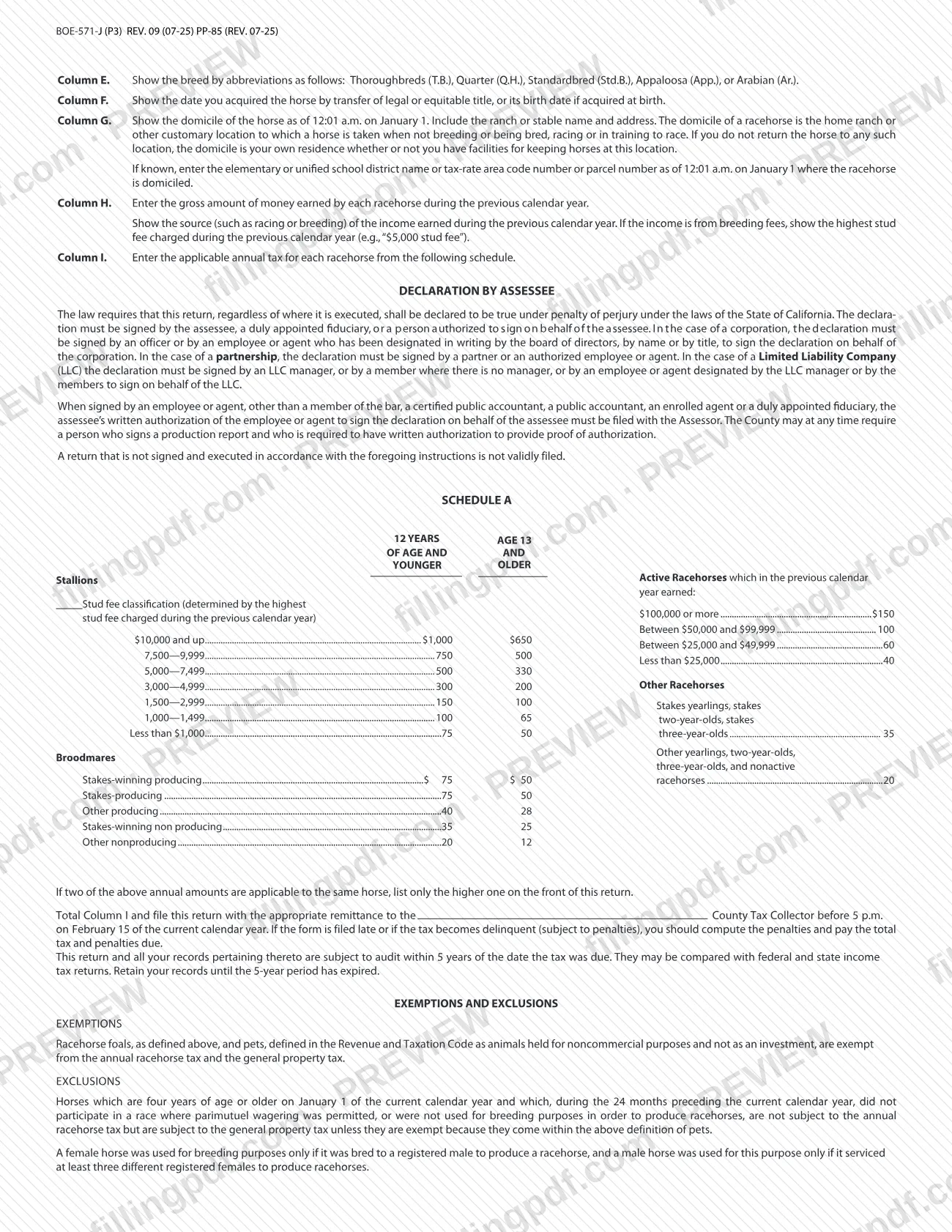
- E: breed; F: date acquired; G: domicile; H: earnings in the previous calendar year and their source; I: annual tax from Schedule A in the instructions.
Below the table, lines (1) to (4) carry the taxes due and the penalties for late payment or late filing, and the declaration under penalty of perjury follows. The statement is subject to audit.
The return covers only racehorses as the instructions define them. It does not cover boarding: if you boarded racehorses for others on January 1, the instructions point to a separate report, BOE-571-J1, Annual Report of Boarded Racehorses. Horses that are not racehorses for this purpose, such as show horses, are on different forms; the Assessor's list names BOE-571-F2 / PP-83, Registered and Showhorses Other Than Racehorses.
Who needs to file BOE-571-J?
The main group is any owner who held a racehorse at 12:01 a.m. on January 1 that is domiciled in Los Angeles County. The instructions define the domicile as the home ranch or other customary location the horse returns to when it is not breeding, racing or in training; if there is no such place, it is the owner's own residence.
Other conditions in the instructions:
- Each different syndicate is a separate legal entity and files its own return, with the names of all its members. Partnerships and joint owners list all partners or owners and attach the list.
- If you own racehorses domiciled in other California counties, file a separate return with the tax collector of each of those counties.
- If you do not owe racehorse tax in this county, you still indicate that on the form, sign it and return it to the tax collector. A box is provided for owners who no longer own a racehorse.
Not covered by this tax: racehorse foals and pets (animals held for noncommercial purposes and not as an investment) are exempt. Horses aged four or older on January 1 that did not race in a parimutuel contest or were not used for breeding in the previous 24 months are excluded from the racehorse tax but remain subject to the general property tax unless they are pets.
An employee, agent, officer, partner, LLC manager or fiduciary may sign for the owner under the signature rules in the instructions.
When to file BOE-571-J
The return, with the appropriate remittance, must be filed with the Los Angeles County Tax Collector before 5 p.m. on February 15 of the current calendar year. The ownership count is taken at 12:01 a.m. on January 1, when racehorse taxes are due and payable.
Lateness has stated consequences on the form: if the tax is paid after 5 p.m. on February 15, a penalty is added at line (2); a further monthly penalty accrues on March 1 and on the first day of each month after (line 3); and if the return is filed after 5 p.m. on February 15, another penalty applies at line (4). If the return is late or the tax is delinquent, you compute the penalties and pay the total.
The return and your records are subject to audit within 5 years of the date the tax was due, so keep them until that period ends.
Documents you need
- List of names and mailing addresses of all partners, joint owners or syndicate members, attached to the return, for partnerships, joint owners and syndicates.
- A separate schedule attached to the return, if you have more racehorses than the lines on the form allow.
- The assessee's written authorization, filed with the Assessor, when an employee or agent other than a member of the bar, CPA, public accountant, enrolled agent or fiduciary signs for the assessee.
- Proof of authorization on request, when the county asks a signer who needs written authorization to provide it.
- Remittance for the total taxes and penalties due, sent with the return to the Los Angeles County Tax Collector.
How to fill out BOE-571-J
Correct the name and mailing address
Check the preprinted name and mailing address and correct any error. For a proprietorship, enter the last name first; give corporation names in full so they are not confused with DBA names.
Check the type of ownership
Mark Proprietorship, Partnership, Syndicate, Corporation or Other, and enter the DBA (ranch or stable name) if you operate under one. Attach the list of all partners, joint owners or syndicate members when the instructions require it.
Give audit and records contacts
Enter the name, address and phone number (with area code) of the authorized person to contact for an audit, and the street address where the books and records are located. Add a local phone number in the county, or an area code, number and city if you have none.
Mark the box if you own no racehorse
Check the box if you no longer own a racehorse. If you owe no racehorse tax in this county, indicate so, sign the form and return it.
Enter name, registration and age
Column A: each racehorse domiciled in this county, or "unnamed". Column B: registration number, or state that it is not registered. Column C: the horse's age as of January 1.
Enter the classification
Column D: the abbreviation for the category in the instructions, such as S, SWPB, SPB, OPB, SWNB, ONB, SY, OY, AR or NAR.
Enter breed and acquisition date
Column E: T.B., Q.H., Std.B., App. or Ar. Column F: the date you acquired the horse by transfer of legal or equitable title, or its birth date if acquired at birth.
Enter the domicile
Column G: the horse's domicile at 12:01 a.m. on January 1, with ranch or stable name and address. If known, add the school district, tax-rate area number or parcel number.
Enter earnings and their source
Column H: gross money earned by each horse in the previous calendar year and the source, such as racing or breeding. For breeding fees, show the highest stud fee charged.
Enter the annual tax
Column I: the annual tax for each horse from Schedule A in the instructions. If two amounts apply to one horse, list only the higher one.
Answer the other-counties question
Mark Yes or No for filing an Annual Racehorse Tax Return in another California county and, if Yes, list the counties.
Complete lines (1) to (4)
Enter the taxes due on line (1) and any penalties on lines (2) to (4), then the total taxes and penalties due. Attach a separate schedule if you need more lines.
Sign, review and download the PDF
Sign and date the declaration with the printed name, title and legal entity name, adding a federal employer ID, preparer details and email if applicable. Review every column, then download or print the completed PDF from FillingPDF.
How to submit BOE-571-J
File the return with the appropriate remittance with the Los Angeles County Tax Collector before 5 p.m. on February 15. The form is addressed to the Tax Collector and prints no mailing address, portal or appointment rule for filing, so confirm the filing method with the county.
- Payment: total Column I, then complete lines (1) to (4) for the taxes and any penalties; the return goes with the remittance for the total due.
- Questions: the Los Angeles County Office of the Assessor, 500 West Temple Street, Los Angeles, CA 90012-2770, telephone 213.974.8613, email [email protected], website assessor.lacounty.gov. For help in Spanish, call 213.974.3211.
- Signer's authorization: an employee or agent who signs, other than a member of the bar, a CPA, a public accountant, an enrolled agent or a duly appointed fiduciary, must have the assessee's written authorization filed with the Assessor.
- Other counties: returns for horses domiciled in other California counties go to those counties' tax collectors.
FillingPDF lets you fill out and download the PDF; submission follows the channels above.
Common mistakes to avoid
- Leaving the return unsigned or signed by someone not authorized; the instructions say such a return is not validly filed.
- Having an employee or agent sign without the assessee's written authorization on file with the Assessor, when that authorization is required.
- Listing horses domiciled in another California county; those go on a return filed with that county's tax collector.
- Filing one return for several syndicates; each different syndicate files its own, with all its members' names.
- Entering both of two applicable Schedule A amounts for one horse instead of only the higher one.
- Omitting the partners', joint owners' or syndicate members' names and mailing addresses for a partnership, joint ownership or syndicate.
- Leaving an unnamed or unregistered horse's name or registration number blank instead of stating that it is unnamed or not registered.
- Filing or paying after 5 p.m. on February 15 without adding the late penalties on lines (2) to (4).
- Returning nothing because no tax is owed; the form says to indicate that, sign it and return it to the tax collector.
Frequently asked questions
What is Form BOE-571-J?
Form BOE-571-J is the Annual Racehorse Tax Return filed with the Los Angeles County Tax Collector. It lists the racehorses you owned at 12:01 a.m. on January 1 that are domiciled in the county and computes the annual racehorse tax due on each.
When is the Los Angeles County racehorse tax return due?
File it with the remittance before 5 p.m. on February 15 of the current calendar year. After that time, the form adds penalties for late payment and for late filing, and an additional monthly penalty accrues starting March 1.
Who has to file the Annual Racehorse Tax Return?
Owners of racehorses domiciled in Los Angeles County at 12:01 a.m. on January 1 file it. Each syndicate files its own return. If you own no racehorse tax here, indicate that on the form, sign it and return it to the tax collector.
Which horses are not subject to the racehorse tax?
Racehorse foals and pets are exempt. Horses four or older that did not race in a parimutuel contest or were not used for breeding in the prior 24 months are excluded but remain subject to the general property tax unless they are pets.
Who can sign the BOE-571-J declaration?
The assessee, a duly appointed fiduciary, or a person authorized for the assessee, such as a corporate officer, partner or LLC manager. Most employees and agents need the assessee's written authorization filed with the Assessor, or the return is not validly filed.
What if I board racehorses for other owners?
The instructions say to file BOE-571-J1, Annual Report of Boarded Racehorses, if you boarded racehorses for others at 12:01 a.m. on January 1. The Assessor will supply a copy on request.
Can I fill out Form BOE-571-J online?
Yes. You can fill out the PDF online on FillingPDF and download or print it. FillingPDF is independent, is not affiliated with the Assessor and does not file the return; you file it with the Los Angeles County Tax Collector.
How long should I keep my racehorse tax records?
Keep them for 5 years. The return and the records are subject to audit within 5 years of the date the tax was due, and the county may compare them with your federal and state income tax returns.
Ready to fill out BOE-571-J?
Fill out BOE-571-J now