
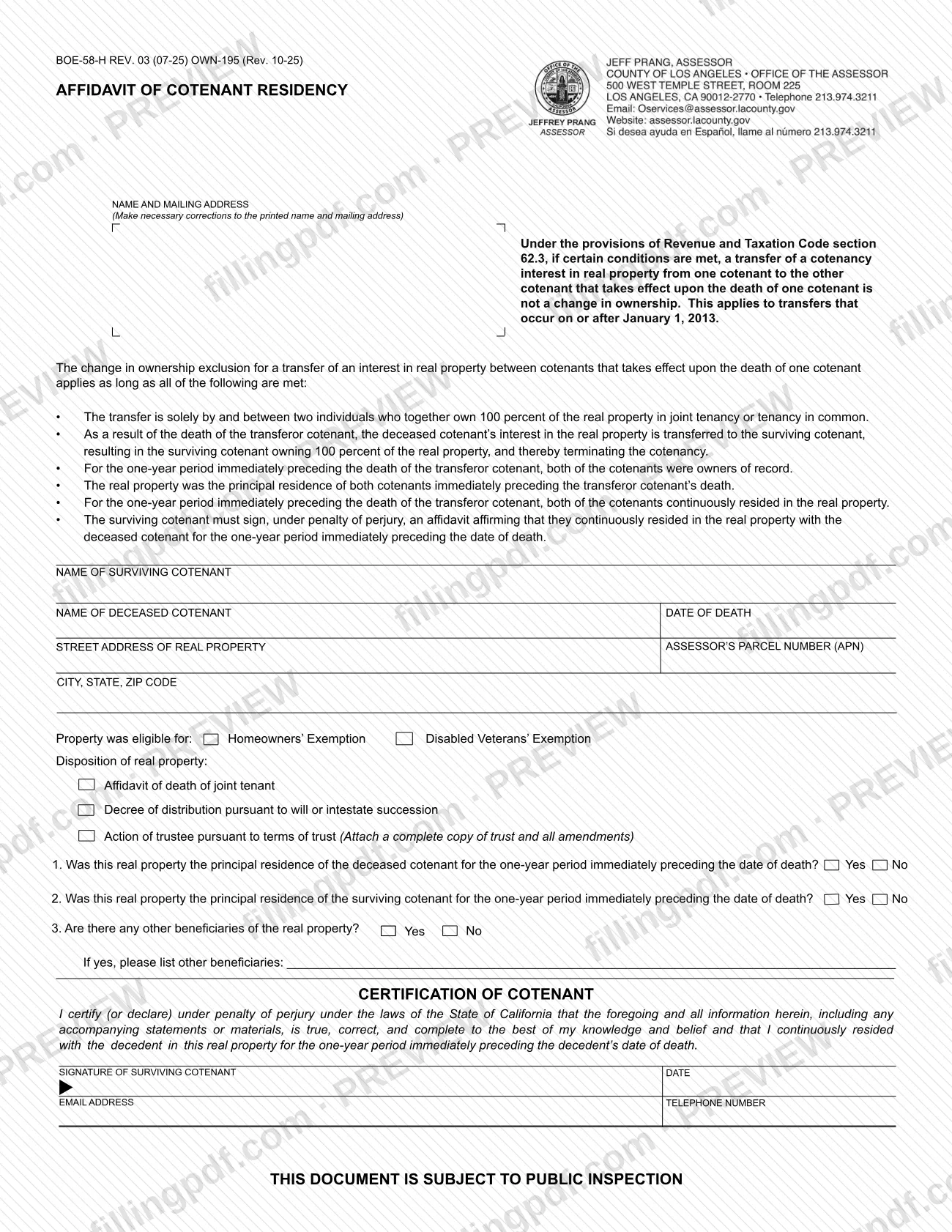
The Affidavit of Cotenant Residency (Form BOE-58-H) is the form a surviving cotenant signs under penalty of perjury to affirm that they continuously lived in the property with the deceased cotenant for the one-year period before the death. It is published by the Los Angeles County Office of the Assessor and is one of the Los Angeles County property tax forms connected to a change in ownership. Under Revenue and Taxation Code section 62.3, a qualifying transfer between two cotenants at death is not a change in ownership. On this page you can fill out the form online on FillingPDF and download or print the completed PDF; the official PDF is published by the Assessor.
Last updated
What is BOE-58-H?
The Affidavit of Cotenant Residency (Form BOE-58-H), also numbered OWN-195 by the Los Angeles County Office of the Assessor, is the sworn statement in which a surviving cotenant confirms that they continuously resided in the real property with the deceased cotenant for the year before the death.
The form rests on Revenue and Taxation Code section 62.3. Under that section, if certain conditions are met, a transfer of a cotenancy interest from one cotenant to the other that takes effect upon the death of one cotenant is not a change in ownership. The form states that this applies to transfers that occur on or after January 1, 2013.
The conditions printed on the form are that:
- the transfer is solely between two individuals who together own 100 percent of the property in joint tenancy or tenancy in common;
- the deceased cotenant's interest passes to the surviving cotenant, who then owns 100 percent and ends the cotenancy;
- both cotenants were owners of record for the one-year period before the death;
- the property was the principal residence of both cotenants immediately before the death, and both continuously resided there for that year.
The form records the parties, the date of death, the street address and Assessor's Parcel Number (APN), whether the property was eligible for the Homeowners' Exemption or the Disabled Veterans' Exemption, how the property was transferred, and three residency and beneficiary questions. The Assessor's forms page lists other ownership-transfer forms separately, such as BOE-502-D, Change in Ownership Statement Death of Real Property Owner, and BOE-58-AH, Claim for Reassessment Exclusion for Transfer Between Parent and Child. BOE-58-H is the one specific to cotenants.
Who needs to file BOE-58-H?
The surviving cotenant completes and signs Form BOE-58-H. The signature is theirs alone, made under penalty of perjury, and it affirms that they continuously resided in the property with the deceased cotenant for the one-year period immediately preceding the date of death.
The exclusion the form supports applies only when all of these conditions are met:
- Two individuals together owned 100 percent of the property in joint tenancy or tenancy in common, and the transfer is solely between them.
- The deceased cotenant's interest passed to the surviving cotenant, leaving that person with 100 percent ownership.
- Both were owners of record for the full year before the death.
- The property was both cotenants' principal residence immediately before the death, and both continuously lived there during that year.
The transfer is described on the form by one of three dispositions: an affidavit of death of joint tenant, a decree of distribution pursuant to will or intestate succession, or an action of trustee pursuant to the terms of a trust. The form does not describe anyone signing on behalf of the surviving cotenant.
When to file BOE-58-H
The triggering event is the death of one of two cotenants who owned the property together. The affidavit looks back at the one-year period immediately preceding the date of death, so the survivor must be able to affirm continuous residence for that whole year. The exclusion applies to transfers that occur on or after January 1, 2013. The form prints no separate due date and does not state a filing window. It is completed after the death and given to the Los Angeles County Office of the Assessor, and the Assessor's forms page at https://assessor.lacounty.gov/forms is the place to confirm any timing that applies.
Documents you need
- A complete copy of the trust and all amendments, only if the disposition of the real property is an action of trustee pursuant to the terms of a trust.
How to fill out BOE-58-H
Correct the name and mailing address
At the top, review the printed Name and Mailing Address block and make any necessary corrections.
Enter the surviving cotenant's name
Write the full name of the surviving cotenant in Name of Surviving Cotenant. This is the person who will sign the certification.
Enter the deceased cotenant and date of death
Write the deceased cotenant's name in Name of Deceased Cotenant and the date in Date of Death. The one-year residency period is measured back from this date.
Identify the real property
Enter the Street Address of Real Property, the City, State, ZIP Code and the Assessor's Parcel Number (APN).
Mark the exemption eligibility
Under Property was eligible for, mark Homeowners' Exemption, Disabled Veterans' Exemption, or both, as they applied to the property.
Select the disposition of the property
Mark one: Affidavit of death of joint tenant, Decree of distribution pursuant to will or intestate succession, or Action of trustee pursuant to terms of trust. For the trust option, attach a complete copy of the trust and all amendments.
Answer questions 1 and 2
Mark Yes or No for whether the property was the principal residence of the deceased cotenant (question 1) and of the surviving cotenant (question 2) for the one-year period immediately preceding the date of death.
Answer question 3 on beneficiaries
Mark Yes or No for whether there are any other beneficiaries of the real property. If Yes, list them on the line provided.
Sign and date the certification
The surviving cotenant signs and dates under Signature of Surviving Cotenant, certifying under penalty of perjury under California law that the information is true and that they continuously resided with the decedent for the year before death.
Add contact details
Enter an Email Address and Telephone Number. The form states that it is subject to public inspection.
Review and download the completed PDF
Check every entry against the property records and the date of death, then download or print the completed PDF from FillingPDF. Attach the trust copy if required and submit through the Assessor's channels.
How to submit BOE-58-H
The form prints no mailing address, portal or appointment rule, so the channels are those of the Los Angeles County Office of the Assessor, which publishes it.
- Agency forms page: the Assessor lists Form BOE-58-H, Affidavit of Cotenant Residency (OWN-195), among its forms at https://assessor.lacounty.gov/forms. Check there or contact the Assessor for where to deliver the signed affidavit.
- Signature: the surviving cotenant must sign and date the certification.
- Trust copy: if the disposition is an action of trustee, the form requires a complete copy of the trust and all amendments to be attached.
The form states that it is subject to public inspection, so consider that before writing an email address and telephone number on it. FillingPDF lets you fill out and download the PDF; submission follows the Assessor's channels.
Common mistakes to avoid
- Leaving the form unsigned or undated; the surviving cotenant must sign the certification under penalty of perjury.
- Choosing the trustee disposition without attaching a complete copy of the trust and all amendments.
- Using the form when the transfer is not solely between two individuals who together owned 100 percent of the property.
- Answering the residency questions for the wrong person; question 1 concerns the deceased cotenant and question 2 the surviving cotenant, each for the one-year period before death.
- Answering Yes to question 3 without listing the other beneficiaries on the line provided.
- Not correcting the printed name and mailing address at the top when they are wrong.
- Signing the certification when the survivor did not continuously reside in the property with the decedent for the full year before the date of death.
- Writing contact details without noting that the form states it is subject to public inspection.
Frequently asked questions
What is Form BOE-58-H used for?
Form BOE-58-H is the Affidavit of Cotenant Residency. A surviving cotenant signs it under penalty of perjury to affirm that they continuously lived in the property with the deceased cotenant for the year before death, supporting the change in ownership exclusion under Revenue and Taxation Code section 62.3.
Who signs the Affidavit of Cotenant Residency?
The surviving cotenant signs it. The certification states, under penalty of perjury under California law, that the information is true and that the signer continuously resided with the decedent in the property for the one-year period immediately preceding the date of death.
What conditions must be met for the cotenant exclusion?
The transfer must be solely between two individuals who together own 100 percent in joint tenancy or tenancy in common, ending in the survivor owning 100 percent. Both must have been owners of record and continuously lived in the property as their principal residence for the year before the death.
Do I need to attach anything to BOE-58-H?
Only if the disposition is an action of trustee pursuant to the terms of a trust. In that case the form says to attach a complete copy of the trust and all amendments. No other attachment is printed on the form.
Where do I send Form BOE-58-H?
The form prints no address or portal. It is published by the Los Angeles County Office of the Assessor, which lists it at https://assessor.lacounty.gov/forms. Check that page or contact the Assessor to confirm where to deliver the signed affidavit.
Is BOE-58-H the same as OWN-195?
Yes. The Assessor's forms page lists the form as BOE-58-H / OWN-195, Affidavit of Cotenant Residency, and the PDF prints both codes: BOE-58-H REV. 03 (07-25) and OWN-195 (Rev. 10-25).
Is the affidavit a public record?
The form states at the bottom: This document is subject to public inspection. Consider that before entering an email address and telephone number, which the form asks for next to the surviving cotenant's signature.
Can I fill out BOE-58-H online on FillingPDF?
Yes. You can fill out the PDF online on FillingPDF and download or print it. FillingPDF is an independent service, not affiliated with the Assessor, and it does not file the affidavit; you submit it through the Assessor's channels.
Ready to fill out BOE-58-H?
Fill out BOE-58-H now