
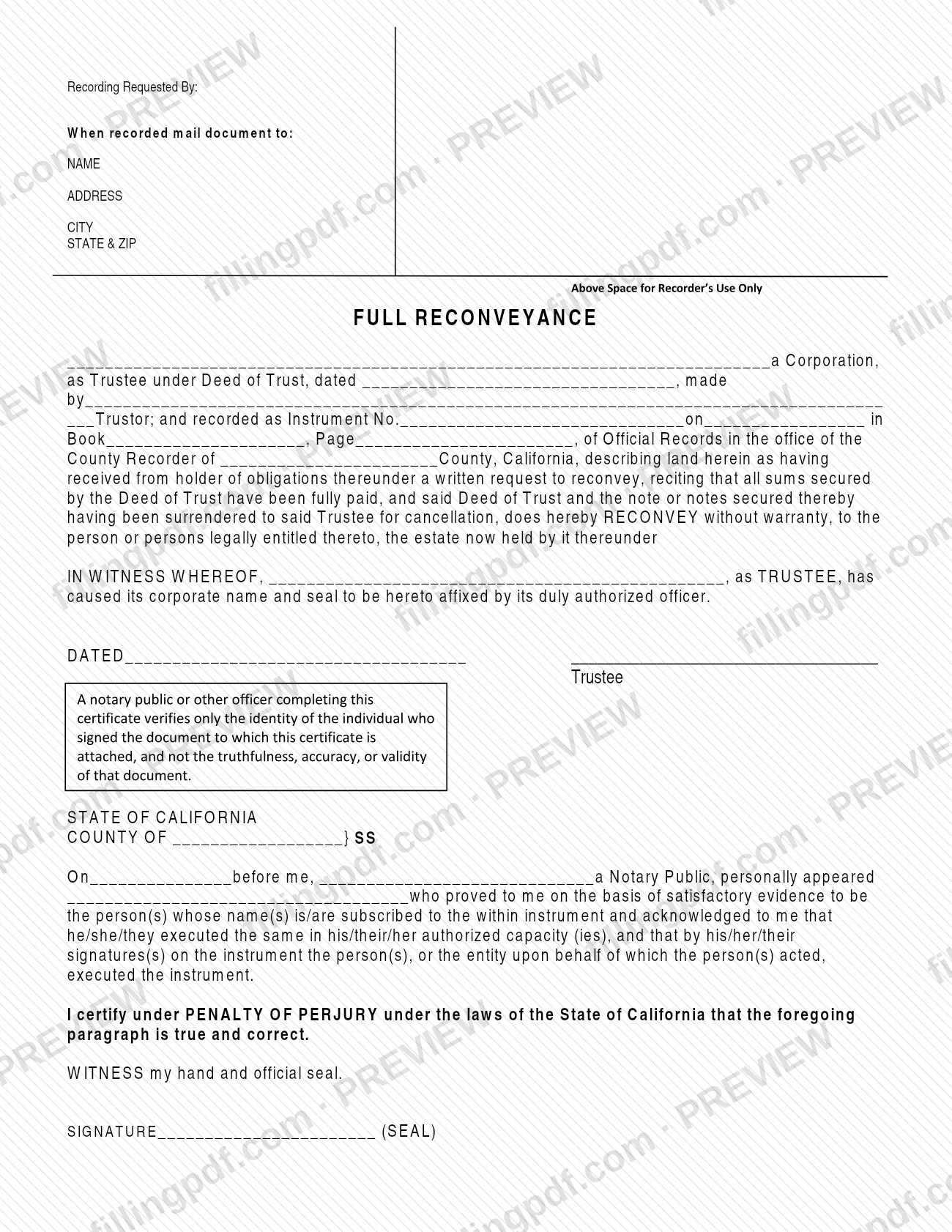
The Full Reconveyance Form is the document a trustee signs to reconvey property after the loan secured by a deed of trust has been paid in full. It is recorded with the Los Angeles County Registrar-Recorder/County Clerk, where it states publicly that the loan has been paid. The trustee completes and signs it, and the trustee's signature must be notarized. On FillingPDF you can fill out the form online and download or print the completed PDF; the county publishes the original PDF and an explanation on its website.
Last updated
What is Full Reconveyance Form – Los Angeles County, CA?
The Full Reconveyance Form is the document a trustee under a deed of trust signs to reconvey, without warranty, the estate it holds once the obligations secured by that deed of trust have been fully paid. Recorded in Los Angeles County, it shows publicly that the loan has been paid.
The form recites the facts the trustee relies on: it has received from the holder of the obligations a written request to reconvey, stating that all sums secured by the deed of trust have been fully paid, and the deed of trust and the note or notes it secures have been surrendered to the trustee for cancellation. The printed text identifies the deed of trust by its date and trustor, and by the Instrument No., recording date, Book and Page in the Official Records of the County Recorder, California county named on the form.
The form has three parts: a recording block at the top ("Recording Requested By" and "When recorded mail document to"), the reconveyance text with the trustee's dated signature, and a California notary acknowledgment below it.
The Los Angeles County Registrar-Recorder/County Clerk explains that this form is different from the Substitution of Trustee and Full Reconveyance, a combined two-document form signed by the present beneficiary and the present trustee, and from the Substitution of Trustee form, used when the present beneficiary wants to name a new trustee.
Who needs to file Full Reconveyance Form – Los Angeles County, CA?
The trustee named on a deed of trust completes and signs the Full Reconveyance Form. The county's page states that the trustee's signature must be notarized and that the trustee named on your deed of trust will usually have the forms available and issue the full reconveyance.
If you are the borrower or owner whose deed of trust or mortgage has been paid in full, this is the document that shows the loan is paid once it is recorded. You would normally ask the trustee for it, and you or the trustee may then arrange the recording.
Do not use this form when a new trustee must first be named. In that case the county describes a Substitution of Trustee form, and the combined Substitution of Trustee and Full Reconveyance, which is signed by the present beneficiary and the present trustee, with both signatures notarized.
The form is written for a trustee that is a corporation: it reads "a Corporation, as Trustee" and says the corporate name and seal are affixed by a duly authorized officer.
When to file Full Reconveyance Form – Los Angeles County, CA
The triggering event is the full payoff of the deed of trust or mortgage. Once the loan is paid in full, you can record a Full Reconveyance from the trustee stating publicly that the loan has been paid. The form recites that the trustee has received the holder's written request to reconvey and that the deed of trust and note have been surrendered for cancellation, so those steps come before the trustee signs. The county's page sets no separate deadline for recording it.
Documents you need
- Written request to reconvey from the holder of the obligations secured by the deed of trust; the form recites that the trustee has received it.
- The deed of trust and the note or notes it secures, surrendered to the trustee for cancellation; the form recites that this has happened.
- A notary acknowledgment of the trustee's signature; the form includes the California certificate for the notary public to complete.
How to fill out Full Reconveyance Form – Los Angeles County, CA
Enter recording and return details
At the top, complete "Recording Requested By" and, under "When recorded mail document to," the NAME, ADDRESS, CITY and STATE & ZIP where the recorded document should be sent. Leave the recorder's space blank.
Name the trustee
In the first line of the reconveyance text, enter the name of the trustee corporation that acts as trustee under the deed of trust.
Identify the deed of trust
Enter the date of the deed of trust and the name of the trustor who made it.
Enter the recording information
Enter the Instrument No. and the date it was recorded, the Book and Page, and the name of the county whose County Recorder holds the Official Records.
Complete the witness clause
On the "IN WITNESS WHEREOF" line, enter the name of the trustee, whose corporate name and seal are affixed by its duly authorized officer.
Date the form and sign as trustee
Enter the date on the DATED line. The trustee signs on the signature line above the word Trustee.
Have the notary complete the acknowledgment
The notary public completes the California certificate: the county, the date, the notary's name, the name of the person who appeared, the signature and the seal. The trustee's signature must be notarized.
Review and download the completed PDF
Check that the names, dates and recording references match the deed of trust, then download or print the completed PDF from FillingPDF and take it to the trustee for signing and notarization before recording.
How to submit Full Reconveyance Form – Los Angeles County, CA
The Full Reconveyance is recorded with the Los Angeles County Registrar-Recorder/County Clerk, which explains the process on its Full Reconveyance page at https://www.lavote.gov/home/recorder/property-document-recording/forms/full-reconveyance.
- Before recording: the trustee completes the form and signs it, and the trustee's signature is notarized by a notary public.
- Recording block: enter who requested recording and the name and address to which the recorded document should be mailed, in the space at the top of the form. The area marked "Above Space for Recorder's Use Only" is for the recorder.
- Where and how: the form and the county page name no mailing address, counter or online portal, so confirm the current recording channels, requirements and any fee with the Registrar-Recorder/County Clerk's recording pages.
FillingPDF lets you fill out and download the PDF; submission follows the channels of the Registrar-Recorder/County Clerk.
Common mistakes to avoid
- Submitting the form without the trustee's notarized signature; the county states the signature must be notarized.
- Using the Full Reconveyance Form when a Substitution of Trustee is needed, which the county describes as a different form.
- Using the single Full Reconveyance when the present beneficiary and trustee must both sign the combined Substitution of Trustee and Full Reconveyance.
- Writing in the area marked "Above Space for Recorder's Use Only", which is reserved for the recorder.
- Leaving out the name and address under "When recorded mail document to", so the recorded document has no return address.
- Entering a deed of trust description that does not match the recorded one: date, trustor, Instrument No., recording date, Book, Page and county.
- Leaving the trustee's name blank in the "IN WITNESS WHEREOF" line or the DATED line unfilled.
Frequently asked questions
What is a full reconveyance?
A full reconveyance is a document in which the trustee under a deed of trust reconveys the estate it holds after all sums secured have been paid. Recorded in Los Angeles County, it states publicly that the deed of trust or mortgage has been paid in full.
Who signs the Full Reconveyance Form?
The trustee completes and signs it, and the trustee's signature must be notarized. The county says the trustee named on your deed of trust usually has the forms available and will issue the full reconveyance.
Where can I get a Full Reconveyance Form?
The county's page says the form can be purchased at most office supply or stationery stores, and that the trustee on your deed of trust usually has forms too. You can also fill out the PDF online on FillingPDF and download it.
What is the difference between a Full Reconveyance and a Substitution of Trustee?
A Full Reconveyance is signed by the trustee when the loan is paid. A Substitution of Trustee is used when the present beneficiary wants to name a new trustee. The combined Substitution of Trustee and Full Reconveyance is signed by the present beneficiary and the present trustee, both notarized.
Does the trustee's signature have to be notarized?
Yes. The county states that the trustee's signature on the Full Reconveyance must be notarized. The form includes a California notary acknowledgment, which verifies only the identity of the person who signed, not the truthfulness or validity of the document.
Is there a deadline to record a full reconveyance?
The form and the county's page set no deadline. You can record a Full Reconveyance once the deed of trust or mortgage has been paid in full, and the trustee has received the holder's written request and the surrendered note.
Can I file the Full Reconveyance Form through FillingPDF?
No. FillingPDF lets you fill out the PDF online and download or print it, but it is independent of the Registrar-Recorder/County Clerk and does not record documents. Recording follows the county's own channels.
Ready to fill out Full Reconveyance Form – Los Angeles County, CA?
Fill out Full Reconveyance Form – Los Angeles County, CA now