
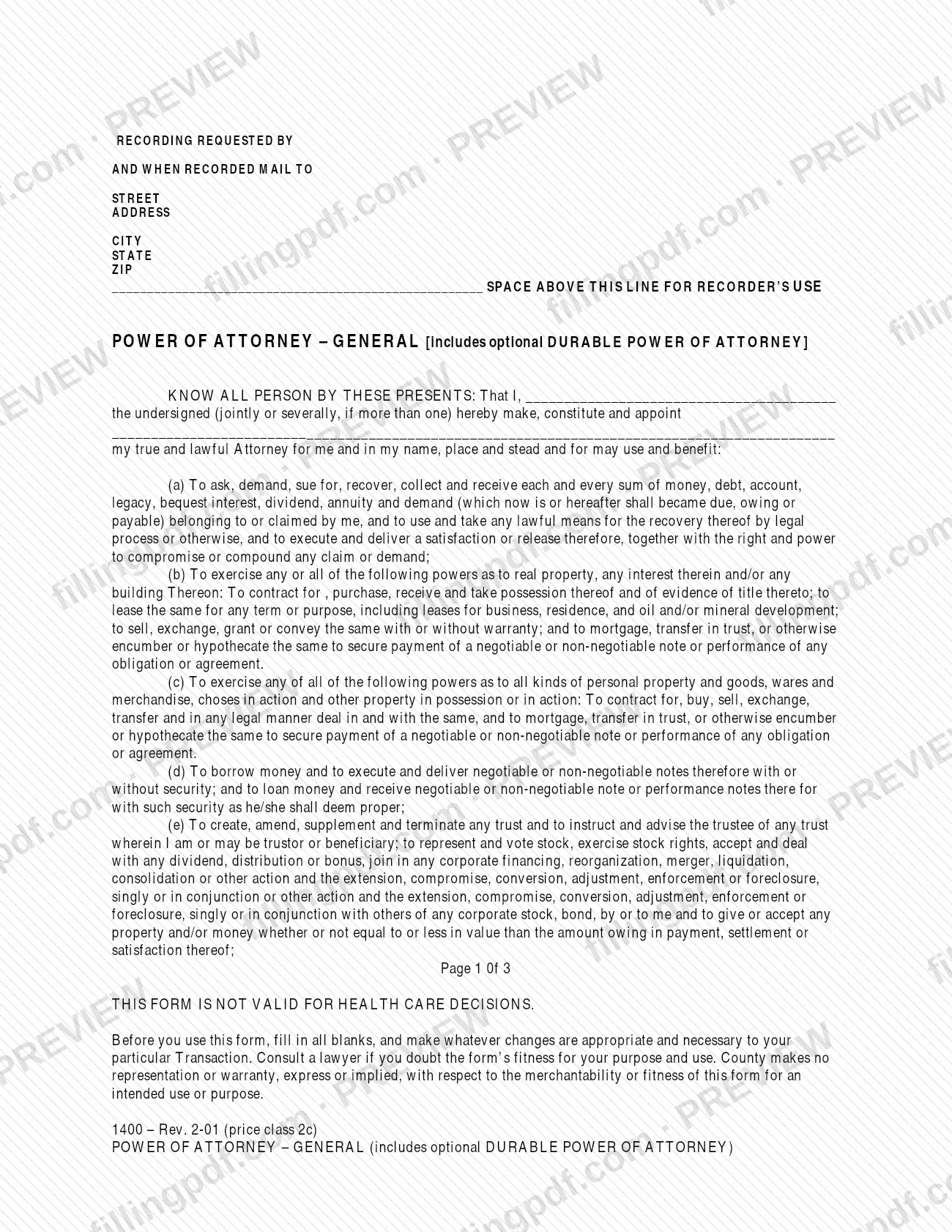
The Power of Attorney – General is a form published by the Los Angeles County Registrar-Recorder/County Clerk (RR/CC) that lets a principal appoint an attorney-in-fact to act in the principal's name, with an optional durable power of attorney. It is a recordable document: the top of page 1 carries the "Recording requested by and when recorded mail to" block and space for the Recorder's use. On FillingPDF you can fill out the form online and download or print the completed PDF; the original PDF is published by the County at lavote.gov. The form is not valid for health care decisions.
Last updated
What is 1400?
The Power of Attorney – General is a form from the Los Angeles County Registrar-Recorder/County Clerk (RR/CC) in which a principal appoints an attorney-in-fact to act for them in their name, place and stead, with an optional durable power of attorney that continues through incapacity.
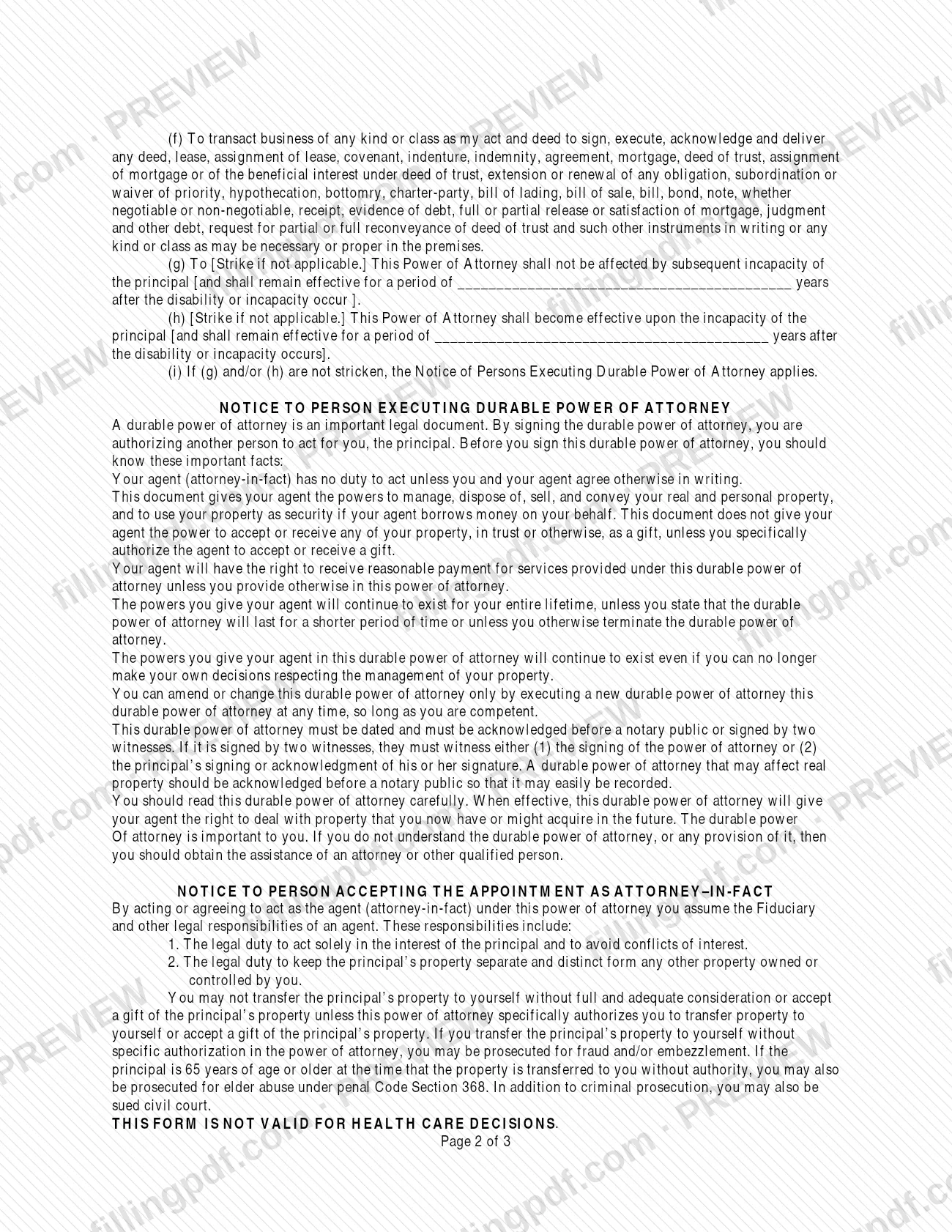
The printed text lists the powers the attorney-in-fact receives: to collect money and debts (a); to deal with real property, including buying, leasing, selling and mortgaging it (b); to deal with personal property and goods (c); to borrow and lend money (d); to create, amend and terminate trusts and to vote stock and act on corporate matters (e); and to sign deeds, leases, mortgages, notes and similar instruments (f). Paragraphs (g) and (h) are the durable options: (g) says the power is not affected by the principal's later incapacity, and (h) says it becomes effective upon the principal's incapacity. Each may carry a number of years after the incapacity occurs. Strike whichever does not apply.
The RR/CC's property document recording page describes a power of attorney as an instrument that appoints an attorney-in-fact, and states that the signature of the principal must be notarized. The County calls the forms it posts samples prepared according to legislation, does not give legal advice and cannot help prepare legal documents. The form states it is not valid for health care decisions. It is marked 1400 – Rev. 2-01.
Who needs to file 1400?
A person who wants to appoint someone else, an attorney-in-fact, to act for them in the matters listed in paragraphs (a) through (f) can use this form. The person granting the authority is the principal. The form allows more than one principal, acting jointly or severally.
- Principals who want the power to survive incapacity keep paragraph (g) or (h) and strike the other if it does not apply. If either is not stricken, the Notice to Person Executing Durable Power of Attorney applies.
- The attorney-in-fact reads the Notice to Person Accepting the Appointment as Attorney-in-Fact and signs and dates the acknowledgment of the legal and fiduciary duties.
- Principals whose document will deal with real property should have it acknowledged before a notary public so it can easily be recorded, according to the form's notice.
Do not use this form for health care decisions: it states in two places that it is not valid for them. The form also advises you to consult a lawyer if you doubt its fitness for your purpose, and the County makes no warranty about its fitness for an intended use.
When to file 1400
The form has no filing deadline. You complete and sign it when you decide to appoint an attorney-in-fact, and the County's property document recording page applies if you then submit it for recording.
Timing of the power is set inside the form. Under paragraph (g), the power is not affected by the principal's later incapacity. Under paragraph (h), it becomes effective upon the incapacity of the principal. Either paragraph can state a number of years the power remains effective after the disability or incapacity occurs. A durable power of attorney must be dated, and the form's notice says that, unless you state a shorter period or terminate it, the powers continue for your entire lifetime. You can amend or change a durable power of attorney only by executing a new one, while you are competent.
How to fill out 1400
Complete the recording block
At the top of page 1, enter who requested recording and where to mail the document when recorded: name, street address, city, state and ZIP. Leave the space above the line for the Recorder's use blank.
Name the principal
In the first blank after "That I," write the name of the principal. If more than one person grants the power, the form covers them jointly or severally.
Name your attorney-in-fact
In the long blank after "hereby make, constitute and appoint," enter the full name of the person you are appointing as your attorney.
Review the powers (a) to (f)
Read paragraphs (a) through (f), covering money and debts, real property, personal property, borrowing and lending, trusts and stock, and signing instruments. The form says to make changes appropriate to your transaction.
Complete or strike paragraphs (g) and (h)
Keep (g) if the power should not be affected by later incapacity and (h) if it should take effect upon incapacity; strike the one that does not apply. Enter the number of years after incapacity where the form provides that blank.
Read the durable power notices
If (g) or (h) is not stricken, paragraph (i) applies the Notice to Person Executing Durable Power of Attorney. The principal should read it, including the dating and notary or two-witness rules.
Have the agent sign the acknowledgment
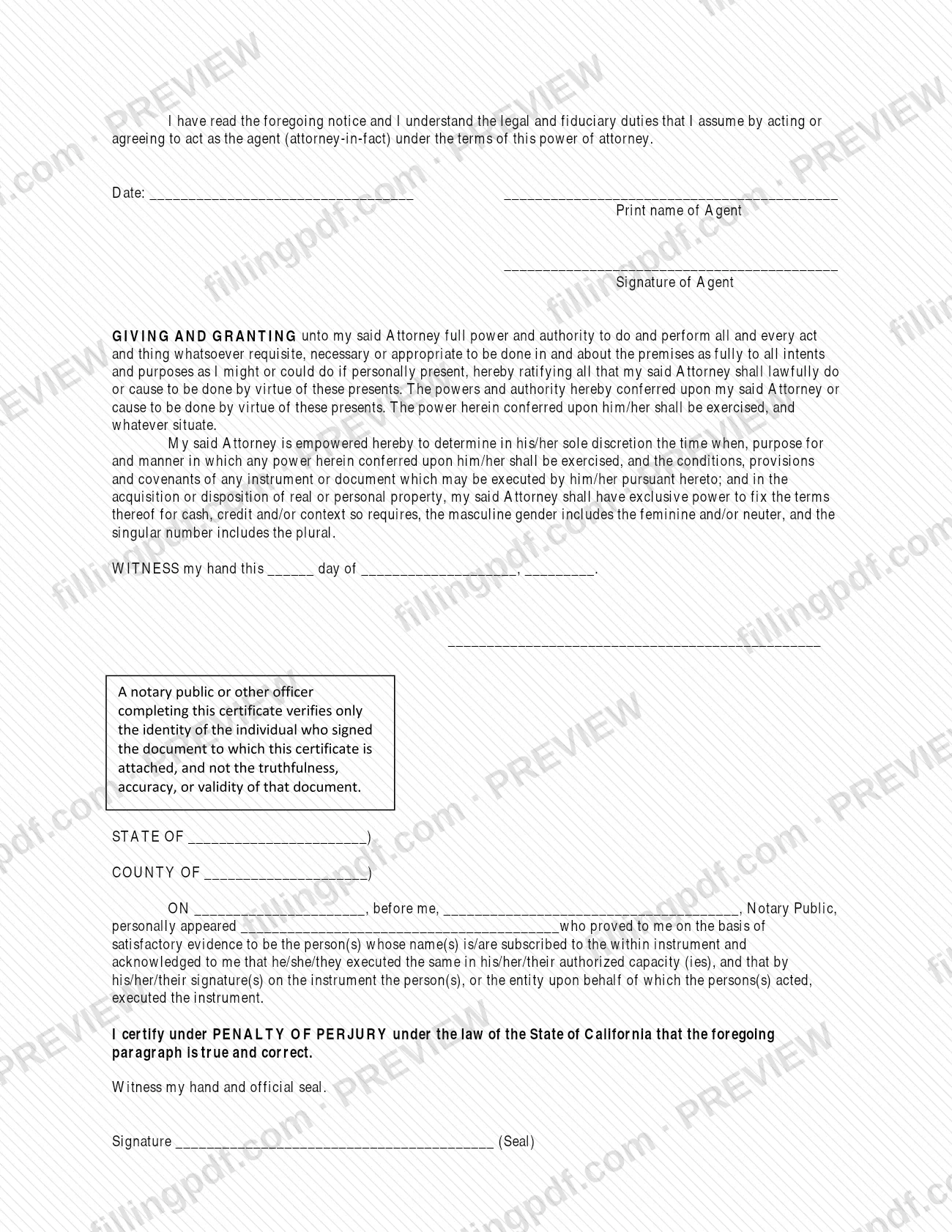
On page 3, the attorney-in-fact enters the date, prints their name and signs, confirming they have read the notice about fiduciary duties.
Date and sign as principal
Complete the "WITNESS my hand this ___ day of ___" line with the day, month and year, and sign above the line. Sign in front of the notary.
Complete the notary acknowledgment
The notary fills in the state, county, date, their own name, the name of the person who appeared, their signature and seal. The principal does not complete this certificate.
Review, download and print
Check every blank and that (g) or (h) is struck if not applicable. Download or print the completed PDF from FillingPDF, sign it before the notary, and then submit it as described under How to submit.
How to submit 1400
The form itself names no filing office, address or portal. It is built for recording: the top of page 1 has a "Recording requested by and when recorded mail to" block and a space above the line for the Recorder's use. The Los Angeles County Registrar-Recorder/County Clerk describes its property document recording services at https://www.lavote.gov/home/records/property-document-recording/forms.
Before you submit the document for recording, complete all blanks and make sure the principal's signature is notarized, as the County's page requires. The County states that its forms are samples, that it does not provide legal advice and that you should consult a legal advisor before submitting for recording. For recording locations, methods and charges, contact the RR/CC through its website.
FillingPDF lets you fill out and download the PDF; submission follows the County's channels above.
Common mistakes to avoid
- Using this form for health care decisions; it states twice that it is not valid for them.
- Leaving blanks unfilled; the form says to fill in all blanks before use.
- Not striking paragraph (g) or (h) when it does not apply, which brings the durable power of attorney notice into effect.
- Signing the principal's signature without notarization; the County's page states the principal's signature must be notarized.
- Leaving the agent's acknowledgment unsigned and undated after the Notice to Person Accepting the Appointment as Attorney-in-Fact.
- Omitting the principal's name, or the name of the person appointed, in the opening lines.
- Leaving the notary's certificate incomplete (state, county, date, notary's name and the name of the person who appeared).
- Relying on the sample form without legal advice when the transaction is unusual; the County warns it makes no warranty of fitness.
Frequently asked questions
What is the Los Angeles County Power of Attorney – General form?
It is a Los Angeles County Registrar-Recorder/County Clerk form in which a principal appoints an attorney-in-fact to handle money, real and personal property, loans, trusts and instruments in the principal's name. It includes an optional durable power of attorney in paragraphs (g) and (h).
Can I use this power of attorney for health care decisions?
No. The form states twice that it is not valid for health care decisions. It covers the property and financial matters listed in paragraphs (a) through (f), not medical choices.
Does a power of attorney have to be notarized?
The County's recording page says the principal's signature must be notarized. The form's notice adds that a durable power of attorney must be acknowledged before a notary public or signed by two witnesses, and one affecting real property should be notarized so it can easily be recorded.
What is the difference between paragraph (g) and paragraph (h)?
Under (g), the power is not affected by the principal's later incapacity. Under (h), it becomes effective only upon the principal's incapacity. Strike the one that does not apply; if either remains, the durable power of attorney notice applies.
Can I fill out this power of attorney form online?
Yes. You can fill out the PDF online on FillingPDF and download or print it. FillingPDF is an independent service and does not file or record the document; it must still be signed before a notary and submitted through the County's channels.
Where do I record the power of attorney in Los Angeles County?
The form names no address. The Registrar-Recorder/County Clerk describes property document recording at lavote.gov, and the form's top block says where the recorded document is mailed back. Contact the RR/CC through its website for recording methods and charges.
Can the County help me prepare the power of attorney?
No. The County says it does not provide legal advice and cannot help the public prepare legal documents. It calls its forms samples and asks you to consult a legal advisor before submitting for recording.
What duties does the person I appoint take on?
The attorney-in-fact assumes fiduciary duties, including acting solely in the principal's interest, avoiding conflicts and keeping the principal's property separate. They may not transfer the principal's property to themselves or accept gifts unless the document specifically authorizes it.
Ready to fill out 1400?
Fill out 1400 now