
Form ACR 320, Declaration and Certification of Certified Court Interpreter, is the declaration a certified or registered court interpreter signs to vouch for an English translation presented to the County Clerk of the Riverside County Assessor-County Clerk-Recorder. It accompanies the original foreign-language document and its English translation, and the interpreter's signature must be acknowledged by a notary public. On this page you can fill out the form online on FillingPDF and download or print the completed PDF; the agency publishes the original PDF on its own website, rivcoacr.org.
Last updated
What is ACR 320?
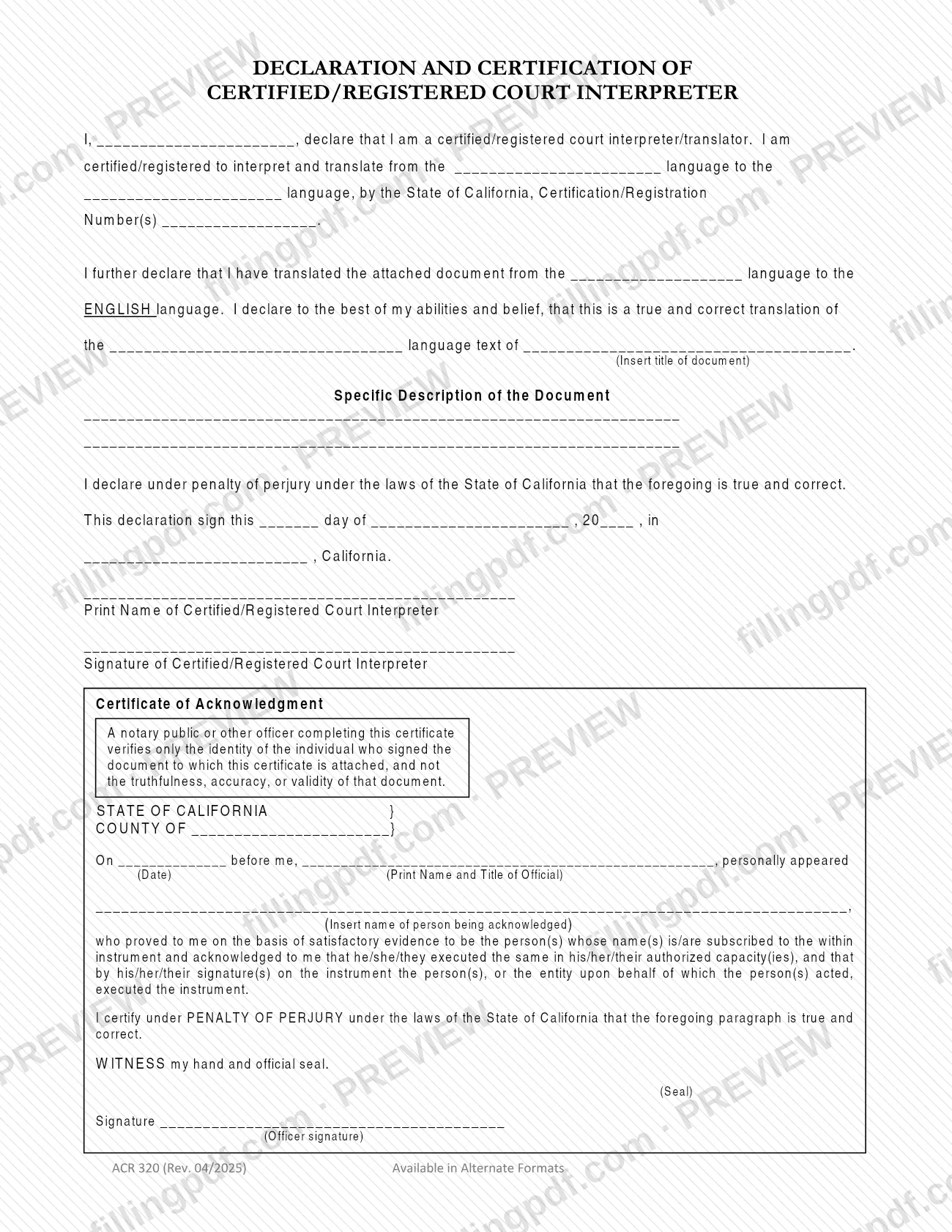
Form ACR 320, Declaration and Certification of Certified Court Interpreter, is the Riverside County Assessor-County Clerk-Recorder form on which a certified or registered court interpreter declares, under penalty of perjury, that an attached document was accurately translated into English.
The form is printed under the title "Declaration and Certification of Certified/Registered Court Interpreter." It has two parts. The first is the interpreter's declaration: the interpreter's name, the languages they are certified or registered to interpret and translate from and to, the State of California certification or registration number(s), the language and title of the translated document, a specific description of that document, and the date and place of signing. The second is a Certificate of Acknowledgment, completed by a notary public or other officer, which verifies only the identity of the person who signed and not the truthfulness, accuracy or validity of the document.
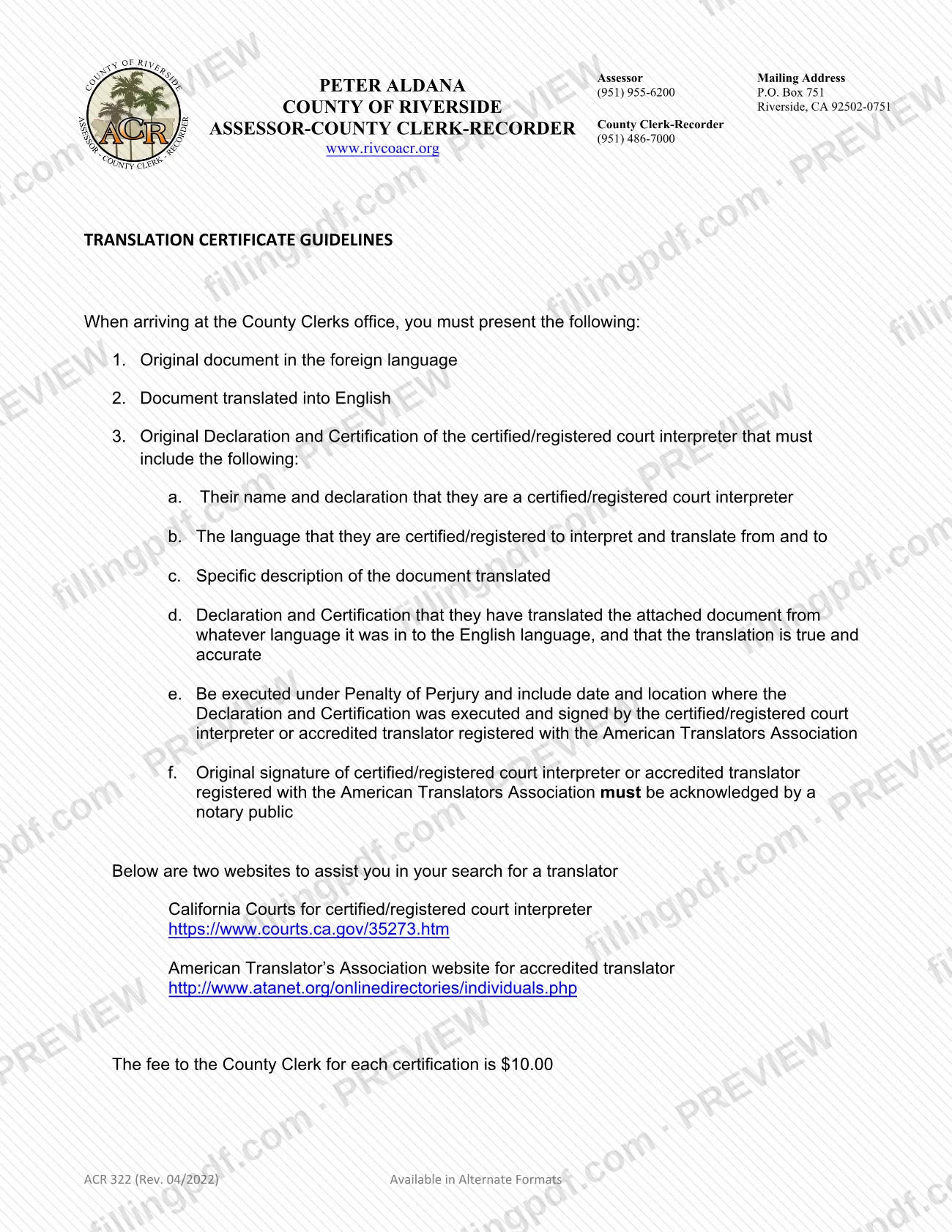
The form is one piece of the County Clerk's translation certificate process. The County Clerk's guidelines, printed in the same PDF as page one (code ACR 322, Rev. 04/2022), say the declaration must be presented together with the original foreign-language document and the English translation. The form does not translate anything itself. A fee to the County Clerk applies for each certification; the amount is not given here, so ask the County Clerk.
Who needs to file ACR 320?
The main group is anyone who must present a translated document to the County Clerk of the Riverside County Assessor-County Clerk-Recorder and needs the translation certified. The translator does the signing: the guidelines require the declaration to be executed and signed by a certified or registered court interpreter, or by an accredited translator registered with the American Translators Association (ATA).
Conditions that come with the form:
- The translation must be into English. The form states that the document was translated from the stated language to the ENGLISH language.
- The signer's original signature must be acknowledged by a notary public.
- The printed declaration refers to a State of California certification or registration number, so the signer enters that number where the form asks for it.
The guidelines name two places to look for a translator: the California Courts website for certified or registered court interpreters, https://www.courts.ca.gov/35273.htm, and the ATA directory for accredited translators, http://www.atanet.org/onlinedirectories/individuals.php. County staff cannot provide legal advice or help prepare legal documents, according to the agency's forms page.
When to file ACR 320
The triggering event is your visit to the County Clerk's office to have a translated document certified. The guidelines say that when you arrive you must already have the original declaration and certification, completed and signed, together with the original foreign-language document and its English translation. Complete the form, including the notary's acknowledgment, before you go.
No separate deadline is printed on Form ACR 320. The declaration records the day, month, year and city in California where the interpreter signed it, and the notary's certificate records the date of the acknowledgment, so schedule both before your visit. For office hours or questions, the form lists the County Clerk-Recorder at (951) 486-7000.
Documents you need
- The original document in the foreign language, presented at the County Clerk's office with the declaration.
- The document translated into English, attached to the declaration it is certified by.
- The original Declaration and Certification (Form ACR 320), completed and signed with the interpreter's or ATA-accredited translator's original signature, including the date and place of signing.
- The notary public's Certificate of Acknowledgment on the form, completed by the notary, acknowledging the original signature of the interpreter or translator.
How to fill out ACR 320
Gather the documents to certify
Collect the original foreign-language document and the English translation that the interpreter will certify. The declaration must describe exactly this document.
Enter the interpreter's name and languages
In the first paragraph, enter the interpreter's name after "I," and the language they are certified or registered to interpret and translate from and the language to, plus the State of California certification or registration number(s).
Identify the translated document
In the second paragraph, enter the original language of the document, then the language of the text and the title of the document. Add a specific description of the document on the lines provided.
Enter the signing date and place
Fill in the day, month and year of signing and the city in California where the declaration is signed. This is the date and location the guidelines require.
Print the name and sign
Print the interpreter's name on the first line and have the certified or registered court interpreter, or the ATA-accredited translator, sign on the second line with an original signature.
Have a notary complete the acknowledgment
The notary public or other officer completes the Certificate of Acknowledgment: county, date, their own name and title, the name of the person acknowledged, their signature and seal.
Review, download and print the PDF
Check every name, language and date against the documents being certified. Download or print the completed PDF from FillingPDF in black ink on 8 1/2" x 11" white paper, sign it, and assemble the package described under How to submit.
How to submit ACR 320
Take the completed package to the County Clerk's office of the Riverside County Assessor-County Clerk-Recorder. The County Clerk's guidelines say the documents are presented when you arrive at the office, and the agency's forms page says its forms do not allow online submission and must be delivered by mail or in person to your local Assessor-County Clerk-Recorder office.
- In person: present the original foreign-language document, the English translation and the original signed and notarized declaration. A fee to the County Clerk applies for each certification; call (951) 486-7000 for the current amount and accepted payment.
- By mail: the agency's forms page allows mailed delivery for its forms in general, but the guidelines for this form describe presenting the documents at the office. Call (951) 486-7000 before you mail original documents.
Print the form in black ink on 8 1/2" x 11" white paper, as the agency requires for all its forms. The agency's website is www.rivcoacr.org. FillingPDF lets you fill out and download the PDF; submission follows the agency's channels above.
Common mistakes to avoid
- Presenting the declaration without the notary's acknowledgment; the guidelines require the interpreter's original signature to be acknowledged by a notary public.
- Bringing a copy instead of the originals: the guidelines call for the original foreign-language document and the original declaration.
- Leaving out the date and the place of signing, which the guidelines require the declaration to include.
- Using a description that is too vague; the declaration must carry a specific description of the document translated, in addition to its title.
- Having someone other than a certified or registered court interpreter, or an ATA-accredited translator, sign the declaration.
- Attempting to submit the form online; the agency says its forms do not allow online submission.
- Printing the form on colored paper, in another size or in non-black ink; the agency requires black ink on 8 1/2" x 11" white paper.
- Arriving at the County Clerk's office without the English translation, or with a translation into a language other than English.
Frequently asked questions
What is Form ACR 320 used for?
Form ACR 320 is the declaration a certified or registered court interpreter signs, under penalty of perjury, to state that a document was translated into English and that the translation is true and correct. It is presented to the County Clerk of the Riverside County Assessor-County Clerk-Recorder with the original document and its English translation.
Who can sign the declaration and certification?
A certified or registered court interpreter, or an accredited translator registered with the American Translators Association, must sign it with an original signature. The County Clerk's guidelines link to the California Courts site and the ATA directory to help you find one.
Does Form ACR 320 have to be notarized?
Yes. The guidelines state that the original signature of the interpreter or accredited translator must be acknowledged by a notary public. The form includes a Certificate of Acknowledgment that the notary completes; it verifies only the signer's identity, not the accuracy of the translation.
What do I bring to the County Clerk's office?
Bring three things: the original document in the foreign language, the document translated into English, and the original Declaration and Certification with the interpreter's signature, date, place and notary acknowledgment. The guidelines say all three must be presented when you arrive.
Is there a fee for the County Clerk's translation certification?
Yes. The County Clerk's guidelines say a fee applies for each certification. This page does not give the amount: call the County Clerk-Recorder at (951) 486-7000 to confirm the current fee and how it can be paid.
Can I submit Form ACR 320 online?
No. The agency says its forms allow online completion and printing but not online submission; they must be delivered by mail or in person to your local Assessor-County Clerk-Recorder office. For this form, the guidelines describe presenting the documents at the County Clerk's office.
Is Form ACR 320 a Riverside County property tax form?
No. Form ACR 320 is a court interpreter's translation declaration handled by the County Clerk. It does not relate to a Riverside County property tax bill or assessment. The form lists the Assessor at (951) 955-6200 and the County Clerk-Recorder at (951) 486-7000.
Can I fill out Form ACR 320 on FillingPDF?
You can fill out the PDF online on FillingPDF and download or print it. FillingPDF is an independent service and does not file the form or arrange the notary; the signed, notarized original is presented to the County Clerk through the agency's channels.
Ready to fill out ACR 320?
Fill out ACR 320 now